


Arizona Prolonged Rupture of Membranes Lawyer
Prolonged rupture of membranes can turn a labor that should be manageable into a time sensitive emergency when delivery is delayed and infection or oxygen loss is not addressed. The risks rise when induction is not started, antibiotics are missed, or fetal monitoring is not treated with urgency, and the results can include permanent brain injury and lifelong disability. Clear records and a careful timeline often determine whether the standard of care was met. If you or a loved one were harmed or worse due to prolonged rupture of membranes malpractice in Arizona, contact Hastings Law Firm for a free, confidential case review.

Last Updated: July 27, 2026
Trial-Ready Birth Injury Representation for Arizona Families
When your child’s birth doesn’t go as expected, and you suspect that something went wrong during labor, the weight of that uncertainty can feel crushing. If your water broke and delivery was delayed, you may be wondering whether the medical team acted quickly enough to protect your baby. These are valid questions, and you deserve clear answers.
As your Arizona Prolonged Rupture of Membranes Lawyer, we focus exclusively on medical malpractice. Our team includes in-house nurse consultants and former defense attorneys who know how hospitals document these events and where critical gaps tend to appear.
If you believe your child was harmed by a delayed delivery after membrane rupture, we can review what happened and explain your options during a free, confidential consultation.

Failure to Induce Labor Following Membrane Rupture
Medical guidelines generally recommend delivery within 24 hours of membrane rupture to help prevent infection, and failure to induce labor or perform a C-section within this window may constitute medical negligence.
Prolonged rupture of membranes (PROM) occurs when the amniotic sac breaks before labor begins on its own. Once the membranes rupture, amniotic fluid leaks out, and the protective barrier between the baby and the outside environment is gone. Most obstetricians follow what is often called the “24-hour clock,” a widely recognized guideline indicating that delivery should happen within roughly 18 to 24 hours of rupture to reduce the risk of bacterial infection entering the uterus. An experienced Arizona birth injury attorney knows that deviating from this timeline creates significant risks.
When labor does not begin naturally after the water breaks, doctors may administer Pitocin, a synthetic form of the hormone oxytocin used to stimulate contractions and move labor forward. Failing to take this step, or choosing a passive “wait and see” approach when risk factors are present, can allow dangerous infections to develop. Labor and delivery complications often arise when this window is missed. Research published in Frontiers in Medicine on adverse perinatal outcomes related to chorioamnionitis confirms that clinical and subclinical infections tied to prolonged membrane rupture significantly increase the risk of harm to both the mother and baby. A qualified PROM malpractice lawyer can evaluate if these risks were ignored.
A delayed delivery attorney in Arizona will look closely at the timeline between membrane rupture and the decision to induce or intervene. Warning signs that the medical team may have waited too long include:
- Rising maternal temperature or fever after the water broke
- Elevated white blood cell count without a documented response
- Fetal heart rate changes that were not addressed promptly
- No administration of Pitocin or other induction agents despite prolonged rupture
- A “wait and see” plan documented without clear clinical justification
In these cases, the question is not simply whether complications occurred, but whether the labor and delivery team followed the standard of care or allowed preventable harm through inaction. Consulting a birth injury lawyer in Arizona is the first step to finding answers. Families often rely on a delayed delivery attorney to handle these complex records. A PROM malpractice lawyer can identify if hospital protocols were systemic failures, while a dedicated Arizona birth injury attorney fights for the compensation your family deserves.
Emergency C-Section Delays and Fetal Distress
When a mother with ruptured membranes shows signs of infection or the baby shows fetal distress, an immediate emergency C-section is often the only appropriate response under the standard of care to prevent permanent brain injury.
After membranes rupture, amniotic fluid levels drop over time. That fluid cushions the umbilical cord, and as it decreases, the cord becomes vulnerable to compression or prolapse. Umbilical cord prolapse, a condition where the cord slips ahead of the baby and becomes compressed, can rapidly cut off oxygen. This is one of the reasons fetal heart rate monitoring, the continuous electronic tracking of the baby’s heart patterns during labor, is so important after PROM. An Arizona malpractice counsel often sees cases where this monitoring was neglected. Non-reassuring heart tones on the monitor often represent the earliest detectable sign that the baby is losing oxygen.
A delayed C-section lawyer in Arizona may examine whether the clinical team recognized these warning signs and acted within an acceptable timeframe. The difference between a planned cesarean section and an emergency one often comes down to the presence of acute fetal distress. Experienced Arizona malpractice counsel understands these nuances.
| Indicator | Planned C-Section | Emergency C-Section |
|---|---|---|
| Timing | Scheduled before labor or early in labor | Performed urgently during active labor |
| Fetal Heart Rate | Stable, reassuring patterns | Non-reassuring or absent variability |
| Maternal Status | No signs of infection | Fever, elevated WBC, or clinical infection |
| Amniotic Fluid | Adequate levels | Low or absent fluid after prolonged rupture |
| Cord Status | No concern for compression | Evidence of cord prolapse or compression |
When fetal heart rate tracings show oxygen deprivation and the team delays performing a cesarean section, the consequences can include severe, irreversible brain damage. A delayed C-section lawyer can investigate if the response time was adequate. Every minute matters, and Arizona malpractice counsel knows that the medical records should reflect urgency that matches the clinical picture. A dedicated delayed C-section lawyer will fight for the truth.
The Hastings Law Firm Difference
Results matter, but what truly sets us apart is how we achieve them. Every verdict, every settlement, and every Arizona courtroom victory comes from one guiding promise: To treat each client’s fight for justice as if it were our own.
This balance of skill, experience, and empathy reflects our core philosophy that justice should not only compensate the injured, but also make health care safer nationwide.

Infection Risks Caused by Prolonged Labor Negligence
The most dangerous consequence of prolonged rupture of membranes is chorioamnionitis, a bacterial infection of the amniotic membranes and fluid that can spread to the fetus, causing sepsis, meningitis, and permanent brain damage if antibiotics are not administered in time.
Chorioamnionitis develops when bacteria, most commonly Group B Streptococcus (GBS), a type of bacteria that many women carry without symptoms, ascend into the uterus after the protective membranes have ruptured. The longer delivery is delayed, the greater the window for this infection to take hold. An infection injury attorney often identifies this delay as the root cause.
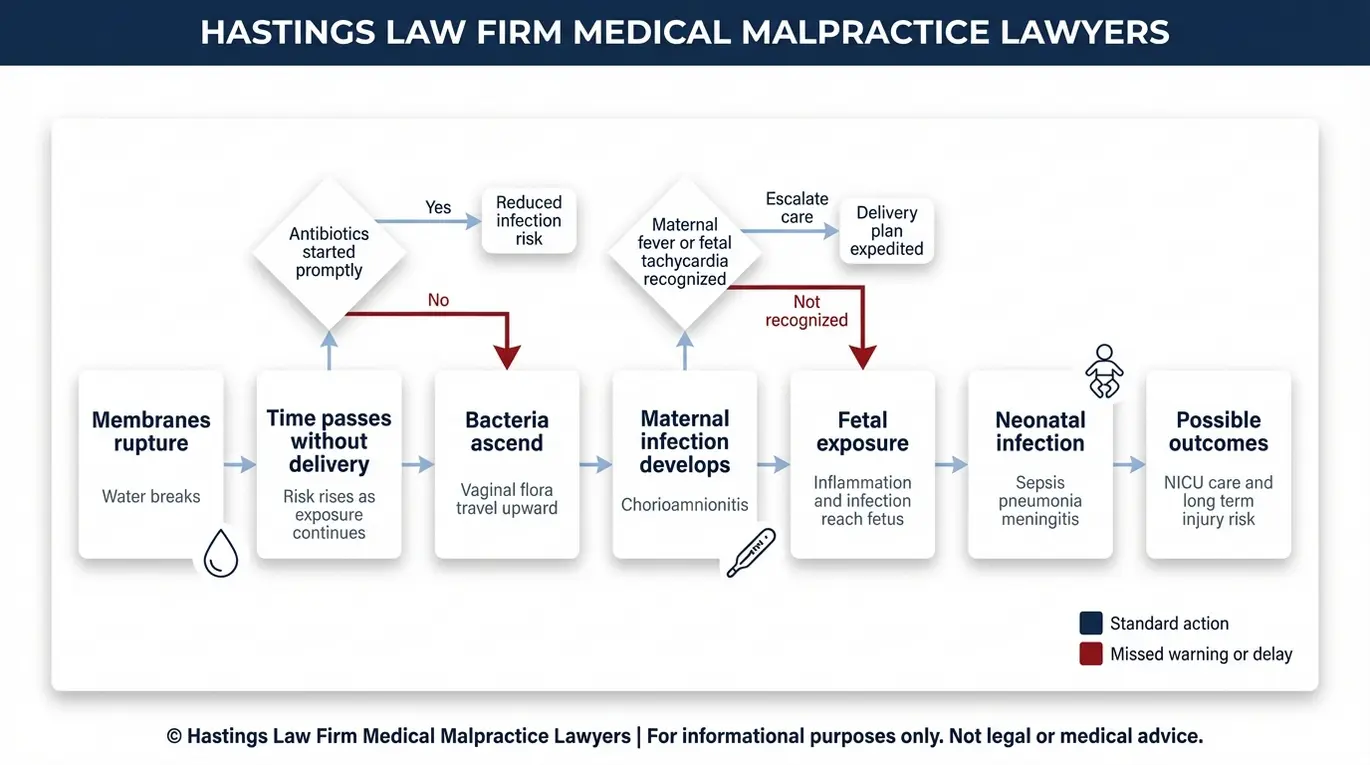
The standard of care as outlined in the ACOG Practice Bulletin Number 217 on Prelabor Rupture of Membranes calls for close monitoring of maternal temperature, white blood cell counts, and fetal heart rate. Prophylactic antibiotics should be administered when risk factors are identified, particularly for mothers who test positive for Group B Strep. An infection injury attorney reviews these records for missed doses. When providers fail to follow these protocols, the infection pathway typically unfolds in a predictable sequence:
- Membranes rupture and the protective barrier is lost
- Bacteria ascend from the vaginal canal into the uterine cavity
- Maternal infection develops, marked by fever, uterine tenderness, or rapid heart rate
- The infection crosses to the baby through the amniotic fluid or placenta
- The newborn develops neonatal sepsis, a bloodstream infection that can progress to meningitis or pneumonia
Each step in this chain represents a point where timely intervention could have changed the outcome. An Arizona medical negligence lawyer will examine the medical records under Arizona Revised Statutes Title 12 to determine whether the standard of care was met at every stage, from the initial rupture through delivery and postnatal treatment.
When these preventable infections cause lasting harm to a child, the gap between what should have happened and what actually occurred forms the foundation of a medical malpractice claim. Consult with an Arizona medical negligence lawyer to review your case. If you need an infection injury attorney, we are here to help. Our Arizona medical negligence lawyer team fights for victims of sepsis.
Establishing the Standard of Care for Arizona Obstetricians
In Arizona, a plaintiff must prove that the obstetrician failed to act as a reasonably prudent specialist would have under similar circumstances, and this typically requires testimony from a qualified expert witness.
The legal standard asks a simple question: would a competent OB-GYN, facing the same clinical situation, have managed labor and delivery differently? In PROM cases, this means evaluating whether the physician’s decision to delay induction, withhold antibiotics, or postpone a C-section fell below the accepted level of care. Our founder, Tommy Hastings, is a board-certified trial lawyer who has focused his career on identifying these failures to establish the proper level of care. A Phoenix medical malpractice lawyer helps establish this breach.
In Arizona, the standard of care is evaluated based on what a reasonably prudent health care provider in the same profession would do “within the state acting in the same or similar circumstances.” This means that obstetricians in well-equipped hospitals with access to advanced fetal monitoring equipment, neonatal intensive care units, and surgical teams on standby may be held to expectations that reflect those available resources. A standard of care attorney can explain how this applies to your case.
Before a medical malpractice case can proceed in Arizona, the law requires a preliminary expert opinion. Under Arizona Revised Statutes § 12-2603, the plaintiff must obtain a certification from a qualified expert confirming that the care provided fell below the standard. This document is often referred to as an Affidavit of Merit. A Phoenix medical malpractice lawyer will secure this certification. This is separate from the elements of proof outlined in Arizona Revised Statutes § 12-563, which require the plaintiff to establish the duty owed, the breach of that duty, and causation linking the breach to the injury. A standard of care attorney ensures all elements are met.
Gestational Diabetes and High-Risk Factors
Pre-existing conditions like gestational diabetes, which causes high blood sugar during pregnancy, make PROM significantly more dangerous. These high-risk pregnancies demand closer monitoring and lower thresholds for intervention to prevent birth injuries. When an obstetrician knows a patient has gestational diabetes or other complicating factors yet fails to plan for an earlier delivery or escalate care after membrane rupture, that gap between the known risk and the clinical response is exactly what we investigate. This is often cited as a failure to plan C-section when complications arise.
Birth Injuries Caused by Untreated Infections or Distress
Failure to manage prolonged membrane rupture can result in catastrophic injuries such as hypoxic-ischemic encephalopathy (HIE), cerebral palsy, and severe cognitive impairments caused by infection or oxygen loss.
Hypoxic-ischemic encephalopathy (HIE) is a type of brain damage that occurs when a newborn’s brain is deprived of adequate oxygen and blood flow around the time of birth. In PROM cases, this can happen when cord compression cuts off circulation or when untreated chorioamnionitis triggers a systemic inflammatory response in the baby. Neonatal sepsis, a life-threatening bloodstream infection in a newborn, can also cause widespread organ damage, including to the brain, if it is not identified and treated rapidly.
The connection between the medical error and the child’s diagnosis is the core of any birth injury case in Arizona. A birth injury lawyer AZ families trust must trace the timeline: when membranes ruptured, when (or if) antibiotics were given, what the fetal heart tracings showed, and how long it took for the team to deliver the baby. When that timeline reveals delays or omissions, and an expert confirms those failures caused the child’s condition, a claim for medical malpractice can move forward. A cerebral palsy attorney can guide you through this process.
The damages in these cases reflect the full scope of the child’s needs and the family’s losses. A birth injury lawyer AZ fights for compensation covering:
- Lifetime medical care: Surgeries, therapies, medications, assistive devices, and 24-hour nursing care
- Lost earning capacity: The income the child will never have the opportunity to earn
- Pain and suffering: The physical discomfort and emotional toll (often categorized as non-economic damages)
- Loss of quality of life: The experiences and milestones affected by a permanent disability
- Wrongful death: If the infant does not survive, the family may pursue a separate wrongful death claim for their loss
These cases often involve economic damages reaching into the millions over a child’s expected lifetime. A detailed life-care plan, prepared by a qualified expert, helps ensure that any recovery accounts for the full cost of care rather than just immediate medical bills. A cerebral palsy attorney ensures that a detailed life-care plan is in place. Trust a birth injury lawyer AZ to handle these calculations. Our cerebral palsy attorney team is dedicated to your child’s future.
Arizona Filing Deadlines for Birth Injury Malpractice Claims
The statute of limitations for medical malpractice in Arizona is generally two years from the date of injury, but specific tolling exceptions exist for minors that may extend this deadline.
Arizona law gives injured patients two years from the date they knew, or reasonably should have known, about the injury and its connection to medical care. This is known as the discovery rule. For birth injuries, the timeline can be more complex because some conditions, such as cerebral palsy or developmental delays, may not be fully apparent until months or years after delivery. An Arizona statute of limitations lawyer can clarify the specific dates.
When the injured patient is a minor, Arizona law tolls (pauses) the statute of limitations. This means the filing deadline may be extended, giving families additional time. This concept is known as tolling for minors. However, waiting carries real risks that have nothing to do with legal deadlines.
Medical evidence can deteriorate or disappear over time. Preserving evidence is important because hospitals have retention policies for records, and electronic fetal monitoring strips may be stored differently than the main medical chart. Key staff members leave, memories fade, and policies change. Under the HIPAA Privacy Rule, you have the right to request your medical records, and doing so early helps preserve the evidence your legal team will need. A filing deadline attorney can ensure nothing is missed.
Steps to protect your claim:
- Request complete labor and delivery records, including fetal monitoring strips, nursing notes, and physician orders
- Document your recollection of events while details are still fresh
- Preserve any discharge paperwork, follow-up instructions, or correspondence from the hospital
- Consult with an Arizona statute of limitations lawyer before assuming you have more time
- Contact a filing deadline attorney immediately
- Do not wait for a formal diagnosis to begin the legal evaluation process

Contact the Arizona Birth Injury Attorneys at Hastings Law Firm Today for Help
A birth injury caused by ignored protocols is more than a medical event. It is a breach of the trust you placed in your care team. You came to the hospital expecting safe, attentive care for you and your baby. If that trust was broken, you have the right to find out what happened and to hold the responsible parties accountable.
Hastings Law Firm has focused exclusively on medical malpractice since 2005. Our legal team includes in-house medical professionals and former defense attorneys who understand how hospitals build their cases, and we use that knowledge to build stronger ones for our clients. As an Arizona Prolonged Rupture of Membranes Lawyer, we prepare every case as if it is going to trial, because that level of preparation is what it takes to pursue fair results.
Your consultation is free, confidential, and comes with no obligation. We work on a contingency fee basis, meaning you pay no attorney fees unless we secure a recovery. If your family is dealing with the consequences of a delayed delivery or untreated infection, contact the medical negligence attorneys at Hastings Law Firm today for a free case evaluation.
Frequently Asked Questions About Prolonged Rupture of Membranes in Arizona


This content was researched and written by the Hastings Law Firm editorial team, which includes attorneys, medical professionals, and experienced researchers. Our writing is informed by internal knowledge and practical experience, and we cross-check critical details against authoritative sources cited throughout. Every piece undergoes human-led fact-checking and legal review. Because legal and medical information can change, if you spot an error, please contact us. Learn more about our content standards and review process on our editorial policy page.

Tommy Hastings, founder of Hastings Law Firm, is a board-certified personal injury trial lawyer dedicated exclusively to healthcare injury cases. Since 2001, he has represented injured patients and families in litigation against major hospital systems, pharmaceutical companies, and negligent healthcare providers nationwide. He has handled numerous high-profile cases that have drawn national media attention and resulted in multi-million dollar recoveries. He draws on that experience in his writing, helping readers understand how these cases work and what options may be available to them.
