


Arizona Postpartum Hemorrhage Lawyer
Excessive bleeding after birth can become a medical emergency when warning signs are missed or treatment is delayed. Postpartum hemorrhage requires careful monitoring of blood loss and vital signs, timely escalation of medications and other interventions, and clear hospital protocols to reduce the risk of life threatening complications. When care falls below accepted standards, families may face lasting physical harm, emotional trauma, and major changes to future health and fertility. If you or a loved one were harmed or worse due to postpartum hemorrhage medical negligence in Arizona, contact Hastings Law Firm for a free, confidential case review.

Last Updated: July 27, 2026
Compassionate Arizona Medical Attorneys for Excessive Bleeding After Birth Claims
Bringing a child into the world should be a moment of joy, not a moment of crisis. When postpartum hemorrhage goes unrecognized or untreated due to medical negligence, the physical and emotional toll on a mother and her family can be devastating. You may be left with serious health consequences, unanswered questions, and the feeling that no one is listening.
At Hastings Law Firm, founded by Tommy Hastings, we focus exclusively on medical malpractice. Our attorneys and legal staff dedicate their entire practice to helping patients affected by medical negligence. As your dedicated Arizona Postpartum Hemorrhage Lawyer, we understand both the clinical details and the human cost behind these cases. We know how to investigate what happened, identify where the standard of care broke down, and hold negligent providers accountable.
If you or a loved one suffered severe injury from uncontrolled bleeding after childbirth, we welcome the chance to review your situation and explain your legal options in a free, confidential consultation.

Understanding Postpartum Hemorrhage and the Standard of Care
Postpartum hemorrhage (PPH) is a severe medical emergency defined as cumulative blood loss of greater than or equal to 1,000 mL, or blood loss accompanied by signs or symptoms of hypovolemia, within 24 hours after birth regardless of mode of delivery. According to the NCBI Bookshelf overview on Postpartum Hemorrhage, PPH remains one of the leading causes of maternal death worldwide, and the majority of these deaths are preventable with timely intervention.
Some degree of bleeding during and after delivery is expected. The difference between normal blood loss and a life-threatening hemorrhage often comes down to how quickly and accurately the medical team responds. The standard of care, which is the level of treatment a reasonably competent provider would deliver under similar circumstances, requires active monitoring of blood loss throughout labor and in the hours that follow.
This includes frequent assessment of vital signs and fundal checks. A fundal check involves a nurse pressing on the mother’s abdomen to ensure the uterus is firm and contracting. The medical team must perform an immediate investigation if parameters deviate from the norm. Failure to adhere to these monitoring practices constitutes a breach of duty.
The ACOG Criteria for Hemorrhage
For decades, many hospitals relied on visual estimation to gauge how much blood a patient had lost during a postpartum hemorrhage. This method is notoriously inaccurate. The American College of Obstetricians and Gynecologists (ACOG) now recommends quantitative blood loss (QBL) measurement, a practice that involves collecting and precisely weighing blood and blood-soaked materials to get an accurate total.
Hospitals should also have an obstetric hemorrhage protocol in place. This is a standardized, staged response plan that triggers specific interventions as blood loss increases. This protocol ensures that the entire medical team moves swiftly from recognition to treatment, minimizing the risk of severe morbidity.
Under Arizona Revised Statutes § 12-563, a medical malpractice claim requires proof that the provider failed to meet this recognized standard. When a postpartum hemorrhage attorney examines a case, one of the first questions is whether the hospital used QBL or relied on unreliable visual estimates, and whether their hemorrhage protocol was followed at every stage.

Common Causes of Hemorrhage Linked to Medical Errors
The primary causes of postpartum hemorrhage are often categorized by the “4 T’s”: Tone, Trauma, Tissue, and Thrombin. Each category represents a distinct clinical problem, and each carries its own risk of medical error. Complications such as placenta previa or placental abruption also fall into these categories and require precise management to avoid excessive blood loss.
- Tone (Uterine Atony): Uterine atony, meaning the uterus fails to contract firmly after delivery, is the most common cause of PPH. When the uterus does not clamp down, the open blood vessels at the placental site continue to bleed. Failure to recognize a soft or “boggy” uterus and respond with uterine massage or medications can rapidly escalate a manageable situation into a crisis.
- Trauma: Trauma in the form of lacerations, or deep tears, to the cervix, vagina, or perineum can occur during delivery. This is common with the use of forceps or vacuum extraction. Surgical errors during a cesarean delivery, including accidental cuts to surrounding tissue or uterine rupture, also fall into this category.
- Tissue (Retained Placenta): After delivery, the entire placenta must be expelled and inspected. Retained placenta, where fragments of placental tissue remain in the uterus, prevents proper contraction and leads to continued bleeding. Failure to thoroughly examine the placenta is a preventable error.
- Thrombin (Coagulation Disorders): Some patients have pre-existing or pregnancy-related clotting disorders that affect the blood’s ability to form clots. If these coagulation conditions are not identified during prenatal care or upon admission, the medical team may be unprepared to manage the resulting hemorrhage.
A statewide obstetric hemorrhage quality improvement initiative published in PubMed Central found that implementing standardized hemorrhage protocols significantly reduced severe maternal morbidity. When hospitals fail to adopt or follow these protocols, preventable injuries can result. An Arizona birth injury lawyer or PPH malpractice lawyer will examine whether the care team identified the cause of bleeding promptly and responded according to accepted clinical guidelines.
The Hastings Law Firm Difference
Results matter, but what truly sets us apart is how we achieve them. Every verdict, every settlement, and every Arizona courtroom victory comes from one guiding promise: To treat each client’s fight for justice as if it were our own.
This balance of skill, experience, and empathy reflects our core philosophy that justice should not only compensate the injured, but also make health care safer nationwide.

Warning Signs of Hemorrhage That Medical Staff Must Monitor
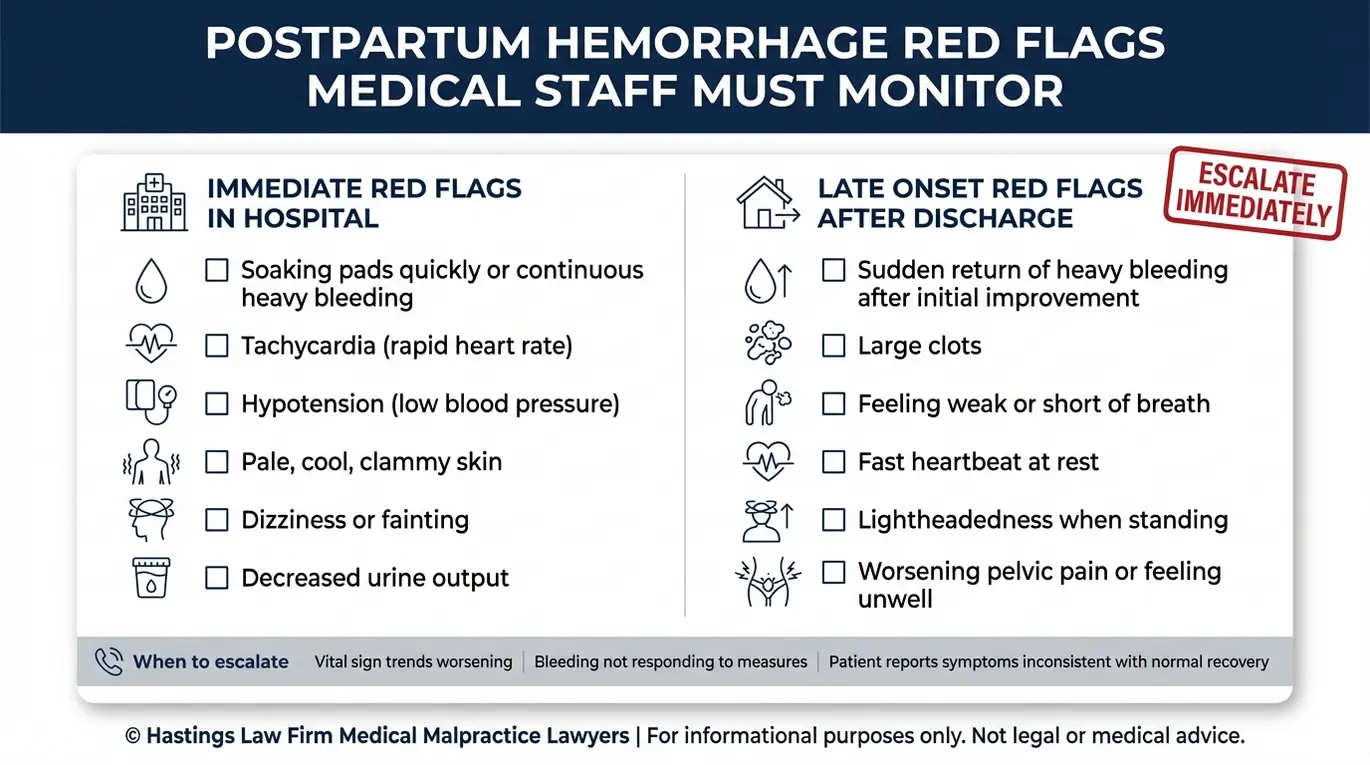
Medical staff must vigilantly monitor for signs of hypovolemic shock, including rapid heart rate (tachycardia), low blood pressure (hypotension), pale skin, and decreased urine output. Hypovolemic shock is a dangerous condition caused by severe blood loss that requires immediate recognition to prevent organ failure.
The critical window for intervention is narrow. Once a patient begins showing signs of shock or hypovolemia, the risk of organ damage and death increases with every passing minute. A maternal early warning system, such as the one outlined by the Florida Department of Health’s Maternal Early Warning System guidelines, is designed to detect these changes before they become catastrophic. Hospitals that do not use structured early warning tools may miss the signs until intervention becomes far more difficult.
Warning signs that should trigger immediate action include:
- Heart rate above 110 beats per minute
- Systolic blood pressure below 85 mmHg
- Oxygen saturation below 95%
- Excessive bleeding soaking more than one pad per hour
- Altered mental status, confusion, or loss of consciousness
- Urine output below 30 mL per hour
There is also a second category that families should understand. Secondary or late-onset postpartum hemorrhage occurs between 24 hours and 12 weeks after birth. It can be caused by retained tissue, infection, or delayed healing. When patients report heavy bleeding after discharge and their concerns are dismissed, a postpartum hemorrhage lawyer in Arizona can investigate whether the hospital’s discharge protocols and follow-up care met the standard.
Medical Negligence Leading to Severe Blood Loss
Medical negligence in postpartum hemorrhage cases occurs when providers fail to diagnose hemorrhage risks or delay the administration of uterotonics. These medications, like oxytocin or the brand name Pitocin, help the uterus contract. Negligence may also involve failing to perform necessary surgical interventions to stop bleeding.
Time is the defining factor in these cases. When blood loss accelerates, the clinical team should follow a staged escalation. They should use uterotonics first, then tranexamic acid (TXA), which is a drug that helps the blood clot more effectively. According to the University of Washington Medicine’s OB Consensus Conference on Tranexamic Acid, TXA should be administered within three hours of birth for best results. Delays beyond that window reduce its effectiveness.
If medications do not control the bleeding, the standard of care may require blood transfusions or surgical repair of lacerations. In the most severe cases, an emergency hysterectomy may be necessary to save the patient’s life. Failing to order blood products when hemoglobin levels drop, or hesitating to proceed with surgical interventions when conservative measures are not working, can turn a treatable complication into a permanent injury.
Our legal team includes former hospital nurses and defense attorneys who use their insider perspective to identify where a hospital’s protocol may have failed. When a new mother reports feeling dizzy, weak, or in severe pain, those symptoms should prompt immediate reassessment. Our team evaluates whether the care team failed to escalate these concerns. An Arizona postpartum hemorrhage lawyer and medical malpractice attorney will examine the medical records minute by minute to determine whether complaints were documented, investigated, and acted on.

Long-Term Consequences of Untreated Excessive Bleeding
Untreated postpartum hemorrhage can lead to catastrophic outcomes, including multi-system organ failure, hypoxic brain injury due to oxygen deprivation, loss of fertility (hysterectomy), and wrongful death. Data from the CDC’s Pregnancy Mortality Surveillance System confirms that hemorrhage remains a leading cause of pregnancy-related death in the United States, and the majority of these deaths are preventable.
The long-term consequences families may face include:
- Sheehan’s Syndrome: This condition occurs when severe blood loss damages the pituitary gland, disrupting hormone production and affecting thyroid function and fertility for years.
- Hypoxic Ischemic Encephalopathy (HIE): When blood loss is severe enough to deprive the brain of oxygen, the result can be permanent brain damage affecting memory and motor function.
- Emergency Peripartum Hysterectomy: This is the surgical removal of the uterus during or shortly after delivery to control life-threatening bleeding, which permanently eliminates the ability to carry future pregnancies.
- Wrongful Death: When errors in managing postpartum hemorrhage result in the death of a mother, surviving family members may pursue a legal claim for damages.
A birth injury attorney can help families understand the full scope of harm and connect them with medical experts who can document the long-term impact of these injuries.
Do I Have a Malpractice Case for Postpartum Hemorrhage in Arizona?
You may have a valid malpractice case if an investigation reveals that your healthcare provider deviated from the standard of care, directly causing severe injury or worsening the outcome of the hemorrhage.
To establish a postpartum hemorrhage malpractice claim in Arizona, four elements must be proven. These include duty (the provider had a responsibility to treat you according to medical standards), breach (they failed to meet that standard), causation (the failure directly caused your injury), and damages (you suffered measurable harm).
Not every difficult delivery or adverse outcome is malpractice. Childbirth carries inherent risks, and complications can develop even when providers do everything right. The distinction is whether the harm was preventable. Qualified medical expert witnesses review the records, compare the care that was given to the care that should have been given, and offer an opinion on whether the standard was met.
An Arizona postpartum hemorrhage lawyer at our firm works alongside in-house nurse consultants to evaluate whether the facts support a claim. Our founder, Tommy Hastings, is board-certified in personal injury trial law by the Texas Board of Legal Specialization and has spent over 20 years handling complex medical liability cases.
Recoverable Damages in Arizona Birth Injury Lawsuits
Victims of postpartum hemorrhage negligence in Arizona may recover economic damages for medical bills and lost wages, as well as non-economic damages for pain, suffering, and loss of quality of life. The Arizona Constitution prohibits caps on personal injury damages, meaning there is no arbitrary limit on what a jury can award.
| Damage Category | Examples |
|---|---|
| Economic Damages | Past and future medical bills (surgery, transfusions, dialysis, rehabilitation), lost wages, reduced earning capacity |
| Non-Economic Damages | Physical pain and suffering, emotional distress, PTSD from traumatic birth, loss of fertility grief, loss of quality of life |
| Loss of Consortium | Compensation for the spouse’s loss of companionship, support, and relationship |
The financial burden of a severe hemorrhage injury extends well beyond the initial hospital stay. Non-economic damages may cover the emotional distress and mental health treatment required after a traumatic birth experience. A medical negligence lawyer will work with economists and life-care planners to document the full cost of the injury and any future medical care required.
Contact the Arizona Birth Injury Attorneys at Hastings Law Firm Today for Help
If you or a loved one suffered severe injury from mismanaged postpartum bleeding, you do not have to face this alone. Hastings Law Firm brings a team of attorneys, former defense counsel, and in-house medical professionals who focus exclusively on medical malpractice.
We understand that reaching out can feel overwhelming, especially when you are still recovering. Our free, confidential consultation allows you to share your story and receive an honest assessment of your legal options. We listen, we review your medical records, and we give you an honest assessment of whether you have a case. There are no attorney fees or costs unless we recover compensation for you.
Contact our Arizona postpartum hemorrhage lawyer team today. Let us help you find the answers you deserve.
Frequently Asked Questions About Postpartum Hemorrhage in Arizona


This content was researched and written by the Hastings Law Firm editorial team, which includes attorneys, medical professionals, and experienced researchers. Our writing is informed by internal knowledge and practical experience, and we cross-check critical details against authoritative sources cited throughout. Every piece undergoes human-led fact-checking and legal review. Because legal and medical information can change, if you spot an error, please contact us. Learn more about our content standards and review process on our editorial policy page.

Tommy Hastings, founder of Hastings Law Firm, is a board-certified personal injury trial lawyer dedicated exclusively to healthcare injury cases. Since 2001, he has represented injured patients and families in litigation against major hospital systems, pharmaceutical companies, and negligent healthcare providers nationwide. He has handled numerous high-profile cases that have drawn national media attention and resulted in multi-million dollar recoveries. He draws on that experience in his writing, helping readers understand how these cases work and what options may be available to them.
