


Arizona Pitocin Overuse Malpractice Lawyer
Written by: Hastings Law Firm | Reviewed by: Tommy Hastings | Updated: July 27, 2026
Pitocin is used to start or strengthen labor, but it requires careful dosing and continuous monitoring. When Pitocin is mismanaged, overly frequent contractions can reduce oxygen delivery to the baby and lead to serious and lasting harm. These situations often involve warning signs on fetal monitoring, delayed responses to fetal distress, and breakdowns in communication among the care team. Understanding how induction errors happen and what records can show helps families make informed decisions after a traumatic birth experience. If you or a loved one were harmed or worse due to Pitocin overuse malpractice in Arizona, contact Hastings Law Firm for a free, confidential case review.

Securing Justice for Infants Injured by Labor Induction Errors in Arizona
What You Should Know About Oxtocin-Induced Labor Injury Claims in Arizona:
- Life changing infant harm can follow Pitocin mismanagement when overly frequent contractions reduce oxygen delivery during labor.
- Long term neurological injury can be tied to the severity and duration of oxygen deprivation during labor.
- Liability disputes can turn on whether Pitocin was continued despite fetal distress or whether an emergency C section was delayed.
- Shared responsibility can arise when nursing concerns about unsafe orders are not effectively escalated through the chain of command.
- Recovery options in Arizona can be limited if the time allowed to bring a claim expires.
- Compensation can include both economic losses and non economic harms because Arizona does not cap damages for personal injury.
- Objective records can be central because electronic fetal monitoring strips show contraction patterns alongside fetal heart rate changes.
- Confirmation of oxygen deprivation can come from cord blood gas results that reflect the baby condition at birth.
- Timeline clarity can depend on nursing notes and medication records that document dosing changes and responses to fetal status.
- Accountability questions can be shaped by physician orders and communication logs that show what was reported and what instructions were given.

A Healthcare Focused Law Firm
When a child is harmed during labor, the emotional weight can feel impossible to carry. If you suspect that the misuse of Pitocin or other labor-inducing drugs played a role in your baby’s injury, you are not alone, and your concerns deserve to be taken seriously. These cases involve both medical and legal details that require specialized knowledge to evaluate properly.
As an Arizona Pitocin overuse malpractice lawyer, Hastings Law Firm focuses exclusively on medical malpractice. Our team includes hospital nurses and former defense attorneys who understand how hospitals operate from the inside. If your family is dealing with a birth injury that may have been preventable, we can review what happened and explain your options in a free, confidential consultation.
Understanding Pitocin and Its Role in Labor Induction
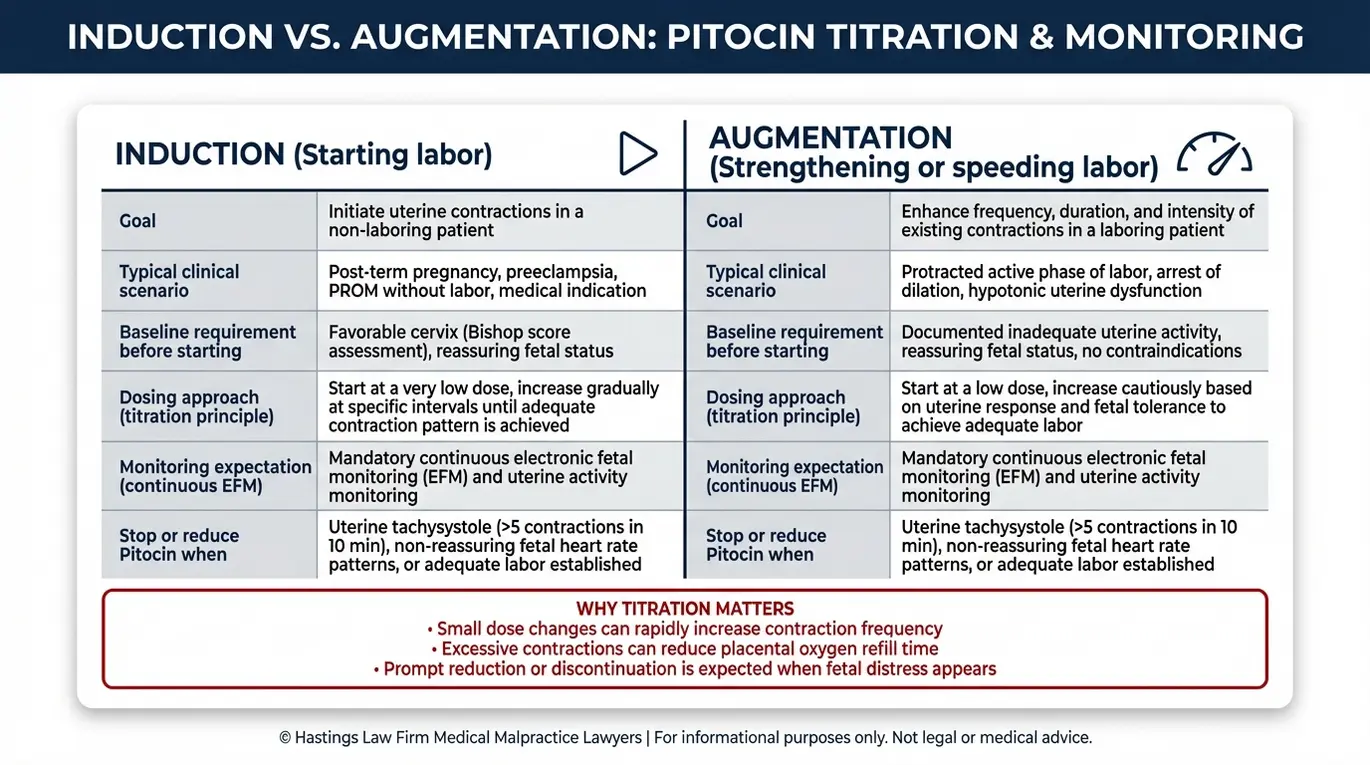
Pitocin, a synthetic form of the hormone oxytocin, is used to induce labor or augment contractions that have stalled. While Pitocin can be an effective tool, it demands precise dosing and constant monitoring because even small miscalculations can have serious consequences. Doctors use the drug for either labor induction (starting contractions when labor has not begun on its own) or labor augmentation (strengthening contractions that have stalled or slowed).
The drug is delivered via intravenous (IV) administration using an infusion pump, which allows medical staff to carefully increase, decrease, or stop the dosage as needed. Doctors use titration to adjust the dose based on how the mother and baby react. This is the medical process of carefully adjusting medication based on how a patient responds.
According to the National Center for Biotechnology Information (NCBI Bookshelf), synthetic oxytocin has a short half-life, meaning its effects can be reduced quickly once the IV is adjusted. This is an important detail in malpractice cases. Because the drug can be turned off rapidly, a failure to do so during fetal distress can suggest the standard of care was not met. This standard represents the level of treatment a reasonably competent provider would deliver under similar circumstances.
The distinction between induction and augmentation matters both medically and legally:
| Induction | Augmentation | |
|---|---|---|
| Purpose | Start labor that has not begun naturally | Strengthen or speed up labor already in progress |
| When Used | Post-term pregnancy, premature rupture of membranes, medical necessity | Stalled labor, weak or irregular contractions |
| Monitoring Required | Continuous electronic fetal monitoring | Continuous electronic fetal monitoring |
| Standard of Care | Gradual titration with frequent reassessment | Gradual titration with frequent reassessment |
Regardless of why Pitocin is administered, the standard of care requires continuous fetal monitoring throughout. A Pitocin birth injury attorney evaluates whether that monitoring was performed correctly and whether the medical team responded appropriately to changes in the baby’s condition. When providers fail to follow safe dosing protocols, the consequences for the infant can be devastating, and families may have grounds to pursue a claim involving the misuse of oxytocin.
The Dangers of Hyperstimulation and Fetal Distress
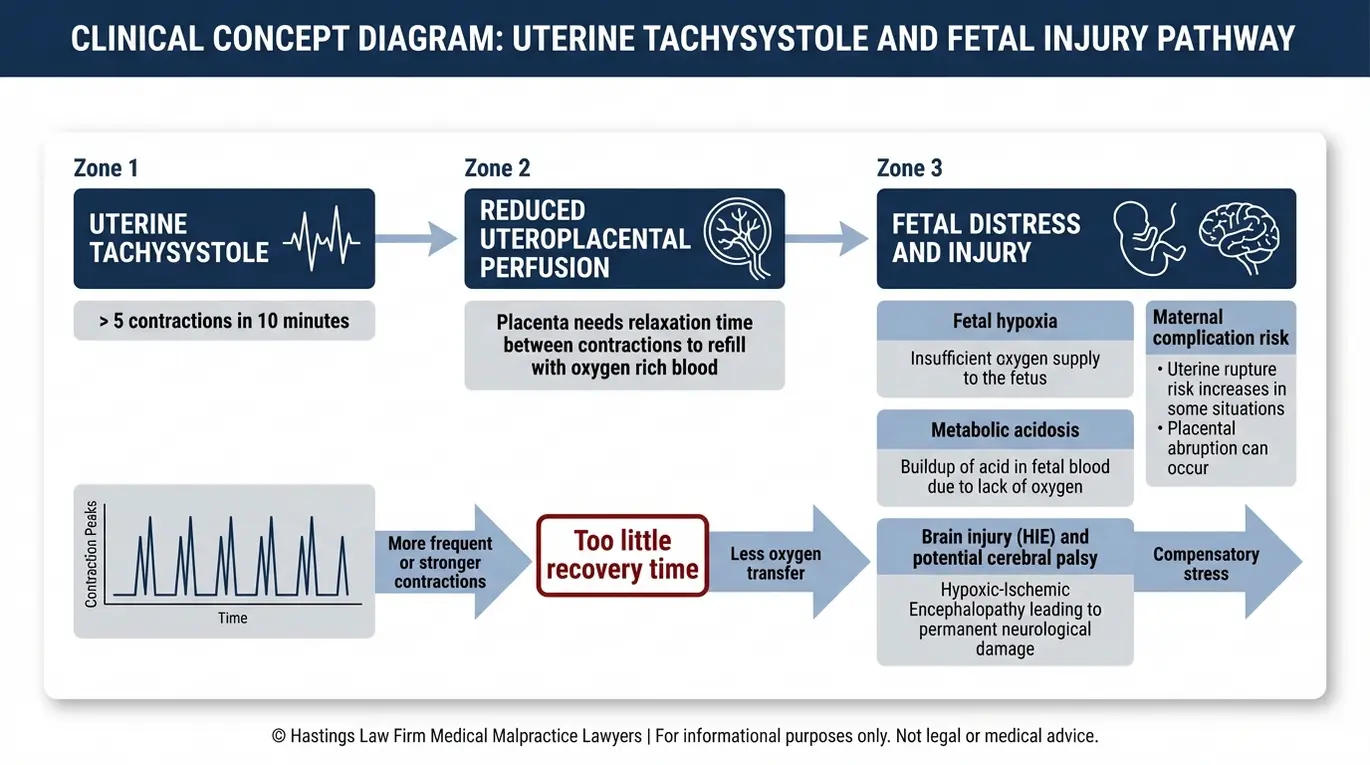
Overuse of Pitocin can cause uterine tachysystole, a condition where the uterus contracts too frequently (more than five contractions in a ten-minute window, averaged over a 30-minute period) or when contractions become excessively strong. This is dangerous because of how oxygen reaches the baby during labor.
A baby receives oxygen through the placenta, but that exchange only happens effectively between contractions, during uteroplacental perfusion, the process by which oxygen-rich blood flows from the mother through the placenta to the fetus. When contractions come too close together or never fully relax, the placenta cannot refill with oxygenated blood. The baby is essentially cut off from its oxygen supply.
Hypoxia is a medical emergency that occurs when the baby does not get enough oxygen during the birth process. This oxygen deprivation, known as hypoxia, can trigger a chain of increasingly serious injuries:
- Fetal distress: The baby’s heart rate shows abnormal patterns, including late decelerations and reduced variability on the fetal monitor.
- Hypoxic-ischemic encephalopathy (HIE): Prolonged oxygen deprivation causes brain cells to begin dying, resulting in a type of brain damage that may be irreversible.
- Cerebral palsy: HIE is one of the leading causes of cerebral palsy, a permanent condition that affects movement, muscle tone, and motor development.
- Placental abruption: Uterine tachysystole can cause the placenta to detach prematurely from the uterine wall, creating a medical emergency for both mother and baby.
- Uterine rupture: The uterus itself can tear, particularly in mothers who have had a prior cesarean section. This is a life-threatening event that requires immediate surgical intervention.
Research published in PubMed Central on predictors of outcome following neonatal encephalopathy confirms that the severity of oxygen deprivation during labor is directly tied to long-term neurological outcomes. The longer a baby goes without adequate oxygen, the greater the risk of permanent injury. An Arizona birth injury lawyer examines whether providers recognized these warning signs and acted quickly enough to prevent harm.
Maternal risks are significant as well. Mothers who undergo Pitocin-augmented labor, especially those attempting vaginal birth after cesarean (VBAC), face an elevated risk of uterine rupture. We evaluate both the infant’s and the mother’s medical records to determine if families have valid oxytocin overdose claims.
The Hastings Law Firm Difference
Results matter, but what truly sets us apart is how we achieve them. Every verdict, every settlement, and every Arizona courtroom victory comes from one guiding promise: To treat each client’s fight for justice as if it were our own.
This balance of skill, experience, and empathy reflects our core philosophy that justice should not only compensate the injured, but also make healthcare safer nationwide.

Proving Medical Negligence in Pitocin Cases
Medical negligence in Pitocin cases is established when providers fail to follow the standard of care, specifically by continuing the drug despite signs of fetal distress or by failing to intervene with an emergency C-section when the situation demands it. Building a successful case requires showing that the medical team either missed or ignored warning signs that a reasonably competent provider would have acted on. Suing for Pitocin errors involves proving that these failures directly caused the injury.
The fetal heart rate monitor is the primary tool that tells the medical team how the baby is tolerating labor. Two patterns are particularly important when evaluating liability for birth injuries:
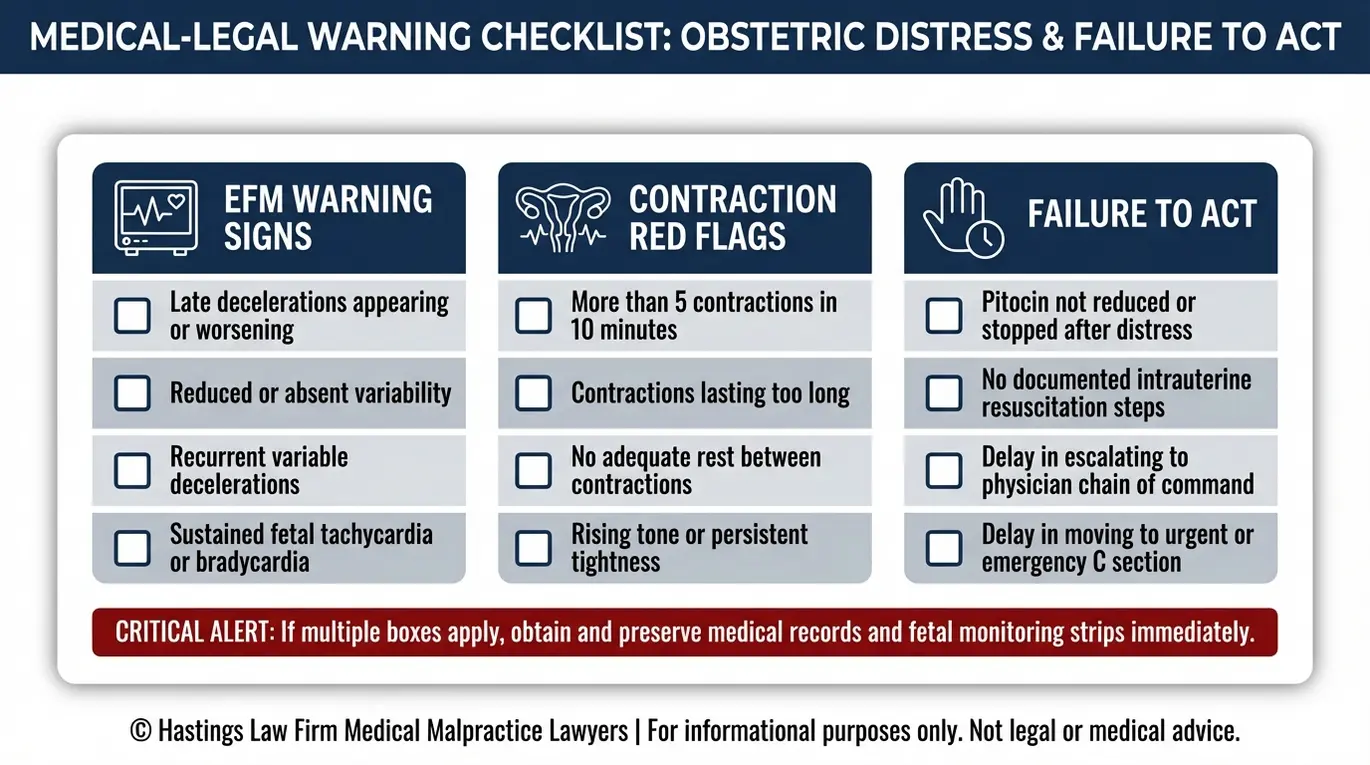
Late decelerations, drops in the baby’s heart rate that occur after the peak of a contraction, can indicate that the placenta is not delivering enough oxygen. Variable decelerations, abrupt drops in heart rate, may signal umbilical cord compression. Either pattern, especially when persistent or worsening, should prompt the medical team to take action.
When reviewing these cases, we look for specific red flags in the medical records:
- Pitocin was increased despite a non-reassuring fetal heart rate pattern
- The drug was not reduced or discontinued after repeated late decelerations
- Nursing notes reveal staff failed to notify the physician of worsening fetal status
- An emergency C-section was not performed within a reasonable time after signs of distress
- The fetal monitoring strip shows prolonged periods without adequate contraction recovery time
- Hospital staffing levels were insufficient to maintain continuous monitoring
Systemic failures at the hospital level can also contribute to these injuries. If a labor and delivery unit is understaffed or if nurses lack proper training on interpreting fetal monitoring strips, critical warning signs may go unrecognized. A medical malpractice lawyer in Phoenix will examine not only the individual actions of doctors and nurses but also the hospital protocols that may have failed.
Nursing Chain of Command and Liability
Nurses have an independent professional duty to advocate for patient safety, even when a physician’s orders conflict with safe practice. The nursing chain of command, the process by which a nurse escalates concerns to a supervisor, department head, or hospital administrator, is important when a doctor’s order appears unsafe.
In Pitocin cases, this often becomes a central issue. If a nurse recognized signs of fetal distress but continued administering the drug because a physician ordered it, the nurse may share liability. Conversely, if a nurse attempted to escalate concerns through the chain of command regarding overriding orders and was overruled, the liability may shift more heavily to the physician or the hospital. We review nursing notes, physician orders, and internal communication records to determine where the breakdown occurred.
Critical Evidence We Gather to Build Your Case
To prove that a Pitocin overdose caused a birth injury, we secure and analyze specific evidence in malpractice cases that reconstructs the timeline of labor and delivery. The electronic fetal monitoring (EFM) strips, which are continuous printed or digital recordings of the baby’s heart rate alongside the mother’s contraction patterns, function as the “black box” of the birth. They provide a second-by-second account of how the baby responded to each contraction and each change in Pitocin dosage.
Our medical experts and expert witness network analyze the EFM strips to evaluate contraction frequency and recovery time. If the strips show that contractions were occurring with little or no rest period between them, that is direct evidence of uterine hyperstimulation. We also assess whether the medical team’s charted actions match what the strips were showing in real time.
Beyond the fetal monitoring data, we gather and review:
- Cord blood gases: Drawn from the umbilical cord immediately after delivery, these lab results measure the baby’s blood pH and oxygen levels at birth. As explained by the NCBI Bookshelf resource on cord blood gas analysis, abnormal results (acidosis) confirm that the baby experienced oxygen deprivation during labor rather than having a pre-existing genetic condition.
- Apgar scores: Assigned at one and five minutes after birth, these scores reflect the baby’s overall condition and can indicate distress.
- Nursing notes and medication administration records: These document when Pitocin was started, how it was titrated, and whether staff responded to changes in fetal status.
- Physician orders and communication logs: These reveal whether doctors were notified of concerning patterns and what instructions they gave.
Time is a factor in preserving this evidence. Under Arizona Revised Statutes § 12-542, the statute of limitations for personal injury claims is two years. An Arizona medical negligence attorney can help ensure that records are preserved and that your claim is filed within the required timeframe.
Why Choose Hastings Law Firm for Your Arizona Case
We are not a general personal injury firm. Hastings Law Firm handles medical malpractice cases exclusively. As a dedicated Phoenix medical malpractice law firm, we have direct access to Arizona’s courts and medical community. Our team includes hospital nurses and former defense attorneys who previously represented hospitals, giving us insight into how the other side prepares its case.
Our founder, Tommy Hastings, is Board Certified in Personal Injury Trial Law by the Texas Board of Legal Specialization, a distinction held by fewer than 2% of Texas attorneys. Our trial-ready philosophy means every case we accept is prepared from day one as though it will go to court. We are committed to acting as patient advocates for families, strengthening our position whether a case resolves through settlement or proceeds to a jury.
We work on a contingency fee basis, which means you pay no attorney fees or costs unless we recover compensation for your family.
Contact the Arizona Birth Injury Attorneys at Hastings Law Firm Today for Help
If your child suffered a preventable injury during labor and you believe Pitocin mismanagement may have been a factor, our team is here to listen. We understand both the medicine and the law behind these cases, and we are committed to helping families find the truth about what happened and secure their child’s financial future.
Contact Hastings Law Firm for a free, confidential case evaluation with our Board Certified team. We serve families throughout Arizona, including Phoenix and Tucson. There is no fee unless we win your case.
Frequently Asked Questions About Pitocin Overuse Malpractice in Arizona


This content was researched and written by the Hastings Law Firm editorial team, which includes attorneys, medical professionals, and experienced researchers. Our writing is informed by internal knowledge and practical experience, and we cross-check critical details against authoritative sources cited throughout. Every piece undergoes human-led fact-checking and legal review. Because legal and medical information can change, if you spot an error, please contact us. Learn more about our content standards and review process on our editorial policy page.

Tommy Hastings, founder of Hastings Law Firm, is a board-certified personal injury trial lawyer dedicated exclusively to healthcare injury cases. Since 2001, he has represented injured patients and families in litigation against major hospital systems, pharmaceutical companies, and negligent healthcare providers nationwide. He has handled numerous high-profile cases that have drawn national media attention and resulted in multi-million dollar recoveries. He draws on that experience in his writing, helping readers understand how these cases work and what options may be available to them.
