


Arizona Patient Fall in Hospital Lawyer
A hospital fall can leave a patient with serious injuries and a family with lasting worry about whether basic safety was ignored. Arizona hospitals have a duty to maintain a safe environment, assess fall risk, and provide appropriate supervision and protective measures. Some falls happen even when proper precautions are taken, but others are linked to missed risk assessments, skipped safety protocols, or delayed assistance. Understanding what happened often depends on the records created before and after the incident. If you or a loved one were harmed or worse due to hospital fall negligence in Arizona, contact Hastings Law Firm for a free, confidential case review.
Last Updated: September 20, 2026
Trusted Arizona Medical Attorneys for Hospital Fall Negligence Claims
When a loved one falls in a hospital, the injury itself is only part of the harm. There is also the sense of betrayal, the feeling that the one place designed to keep them safe failed at the most basic level. If you or a family member suffered serious injuries from a fall during a hospital stay, you may be wondering whether what happened was preventable and whether someone should be held accountable.
Those questions deserve honest answers. As an Arizona patient fall in hospital lawyer team, Hastings Law Firm focuses exclusively on medical malpractice litigation. Our legal and medical professionals review the circumstances of every case to determine whether hospital negligence contributed to a preventable fall. We understand how overwhelming this time can be, and we are here to help you understand your options clearly and without pressure.
If you believe your loved one’s fall should not have happened, we welcome the chance to review what occurred and explain the legal path forward. Consultations are free and confidential.

Legal Recourse for Preventable Hospital Falls in Arizona
Hospital falls are frequently classified as “Never Events” by CMS, meaning they are identifiable, preventable, and serious errors that should not occur under proper care. This federal classification carries significant weight in medical malpractice cases because it reflects a national consensus: hospitals have a duty of care to protect patients from falling, and a failure to meet that duty can establish liability.
Every hospital in Arizona owes its patients a legal obligation to maintain a safe environment. An experienced hospital fall attorney in Arizona understands this includes assessing each patient’s fall risk, implementing protective measures, and ensuring staff are available to assist patients. When a hospital fails to meet these obligations and a patient is harmed, the resulting injury may constitute medical negligence.
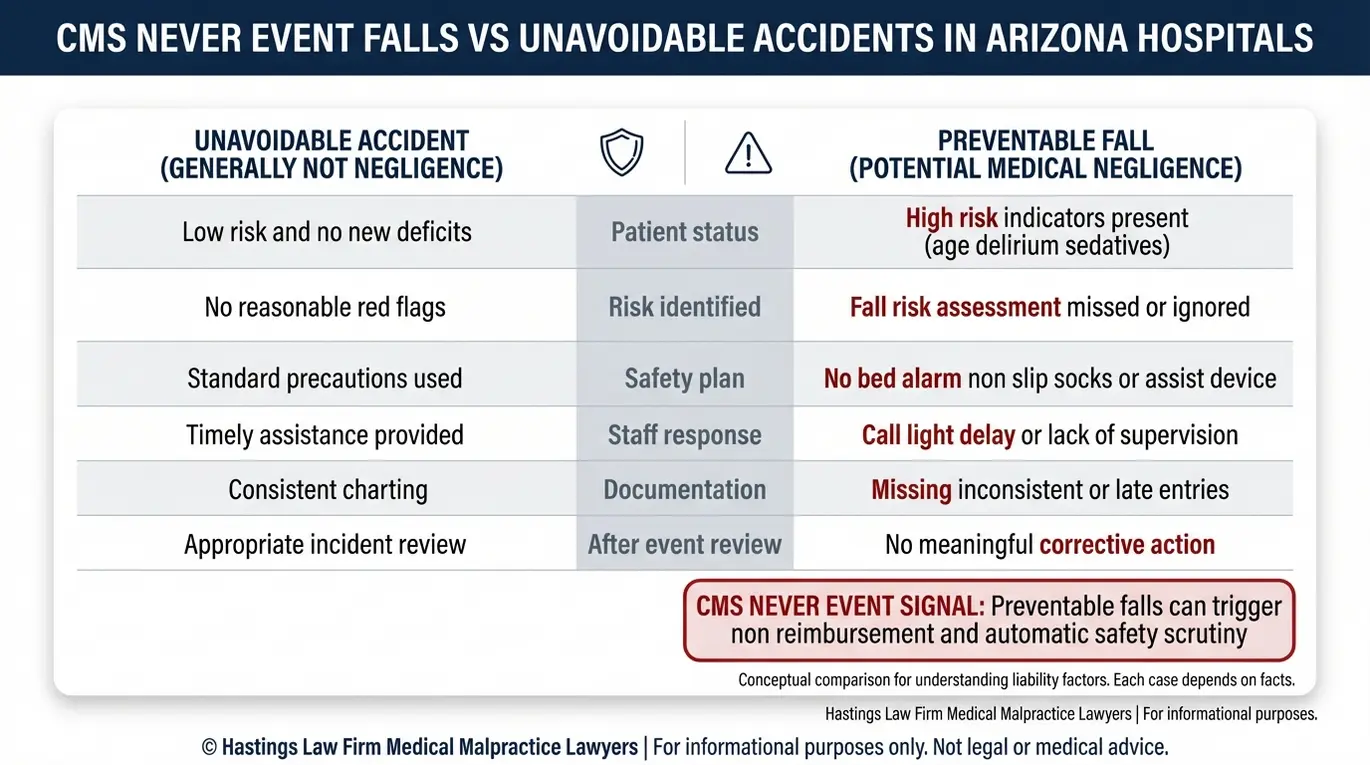
Not every fall qualifies as malpractice. An unavoidable accident, where all appropriate precautions were taken and the patient still fell, is different from an unassisted fall, a preventable incident where a patient needing help was left without supervision. The distinction between the two often determines whether a lawyer for hospital falls can establish that a legal claim exists.
An Arizona patient fall in hospital lawyer can help you understand where your situation falls on that spectrum. Here is how the key differences break down:
- Unavoidable accident: All safety protocols were followed, risk assessments were completed, and precautions were in place, yet the patient still fell due to an unforeseeable event.
- Actionable medical negligence: The hospital failed to assess fall risk, did not implement required safety measures, or left a high-risk patient without supervision, directly contributing to the fall.
CMS Never Event Classification
The CMS (Centers for Medicare & Medicaid Services) designation of certain falls as “Never Events” has direct implications for liability. A hospital-acquired condition (HAC) is a medical complication or injury that develops during a hospital stay and was not present at admission. This status can disqualify a facility from receiving Medicare reimbursement for the costs associated with treating the injury, highlighting that the standard of care was not met. Falls with serious injuries are specifically listed on the ICD-10 HAC List maintained by CMS.
When CMS determines that a fall should never have happened under proper care and refuses to reimburse the hospital for it, that designation becomes a powerful piece of evidence in a malpractice case. It signals that even the federal government recognizes the standard of care was not met. For an attorney for hospital patient falls, this classification can help establish that the facility’s own protocols fell short of what patients deserve.
Common Causes of Negligent Patient Falls in Arizona Hospitals
Negligent falls often stem from systemic failures such as understaffing, failure to respond to call lights, or improper medication administration that leaves patients disoriented. These are not random accidents. They are breakdowns in the systems hospitals are required to maintain.
An attorney for hospital patient falls will investigate these root causes to determine what went wrong. Common contributing factors include:
- Understaffing and fatigue: When too few nurses are responsible for too many patients, response times suffer. Research published through the National Center for Biotechnology Information on acute care nursing staff shortages documents how compromised nurse-to-patient ratios directly affect patient safety outcomes. A patient fall lawyer often finds that low staffing levels prevented timely assistance.
- Medication errors and sedative mismanagement: Sedatives, medications that calm or sedate a patient, can cause dizziness, confusion, and impaired balance. When staff administer these drugs without increasing supervision, high-risk patients may attempt to move without assistance. A hospital fall attorney knows that patients with dementia or cognitive impairment face even greater risk when protocols are ignored.
- Environmental hazards and poor room placement: Wet floors, cluttered pathways, and lack of handrails create trip hazards. Placing a high-risk patient in a room far from the nurses’ station can delay help when it is needed most, a factor often cited in negligence claims.
- Failure to supervise known high-risk patients: Some patients arrive with documented risk factors, including advanced age, prior falls, or balance disorders. When a hospital ignores these risk factors, the resulting fall may reflect clear negligence.
An Arizona hospital negligence lawyer will review staffing logs, medication administration records, and nursing notes to determine whether these failures played a role in your loved one’s injury.
The Hastings Law Firm Difference
Results matter, but what truly sets us apart is how we achieve them. Every verdict, every settlement, and every Arizona courtroom victory comes from one guiding promise: To treat each client’s fight for justice as if it were our own.
This balance of skill, experience, and empathy reflects our core philosophy that justice should not only compensate the injured, but also make health care safer nationwide.

Adherence to the Standard of Care in Fall Prevention Protocols
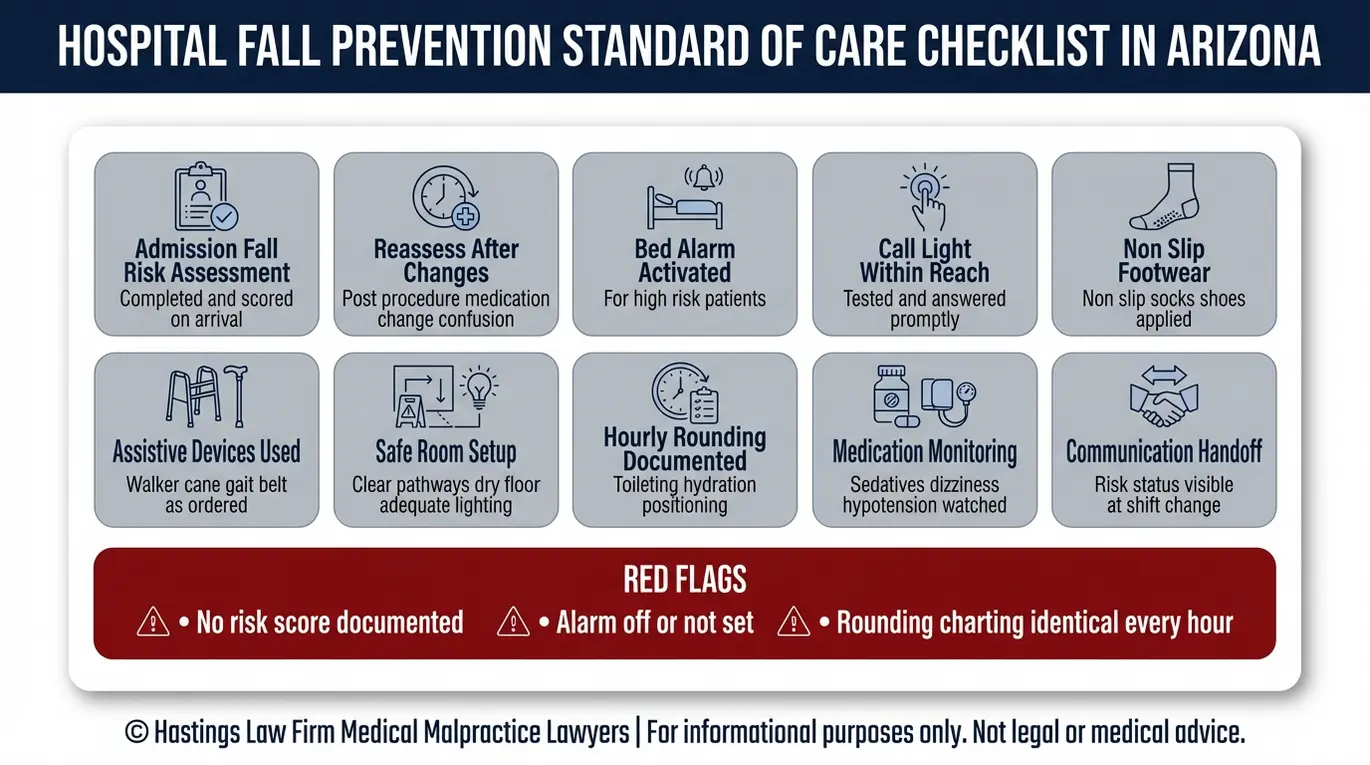
The standard of care requires hospitals to conduct fall risk assessments upon admission and implement preventive measures like bed alarms, hourly rounding, and non-slip footwear for high-risk patients. This legal benchmark represents the level of care a competent professional would provide under similar circumstances. When these protocols are skipped or ignored, the hospital may be liable for injuries that result.
One of the most widely used tools is the Morse Fall Scale, featured in the VA National Center for Patient Safety falls toolkit, a validated scoring system that evaluates factors like a patient’s history of falling and mental status. A high score triggers a series of mandatory interventions.
An Arizona patient fall in hospital lawyer will compare the hospital’s documented actions against these required protocols. Here is what a proper fall prevention plan should include:
- Fall risk assessment completed within hours of admission using a validated tool like the Morse Fall Scale
- Bed alarms activated for high-risk patients (pressure-sensitive devices on the bed or chair that alert staff when a patient attempts to stand)
- Non-slip socks or footwear provided and documented in the chart
- Assistive devices such as walkers or gait belts made accessible at bedside
- Call light placed within easy reach and its use explained to the patient
- Hourly rounding performed and documented, including checks for toileting needs, pain, and positioning
- Room placement near the nurses’ station for patients with the highest risk scores
Research on intentional hourly rounding in acute care settings published through DigitalCommons at the University of Maine confirms that consistent, scheduled check-ins significantly reduce fall rates by addressing patient needs before the patient attempts to get up unassisted.
A medical malpractice lawyer for falls will review nursing logs and charting to determine whether these steps were actually taken. Failure to adhere to these standards is a primary focus for an Arizona hospital fall attorney. When records show that bed alarms were ignored or rounding was skipped, a lawyer for hospital falls can use this evidence to prove a breach in the standard of care.
Severe Injuries Resulting from Hospital Fall Negligence
Falls in medical settings often result in catastrophic secondary injuries, including hip fractures requiring surgery, traumatic brain injuries (subdural hematomas), and internal bleeding.
Orthopedic injuries are among the most common and most life-altering. Hip fractures, pelvic fractures, and spinal injuries can permanently reduce mobility, particularly in elderly patients. A hospital injury lawyer often sees cases where a broken hip leads to extended rehabilitation and a dramatically diminished quality of life.
Neurological injuries pose an even more urgent threat. A traumatic brain injury from a fall can cause lasting cognitive and physical impairment. The danger is compounded for patients taking anticoagulants (blood thinners), because these medications increase the risk of uncontrolled brain bleeds.
After any fall involving a head impact, neurological checks, which are repeated assessments of a patient’s consciousness and motor function, should be performed frequently. A fall in hospital lawyer knows that when staff fail to order these checks, a treatable bleed can become fatal. Secondary complications can arise when these initial injuries are not managed with the proper level of care.
| Injury Type | Examples | Key Risk Factors |
|---|---|---|
| Orthopedic | Hip fractures, pelvic fractures, spinal compression fractures | Advanced age, osteoporosis, lack of assistive devices |
| Neurological | Traumatic brain injury, subdural hematoma | Anticoagulant use, delayed neuro checks |
| Internal | Organ damage, internal bleeding | Blood thinners, delayed imaging after fall |
| Secondary Complications | Pneumonia, sepsis, blood clots | Extended immobility post-fall |
Secondary complications are often overlooked but can be just as deadly. A patient immobilized by a fracture may develop pneumonia, blood clots, or sepsis. A study published in PubMed Central on risk factors for mortality in bedridden patients with hospital-acquired pneumonia found that prolonged bed rest following injury significantly increases the risk of life-threatening respiratory infections.
An Arizona patient fall attorney can pursue damages for every complication. In the most tragic cases, these complications can lead to wrongful death, necessitating immediate legal action by a qualified Arizona hospital fall lawyer.
Establishing Liability and Proving Negligence in Fall Lawsuits
Proving negligence requires clear evidence that the hospital breached its duty of care, typically established through medical records, incident reports, and expert testimony verifying the failure to follow safety protocols. An Arizona patient fall in hospital lawyer builds this evidence methodically, examining every piece of documentation the hospital generated before, during, and after the fall.
Incident reports are a critical starting point. Hospitals are required to generate an internal report whenever a patient falls. These documents often contain details about the circumstances of the fall. However, hospitals may attempt to classify these reports as privileged. Our team knows how to compel their production through discovery.
Nursing notes and charting often tell a different story than the hospital’s official narrative. We look for gaps in documentation and evidence that hourly rounding (scheduled nursing checks typically performed every 60 minutes to address patient needs and prevent unassisted movement) was not completed as required. We also secure witness statements from roommates or visitors who observed the lack of care.
Expert testimony ties the evidence together. A qualified medical expert reviews the records and offers an opinion on whether the hospital’s actions fell below the standard of care. A hospital negligence attorney ensures this testimony is ready for trial.
One of the most common defenses hospitals raise is comparative negligence, which involves arguing that the patient was partially at fault. A hospital negligence attorney anticipates this defense early and builds evidence to counter it. An experienced Arizona patient fall in hospital lawyer knows how to dismantle these defenses effectively.

Compensation and Damages Available for Hospital Fall Victims
Victims of hospital negligence in Arizona may recover economic damages for medical bills and lost wages, as well as non-economic damages for pain, suffering, and loss of quality of life. The specific amount depends on the severity of the injury. Securing fair compensation for hospital falls requires a detailed accounting of all losses.
Recoverable damages in a hospital fall case may include:
- Economic damages: Past and future medical expenses, surgical costs, rehabilitation, home care, assistive equipment, and lost income or diminished earning capacity.
- Non-economic damages: Physical pain, emotional suffering, mental anguish, loss of independence, and reduced quality of life.
- Wrongful death damages: If the fall contributed to a patient’s death, surviving family members may pursue compensation for funeral expenses, loss of companionship, and the emotional toll of their loss.
Each category of damage requires documentation and, in many cases, expert analysis to calculate the full scope of harm. Medical malpractice damages must be calculated with precision. Our team works with medical and financial professionals to project future care costs, ensuring that the settlement covers a lifetime of needs rather than just immediate bills.
Contact the Arizona Hospital Malpractice Attorneys at Hastings Law Firm Today for Help
Patient safety is a right, not a privilege. If your loved one suffered a fall in an Arizona hospital and you suspect negligence played a role, you deserve to know the truth about what happened and why.
Hastings Law Firm is a medical malpractice firm built specifically for moments like this. Founded by board-certified trial attorney Tommy Hastings in 2005, we focus exclusively on medical negligence litigation. Our legal team includes former defense attorneys and experienced hospital nurses who understand the systems they now challenge.
We prepare every case as if it will go to trial. This level of preparation helps us provide a strong voice for patients and families. You pay nothing unless we recover compensation on your behalf. There are no upfront costs and no financial risk to you.
If you are ready to take the first step, contact our Phoenix office for a free, confidential case evaluation. An Arizona patient fall in hospital lawyer at Hastings Law Firm can review your situation, answer your questions, and help you understand what comes next.
Frequently Asked Questions About Patient Fall in Hospital in Arizona


This content was researched and written by the Hastings Law Firm editorial team, which includes attorneys, medical professionals, and experienced researchers. Our writing is informed by internal knowledge and practical experience, and we cross-check critical details against authoritative sources cited throughout. Every piece undergoes human-led fact-checking and legal review. Because legal and medical information can change, if you spot an error, please contact us. Learn more about our content standards and review process on our editorial policy page.

Tommy Hastings, founder of Hastings Law Firm, is a board-certified personal injury trial lawyer dedicated exclusively to healthcare injury cases. Since 2001, he has represented injured patients and families in litigation against major hospital systems, pharmaceutical companies, and negligent healthcare providers nationwide. He has handled numerous high-profile cases that have drawn national media attention and resulted in multi-million dollar recoveries. He draws on that experience in his writing, helping readers understand how these cases work and what options may be available to them.
