


Arizona Otolaryngologist Malpractice Lawyer
Written by: Hastings Law Firm | Reviewed by: Tommy Hastings | Updated: July 27, 2026
Otolaryngologist negligence can cause serious, lasting harm when an ENT specialist makes a preventable error during diagnosis, surgery, or postoperative care. Injuries in the head and neck can affect breathing, swallowing, speech, and daily function, and the line between a known complication and avoidable negligence is often central to accountability. Arizona cases may involve surgical mistakes, delayed diagnosis, informed consent problems, or rare events where negligence may be presumed. If you or a loved one were harmed or worse due to otolaryngologist malpractice in Arizona, contact Hastings Law Firm for a free, confidential case review.
Trusted Legal Representation for Medical Specialist Negligence in Arizona
What You Should Know About ENT Doctor Negligence Claims in Arizona:
- Long term functional and quality of life harm can follow ENT negligence because head and neck anatomy leaves little margin for error.
- Accountability can turn on whether an outcome is treated as a known complication or a preventable mistake tied to substandard care.
- Permanent sensory or nerve related injuries can be central in ENT malpractice disputes because they can change speech, swallowing, and daily activities.
- More aggressive and life altering treatment can result from delayed diagnosis when cancer warning signs are not properly worked up.
- Options for financial recovery in Arizona are not limited by damage caps for personal injury or wrongful death.
- A claim can be blocked by missed timing requirements because Arizona medical malpractice and government entity cases can have strict deadlines.
- Liability disputes often depend on whether qualified expert testimony supports a breach of the ENT standard of care.
- Informed consent issues can create exposure even when a procedure is performed correctly if a material risk was not disclosed.
- Presumed negligence can apply in rare situations where the injury ordinarily does not occur without error.
- Medical records such as imaging, operative reports, and nursing notes can be central to evaluating what happened and why harm occurred.

A Healthcare Focused Law Firm
When an ear, nose, and throat specialist causes harm through a preventable error, the consequences can be life-altering. Patients may face facial paralysis, the loss of motor control in facial muscles due to nerve damage, or anosmia, the complete loss of the sense of smell. These injuries affect how you eat, how you speak, and how you move through daily life.
If you suspect that an ENT doctor’s mistake caused your injury or a loved one’s suffering, you deserve answers. Since 2005, Hastings Law Firm has focused exclusively on medical malpractice cases, providing the specialized legal and medical knowledge necessary to evaluate these complex injuries. Contact us for a free, confidential case review. We can examine your records, explain your options, and help you understand whether negligence played a role.
Understanding Negligence in Otolaryngology Procedures
Otolaryngology negligence occurs when an ENT specialist deviates from the accepted standard of care during diagnosis, surgery, or postoperative treatment, resulting in preventable harm to the patient. Not every poor outcome qualifies as malpractice. However, when a doctor’s actions fall below what a reasonably competent specialist would have done under similar circumstances, the law provides a path to accountability.
An otolaryngologist, commonly known as an ENT doctor, is a physician who specializes in treating conditions of the ears, nose, throat, and related structures of the head and neck. Otolaryngology covers everything from chronic ear infections and sinus disease to complex head and neck cancer surgeries. As described by the American Academy of Otolaryngology-Head and Neck Surgery, these specialists undergo extensive training to manage the delicate anatomy of this region.
These professionals must balance functional outcomes, such as breathing and swallowing, with cosmetic considerations in reconstructive cases. Because the margin for error is so slight in the head and neck, precise adherence to safety protocols is mandatory.
The standard of care for ENT specialists in Arizona is the level of treatment, skill, and judgment that a qualified otolaryngologist in the same or similar situation would reasonably provide. It is an objective benchmark used to evaluate professional conduct. When that standard is not met, and a patient is harmed as a result, it may constitute ENT doctor negligence.
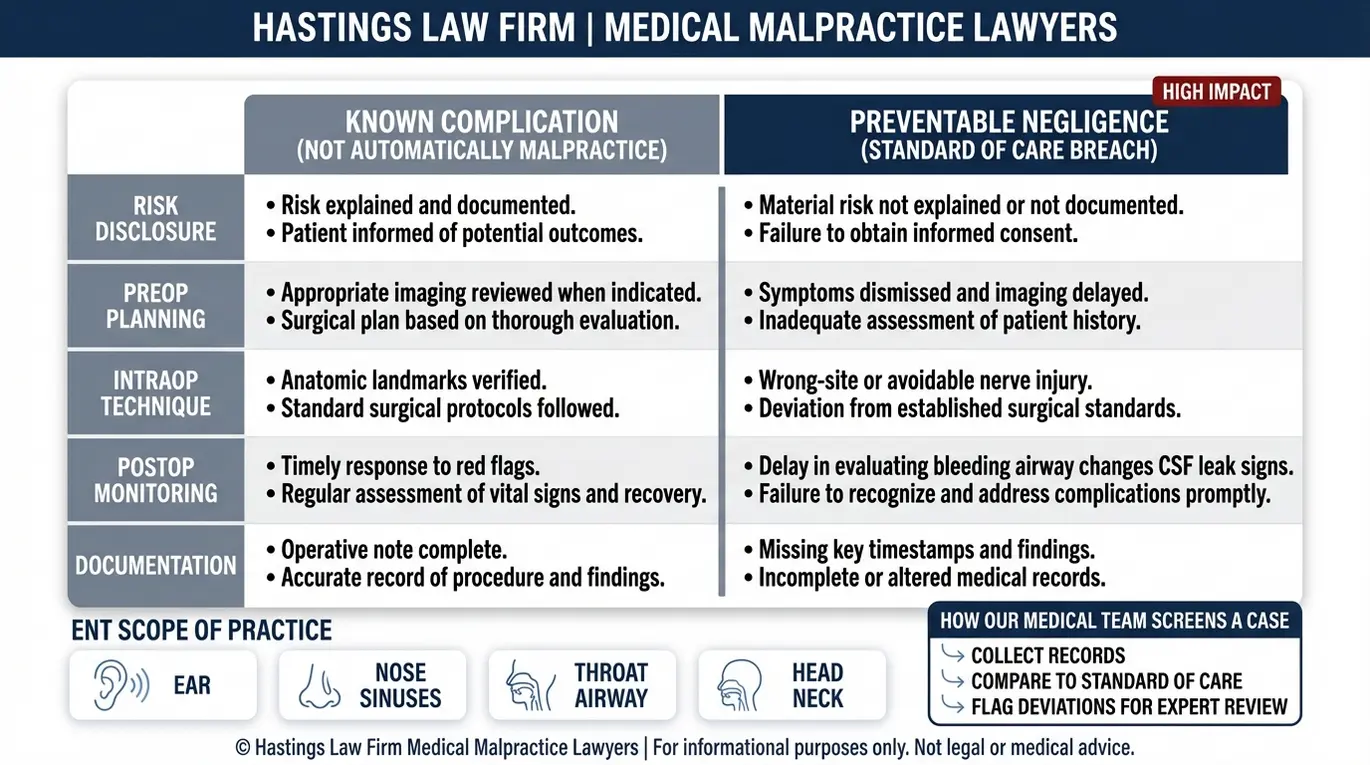
One important distinction shapes every ENT malpractice case: the difference between a known surgical complication and preventable negligence. While patients consent to known risks, they do not consent to errors caused by carelessness or lack of skill.
- Known complication: A recognized risk that can occur even when the surgeon performs the procedure correctly and follows all appropriate protocols.
- Preventable negligence: An error caused by a failure to follow accepted medical standards, such as damaging a nerve due to improper surgical technique or failing to identify a critical anatomical landmark.
Every surgery carries some degree of risk. But a known risk does not excuse a doctor from performing the procedure with the care and precision the standard requires. We investigate whether the harm resulted from an unavoidable complication or from a preventable mistake. We scrutinize the operative reports and medical history to determine if the surgeon’s conduct adhered to the rigorous demands of the profession.
Common Surgical Errors and Diagnostic Failures by ENT Specialists
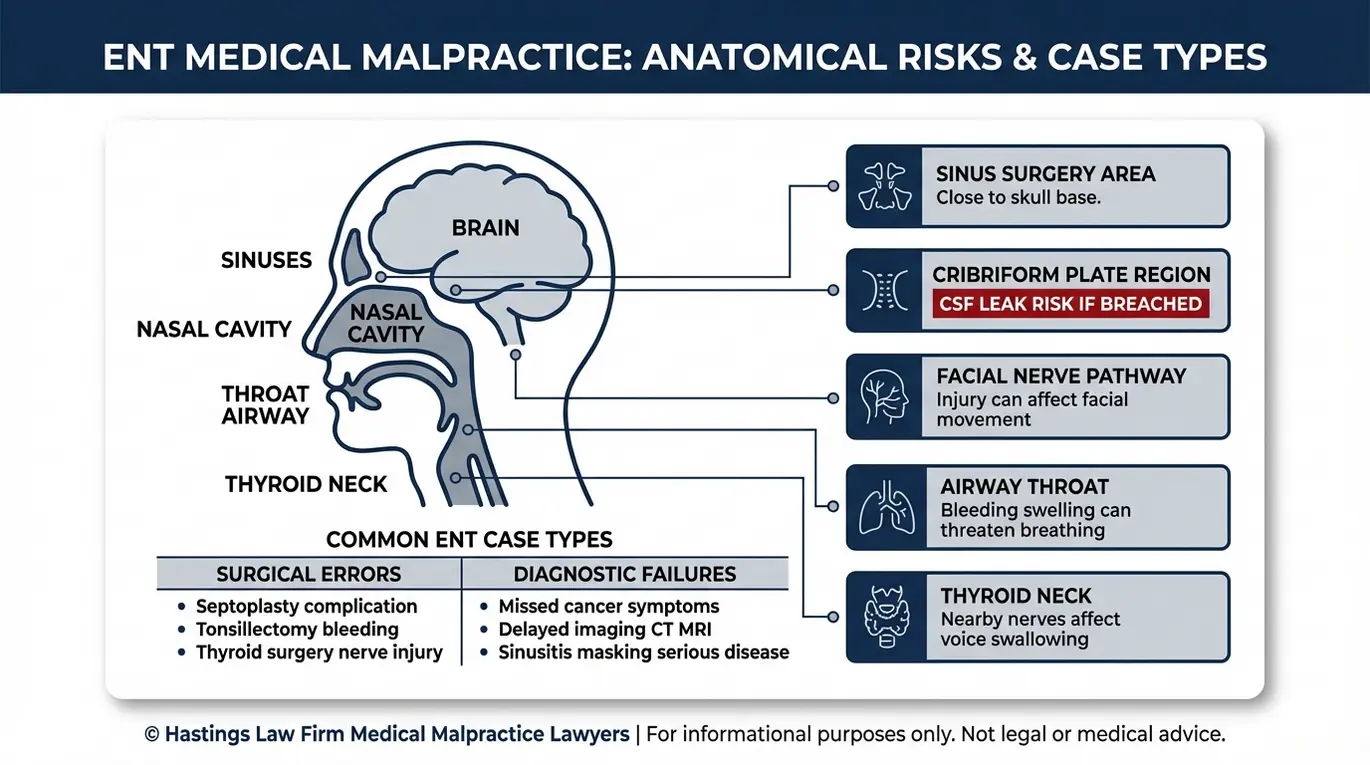
ENT doctors are most frequently sued for surgical errors involving the sinuses or thyroid, failure to diagnose oral or throat cancers, and nerve damage resulting in facial paralysis or loss of senses. These cases often involve highly specialized procedures performed in areas where even small mistakes can cause serious, permanent injury.
Surgical Errors
The head and neck contain some of the most densely packed and sensitive anatomy in the body. Nerves controlling facial movement, voice production, and sensory function run in close proximity to the structures ENT surgeons operate on daily. Because of this anatomical proximity to the brain and other critical structures, a slight deviation during surgery can lead to catastrophic outcomes.
The base of the skull separates the sinus cavities from the frontal lobes of the brain. Because of this proximity of ENT structures to the brain, a surgeon must visualize landmarks with absolute clarity. Even a millimeter of error can breach the dura mater, leading to potential brain injury, infection, or long-term neurological deficits.
Wrong-site surgery, though rare, is a “never event” that can occur in otolaryngology, particularly when treating paired structures like the ears or sinuses. Operating on the healthy side leaves the diseased area untreated and inflicts unnecessary trauma on functional anatomy.
During functional endoscopic sinus surgery (FESS), a minimally invasive procedure used to treat chronic sinusitis by opening blocked sinus passages, one of the most serious risks involves damage to the cribriform plate, the thin bone separating the nasal cavity from the brain. A breach of this structure can cause a cerebrospinal fluid (CSF) leak, a condition where the fluid surrounding the brain drains through the nose. Research published in PubMed Central reviewing CSF leak repairs highlights the complexity involved in correcting these injuries, which may require additional surgical intervention.
Other documented surgical errors in ENT practice include:
| Procedure | Potential Error | Possible Consequence |
|---|---|---|
| Thyroidectomy | Damage to the recurrent laryngeal nerve | Permanent voice changes or vocal cord paralysis |
| Parotidectomy | Accidental severance of the facial nerve | Facial paralysis on the affected side |
| Sinus Surgery (FESS) | Penetration of the cribriform plate | CSF leak, meningitis risk, brain injury |
| Septoplasty | Perforation of the nasal septum | Chronic breathing difficulty, whistling, crusting |
| Tonsillectomy | Excessive bleeding or thermal injury | Post-tonsillectomy hemorrhage, airway compromise |
Diagnostic Failures
Failure to diagnose or delayed diagnosis of head and neck cancers represents another significant category of ENT malpractice claims. In some cases, symptoms of nasopharyngeal or throat cancer may be dismissed as chronic sinusitis or persistent allergies without appropriate follow-up testing. Patients often present with complaints of hoarseness, difficulty swallowing, or a persistent lump in the neck.
If these red flags are ignored, the window for effective treatment closes. A delayed diagnosis often necessitates more aggressive treatments, such as radical neck dissection or high-dose radiation, which carry their own life-long side effects.
When an ENT doctor does not order timely imaging such as a CT scan or MRI to investigate persistent symptoms, a treatable early-stage cancer can progress to an advanced stage before it is identified. The difference in prognosis between early detection and late-stage diagnosis can be dramatic, both in terms of survival and quality of life.
Our team investigates whether the treating physician ordered appropriate diagnostic studies, followed up on abnormal findings, and referred the patient for further evaluation when warranted. Our Arizona ENT malpractice legal team works with qualified medical experts to reconstruct the clinical timeline and determine whether earlier action could have changed the outcome.
The Hastings Law Firm Difference
Results matter, but what truly sets us apart is how we achieve them. Every verdict, every settlement, and every Arizona courtroom victory comes from one guiding promise: To treat each client’s fight for justice as if it were our own.
This balance of skill, experience, and empathy reflects our core philosophy that justice should not only compensate the injured, but also make healthcare safer nationwide.

Proving Liability in Arizona ENT Negligence Cases
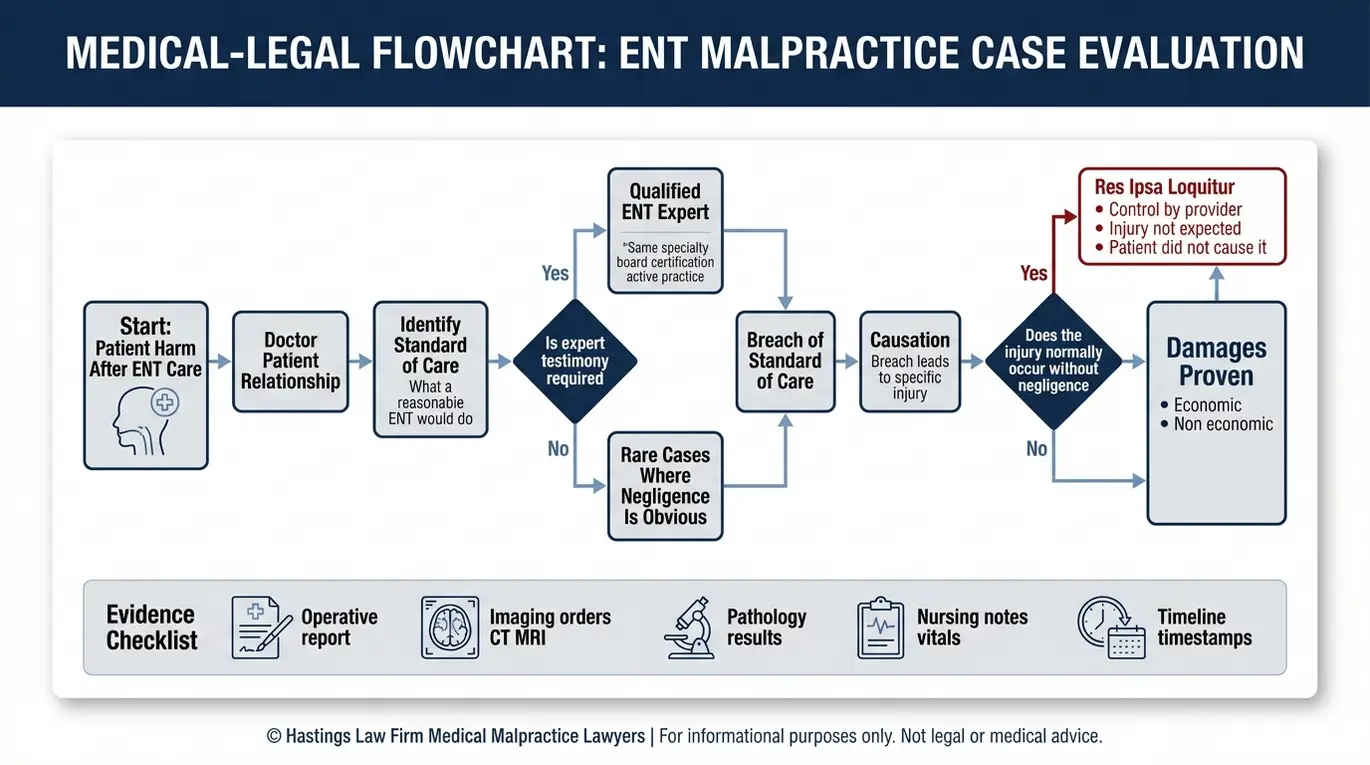
Proving liability requires demonstrating that a doctor-patient relationship existed, the ENT breached the standard of care, and this breach directly caused the patient’s specific injury and damages. Each of these elements must be supported by evidence, and the process for building that evidence follows a structured approach. When suing an Arizona otolaryngologist, the plaintiff bears the burden of proof.
1. Establishing the doctor-patient relationship. This is typically the most simple element. If the ENT specialist examined, treated, or performed surgery on you, a legal duty of care existed.
2. Demonstrating a breach of the standard of care. This is where expert testimony becomes essential. Under Arizona Revised Statutes § 12-2604, a qualified expert witness must testify about what a competent ENT specialist would have done in the same situation and how the defendant’s actions fell short. The expert must practice in the same specialty as the doctor being sued.
3. Proving causation. It is not enough to show the doctor made an error. We must also prove proximate causation, meaning the specific breach directly led to the patient’s injury. For example, if a surgeon severed the recurrent laryngeal nerve during a thyroidectomy, the legal team must connect that specific error to the patient’s resulting vocal cord paralysis rather than attributing it to an inherent risk of the procedure.
4. Documenting damages. The patient must show measurable harm, whether physical, financial, or emotional, that resulted from the breach. High-stakes injuries, such as a cerebrospinal fluid (CSF) leak, where fluid surrounding the brain drains into the nose, require precise causation arguments.
Informed Consent Failures
Informed consent means the doctor explained the specific risks, benefits, and alternatives of a procedure before the patient agreed to it. If an ENT surgeon failed to disclose a known risk of a tonsillectomy or septoplasty, and that undisclosed risk materialized, the patient may have a claim even if the procedure itself was performed correctly.
Res Ipsa Loquitur
In certain cases, negligence can be presumed under a legal doctrine called res ipsa loquitur, a Latin phrase meaning “the thing speaks for itself.” This applies when the injury is of a type that simply does not occur without error. An example is a surgical instrument left in a patient’s throat. When this doctrine applies, the burden shifts to the medical provider to explain how the injury occurred without negligence.
At Hastings Law Firm, our team includes in-house medical staff and former defense attorneys who know how to build and pressure-test these cases. We evaluate medical records, imaging studies, operative reports, and nursing notes to construct a detailed timeline of what happened and where the care deviated from accepted standards.
Calculating Damages in ENT Malpractice Settlements
ENT malpractice settlements cover economic damages like medical bills and lost wages, as well as non-economic damages for pain, suffering, and permanent loss of sensory function. The value of any individual case depends on the severity of the injury, the degree of the provider’s departure from the standard of care, and the long-term impact on the patient’s life.
Economic damages compensate for financial losses that can be documented and calculated:
- Costs of corrective or revision surgeries
- Ongoing medical treatment and rehabilitation
- Speech therapy or swallowing therapy
- Lost income and diminished earning capacity
- Future care needs related to the injury
Non-economic damages address the less tangible but deeply personal consequences of ENT negligence:
- Permanent loss of smell or taste
- Facial disfigurement or scarring
- Chronic pain
- Voice loss or impairment
- Emotional distress and reduced quality of life
Our firm founder, Tommy Hastings, is a board-certified trial lawyer and a member of the American Board of Trial Advocates with over 20 years of experience in medical negligence. A septoplasty, a surgery to straighten the nasal septum, or a thyroidectomy, the surgical removal of part or all of the thyroid gland, may seem routine. But when errors during these procedures cause lasting harm, the resulting damages can be substantial.
Wrongful death claims may arise when a patient dies as a result of ENT negligence, such as an uncontrolled post-surgical hemorrhage or a cancer that went undiagnosed until it was untreatable. In these tragic circumstances, the family may recover compensation for funeral expenses, loss of companionship, and the lost future income of the deceased.
Case Value Differences
In many instances, diagnostic failure cases, particularly those involving missed cancers, often carry higher settlement and verdict values than minor surgical error cases. The reason is direct: a delayed cancer diagnosis can mean the difference between a curable condition and a terminal one, and the resulting damages reflect that progression.
Settlements for scar revision or temporary nerve damage may cover medical bills and suffering. Cases involving permanent disability, such as blindness or loss of voice, often result in higher compensation. The loss of a sense, like smell or taste, also carries unique value in Arizona courts, as it fundamentally alters a person’s enjoyment of life.
Arizona’s Prohibition on Damage Caps
The Arizona Constitution expressly prohibits caps on damages for personal injury or wrongful death. This means juries in Arizona can award the full amount they believe reflects the harm caused, without an artificial ceiling reducing the verdict.
This constitutional protection makes Arizona one of the more favorable states for injured patients. But it also means that having a lawyer for otolaryngology negligence who is prepared to take a case to trial is essential. Many malpractice insurance policies contain “consent to settle” provisions that give the physician a say in whether a case is settled, so if the doctor refuses to settle, the case will proceed to a jury. That reality makes trial readiness a necessity, not a preference.
At Hastings Law Firm, we prepare every ENT malpractice case as if it will go to trial from the day we accept it. This approach strengthens our position whether the case resolves through settlement or verdict.
Contact the Arizona Doctor Malpractice Attorneys at Hastings Law Firm Today for Help
If you or a loved one suffered harm because of an ENT specialist’s negligence, you do not have to face the medical system alone. Hastings Law Firm focuses exclusively on medical malpractice. Our team of attorneys, nurse consultants, and medical experts understands both the medicine and the law behind these cases.
As your Arizona otolaryngologist malpractice lawyer, we will review your medical records, consult with qualified ENT experts, and give you an honest assessment of your case. We charge no fees unless we recover compensation for you.
You trusted a specialist with your care. If that trust was broken, we are here to help you find the answers you deserve. Contact Hastings Law Firm today for a free, confidential case evaluation.
Frequently Asked Questions About Otolaryngologist Malpractice in Arizona


This content was researched and written by the Hastings Law Firm editorial team, which includes attorneys, medical professionals, and experienced researchers. Our writing is informed by internal knowledge and practical experience, and we cross-check critical details against authoritative sources cited throughout. Every piece undergoes human-led fact-checking and legal review. Because legal and medical information can change, if you spot an error, please contact us. Learn more about our content standards and review process on our editorial policy page.

Tommy Hastings, founder of Hastings Law Firm, is a board-certified personal injury trial lawyer dedicated exclusively to healthcare injury cases. Since 2001, he has represented injured patients and families in litigation against major hospital systems, pharmaceutical companies, and negligent healthcare providers nationwide. He has handled numerous high-profile cases that have drawn national media attention and resulted in multi-million dollar recoveries. He draws on that experience in his writing, helping readers understand how these cases work and what options may be available to them.
