


Arizona Orthopedist Malpractice Lawyer
Orthopedic malpractice can leave patients facing worsening pain, reduced mobility, and the stress of additional procedures when care falls below the accepted standard. In Arizona, these claims often turn on whether harm came from a preventable error rather than a recognized surgical risk that was properly disclosed. Common concerns include surgical mistakes, diagnostic failures, and delayed infection response, which can lead to lasting impairment and major life disruption. If you or a loved one were harmed or worse due to orthopedic malpractice in Arizona, contact Hastings Law Firm for a free, confidential case review.

Last Updated: July 27, 2026
Trusted Legal Representation for Medical Specialist Negligence in Arizona
When an orthopedic surgeon’s error leaves you or a loved one with worsening pain, limited mobility, or the need for additional surgery, the experience can feel deeply unsettling. You trusted a specialist to help you heal, and instead, you may be facing a longer, harder road to recovery than you ever expected.
Hastings Law Firm focuses exclusively on medical malpractice, and our team includes in-house medical professionals who review surgical records, imaging, and clinical data to determine whether your care fell below the accepted standard. If you suspect something went wrong during your orthopedic treatment, an Arizona orthopedist malpractice lawyer at our firm can review what happened and explain your options at no cost to you.

Defining Orthopedic Malpractice Under Arizona Law
Orthopedic malpractice occurs when a bone or joint specialist deviates from the accepted medical standard of care, resulting in further injury, loss of mobility, or permanent disability for the patient. Founded by board-certified trial lawyer Tommy Hastings, our firm focuses on these intricate medical issues to ensure patients find the truth. The distinction between a recognized complication and a preventable error is central to every case we evaluate.
Orthopedic surgeons treat the musculoskeletal system. This is the network of bones, joints, muscles, tendons, and ligaments that allow the body to move. Because this system is interconnected, even a small error during a procedure can trigger a cascade of problems. These may include chronic pain, nerve damage, or the failure of orthopedic hardware like artificial joints.
Under Arizona malpractice laws, a patient must show that the orthopedic surgeon owed a duty of care, that the surgeon breached that duty, and that the breach directly caused harm. The difference between a bad outcome and bone and joint doctor negligence is critical. A known surgical risk that was properly disclosed is generally not malpractice. But when a surgeon makes a preventable error or fails to follow established protocols, that crosses the line into negligence.
These cases require an experienced orthopedic malpractice attorney who can work alongside medical professionals to interpret operative reports and identify exactly where the standard of care was violated. General personal injury firms rarely have that depth of medical knowledge in-house.
Common Errors Committed by Arizona Orthopedic Surgeons
Actionable orthopedic errors often involve surgical mistakes such as operating on the wrong site, implanting defective hardware, failing to diagnose fractures on imaging, or neglecting postoperative infections that lead to sepsis. While orthopedic procedures carry inherent risks, certain failures clearly cross the line from acceptable complication into actionable bone doctor errors or orthopedic surgeon malpractice.
Surgical Errors
Wrong-site surgery, where a surgeon operates on the wrong limb, joint, or spinal level, remains one of the most preventable errors in medicine. Protocols exist specifically to stop this from happening, and when those protocols are ignored, the result can be catastrophic. Foreign object retention, meaning a sponge or instrument left inside the body after a procedure, is another error that should never occur. Both types of mistakes can cause severe infections and lasting damage.
Nerve damage during surgery can lead to conditions like foot drop. This is a condition where the patient has difficulty lifting the front of the foot, resulting in difficulty walking. A survey published by the American Academy of Orthopaedic Surgeons (AAOS) documented that medical errors in orthopedics span a wide range, from wrong-site procedures to communication breakdowns in the operating room.
Joint Replacement Failures
Joint replacement surgery, including total knee arthroplasty (knee replacement) and total hip arthroplasty (hip replacement), is among the most commonly performed orthopedic procedures. When a knee or hip replacement fails prematurely, the cause may be a defective implant or surgical error. Alignment mistakes during implantation or improper sizing of components can lead to instability and the need for painful revision surgery. Revision surgery is a follow-up procedure used to correct a failed or damaged implant.
Diagnostic Failures
Orthopedic misdiagnosis and delay in diagnosis are common sources of preventable harm. A missed fracture on an X-ray or CT scan can result in the bone healing improperly. This often requires surgical intervention that would not have been necessary with a timely, accurate reading. MRI findings that are overlooked or misinterpreted may allow soft tissue injuries to worsen.
Infection Management
Postoperative infection is a known risk of any surgery, but the standard of care requires surgeons and their teams to monitor for early signs and respond promptly. Failure to recognize or treat a developing infection can lead to sepsis. Sepsis is a life-threatening medical emergency where the body responds to an infection by damaging its own tissues. In surgical negligence cases, we often focus on whether the care team followed established infection control protocols.
The table below illustrates how we distinguish between a recognized complication and potential negligence:
| Scenario | Recognized Complication | Potential Negligence |
|---|---|---|
| Post-surgical stiffness after knee replacement | Expected recovery phase with gradual improvement through physical therapy | Implant placed in severe malalignment, causing mechanical restriction |
| Infection after hip replacement | Low-percentage risk despite proper sterile technique and prophylactic antibiotics | Failure to administer pre-operative antibiotics or recognize early infection signs |
| Nerve symptoms after spinal surgery | Temporary numbness in a nerve’s distribution that resolves | Permanent foot drop caused by documented intraoperative nerve transection |
| Hardware loosening over time | Gradual wear after 15+ years of normal implant life | Premature failure within months due to improper component fixation |
| Continued pain after fracture repair | Some residual discomfort within normal healing parameters | Missed fracture on initial X-ray leading to malunion and chronic impairment |
Never Events and Robotic Surgery Risks
Certain orthopedic errors are classified as never events, a term used by patient safety organizations to describe serious, preventable incidents that should not occur under any circumstances. Wrong-site surgery and retained foreign objects both fall into this category. When a never event happens, it typically signals a breakdown in safety protocols.
Robotic-assisted orthopedic surgery is a technology that allows surgeons to plan and perform complex procedures with greater precision. While these systems can improve outcomes, they also introduce new risks. If a surgeon lacks adequate training on the robotic system, or if the device malfunctions, the patient may suffer injuries that would not have occurred with a conventional approach. As your Arizona orthopedist malpractice lawyer, we examine credentialing records and training logs to identify the source of the error.

The Hastings Law Firm Difference
Results matter, but what truly sets us apart is how we achieve them. Every verdict, every settlement, and every Arizona courtroom victory comes from one guiding promise: To treat each client’s fight for justice as if it were our own.
This balance of skill, experience, and empathy reflects our core philosophy that justice should not only compensate the injured, but also make health care safer nationwide.

Proving Orthopedic Negligence with Expert Testimony
Proving a claim requires establishing four elements: duty of care, breach of that duty, direct causation of injury, and quantifiable damages, all substantiated by expert testimony from a similarly qualified orthopedic surgeon. The process of proving orthopedic negligence requires evidence, and a weakness in any one of these elements can undermine the case.
The first element, duty of care, is established the moment a doctor-patient relationship begins. Breach occurs when we demonstrate that the orthopedic surgeon’s actions fell below the professional standard of care. Causation requires proof that the breach, not a known risk, directly caused the patient’s injury.
For instance, if a patient suffers foot drop, we must prove the nerve damage occurred during the procedure. Finally, damages must be documented and quantifiable. These cover both financial losses and the physical and emotional toll of the injury.
Arizona law sets a specific procedural requirement for medical malpractice claims. Under A.R.S. § 12-2603, a patient must provide a preliminary expert opinion from a qualified medical professional confirming that the standard of care was breached and that the breach caused harm. This requirement exists to ensure that claims are supported by medical analysis before they proceed through the court system.
Our team gathers and analyzes the evidence needed to build each element of the case. Here is what that process typically involves:
- Operative reports and surgical notes documenting what occurred during the procedure
- Pre-operative and post-operative imaging, including X-rays, MRI scans, and CT scans
- Anesthesia records and intraoperative monitoring logs
- Physical therapy and rehabilitation records tracking functional progress or decline
- Implant specifications and device tracking records for joint replacement cases
- Witness statements from staff who may have observed the breach of protocol
- Informed consent documentation to evaluate whether high-risk outcomes were properly disclosed
- Medical expert review by a board-certified orthopedic surgeon
Informed consent is a separate but related issue in many orthopedic cases. If a patient was not warned about a specific, high-risk outcome before surgery, there may be grounds for a claim even if the surgical technique was adequate. We review consent forms alongside the clinical record to evaluate whether the disclosure was meaningful.

Damages and Compensation for Musculoskeletal Injuries
Patients who have been harmed by orthopedic malpractice may recover economic damages for revision surgeries, physical therapy, and lost wages, as well as non-economic damages for pain, suffering, and permanent loss of mobility. These represent the measurable financial costs of the injury.
Revision surgery is one of the most common and expensive consequences of orthopedic negligence. The cost of treating a joint infection can be significant because it often requires multiple operations and hospital stays. Long-term physical rehabilitation, assistive devices, and lost earning capacity are also recoverable.
Orthopedic injuries affect how a person moves through the world. Chronic pain, the inability to walk without assistance, or the loss of independence can fundamentally change your quality of life. Arizona law recognizes these losses.
Under Article II, Section 31 of the Arizona Constitution, the right to recover damages for injuries is preserved. Arizona does not impose a statutory cap on non-economic damages in medical malpractice cases. These damages encompass the loss of enjoyment of life, such as the inability to hike or play with grandchildren.
Physical therapy records are often some of the most valuable evidence in a settlement analysis. These records document, visit by visit, what the patient can and cannot do. They show whether function is improving and provide an objective measure of how the injury has affected daily activities.
Arizona Statute of Limitations for Medical Injury Claims
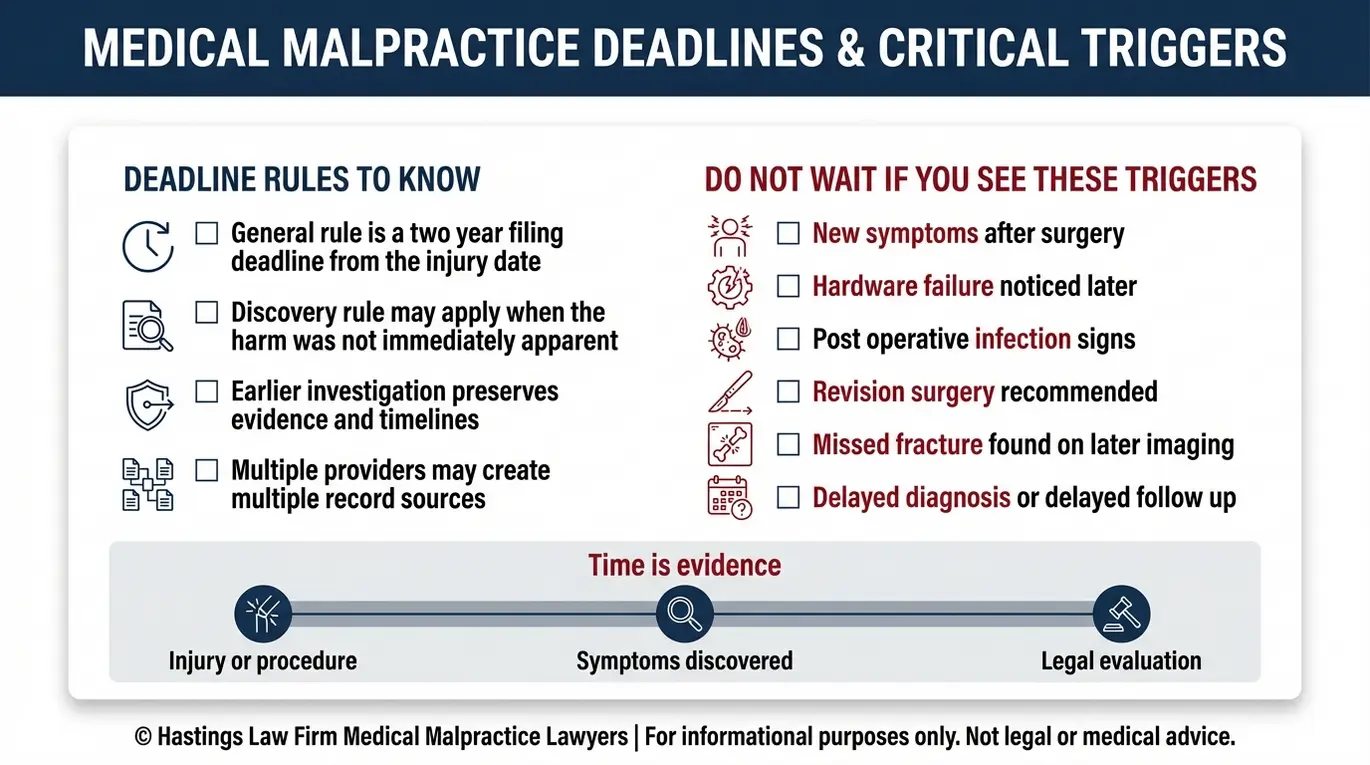
In Arizona, the standard statute of limitations for medical malpractice is two years from the date of the injury, though the “discovery rule” may extend this deadline if the error was not immediately apparent. This is the legal time limit for filing a lawsuit. Missing this deadline means losing the right to file a claim, regardless of how strong the evidence may be.
Under A.R.S. § 12-542, the two-year clock generally begins on the date the injury occurs. However, orthopedic cases often involve conditions that do not become apparent right away. A retained screw or a slowly loosening implant may not produce symptoms for months after the original procedure.
The discovery rule provides an important protection for patients. Under this rule, the statute of limitations may begin on the date the patient knew or reasonably should have known that the injury was caused by medical error. For an Arizona orthopedist malpractice lawyer, this distinction can be the difference between a viable case and one that is barred by time.
Do not wait to have your case evaluated. Even with the discovery rule, medical records can be lost, and memories fade. If you suspect your orthopedic surgeon made an error, contact our team as soon as possible to preserve your legal options.
Contact the Arizona Doctor Malpractice Attorneys at Hastings Law Firm Today for Help
If you believe an orthopedic surgeon’s error caused you or a loved one additional harm, Hastings Law Firm is here to help you find answers. Unlike general injury firms, we focus exclusively on medical malpractice. Our legal team includes former defense attorneys, nurse consultants, and board-certified patient advocates who understand how to identify where the standard of care was violated.
Your initial consultation is free and confidential. We will review your medical records, explain whether you have a viable claim, and walk you through your options. Because we work on a contingency fee basis, you pay no attorney fees or costs unless we recover compensation for you.
Contact an Arizona orthopedist malpractice lawyer at Hastings Law Firm today to schedule your risk-free case evaluation.
Frequently Asked Questions About Orthopedist Malpractice in Arizona


This content was researched and written by the Hastings Law Firm editorial team, which includes attorneys, medical professionals, and experienced researchers. Our writing is informed by internal knowledge and practical experience, and we cross-check critical details against authoritative sources cited throughout. Every piece undergoes human-led fact-checking and legal review. Because legal and medical information can change, if you spot an error, please contact us. Learn more about our content standards and review process on our editorial policy page.

Tommy Hastings, founder of Hastings Law Firm, is a board-certified personal injury trial lawyer dedicated exclusively to healthcare injury cases. Since 2001, he has represented injured patients and families in litigation against major hospital systems, pharmaceutical companies, and negligent healthcare providers nationwide. He has handled numerous high-profile cases that have drawn national media attention and resulted in multi-million dollar recoveries. He draws on that experience in his writing, helping readers understand how these cases work and what options may be available to them.
