


Arizona Ophthalmologist Malpractice Lawyer
Ophthalmologist malpractice can leave a person with lasting vision loss and major changes to daily life when an eye doctor fails to meet the accepted standard of care. Surgical mistakes, missed or delayed diagnosis, and medication errors can create preventable harm, and disputes often focus on whether the outcome was caused by negligence or an underlying condition. Accountability can also be complicated when care is shared between providers in co managed settings. If you or a loved one were harmed or worse due to ophthalmologist malpractice in Arizona, contact Hastings Law Firm for a free, confidential case review.
Last Updated: July 27, 2026
Trial-Ready Legal Representation for Victims of Eye Doctor Negligence
Losing your vision, or learning that a preventable medical error may have caused lasting damage to your sight, can feel overwhelming. You trusted a specialist with one of your most important senses, and now you may be left with more questions than answers. If you or a loved one has suffered a serious eye injury due to a doctor’s mistake, you deserve to know what happened and whether negligence was involved.
At Hastings Law Firm, we focus exclusively on medical malpractice. Founded by board-certified trial attorney Tommy Hastings, our firm works to hold eye care providers accountable when they fail their patients. Tommy is an elite trial lawyer and a member of the American Board of Trial Advocates, an invitation-only organization representing less than 1 percent of attorneys. Our team of attorneys, in-house nurses, and medical consultants understands the medicine behind these cases. As an experienced Arizona ophthalmologist malpractice lawyer, we can review your situation, explain your legal options, and help you take a clear next step forward.
Contact us for a free, confidential case evaluation. You pay nothing unless we recover for you.

Common Errors Committed by Arizona Eye Doctors and Surgeons
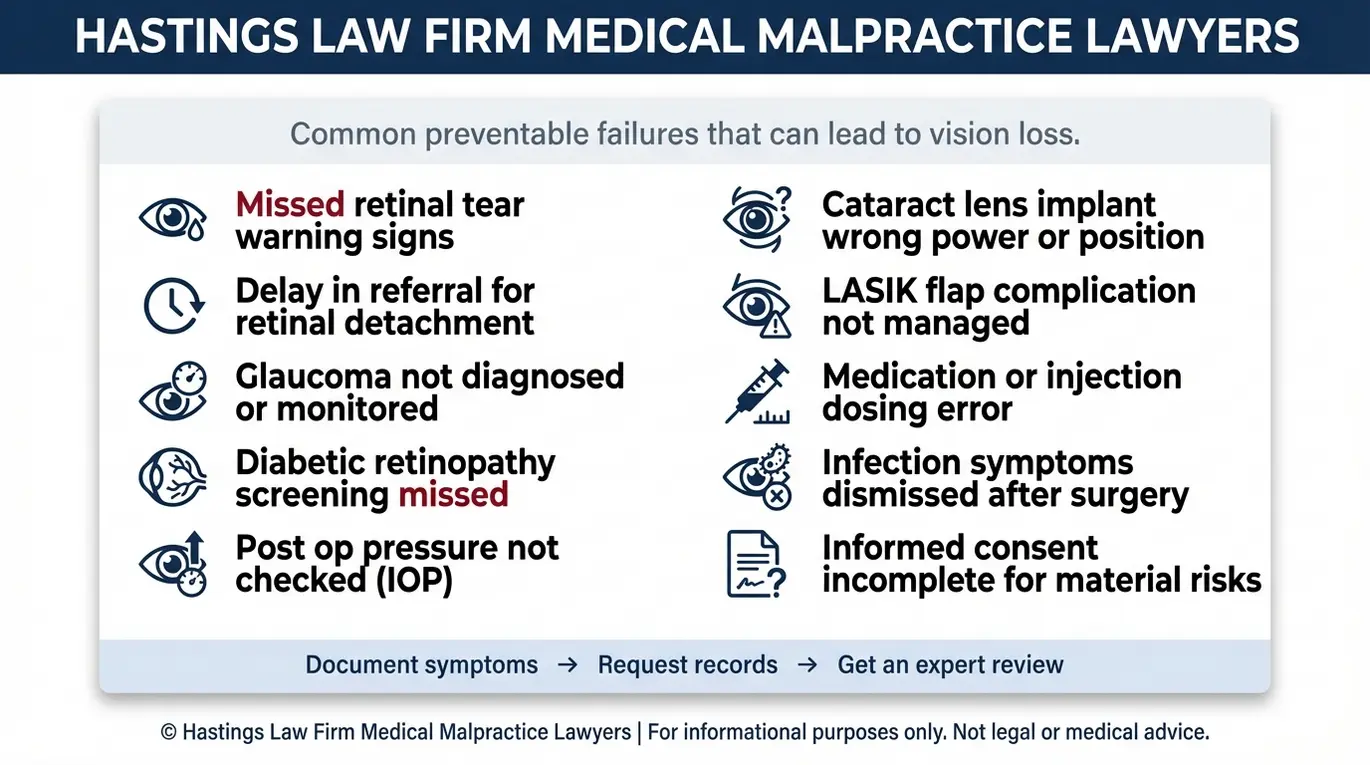
Ophthalmologist malpractice occurs when a vision specialist deviates from the accepted standard of care, resulting in preventable injury such as blindness, retinal detachment, or surgical complications. These errors generally fall into distinct categories. Understanding these types of medical error can help you recognize whether what happened to you or your loved one may have been avoidable.
Surgical Errors
Eye surgery demands extraordinary precision. Surgical errors in ophthalmology involve deviations from standard procedure during delicate eye operations. Even small deviations can result in permanent damage. Common surgical mistakes include:
- Cataract surgery complications: Cataract surgery, a procedure to remove a clouded natural lens and replace it with an artificial one, is one of the most frequently performed surgeries in the country. Errors can occur during intraocular lens (IOL) implantation, the process of inserting a synthetic replacement lens into the eye. Selecting the wrong lens power, improperly positioning the implant, or perforating the lens capsule can leave a patient with worsened vision or the need for additional corrective procedures.
- LASIK and laser eye surgery mistakes: Flap creation errors, overcorrection, undercorrection, or operating on patients who were not suitable candidates can lead to chronic dry eye, halos, or progressive vision loss.
- Retinal surgery failures: Delayed or improperly performed procedures to repair a retinal detachment, where the light-sensitive tissue separates from the back of the eye, can result in irreversible blindness.
Diagnostic Failures
Diagnostic errors happen when a specialist fails to identify a condition in time to prevent harm. According to the National Academies of Sciences, Engineering, and Medicine’s report on Improving Diagnosis in Health Care, diagnostic errors represent a significant and underrecognized source of patient harm across all medical specialties. In ophthalmology, missed or delayed diagnostic errors carry especially high stakes because many eye conditions progress quickly and silently. Examples include:
- Glaucoma: Failing to monitor intraocular pressure or recognize optic nerve changes can allow this condition to advance undetected until significant, permanent vision loss has occurred.
- Diabetic retinopathy: Patients with diabetes require regular retinal screenings. A failure to diagnose or track the progression of diabetic retinopathy can lead to preventable blindness.
- Macular degeneration: Delaying referral for treatment of wet macular degeneration, where every week matters, can mean the difference between preserving functional sight and losing it.
Medication Errors
Medication errors involve the improper use of drugs or improper administration techniques. Ophthalmologists frequently administer specialized medications, including intravitreal injections delivered directly into the eye. These treatments are often used for conditions like macular degeneration. Using incorrect dosages, contaminated compounds, or failing to monitor a patient’s intraocular pressure after treatment are all forms of potential negligence.
An experienced ophthalmologist malpractice attorney reviews the clinical records, imaging studies, and treatment timeline to determine whether your eye doctor met the standard expected of a competent specialist. If you suspect an error caused your vision loss, consulting with an eye doctor negligence lawyer can help you understand what went wrong.
Liability in LASIK and Co-Managed Care
LASIK procedures often involve a care model known as co-managed care, where an optometrist handles the initial screening and postoperative follow-up visits while an ophthalmologist performs the actual surgery. This split in responsibility can create gaps in accountability and challenge cases involving optometry malpractice.
If the optometrist clears a patient for surgery despite contraindications, or if important postoperative warning signs are missed during a follow-up visit, the question of who bears responsibility becomes more challenging. Informed consent for refractive surgery, meaning the process by which a doctor explains the risks, alternatives, and expected outcomes, may also be divided between providers. If neither provider gave you a full picture of the risks specific to your eyes, that breakdown in communication could be actionable. We examine the roles each provider played and identify where the duty of care was breached.
Proving Negligence and Overcoming Defense Tactics
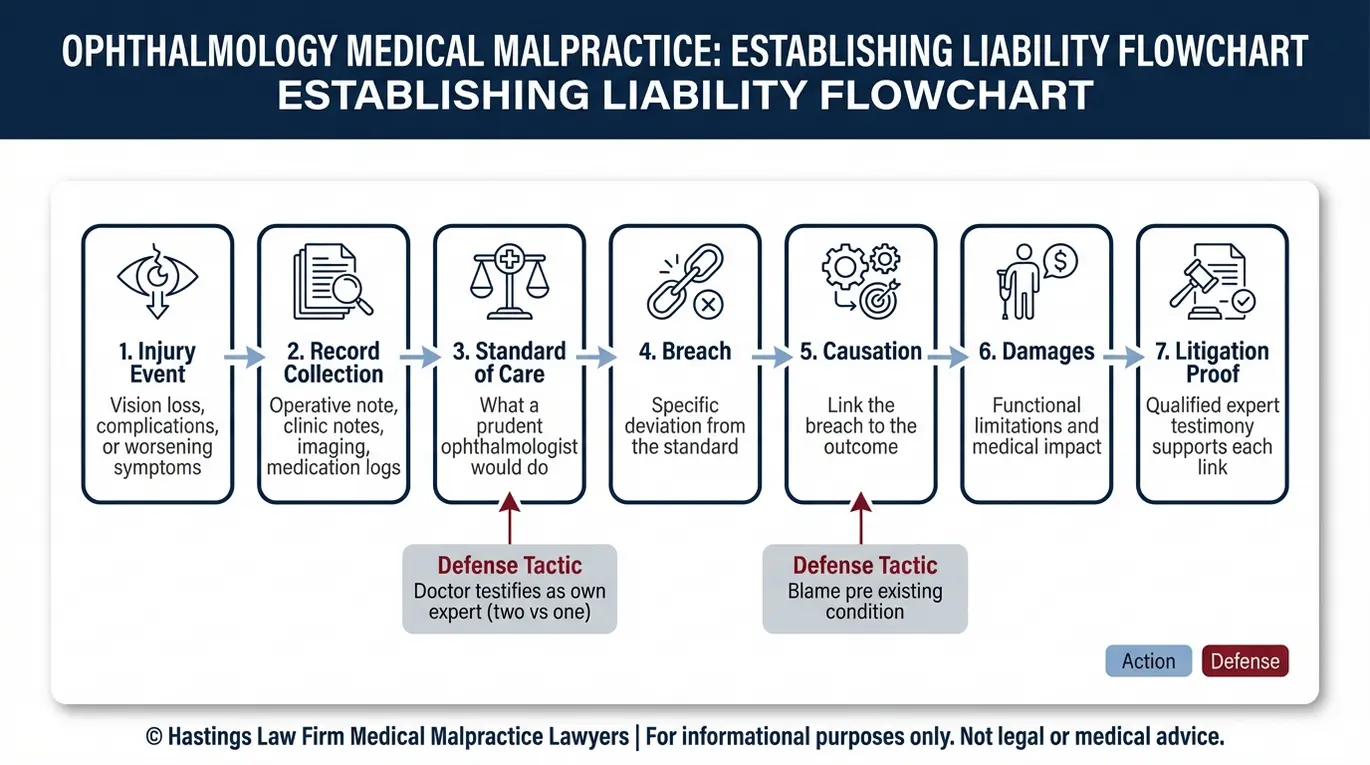
To prove negligence in an eye injury case, the patient must establish the standard of care, prove a breach of that duty, and directly link that breach to the vision loss through expert witness testimony. Each of these elements requires medical precision, not just legal skill.
Establishing the Standard of Care
The standard of care is the level of treatment a reasonably competent ophthalmologist would have provided under the same circumstances. This legal benchmark establishes the specific duty of care owed to the patient. When a provider fails to meet these obligations, it constitutes a breach of duty.
In practical terms, this means identifying what a qualified specialist should have done at each decision point. We look at whether they should have ordered an optical coherence tomography (OCT) scan. This is a high-resolution test used to examine retinal layers. We also evaluate whether they should have measured intraocular pressure (IOP), which is the fluid pressure inside the eye. Our review includes determining if they should have referred for emergency surgery or adjusted a treatment plan based on changing symptoms.
We work with board-certified ophthalmologists who can testify about what the standard required and where it was not met.
The “Two-vs-One” Problem
The defendant doctor often holds dual credibility as both the treating physician and their own expert. This dynamic occurs because the doctor acts as their own medical authority during a trial. This gives the defense an inherent advantage because jurors may be inclined to trust the specialist’s account of their own care. Local professionals are also often hesitant to testify against colleagues.
Our Strategy: We counter the defense’s inherent advantage by retaining unbiased professionals from outside Arizona. These independent ophthalmology experts can objectively evaluate the care and explain to a jury why the defendant’s conduct fell below the accepted standard, dismantling the “two-vs-one” dynamic.
A malpractice lawyer for eye injuries must be prepared to handle this advantage. At Hastings Law Firm, our team includes former defense attorneys and experienced hospital nurses who previously worked for the systems they now challenge. This allows us to anticipate defense tactics and identify charting inconsistencies. We retain independent ophthalmology experts who can objectively evaluate the care and clearly explain to a jury why the defendant’s conduct fell below the accepted standard.
Causation: Connecting the Error to the Injury
Causation analysis is used to determine if a specific medical error directly led to the patient’s harm. The defense will almost always argue that the patient’s vision loss was caused by the underlying disease, not the doctor’s actions. If a patient had pre-existing diabetes, for instance, the defense may claim that blindness was an inevitable consequence of diabetic retinopathy rather than a missed diagnosis.
Detailed medical reconstruction proves how the error led to the damage. In some instances, we may uncover discrepancies in the documentation. Altered records or retrospective notes added after a poor outcome can be important evidence of negligence. Our team meticulously audits the metadata of electronic health records to ensure the integrity of the evidence.
Our in-house nursing staff and outside experts build a clinical timeline showing when the condition could have been detected. We show what treatment should have been initiated and what the patient’s visual prognosis would have been with timely intervention. This causation analysis, supported by imaging records, lab results, and specialist consultations, is often the most contested part of the case.
The Arizona Supreme Court’s decision in Henke v. Hospital Development of West Phoenix clarifies how Arizona courts evaluate the standard of proof for causation in medical malpractice claims. An Arizona ophthalmology negligence attorney must understand these legal standards and how to apply them to the specific facts of your case.
The Role of Litigation Economics in Eye Injury Cases
Transparency matters to us. Eye malpractice cases require significant financial investment before they ever reach a courtroom. Qualified ophthalmology experts, medical record analysis, advanced imaging review, and life care planning all carry substantial costs. Because of these expenses, we must evaluate whether the injury is significant and permanent enough to justify the litigation economics required to pursue the case.
This does not mean smaller injuries do not matter. It means that the legal system, as it currently functions, makes it difficult to pursue cases where the damages are limited. During your free consultation, we will give you an honest assessment of whether your case is viable and explain why.
The Hastings Law Firm Difference
Results matter, but what truly sets us apart is how we achieve them. Every verdict, every settlement, and every Arizona courtroom victory comes from one guiding promise: To treat each client’s fight for justice as if it were our own.
This balance of skill, experience, and empathy reflects our core philosophy that justice should not only compensate the injured, but also make health care safer nationwide.

Compensation for Vision Loss and Blindness
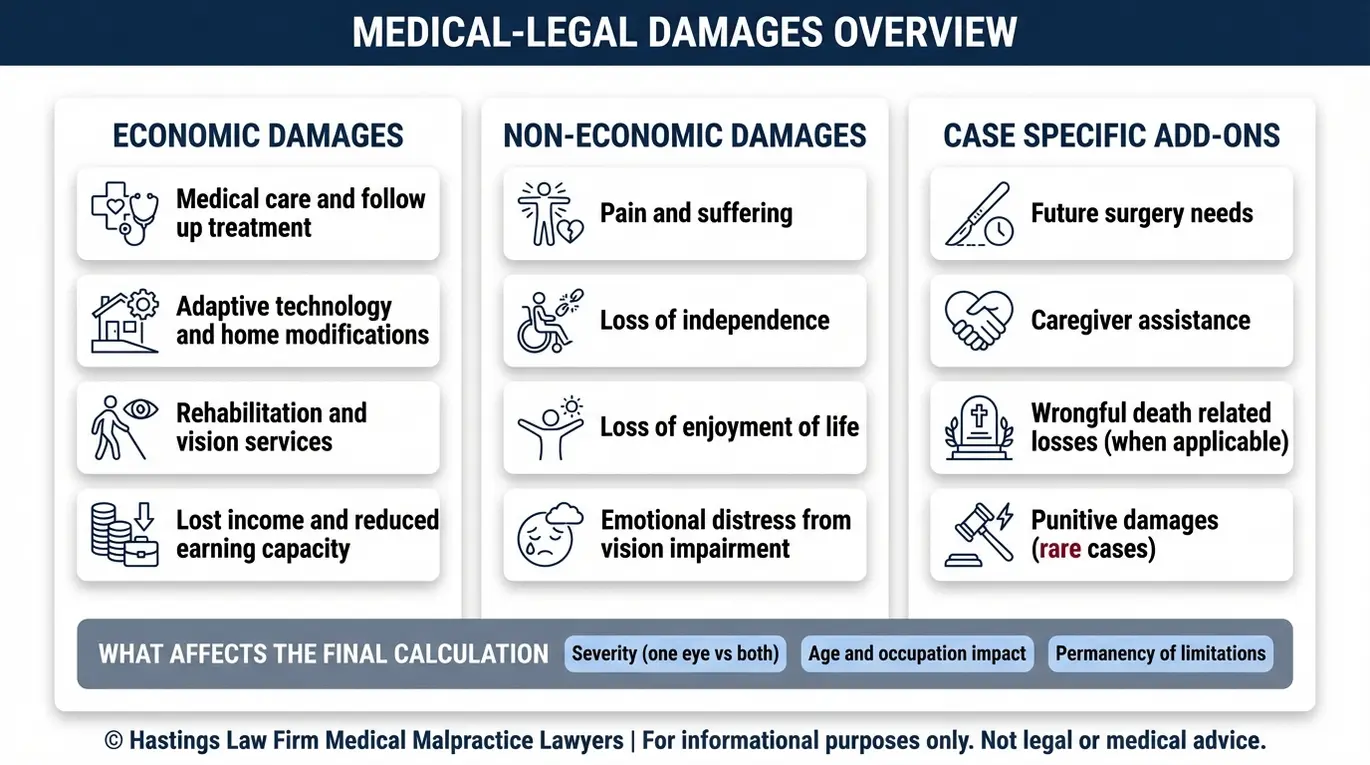
Victims of eye doctor negligence may recover economic damages for medical costs and lost career opportunities, as well as non-economic damages for the profound loss of sight and independence. The profound loss of sight affects nearly every aspect of daily life, and Arizona law recognizes that compensation should reflect the full scope of that impact.
Economic damages cover the measurable financial losses tied to the injury. These are the specific costs that can be calculated based on receipts and bills:
- Past and future medical bills, including corrective surgeries, ongoing treatment, and prescription costs
- Adaptive technology and equipment, such as screen readers, magnification devices, and mobility aids
- Low vision rehabilitation, the specialized therapy that helps patients relearn daily tasks with reduced sight
- Lost wages and diminished earning capacity. For patients whose careers depend on visual acuity, such as surgeons, pilots, or commercial drivers, an eye injury can end a professional life. We calculate not just current lost income, but the loss of future advancements, benefits, and retirement contributions.
Non-economic damages address the personal toll of vision loss:
- Pain and suffering related to the injury and ongoing treatment
- Loss of enjoyment of life. The psychological impact of vision loss is significant. Many patients experience depression, anxiety, and a loss of confidence when they can no longer drive, read, recognize faces, or experience visual moments with family.
- Emotional distress and loss of independence
In cases involving legal blindness, defined as visual acuity of 20/200 or worse in the better eye with correction, these non-economic damages can be substantial.
Punitive damages may be available in rare cases where the provider’s conduct was especially reckless or egregious. Under Arizona law, these are reserved for cases where the provider acted with conscious disregard for patient safety, such as operating under the influence or knowingly concealing a complication.
Wrongful death claims may arise when surgical anesthesia errors or other serious negligence leads to a patient’s death. Surviving family members can seek compensation for their loss, including funeral expenses, lost financial support, and the emotional devastation of losing a loved one.
A dedicated ophthalmology malpractice law firm understands how to document and present these damages so that the full picture of your loss is clear to a jury or during settlement discussions.
Contact the Arizona Doctor Malpractice Attorneys at Hastings Law Firm Today for Help
If you or someone you love has suffered vision loss or a serious eye injury because of a medical provider’s error, we are here to help you find answers. At Hastings Law Firm, every case begins with a free evaluation led by a Board Certified Patient Advocate who can review your medical records and help determine whether negligence may have occurred.
Our team of attorneys, in-house nurses, and medical consultants focuses exclusively on medical malpractice. We prepare every case as if it will go to trial, and that preparation gives us the ability to negotiate from a position of strength. As your Arizona ophthalmologist malpractice lawyer, we handle the legal and medical details so you can focus on your health and your family.
There is no fee unless we win. Contact us today for a confidential, risk-free consultation.
Frequently Asked Questions About Ophthalmologist Malpractice in Arizona


This content was researched and written by the Hastings Law Firm editorial team, which includes attorneys, medical professionals, and experienced researchers. Our writing is informed by internal knowledge and practical experience, and we cross-check critical details against authoritative sources cited throughout. Every piece undergoes human-led fact-checking and legal review. Because legal and medical information can change, if you spot an error, please contact us. Learn more about our content standards and review process on our editorial policy page.

Tommy Hastings, founder of Hastings Law Firm, is a board-certified personal injury trial lawyer dedicated exclusively to healthcare injury cases. Since 2001, he has represented injured patients and families in litigation against major hospital systems, pharmaceutical companies, and negligent healthcare providers nationwide. He has handled numerous high-profile cases that have drawn national media attention and resulted in multi-million dollar recoveries. He draws on that experience in his writing, helping readers understand how these cases work and what options may be available to them.
