


Arizona Nursing Home Sexual Abuse Lawyer
Sexual abuse in a nursing home can leave an older adult with physical injuries, lasting emotional trauma, and a deep loss of dignity and safety. Warning signs may show up as unexplained injuries or sudden changes in behavior, and some residents cannot clearly report what happened due to cognitive impairment. Families often face resistance or minimization from facilities, which can delay protection and accountability. Clear documentation and prompt reporting can matter when concerns arise. If you or a loved one were harmed or worse due to nursing home sexual abuse in Arizona, contact Hastings Law Firm for a free, confidential case review.

Last Updated: July 27, 2026
Trusted Legal Representation for Elderly Sexual Abuse in Arizona
Learning that a loved one may have been sexually abused in a nursing home is one of the most devastating experiences a family can face. The people and institutions you trusted to provide safety and dignity failed in the most fundamental way. If you suspect that your family member has been harmed, you are not wrong for questioning what happened, and you are not alone in seeking answers.
At Hastings Law Firm, our team of attorneys, in-house nurses, and patient advocates focuses exclusively on holding negligent medical facilities accountable. Our founder, Tommy Hastings, is a board-certified trial attorney who has dedicated his career to representing families betrayed by the medical system. As your Arizona Nursing Home Sexual Abuse Lawyer, we prepare every case from day one as though it will go before a jury. This level of preparation is what it takes to uncover the truth and pursue the compensation your family deserves.
If you believe abuse has occurred, we are here to listen. Contact us for a free, confidential case evaluation to understand your options.

Identifying the Warning Signs of Sexual Abuse in the Elderly
Sexual abuse in nursing homes often presents through unexplained physical trauma such as bruising on inner thighs or genitals, torn undergarments, or the contraction of sexually transmitted diseases. Behavioral changes, including sudden withdrawal, fear of specific staff members, or regression to infantile behaviors, are also critical indicators. Recognizing these signs early is essential, because many facilities will minimize or dismiss them entirely.
Physical Warning Signs
Some of the most telling evidence of sexual abuse is physical. Anogenital trauma, meaning injuries to the genital or anal area, may include bruising, tearing, or unexplained bleeding. Residents may suddenly have difficulty walking or sitting, or they may develop sexually transmitted infections (STIs/STDs), infections passed from person to person through sexual contact, that have no other medical explanation.
Facilities sometimes document these injuries as the result of routine falls or incontinence care. That is why having the right medical professionals review the records matters. Our in-house nursing team is trained to identify injuries that do not match the explanations provided in facility charts.
Behavioral Red Flags
Physical evidence is not always present, especially if time has passed. Behavioral signs can be just as significant. Residents with dementia or Alzheimer’s disease may not be able to verbalize what happened. Instead, they may become suddenly non-verbal, refuse hygiene care, flinch at the touch of certain caregivers, or exhibit signs of severe agitation or fear.
The Elder Abuse First Responder Checklist published by the Wisconsin Department of Health Services outlines many of the physical and behavioral indicators that trained responders look for when abuse is suspected. Families should be aware of these same signs.
Red Flag Checklist:
- Unexplained bruising, especially on inner thighs, breasts, or genitals
- Torn, stained, or bloody undergarments or bedding
- New or unexplained sexually transmitted infections
- Difficulty walking or sitting without a documented medical cause
- Sudden fear or agitation around a specific staff member
- Withdrawal from social activities or refusal to be alone with caregivers
- New onset of nightmares, sleep disturbances, or crying episodes
- Regression to infantile behaviors such as rocking or thumb-sucking
If you notice any combination of these signs, consulting a lawyer for nursing home sexual abuse can help you determine whether a formal investigation is warranted.

Immediate Steps Families Must Take if Abuse is Suspected
If sexual abuse is suspected, immediate action is required to preserve evidence and ensure safety. Families should call 911 immediately if the danger is active, demand a transfer to a hospital for a forensic exam, and report the incident to Arizona Adult Protective Services (APS). Following these protocols helps protect the legal rights of patients in elder care facilities.
Step 1: Contact Law Enforcement
Call 911 or your local police department. An official police report creates a documented record of the suspected abuse and can trigger a formal criminal investigation. Under A.R.S. § 13-1401, Arizona law defines sexual abuse and assault in specific terms, and law enforcement is trained to investigate these allegations in institutional settings.
Step 2: Request a Forensic Medical Examination
Ask that your loved one be transported to a hospital for a forensic sexual assault exam, a thorough medical evaluation used to collect evidence after a suspected assault. This exam should be conducted by a Sexual Assault Nurse Examiner (SANE), a nurse with specialized training in collecting and preserving DNA and physical evidence from sexual assault cases. Do not allow the facility to discourage this step. Even if hours or days have passed, medical evidence may still be recoverable.
The Southern Arizona Center Against Sexual Assault (SACASA) provides detailed information on what families can expect during a medical forensic exam.
Step 3: Document and Preserve Physical Evidence
If possible, photograph any visible injuries before they are treated. Preserve unwashed clothing, bedding, or any personal items that may contain biological evidence. Do not allow the facility to launder or dispose of these materials.
Step 4: Report to Adult Protective Services
File a report with Arizona APS. This creates a parallel investigation that can support your legal case.
Step 5: Contact an Arizona Nursing Home Sexual Abuse Lawyer
An attorney experienced in these cases can begin preserving facility records, surveillance footage, staffing logs, and employee files before the facility has an opportunity to alter or destroy them. Early legal involvement protects the integrity of your case.

The Hastings Law Firm Difference
Results matter, but what truly sets us apart is how we achieve them. Every verdict, every settlement, and every Arizona courtroom victory comes from one guiding promise: To treat each client’s fight for justice as if it were our own.
This balance of skill, experience, and empathy reflects our core philosophy that justice should not only compensate the injured, but also make health care safer nationwide.

Liability in Nursing Home Sexual Abuse Cases
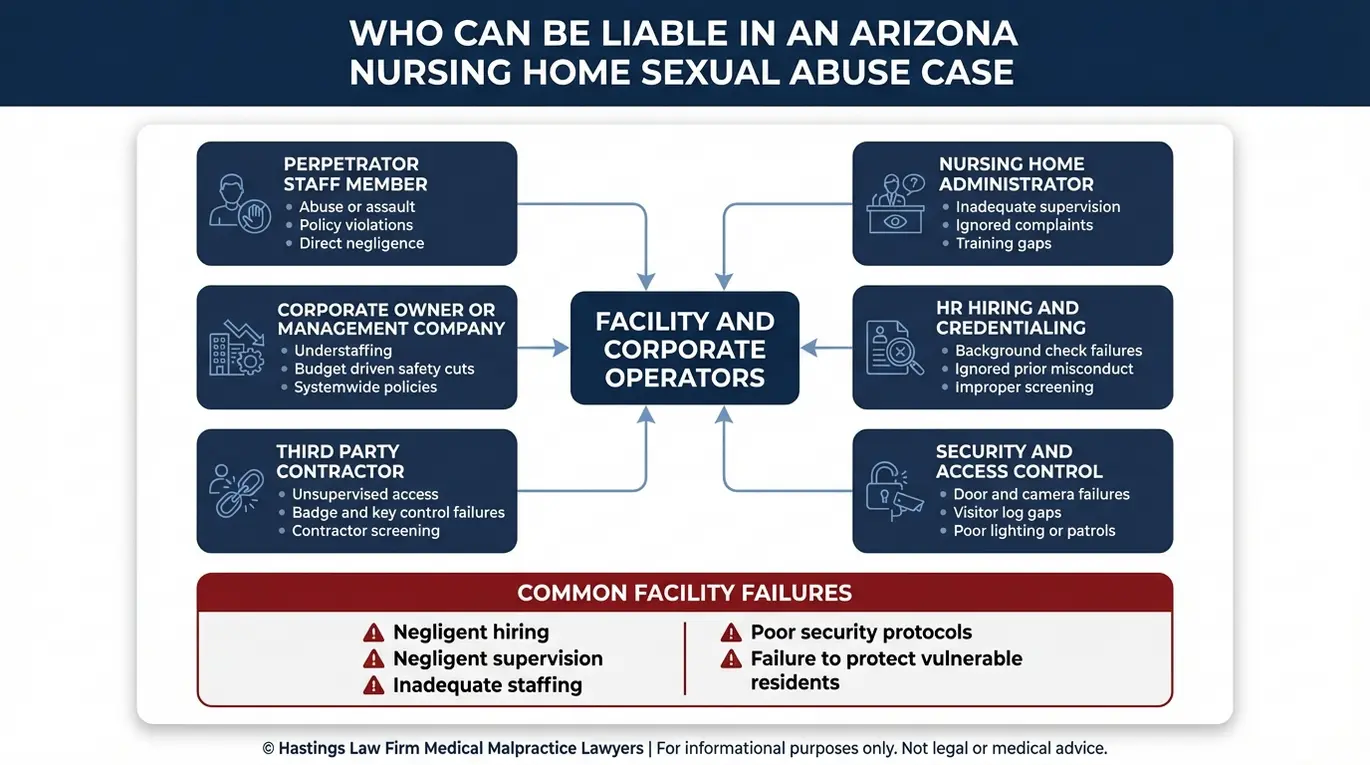
Liability often extends beyond the perpetrator to the facility itself for failing to protect the resident. Nursing homes may be held liable for negligent hiring (failing background checks), understaffing that leaves residents vulnerable, or inadequate security protocols that allow unauthorized access. Through the principle of vicarious liability, the facility is accountable for the actions of its employees and the environment it creates.
Negligent Hiring and Background Check Failures
Facilities have a legal duty to screen employees before granting them access to residents. When a nursing home fails to conduct proper background checks, or hires a staff member with a known history of sexual offenses, it can be held directly responsible for any resulting harm. Arizona sexual abuse attorneys investigate hiring records, personnel files, and prior disciplinary actions to determine whether the facility ignored red flags.
Understaffing and Supervision Gaps
Understaffing, meaning a facility operates with fewer caregivers than needed to safely monitor its residents, creates conditions where abuse can go undetected. When hallways are unmonitored, rooms are left unchecked, and call lights go unanswered, residents are left exposed. The CMS Five-Star Quality Rating System, maintained by the Centers for Medicare & Medicaid Services, publicly rates nursing homes on staffing levels and quality measures. Low ratings in staffing can be relevant evidence in a negligence claim.
Third-Party Contractor Access
Abuse does not always come from direct care staff. Facilities also bear responsibility for contractors, such as janitorial, maintenance, or food service workers, who may have unsupervised access to resident areas. If a facility failed to vet or supervise a third-party worker, it can share in the liability.
| Liable Party | Basis for Liability | Evidence We Examine |
|---|---|---|
| Direct care staff | Assault committed during care duties | Shift logs, incident reports, prior complaints |
| Nursing home facility | Negligent hiring, understaffing, or security failures | Background check records, staffing ratios, CMS reports |
| Third-party contractors | Unsupervised access without adequate screening | Vendor contracts, access logs, background check policies |
| Corporate ownership groups | Systemic cost-cutting affecting resident safety | Budget records, corporate staffing mandates, inspection histories |
Understanding Capacity and Consent in Elder Care
Under Arizona law, a resident is considered unable to consent if they suffer from cognitive impairments such as Alzheimer’s or dementia that prevent them from understanding the nature of sexual acts. Any sexual contact with a resident lacking capacity is legally considered abuse/assault, regardless of implied acquiescence. These cases often hinge on whether the patient could legally agree to the encounter.
Capacity to consent, the legal and cognitive ability to understand and voluntarily agree to sexual activity, is the central issue in these cases. Defense attorneys often try to argue that a sexual encounter was consensual. A lawyer specializing in elder sexual assault works with medical experts in neurology and geriatric psychiatry to demonstrate that the resident’s cognitive decline made meaningful consent impossible. Medical records, cognitive assessments, and testimony from treating physicians all become critical in establishing the resident’s true mental state. Family members holding power of attorney or legal guardianship should be consulted to verify the resident’s legal status and history.
The facility’s responsibility does not end with its own staff. When a resident with a documented history of sexual aggression or sexual disinhibition, a loss of impulse control that can accompany certain types of brain injury or dementia, is housed near vulnerable peers, the facility has a duty to implement safeguards.
Resident on Resident Sexual Abuse
Facilities are required to assess each resident’s behavioral risks and develop individualized care plans. If a known aggressor is allowed contact with others, the facility must take steps to monitor, redirect, and physically separate that individual from potential targets. When a nursing home fails to act on documented behavioral patterns, it can be held liable for the resulting harm. We investigate for care plan failure and lack of supervision to determine whether the facility met its duty of care.
Arizona Laws Protecting Vulnerable Adults from Sexual Assault
Arizona Revised Statutes (A.R.S.) § 46-454 mandates that medical professionals, social workers, and care facility staff report any reasonable suspicion of abuse to APS or law enforcement immediately. Failure to report is a crime and creates civil liability for the facility. These requirements ensure that suspected cases are documented and investigated by the proper authorities.
Adult Protective Services (APS), a state agency that investigates reports of abuse, neglect, and exploitation of vulnerable adults, works alongside law enforcement to verify claims. Under the Adult Protective Services Act, mandatory reporting is a strict requirement for all caregivers. Failure to meet these obligations constitutes standard of care violations that can strengthen a civil claim.
Under A.R.S. § 13-3623, abuse of a vulnerable adult is a felony in Arizona. Criminal vs. civil proceedings serve different purposes; criminal cases punish the offender, while civil cases compensate the patient. Even if the state declines to press criminal charges, families can still file a civil claim to recover damages. Criminal cases require proof beyond a reasonable doubt, while civil cases use a lower standard of preponderance of the evidence, meaning it is more likely than not that the abuse occurred.
Arizona residents in long-term care facilities are also entitled to protections under federal and state regulations. Key rights include:
- The right to be free from physical, sexual, and verbal abuse
- The right to privacy and dignity in all aspects of care
- The right to file grievances without retaliation
- The right to have complaints investigated by the state
The Long-Term Care Ombudsman, an independent advocate who investigates complaints about care facilities, is another resource for families. The Arizona Ombudsman Citizens’ Aide office provides information on how to file complaints and what to expect from the investigation process. An Arizona Nursing Home Sexual Abuse Lawyer can coordinate with both APS and the Ombudsman to ensure that every available avenue of accountability is pursued.
Compensation for Victims of Institutional Sexual Abuse
Patients and their families may recover economic damages for medical treatment and therapy, as well as non-economic damages for pain, suffering, emotional distress, and loss of dignity. In cases of egregious negligence, punitive damages may be awarded to punish the facility. These legal claims help families cover the high costs of trauma care and future safety needs.
Economic Damages
These cover the measurable financial costs resulting from the abuse:
- Medical expenses for treating physical injuries
- Therapy costs for ongoing psychological counseling
- Relocation costs to move the resident to a safer facility
- Any additional care needs resulting from the trauma
Non-Economic Damages
Sexual abuse inflicts harm that goes far beyond medical bills. Non-economic damages account for:
- Physical pain and suffering
- Emotional distress, anxiety, and depression
- Loss of dignity and sense of personal security
- Diminished quality of life and social withdrawal
Calculating these damages requires experience and sensitivity. A nursing home abuse attorney works with medical experts, psychologists, and life care planners to present a clear picture of the full impact on the resident’s well-being. Families often underestimate the financial toll of such trauma. Securing full compensation ensures high-quality future care.
Punitive Damages
When a facility’s conduct is especially reckless, such as knowingly retaining an employee with a history of sexual misconduct or systematically ignoring abuse complaints, Arizona courts may award punitive damages. These awards are not tied to the resident’s losses but are intended to hold the facility accountable and send a message that this level of negligence will not be tolerated.
Contact the Arizona Nursing Home Attorneys at Hastings Law Firm Today for Help
Sexual abuse in a nursing home demands a legal response that is both compassionate and thorough. At Hastings Law Firm, we dedicate our full resources to exposing what happened and holding negligent facilities accountable. Our team includes former defense attorneys who understand how institutions protect themselves, and in-house medical professionals who know how to read between the lines of facility records.
We operate on a contingency fee basis, which means there is no cost to you unless we secure a recovery. Your family has already endured enough. Let us carry the legal burden from here.
Contact an Arizona Nursing Home Sexual Abuse Lawyer at Hastings Law Firm today for a free, confidential case evaluation. We are ready to listen, investigate, and help you take the next step toward answers and accountability.
Frequently Asked Questions About Nursing Home Sexual Abuse in Arizona


This content was researched and written by the Hastings Law Firm editorial team, which includes attorneys, medical professionals, and experienced researchers. Our writing is informed by internal knowledge and practical experience, and we cross-check critical details against authoritative sources cited throughout. Every piece undergoes human-led fact-checking and legal review. Because legal and medical information can change, if you spot an error, please contact us. Learn more about our content standards and review process on our editorial policy page.

Tommy Hastings, founder of Hastings Law Firm, is a board-certified personal injury trial lawyer dedicated exclusively to healthcare injury cases. Since 2001, he has represented injured patients and families in litigation against major hospital systems, pharmaceutical companies, and negligent healthcare providers nationwide. He has handled numerous high-profile cases that have drawn national media attention and resulted in multi-million dollar recoveries. He draws on that experience in his writing, helping readers understand how these cases work and what options may be available to them.
