


Arizona Nursing Home Choking Lawyer
Nursing home choking and aspiration incidents can leave families reeling and searching for clear answers about how a trusted facility allowed a preventable emergency to happen. The underlying issues often involve missed swallowing risks, ignored diet orders, inadequate mealtime supervision, and breakdowns in a resident care plan. These failures can lead to severe injury, serious lung infection, sepsis, or fatal outcomes, along with lasting emotional harm for families. If your loved one was harmed or worse due to nursing home choking and aspiration negligence in Phoenix, Arizona, contact Hastings Law Firm for a free, confidential case review.

Last Updated: July 27, 2026
Compassionate Arizona Injury Attorneys for Nursing Home Choking and Aspiration Claims
When a loved one chokes or develops a serious lung infection in a nursing home, the shock is immediate, and so are the questions. You trusted a facility to provide safe, attentive care. Now you need to understand what went wrong and whether the people responsible can be held accountable.
These cases demand a legal team that understands both the medicine and the law behind choking and aspiration injuries in care facilities. At Hastings Law Firm, our attorneys work alongside in-house nurse consultants and Board Certified Patient Advocates to investigate exactly what happened, who failed in their duties, and how to build a case that reflects the full scope of the harm your family has suffered.
Our founder, Tommy Hastings, is board-certified in personal injury trial law by the Texas Board of Legal Specialization, a distinction held by fewer than 2% of attorneys in that state. If you believe a nursing home’s negligence led to a choking injury or death, an experienced Arizona Nursing Home Choking Lawyer at our firm can review the facts and explain your legal options. The consultation is free, and you pay no fees unless we recover compensation on your behalf.

Why Choking and Aspiration Injuries Occur in Arizona Care Facilities
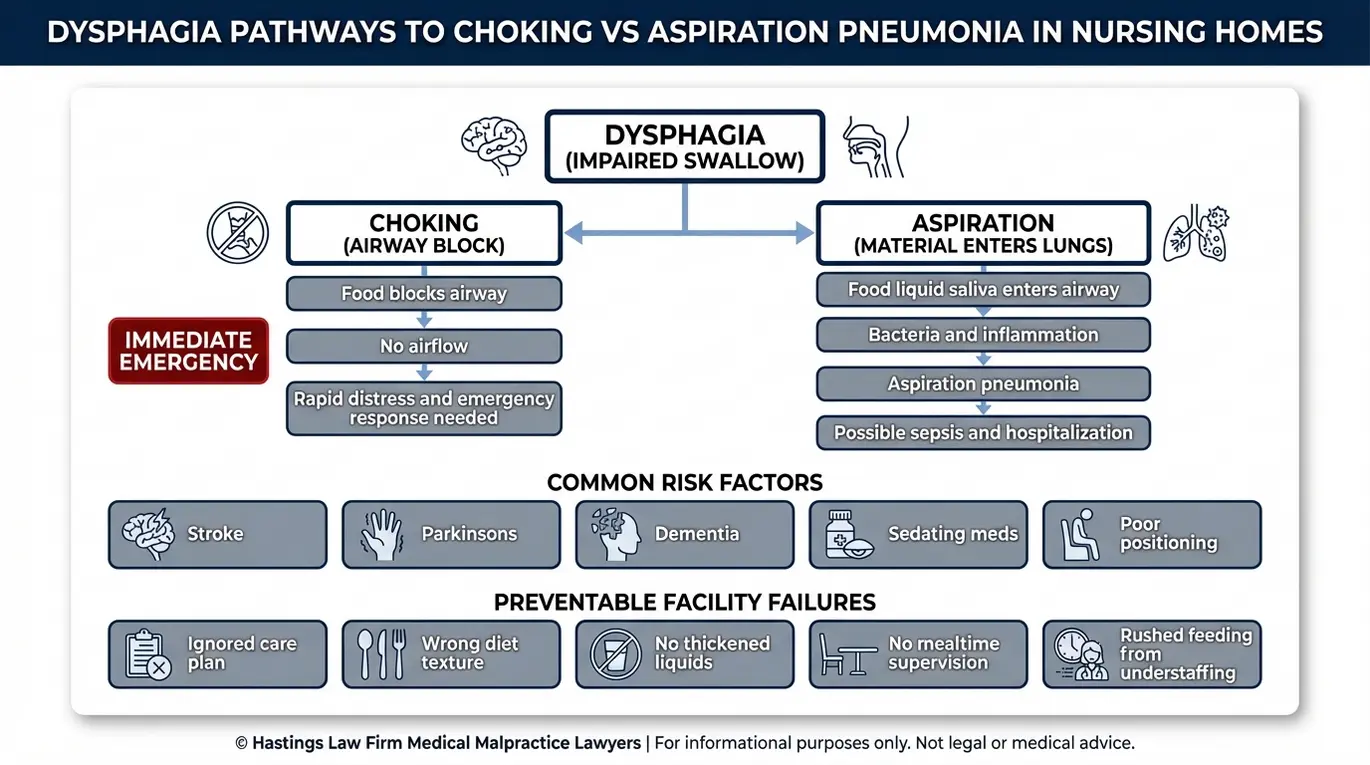
Choking and aspiration injuries in nursing homes typically result from a failure to follow physician-ordered dietary restrictions, inadequate staffing levels during meals, or a lack of supervision for residents with known swallowing difficulties (dysphagia). These incidents are rarely true accidents. In most cases, they trace back to breakdowns in the resident’s plan of care.
The role of dysphagia. Dysphagia, a medical term for difficulty swallowing, is common among elderly nursing home residents. Conditions like stroke, Parkinson’s disease, Alzheimer’s disease, and other forms of dementia and cognitive impairment can weaken the muscles and reflexes that control swallowing. These neurological deficits disrupt the coordinated muscle movements required to protect the airway.
Research published on dysphagia in neurological disorders (PubMed) confirms that neurological conditions are among the leading causes of swallowing dysfunction in older adults. When a facility knows a resident has dysphagia but fails to adjust their care accordingly, the risk of a choking event rises dramatically.
Staffing failures at mealtime. Understaffing is one of the most persistent problems in Arizona care facilities. Residents who need feeding assistance, meaning hands-on help with eating, proper positioning, or monitoring during meals, may be left unattended or rushed through their food. When staff are overworked, they may attempt to feed too many residents simultaneously, a dangerous practice known as “cluster feeding” that prevents them from noticing subtle signs of distress.
A single aide responsible for feeding multiple residents at once cannot provide the level of mealtime supervision these individuals require. When staff are stretched too thin, residents with swallowing problems are placed in danger.
Breakdowns in the care plan. Every resident with a known swallowing difficulty should have an individualized care plan that spells out dietary texture, liquid consistency, positioning, and supervision requirements. When that plan is ignored, outdated, or never created in the first place, a lawyer for aspiration negligence can often trace the resulting injury directly to the facility’s systemic negligence.
High-risk factors that may signal negligence:
- Resident has a documented diagnosis of dysphagia, stroke, or dementia
- No swallowing evaluation was performed after a change in condition
- Feeding assistance was ordered but not consistently provided
- Staffing logs show inadequate aide-to-resident ratios during meals
- The care plan does not reflect current physician orders for diet or supervision
Aspiration Pneumonia: A Silent but Deadly Consequence
Aspiration pneumonia is a serious and potentially fatal lung infection caused by inhaled food, liquid, or bacteria-laden saliva reaching the lungs. It occurs when food particles or liquids silently enter the lungs instead of blocking the airway.
This condition can develop over hours or days, making it harder to detect than an acute choking event. Poor oral hygiene compounds the risk significantly. When staff neglect routine oral care, harmful bacteria accumulate in the mouth.
If a resident then aspirates even small amounts of saliva, those bacteria can seed a severe infection that leads to sepsis and death. For families investigating a loved one’s decline, an Arizona nursing home negligence lawyer can help determine whether aspiration pneumonia was the result of preventable failures in care.
Common Causes of Choking and Suffocation in Elderly Residents
The most common causes of choking in nursing homes involve providing solid foods to residents on restricted diets, failure to thicken liquids to the proper consistency according to IDDSI standards, bedrail entrapment, and negligent positioning of residents during feeding. A choking negligence lawyer often sees cases where kitchen staff send the wrong meal tray to a resident, leading to immediate harm.
Dietary mix-ups. One of the most preventable errors occurs when kitchen staff send the wrong meal tray to a resident. A resident whose physician ordered a pureed diet, food that has been blended to a smooth, uniform consistency, may receive solid foods like meat or raw vegetables that they physically cannot chew or swallow safely. These errors can be traced back to poor communication between nursing, dietary, and medical staff.
Liquid consistency failures. Many residents with dysphagia require thickened liquids because thin water or juice moves too quickly and can slip into the airway before the swallowing reflex activates. The International Dysphagia Diet Standardisation Initiative (IDDSI) framework, a globally recognized system that classifies food textures and liquid thickness on a scale from 0 to 7, gives care teams a standardized language for diet orders. When staff fail to use thickening agents or prepare liquids at the wrong IDDSI level, the resident faces a direct aspiration risk, the danger of inhaling food or liquid into the airway.
| IDDSI Level | Liquid Consistency | Description |
|---|---|---|
| 0 | Thin | Regular water, juice, coffee |
| 1 | Slightly Thick | Thicker than water but flows quickly |
| 2 | Mildly Thick | Flows off a spoon slowly |
| 3 | Moderately Thick | Smooth, pourable, does not hold shape |
| 4 | Extremely Thick | Holds its shape on a spoon, cannot be poured |
Bedrail entrapment. Choking and suffocation are not limited to mealtime. Bedrail entrapment, where a resident becomes wedged between the mattress and the side rail of the bed, is a known suffocation hazard. Residents with cognitive impairment or limited mobility are especially vulnerable if rails are improperly sized, poorly maintained, or used without adequate monitoring.
The Link Between Oral Hygiene and Aspiration
Oral hygiene, or oral care, the practice of keeping the mouth clean to prevent disease, is directly tied to aspiration risk. When staff neglect brushing, mouth swabbing, or denture cleaning, the bacterial load in a resident’s mouth increases significantly. Even micro-aspirations of this bacteria-heavy saliva can seed dangerous lung infections. Consistent oral care is a basic but essential layer of pneumonia prevention, and a Phoenix nursing home abuse attorney can cite its absence as strong evidence of systemic neglect.
The Hastings Law Firm Difference
Results matter, but what truly sets us apart is how we achieve them. Every verdict, every settlement, and every Arizona courtroom victory comes from one guiding promise: To treat each client’s fight for justice as if it were our own.
This balance of skill, experience, and empathy reflects our core philosophy that justice should not only compensate the injured, but also make health care safer nationwide.

Liable Parties in Arizona Nursing Home Choking Lawsuits
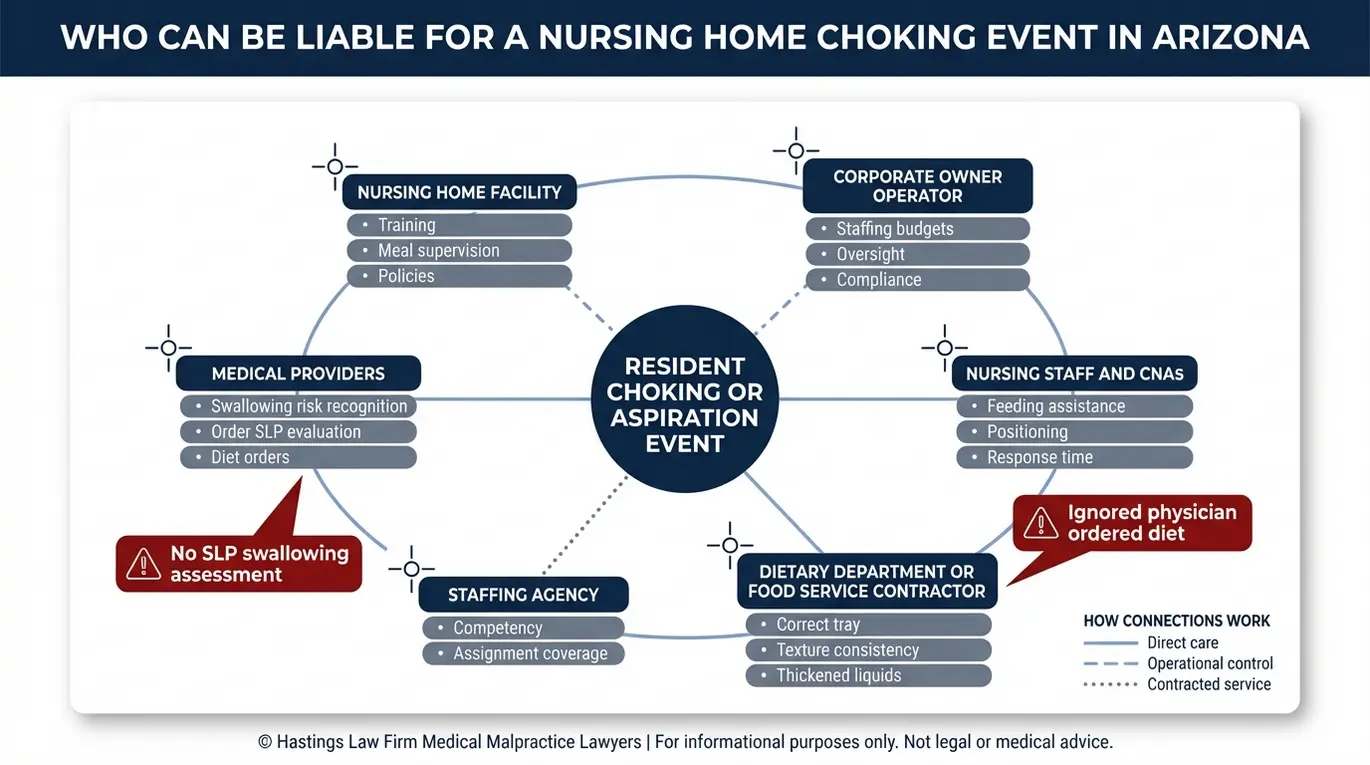
Liability in these cases can extend well beyond the facility itself to include corporate operators, third-party dietary contractors, staffing agencies, and individual medical providers who failed to assess or manage swallowing risks. In the process of suing a nursing home for choking, we identify every responsible entity involved in the resident’s care.
A choking negligence lawyer investigates each link in the chain of responsibility. In many nursing homes, daily operations are divided among multiple entities, each with distinct legal obligations to the resident.
Potential defendants in a choking or aspiration case:
- The facility or its corporate owner for systemic issues like understaffing, inadequate training, or failure to implement proper dietary protocols. Corporate entities often implement deep budget cuts that directly reduce the number of aides available to assist with meals.
- Nursing staff for failure to supervise meals, position residents correctly, or follow the care plan.
- Dietary and kitchen staff for preparing food or liquids at incorrect consistencies.
- Attending physicians or nurse practitioners for failing to order a swallowing assessment when signs of dysphagia first appeared.
- Speech-language pathologists (SLPs), the specialists trained to evaluate and treat swallowing disorders, if their assessment was negligent or their recommendations were ignored. These professionals are responsible for prescribing the exact food textures and liquid viscosities necessary to prevent aspiration.
- Third-party staffing agencies that supplied undertrained or insufficient personnel.
A swallowing assessment, a clinical evaluation often performed by an SLP that determines how safely a resident can eat and drink, must be requested whenever a resident shows signs of coughing during meals, pocketing food, or losing weight. Failure to do so may constitute a breach of the standard of care.
At Hastings Law Firm, our team includes former defense attorneys who previously worked for the hospital systems they now challenge. An Arizona elder abuse lawyer will identify every responsible entity early so that no one escapes accountability.
How We Prove Negligence in Choking and Wrongful Death Cases
Proving negligence requires securing the resident’s care plan, dietary orders, staffing logs, and surveillance footage to demonstrate a clear deviation from the standard of care established by Arizona and federal regulations. Our investigation starts by reconstructing a detailed timeline of the events leading up to the injury or death. When investigating nursing home death cases, we start by reconstructing a detailed timeline of the events leading up to the injury.
Building the paper trail. The core of every choking lawsuit is the comparison between physician orders and the care actually provided. This includes orders for a pureed diet (food blended to a smooth consistency) or thickened liquids (fluids with added consistency to prevent aspiration).
We obtain and cross-reference medical records, kitchen preparation logs, meal delivery documentation, and, in fatal cases, the autopsy report. Gaps or inconsistencies in this paper trail often reveal where the standard of care was violated.
State inspection reports. The Arizona Department of Health Services Statement of Deficiencies search page provides public access to past inspection citations against licensed facilities. Prior citations for dietary errors, staffing shortages, or supervision failures can establish a pattern of systemic neglect, which strengthens the negligence claim and may support punitive damages.
Surveillance and witness evidence. Dining room or hallway camera footage can show whether staff were present during a choking event, how quickly they responded, and whether proper emergency protocols were followed. This evidence can disappear quickly. Securing choking lawsuit evidence like video footage is one of the first steps we take after being contacted by a family.
We also interview roommates and former employees who may have witnessed the facility’s habitual understaffing or specific neglectful practices.
Evidence we work to secure in every investigation:
- Physician-ordered diet and liquid consistency instructions
- The resident’s individualized care plan and any updates
- Staffing schedules and aide assignment logs for the date of the incident
- Kitchen preparation records and meal tray tracking
- Incident reports filed by the facility
- Surveillance footage from dining areas, hallways, and common rooms
- Witness statements from staff, other residents, and visiting family members
- Prior state inspection deficiency reports
- Expert medical testimony linking the care failures to the injury or death
Our Arizona wrongful death attorneys and in-house medical staff work together to analyze these records and state and federal regulations (including CMS guidelines) to retain qualified experts who can testify about exactly where the facility’s care fell below the accepted standard. Internal facility reports often contain admissions of error that are not documented in the medical chart, making them essential pieces of evidence.

Compensation for Choking-Related Harm in Arizona
Families may recover economic damages for medical bills and funeral costs, as well as non-economic damages for the resident’s pain and suffering and the family’s loss of companionship and guidance.
Conscious pain and suffering. Choking is a terrifying experience. When a resident suffers before death or survives with lasting injuries, the law recognizes compensation for the physical pain and emotional distress endured during and after the event. This category of damages accounts for the profound physical distress and difficulty breathing that can occur during such an event. It reflects the conscious experience of oxygen deprivation and the resulting panic the patient may endure.
Wrongful death damages. When a choking incident or aspiration pneumonia leads to a resident’s death, surviving family members, typically a spouse, children, or parents, may pursue a wrongful death claim. This compensates the family for their loss of companionship, guidance, emotional support, and the relationship itself. In Arizona, statutory beneficiaries include the surviving spouse, children, and parents, who are entitled to compensation for the loss of the relationship.
Categories of damages in Arizona choking cases:
- Medical expenses related to emergency treatment, hospitalization, or ongoing care
- Funeral and burial costs
- The resident’s physical pain and conscious suffering before death
- Emotional distress experienced by surviving family members
- Loss of companionship and consortium
- Punitive damages in cases involving extreme or reckless disregard for resident safety
Punitive damages are not available in every case, but where evidence shows a facility acted with gross negligence or conscious indifference to a known danger, Arizona courts may award them to deter similar conduct. Each family’s situation is different, and a thorough case evaluation is the best way to understand potential nursing home settlement amounts and the full range of recoverable damages.
Regulatory Standards and Reporting Abuse in Arizona
Arizona nursing homes must comply with the federal Nursing Home Reform Act, codified under 42 CFR Part 483 (Electronic Code of Federal Regulations), and corresponding state regulations that guarantee residents the right to adequate supervision, proper nutrition, and freedom from neglect. A facility’s failure to meet these nursing home regulations is not just a regulatory violation; it can serve as powerful evidence of actionable negligence in a civil lawsuit.
Federal protections. Under CMS (Centers for Medicare & Medicaid Services) regulations, every nursing home receiving Medicare or Medicaid funding must provide sufficient staff. They must also maintain individualized care plans and ensure residents receive assistance with eating and drinking. The Resident Bill of Rights specifically mandates that facilities must provide an environment that enhances the resident’s quality of life, which includes freedom from preventable accidents. These are not aspirational guidelines. They are enforceable legal obligations. Failure to uphold this standard of care is not just a regulatory violation but a breach of trust.
Reporting channels in Arizona. If you suspect neglect or abuse, you can file a report with the Arizona Department of Health Services or contact the Arizona Long-Term Care Ombudsman Program (Arizona Department of Economic Security), which investigates complaints on behalf of nursing home residents. When reporting nursing home abuse in Arizona, providing specific details about dates, times, and staff members involved can help investigators substantiate the claim. For situations involving immediate danger, contact local law enforcement or Adult Protective Services (APS).
How regulatory violations strengthen your case. When a facility has been cited by state inspectors for the same types of failures that contributed to your loved one’s injury, such as dietary preparation errors, staffing deficiencies, or supervision lapses, those documented violations become evidence that the facility knew about the problem and failed to correct it. Our attorneys obtain and analyze these records as part of every investigation to build the strongest possible case.
Contact the Arizona Nursing Home Attorneys at Hastings Law Firm Today for Help
Your family should not have to face a nursing home’s corporate legal team alone. At Hastings Law Firm, our Phoenix nursing home choking lawyers and in-house medical professionals are prepared to investigate what happened, identify who is responsible, and pursue the accountability your loved one deserves.
We take these cases on a contingency fee basis, which means you pay no attorney fees or costs unless we recover compensation for your family. Our priority is finding the truth about what happened and making sure it does not happen to someone else.
If your loved one was harmed or killed by a choking or aspiration incident in an Arizona care facility, contact our Phoenix office for a confidential case evaluation. We can review the circumstances, explain your options, and help you decide on the right path forward.
Frequently Asked Questions About Nursing Home Choking in Arizona


This content was researched and written by the Hastings Law Firm editorial team, which includes attorneys, medical professionals, and experienced researchers. Our writing is informed by internal knowledge and practical experience, and we cross-check critical details against authoritative sources cited throughout. Every piece undergoes human-led fact-checking and legal review. Because legal and medical information can change, if you spot an error, please contact us. Learn more about our content standards and review process on our editorial policy page.

Tommy Hastings, founder of Hastings Law Firm, is a board-certified personal injury trial lawyer dedicated exclusively to healthcare injury cases. Since 2001, he has represented injured patients and families in litigation against major hospital systems, pharmaceutical companies, and negligent healthcare providers nationwide. He has handled numerous high-profile cases that have drawn national media attention and resulted in multi-million dollar recoveries. He draws on that experience in his writing, helping readers understand how these cases work and what options may be available to them.
