


Arizona Nuchal Cord Malpractice Lawyer
Nuchal cord complications can be harmless, but when the umbilical cord compresses during labor, a baby can lose oxygen and suffer lasting harm. Careful monitoring and timely decisions during delivery are central to preventing avoidable injury. When warning signs are missed or delivery is delayed, families may be left facing intensive medical care, long term therapy needs, and profound uncertainty about the future. If you or a loved one were harmed or worse due to nuchal cord malpractice in Arizona, contact Hastings Law Firm for a free, confidential case review.

Last Updated: July 27, 2026
Top Rated Arizona Birth Injury Attorneys for Nuchal Cord Cases
When your child has been harmed during delivery due to complications with the umbilical cord, the weight of that experience can feel impossible to carry alone. You may have questions about what went wrong, whether the medical team responded appropriately, and what options your family has now. Those questions deserve honest, informed answers.
At Hastings Law Firm, founded by board-certified trial attorney Tommy Hastings, our legal and medical team focuses exclusively on medical malpractice cases. Our in-house nurses and former defense attorneys review the clinical details of every case, and we prepare each one as though it will go before a jury. If you are looking for an Arizona nuchal cord malpractice lawyer, we welcome you to contact us for a free, confidential case evaluation so we can review what happened and explain your options.

Understanding Nuchal Cord Complications and Birth Injuries
A nuchal cord occurs when the umbilical cord wraps around the fetal neck, which is often benign but can become life-threatening if it compresses during delivery and cuts off oxygen.
In medical malpractice litigation, the clinical distinction matters, and it is something any qualified nuchal cord injury attorney will want to understand early in the case review:
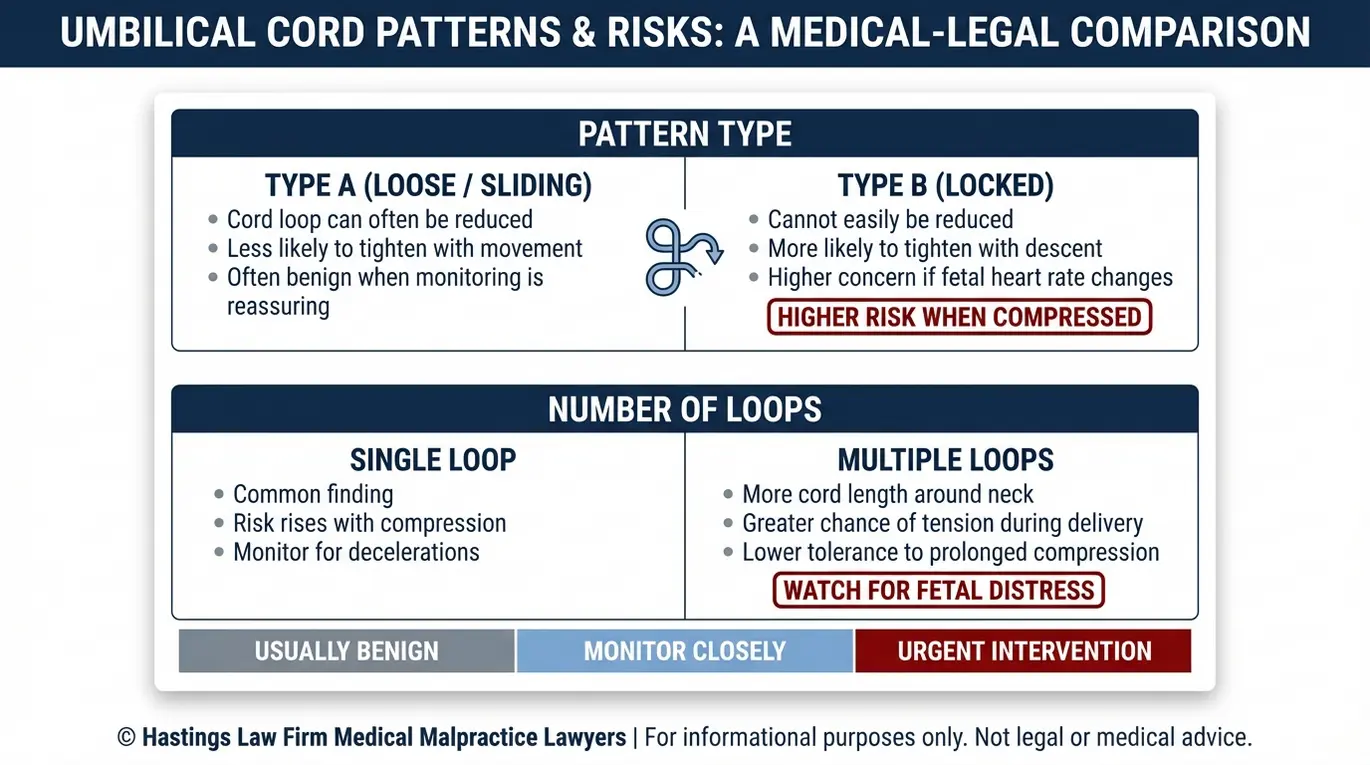
- Type A nuchal cord: The cord is wrapped loosely and can slide freely over the baby’s head during delivery. These are often resolved without complication.
- Type B nuchal cord: The cord is locked in a pattern around the neck and cannot be easily unwound. This type poses a significantly higher risk of compression.
- Single loop vs. multiple loops: A single wrap may be manageable, but multiple loops increase the chance that the cord will tighten as the baby descends through the birth canal.
A retrospective cohort study published on PubMed found a meaningful relationship between nuchal cords and adverse neonatal outcomes, reinforcing that proper identification and monitoring are essential. Under Arizona Revised Statutes § 12-2604, any umbilical cord malpractice lawyer or Arizona birth injury counsel pursuing these claims must work with qualified medical experts who can speak to whether the clinical response met the accepted standard.
Standard of Care for Managing Nuchal Cords During Labor
The standard of care requires obstetricians and labor teams to continuously monitor fetal heart rates for signs of deceleration and to act decisively, including performing an emergency C-section, if cord compression threatens the baby’s oxygen supply.
A medical team is generally expected to follow the standard of care when a nuchal cord is suspected or identified, which often includes the following actions:
- Prenatal screening: During routine prenatal care, Doppler ultrasound may reveal the presence of a nuchal cord. While ultrasound is not always definitive, it can alert the care team to prepare for potential complications during delivery.
- Continuous fetal monitoring during labor: Once labor begins, the medical team should closely watch the fetal heart rate tracing for variable decelerations, which are sudden drops in heart rate that can signal cord compression. The NCBI Bookshelf resource on early decelerations explains how different deceleration patterns help clinicians identify the source of fetal stress.
- Conservative interventions first: When variable decelerations appear, the standard approach typically includes repositioning the mother, administering oxygen, and increasing IV fluids to improve blood flow to the baby.
- Escalation to emergency C-section: An emergency Cesarean section, the surgical delivery of the baby through an abdominal incision, becomes necessary when conservative measures fail to resolve the distress. Delaying this decision when the fetal heart rate pattern is not recovering can result in prolonged oxygen deprivation.
A medical malpractice lawyer evaluating a nuchal cord malpractice case will examine whether each of these steps was followed and, if not, where the standard of care in Arizona was breached.
The Hastings Law Firm Difference
Results matter, but what truly sets us apart is how we achieve them. Every verdict, every settlement, and every Arizona courtroom victory comes from one guiding promise: To treat each client’s fight for justice as if it were our own.
This balance of skill, experience, and empathy reflects our core philosophy that justice should not only compensate the injured, but also make health care safer nationwide.

When Nuchal Cord Complications Become Medical Malpractice
Medical negligence arises when a healthcare provider fails to detect signs of fetal distress caused by a nuchal cord or delays the interventions needed to prevent injury.
A nuchal cord alone does not automatically create liability. These cases may become malpractice claims if the medical team’s breach of duty falls below what the situation required. Common failures an Arizona malpractice attorney may identify to determine if fetal distress was ignored include:
Ignoring or misreading the fetal heart rate monitor
In many birth injury cases, ignoring or misreading the fetal heart rate monitor can be a frequent issue. Abrupt drops in heart rate, known as variable decelerations, should prompt immediate evaluation. When these patterns are dismissed as routine labor stress, the window to intervene can close.
Delayed delivery decisions
During a complicated labor, delayed delivery decisions can also give rise to claims. If the fetal heart rate tracing shows persistent distress and intrauterine resuscitation, the set of bedside interventions used to stabilize a baby in utero, is not working, a timely C-section may be the only path to preventing serious harm. Waiting too long can lead to irreversible oxygen deprivation.
Improper use of delivery instruments
When delivery complications arise, the improper use of delivery instruments like forceps or vacuum extractors can worsen cord compression rather than resolve it. A birth injury lawyer will review the full delivery record to determine whether the tools used and the timing of their application were appropriate.
Injuries Caused by Failure to Manage Umbilical Cord Wrapping
Negligent management of a nuchal cord can lead to severe oxygen deprivation injuries, including Hypoxic Ischemic Encephalopathy (HIE) and permanent cerebral palsy.
When the umbilical cord is compressed and oxygen flow to the baby is interrupted, even a short period of deprivation, known medically as perinatal hypoxia, can cause lasting damage to the developing brain. The specific injury often depends on how long the oxygen supply was reduced and how quickly the medical team responded.
| Injury | Long-Term Impact |
|---|---|
| Hypoxic Ischemic Encephalopathy (HIE) | Seizures, cognitive impairment, organ damage; severity ranges from mild to profound depending on duration of oxygen loss |
| Cerebral Palsy | Permanent motor disability affecting movement, posture, and coordination; may require lifelong therapy and assistive devices |
| Meconium Aspiration Syndrome | Occurs when the baby inhales meconium-stained amniotic fluid, the mixture of fetal waste and fluid released under stress, leading to respiratory complications |
| Developmental Delays | May not become apparent until the child is older; can affect speech, learning, and motor skills |
Research published in Frontiers in Neurology confirms that birth asphyxia is associated with an increased risk of cerebral palsy. For families, this means the malpractice consequences in these cases are not theoretical. These injuries often reshape the trajectory of a child’s entire life.
Proving Negligence in Arizona Nuchal Cord Malpractice Cases
Proving negligence requires clear evidence that the doctor deviated from the standard of care and that this deviation directly caused the infant’s injury, which is typically established through qualified expert testimony.
An Arizona nuchal cord malpractice lawyer builds these cases by following a structured process:
- Obtain and preserve critical records. The first step is securing all medical records from the pregnancy, labor, and delivery. Electronic fetal monitoring (EFM) strips are often the single most important piece of birth injury evidence. These continuous printouts graph the baby’s heart rate and the mother’s contractions in real time.
- Analyze umbilical cord blood gas results. Umbilical cord blood gas analysis, or cord gases, involves testing blood samples taken from the umbilical cord immediately after birth to provide objective data about the baby’s oxygen levels at the time of delivery. These values help establish whether oxygen deprivation occurred and how severe it was.
- Engage qualified expert witnesses. Arizona law requires expert testimony in medical malpractice cases. Board-certified obstetricians review the medical records and testify about what a competent physician should have done under the same circumstances. Their opinion on whether the standard of care was met or breached is central to proving malpractice.
- Establish direct causation. Meeting the burden of proof requires showing that the specific failure, whether a delayed C-section or missed monitor reading, was the direct cause of the child’s injuries. The legal investigation into these nuchal cord injuries focuses on demonstrating this link.
Our team, which includes in-house nurses and former defense attorneys, knows how to reconstruct a delivery timeline and identify the moments where the clinical response may have fallen short.

Compensation for Families Affected by Nuchal Cord Injuries
Compensation in these cases covers past and future medical expenses, life care planning, pain and suffering, and loss of future earning capacity for the injured child.
The financial reality of a birth injury can be staggering. Immediate costs often include extended NICU stays, neonatal surgeries, and emergency interventions for babies affected by umbilical cord complications. But the long-term expenses frequently dwarf those initial bills. Lifetime therapy, specialized education, adaptive equipment, and home modifications can cost millions of dollars over a child’s life.
A study published in PubMed Central documented the significant future medical costs associated with cerebral palsy care, underscoring the scope of the financial burden families face. Recoverable economic damages account for every foreseeable need across the child’s lifetime, while non-economic damages address the child’s pain, suffering, and loss of enjoyment of life.
Arizona Statute of Limitations for Birth Injury Lawsuits
In Arizona, the statute of limitations for medical malpractice is generally two years, but specific tolling rules may extend the filing deadline for claims involving minors.
For parents bringing their own claims, such as emotional distress or loss of consortium, the two-year window typically applies. For the child’s claim, Arizona medical malpractice law may apply tolling rules that pause the statute of limitations during the child’s minority. This pause allows families to pursue legal action for nuchal cord injuries as the child’s developmental needs become clearer over time.
Do not assume you have unlimited time. Medical records can be altered or lost. Witness memories fade. Electronic fetal monitoring strips may not be preserved indefinitely. The sooner you consult with an attorney, the better your chances of securing the evidence needed to build a strong case. An early legal consultation protects both your rights and the integrity of the available proof.

Contact the Arizona Birth Injury Attorneys at Hastings Law Firm Today for Help
At Hastings Law Firm, every case we take is driven by two goals: restoring a sense of trust for families who have been let down by the healthcare system, and holding providers accountable so the same failures are less likely to happen to someone else’s child.
Our team includes in-house nurses and board-certified patient advocates who review your medical records from day one. We also have former defense attorneys on staff who understand how hospitals and insurers approach these cases from the other side. That combination allows us to prepare your case with the kind of detail and strategy that leads to meaningful results.
There are no upfront fees. We work on a contingency basis, which means you pay nothing unless we recover compensation for your family. If your child was injured during delivery and you believe a nuchal cord was involved, we are ready to listen and give you the answers you need. Contact Hastings Law Firm for a free, confidential case evaluation today.
Frequently Asked Questions About Nuchal Cord Malpractice in Arizona


This content was researched and written by the Hastings Law Firm editorial team, which includes attorneys, medical professionals, and experienced researchers. Our writing is informed by internal knowledge and practical experience, and we cross-check critical details against authoritative sources cited throughout. Every piece undergoes human-led fact-checking and legal review. Because legal and medical information can change, if you spot an error, please contact us. Learn more about our content standards and review process on our editorial policy page.

Tommy Hastings, founder of Hastings Law Firm, is a board-certified personal injury trial lawyer dedicated exclusively to healthcare injury cases. Since 2001, he has represented injured patients and families in litigation against major hospital systems, pharmaceutical companies, and negligent healthcare providers nationwide. He has handled numerous high-profile cases that have drawn national media attention and resulted in multi-million dollar recoveries. He draws on that experience in his writing, helping readers understand how these cases work and what options may be available to them.
