


Arizona NICU Malpractice Lawyer
Neonatal intensive care errors can leave families facing overwhelming uncertainty and long term needs. This topic focuses on preventable NICU harm tied to medication mistakes, monitoring failures, delayed diagnosis, and other lapses in the standard of care. It also addresses how adverse events differ from negligence, why records and expert review matter, and how serious outcomes can shape a child’s future care and financial stability. If you or a loved one were harmed or worse due to NICU malpractice in Arizona, contact Hastings Law Firm for a free, confidential case review.

Last Updated: July 27, 2026
Compassionate Legal Representation for Neonatal Injuries in Arizona
When a newborn is harmed by a preventable medical error in the neonatal intensive care unit (NICU), the specialized unit designed to care for the most fragile infants, the emotional weight can feel unbearable. You trusted a medical team with your child’s life, and something went wrong. That sense of betrayal is real, and you deserve answers about what happened and why.
An experienced Arizona NICU malpractice lawyer can help you understand whether your baby’s injury resulted from negligence and what legal options may be available to your family. At Hastings Law Firm, founded by Tommy Hastings, who is among the less than 2% of attorneys board-certified in personal injury trial law, our team focuses exclusively on medical malpractice litigation. We are here to listen, investigate, and help restore trust for families who feel ignored by the healthcare system.
If your infant was injured during neonatal care, contact us for a free, confidential case evaluation. There is no fee unless we recover compensation for your family.

Common Types of NICU Negligence in Arizona Hospitals
NICU negligence occurs when medical professionals deviate from the accepted standard of care, the level of treatment a reasonably competent provider would deliver under similar circumstances, resulting in preventable harm to a newborn. These cases can involve medication errors, monitoring failures, delayed treatment, or surgical mistakes.
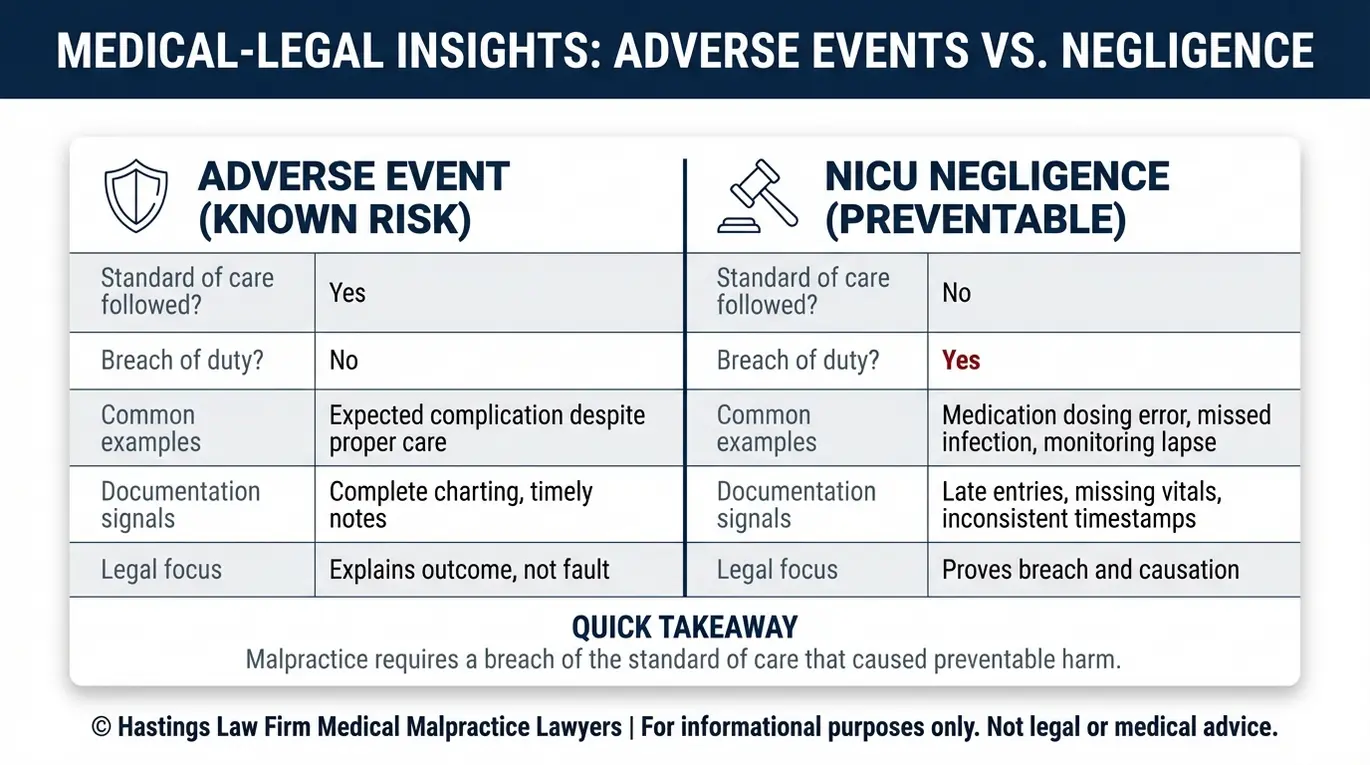
Not every negative outcome in the NICU qualifies as malpractice. Premature and critically ill infants face inherent medical risks, and some complications occur despite proper care. The distinction lies in whether a neonatologist (a physician specializing in newborn critical care), neonatal nurse (a specially trained nursing professional), or other provider failed to meet the standard of care expected of their role, and whether that failure, known as a breach of duty, directly caused the infant’s injury.
That distinction between an unavoidable adverse event and preventable medical negligence is central to every case an Arizona NICU malpractice lawyer evaluates. Common categories of NICU negligence include:
- Failure to identify and treat infections such as sepsis
- Improper resuscitation techniques during neonatal emergencies
- Surgical errors, including complications from central line placement
- Medication dosing mistakes
- Failure to monitor oxygen levels or respond to equipment alarms
- Delayed diagnosis of treatable conditions
The margin for error in a neonatal intensive care unit is extremely small. An infant’s developing brain and organs are highly vulnerable, which means errors that might be minor in an adult patient can cause lifelong consequences for a newborn. That is why a thorough investigation by a NICU malpractice attorney in Arizona with access to qualified medical experts is so important.
Distinguishing Medical Errors from Adverse Events
A poor outcome alone does not establish liability. Liability is the legal responsibility for harm caused by the actions or omissions of another party. To support a malpractice claim, we must show that a provider breached the standard of care and establish causation, which involves proving that this breach directly resulted in the injury.
When reviewing neonatal intensive care cases, our medical team reviews the records closely to determine which category applies. If a newborn’s condition worsens despite appropriate, timely care, that may be classified as an adverse event rather than negligence.
Medication Administration Errors in Neonatal Care
Medication errors in the NICU often involve incorrect dosing calculations, confusion between sound-alike drugs, or administering medication to the wrong patient, which can be fatal given an infant’s small size. Given an infant’s extremely small body weight, even a minor miscalculation can be life-threatening.
In the neonatal intensive care unit (NICU), one of the most well-documented risks is the ten-fold dosing error, where a misplaced decimal point results in a dose ten times higher or lower than intended. Because neonatal doses are calculated in fractions of milligrams based on body weight, the potential for decimal-point mistakes is significant. A milligram is a tiny unit of weight used for measuring medication for infants.
A review of medication errors among neonates published in PubMed Central confirms that dosing errors are among the most frequent and dangerous types of medication mistakes in neonatal care. Medication compounding, the process of mixing or preparing customized drug formulations, introduces another layer of risk, potentially involving pharmacist liability.
If a pharmacy prepares a concentration incorrectly or uses a contaminated ingredient, the infant may receive a harmful dose before anyone detects the problem. Negligent charting can make these errors even harder to identify after the fact. When medication administration records are incomplete, altered, or inconsistent, it may obscure what the infant actually received and when.
The Hastings Law Firm Difference
Results matter, but what truly sets us apart is how we achieve them. Every verdict, every settlement, and every Arizona courtroom victory comes from one guiding promise: To treat each client’s fight for justice as if it were our own.
This balance of skill, experience, and empathy reflects our core philosophy that justice should not only compensate the injured, but also make health care safer nationwide.

Failures in Vital Sign and Oxygen Monitoring
Monitoring failures occur when staff ignore alarms, fail to recognize signs of distress such as hypoxia, or do not properly manage mechanical ventilator settings, the machines that assist or control breathing for infants, leading to brain injury. These failures can lead to brain injury within minutes. Hypoxia is a medical condition where the body or a specific organ does not receive enough oxygen.
Premature infants require constant monitoring because their respiratory and cardiovascular systems are underdeveloped. Even brief periods of oxygen deprivation can cause irreversible damage. Respiratory therapists and neonatal nurses are responsible for tracking oxygen saturation, adjusting ventilator parameters, and managing intubation.
A recognized contributing factor is alarm fatigue, a condition where staff become desensitized to the constant sounds of monitoring equipment and begin to respond more slowly or ignore warnings altogether. Research published in the Online Journal of Issues in Nursing on alarm fatigue in neonatal intensive care units documents how this phenomenon directly affects patient safety in the NICU setting.
Understaffing compounds the problem. When a unit does not have enough qualified nurses or respiratory therapists for the number of patients, response times suffer. If you have concerns about the care your infant received, the Arizona Ombudsman Citizens’ Aide can provide information about filing healthcare-related complaints.
Families should also be aware that under Arizona Revised Statutes § 12-542, the general statute of limitations for personal injury claims is two years, making timely legal consultation important.
Misdiagnosis and Delayed Diagnosis of Infant Conditions
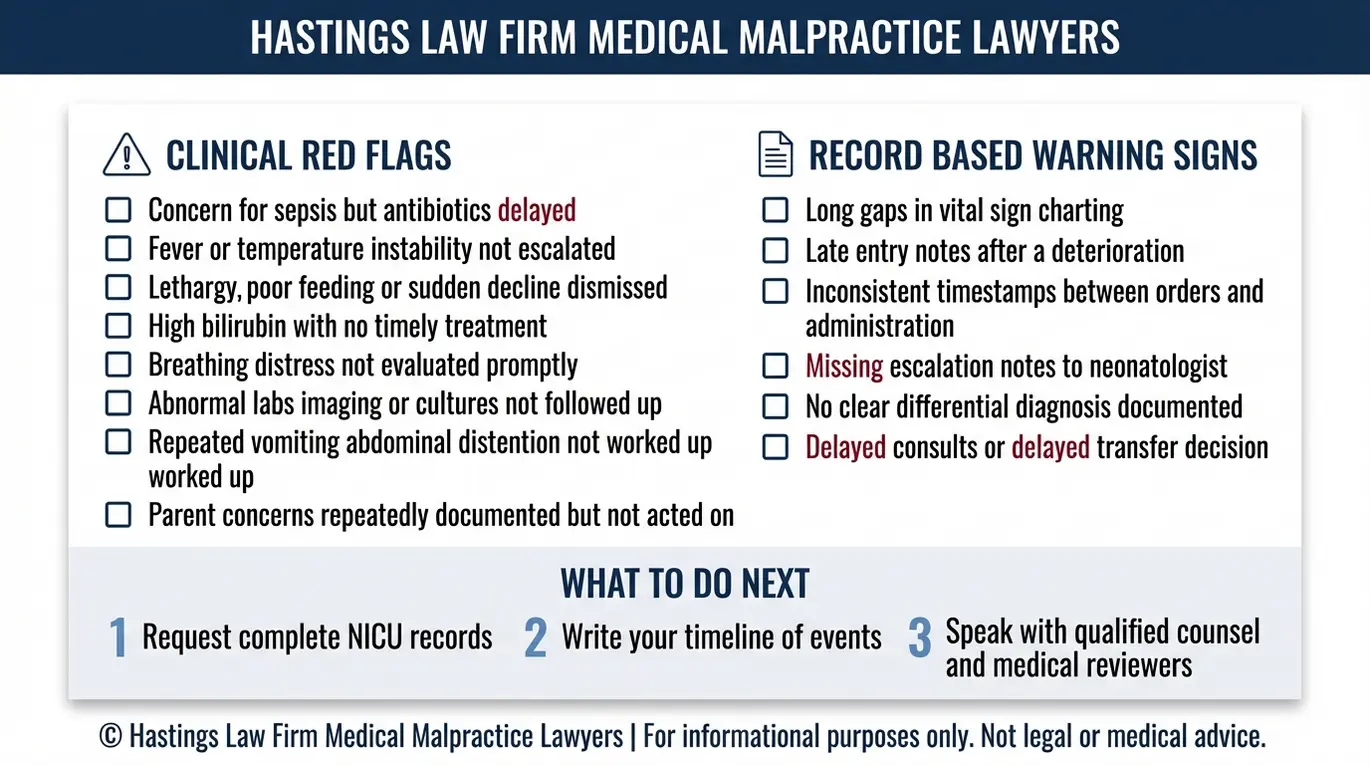
Delayed diagnosis in the NICU can prevent timely treatment of critical conditions like sepsis, jaundice, or congenital heart defects, allowing them to progress to permanent injury or death. When neonatologists or nursing staff miss early warning signs, the window for effective intervention can close quickly. Sepsis is a severe and life-threatening reaction to an infection.
In a neonatal care setting, research published in PubMed Central on time-to-antibiotics recommendations in pediatric sepsis underscores how delays in administering antibiotics can significantly worsen outcomes. An infant showing signs of infection needs prompt blood cultures and treatment, not a wait-and-see approach.
Jaundice is another condition where delayed diagnosis carries severe consequences. If elevated bilirubin levels, a yellow pigment in the blood, are not identified and treated, the condition can progress to kernicterus, a form of brain damage caused by bilirubin toxicity that can result in permanent hearing loss, intellectual disability, and movement disorders.
Conditions commonly subject to diagnostic failures in the NICU include:
- Neonatal sepsis and bloodstream infections
- Severe jaundice progressing toward kernicterus
- Congenital heart defects requiring early surgical intervention
- Necrotizing enterocolitis (NEC)
- Intracranial hemorrhage
An Arizona NICU malpractice lawyer examines whether the medical team ordered appropriate labs and imaging in a timely manner. We also look at whether test results were properly interpreted and if delays in diagnosis fell below the standard of care.
Long-Term Consequences of NICU Errors
Injuries sustained in the NICU, such as brain damage or spinal trauma, often result in lifelong disabilities that require around-the-clock care, specialized therapy, and significant financial resources. These are not temporary setbacks. For many families, they define the course of a child’s entire life.
Hypoxia can lead to hypoxic-ischemic encephalopathy (HIE), a serious form of brain injury that occurs when oxygen deprivation is combined with restricted blood flow. HIE is a type of brain damage caused by a lack of oxygen and blood flow to the brain. According to research published in PubMed Central on hypoxic-ischemic encephalopathy, HIE can result from errors during resuscitation, prolonged ventilator mismanagement, or delayed response to fetal distress.
Cerebral palsy is another potential consequence of NICU negligence, particularly when oxygen deprivation or trauma affects the developing brain. Children with cerebral palsy may face challenges with movement, coordination, speech, and cognition that persist throughout their lives.
The long-term impact of these injuries extends well beyond medical diagnoses:
| Injury | Potential Long-Term Impact |
|---|---|
| Hypoxic-ischemic encephalopathy (HIE) | Cognitive impairment, seizure disorders, developmental delays |
| Cerebral palsy | Motor dysfunction, speech difficulties, need for assistive devices |
| Severe sepsis complications | Organ damage, hearing loss, neurological deficits |
| Kernicterus | Hearing loss, intellectual disability, involuntary movement |
These are not only medical concerns but life care financial issues. A child who requires decades of therapy, adaptive equipment, and personal care attendants will need resources that far exceed what most families can provide. A lawyer for NICU negligence works with life care planners to project the full scope of a child’s future needs.
Establishing Liability and Overcoming Arbitration Clauses
Building a case requires securing medical records, identifying the specific breach of duty, and using expert testimony to prove that a hospital’s negligence directly caused the infant’s injury. The process is methodical, and each step builds on the one before it.
- Secure neonatal medical records and charting immediately. These records form the foundation of every NICU malpractice case and are the primary evidence used to determine if a facility deviated from medical protocols. They include nursing notes, medication administration logs, and physician orders.
- Conduct a medical expert review. Arizona law requires that a qualified medical expert review the records and provide an Affidavit of Merit within 60 days after filing a lawsuit, confirming that negligence likely occurred. A medical expert review allows us to consult specialists who explain how a specific action caused the infant’s injury.
- Challenge mandatory arbitration clauses if applicable. Many parents unknowingly sign arbitration agreements in hospital admission paperwork, which can limit the right to a jury trial. Arbitration is a private legal process where a neutral third party, rather than a judge or jury, decides the outcome of a dispute.
- Establish causation through expert testimony. It is not enough to show that a mistake was made. This analysis uses scientific evidence to show the direct link between medical errors and long-term health outcomes, demonstrating that the harm would not have occurred with proper care.
Our team includes former defense attorneys who understand how hospitals and their insurers build their cases. That perspective allows us to anticipate challenges and prepare accordingly from day one.

Recoverable Damages for Families in Arizona
Families may recover compensation for past and future medical bills, life care planning costs, pain and suffering, and lost earning capacity for the child. Arizona does not cap non-economic damages in medical malpractice cases, which means juries can award compensation that reflects the true scope of the harm.
Economic damages cover the measurable financial losses tied to the injury:
- Past and future medical expenses, including surgeries and hospital stays
- Rehabilitation and therapy costs (physical, occupational, and speech therapy)
- Home modifications such as wheelchair ramps and specialized equipment
- Lost earning capacity if the child’s disability limits future employment
Non-economic damages address the less tangible but equally real impact of the injury:
- Physical pain and suffering
- Emotional distress experienced by the child and family
- Loss of enjoyment of life
For children with conditions like cerebral palsy, which the CDC’s data on cerebral palsy shows affects approximately 1 in 345 children, the lifetime cost of care can reach millions of dollars. Life care plans are detailed projections that map out 50 or more years of anticipated needs. These plans ensure that any legal claim accounts for every anticipated cost.
Contact the Arizona Birth Injury Attorneys at Hastings Law Firm Today for Help
No amount of money can undo what happened to your child. But compensation is the only tool the legal system provides to secure your child’s future care and hold the responsible parties accountable for what went wrong.
At Hastings Law Firm, we focus exclusively on medical malpractice litigation. Our team includes former defense attorneys and experienced hospital nurses who understand how healthcare systems manage these cases. We prepare every case as if it will go to trial, and that level of preparation strengthens our position whether a case resolves through negotiation or before a jury.
Your consultation is free and confidential. We charge no attorney fees or costs unless we recover compensation for your family. If you believe your infant was harmed by negligent neonatal care, contact us today. We can review what happened, explain your legal options, and help you take the first step toward answers and accountability.
Frequently Asked Questions About NICU Malpractice in Arizona


This content was researched and written by the Hastings Law Firm editorial team, which includes attorneys, medical professionals, and experienced researchers. Our writing is informed by internal knowledge and practical experience, and we cross-check critical details against authoritative sources cited throughout. Every piece undergoes human-led fact-checking and legal review. Because legal and medical information can change, if you spot an error, please contact us. Learn more about our content standards and review process on our editorial policy page.

Tommy Hastings, founder of Hastings Law Firm, is a board-certified personal injury trial lawyer dedicated exclusively to healthcare injury cases. Since 2001, he has represented injured patients and families in litigation against major hospital systems, pharmaceutical companies, and negligent healthcare providers nationwide. He has handled numerous high-profile cases that have drawn national media attention and resulted in multi-million dollar recoveries. He draws on that experience in his writing, helping readers understand how these cases work and what options may be available to them.
