


Arizona Newborn Opioid Withdrawal Lawyer
Written by: Hastings Law Firm | Reviewed by: Tommy Hastings | Updated: July 27, 2026
Newborn opioid withdrawal can place a baby in intensive care and leave families facing painful uncertainty about what went wrong and what comes next. The condition is linked to opioid exposure during pregnancy and can involve severe withdrawal symptoms, complex treatment, and concerns about long term development. Responsibility may involve negligent prescribing and monitoring by healthcare providers or deceptive marketing and distribution practices by opioid companies. If your child suffered harm due to newborn opioid withdrawal in Arizona, contact Hastings Law Firm for a free, confidential case review.

Compassionate Arizona Medical Attorneys for Neonatal Abstinence Syndrome Claims
What You Should Know About Neonatal Abstinence Syndrome Malpractice Claims in Arizona:
- Long term needs can drive substantial losses when newborn opioid withdrawal leads to ongoing therapy, special education, or permanent cognitive or physical impairment.
- Liability can turn on whether opioid exposure during pregnancy resulted from negligent prescribing or inadequate monitoring by a healthcare provider.
- Recovery options can also depend on whether deceptive marketing or distribution failures by opioid companies contributed to opioid exposure.
- Compensation can include economic damages for medical expenses and non economic damages for pain and suffering.
- Options can narrow if filing deadlines are missed, including shorter time limits for claims involving government entities.
- Recovery can remain possible even after an opioid manufacturer files bankruptcy because some cases are paid through dedicated trust funds.
- Disputes often focus on whether prenatal records and prescribing history show safer alternatives existed or safeguards were not used.
- Case strength can depend on whether NICU documentation shows the severity and duration of withdrawal, including Finnegan scores and medication logs.
- Proof can hinge on qualified expert support when Arizona law requires an expert statement that the claim has merit.

A Healthcare Focused Law Firm
When a baby is born dependent on opioids, the first days of life can be filled with pain, medical intervention, and fear. Newborn opioid withdrawal, a condition where an infant suffers physical dependence after being exposed to opioids before birth, often means an extended stay in the NICU (Neonatal Intensive Care Unit), the specialized hospital ward designed to treat critically ill newborns. For families going through this, the questions can feel overwhelming: How did this happen? Could it have been prevented? What does this mean for my child’s future?
As an Arizona newborn opioid withdrawal lawyer, Hastings Law Firm helps families find those answers. Our firm is led by Tommy Hastings, a board-certified trial attorney with over 20 years of experience in medical negligence. Tommy is also a member of the American Board of Trial Advocates (ABOTA), an invitation-only group for experienced trial lawyers. Our medical-legal team, which includes in-house nurse consultants and former defense attorneys, investigates these cases to determine whether negligent prescribing or deceptive pharmaceutical practices caused your child’s suffering. If you believe your baby’s condition could have been prevented, we welcome the chance to review what happened and explain your options in a free, confidential consultation.
Filing a Neonatal Abstinence Syndrome Lawsuit in Arizona
A Neonatal Abstinence Syndrome (NAS) lawsuit is a legal claim filed on behalf of an infant injured by in utero opioid exposure, seeking compensation for medical treatments, pain and suffering, and long-term developmental care. Neonatal Abstinence Syndrome, sometimes referred to as Neonatal Opioid Withdrawal Syndrome (NOWS), is the clinical diagnosis given when a newborn exhibits withdrawal symptoms after being exposed to addictive substances during pregnancy.
These cases generally follow one of two legal paths, and understanding the difference is the first step toward protecting your child’s rights.
Medical malpractice applies when a healthcare provider negligently prescribed opioids during pregnancy. Medical negligence or malpractice claims arise if a doctor failed to screen for risk factors, continued prescribing when safer alternatives existed, or did not properly monitor the mother’s medication. In these cases, the claim is directed at the individual prescriber, the medical practice, or the hospital.
Product liability and mass tort litigation applies when the opioid manufacturer or drug distributor bears responsibility. Liability also applies if a pharmaceutical company engaged in deceptive marketing, or if a distributor ignored suspicious opioid prescribing patterns. Many claims are consolidated in national opioid litigation through multidistrict litigation (MDL) to group similar lawsuits for efficient handling.
| Factor | Medical Malpractice | Product Liability / Mass Tort |
|---|---|---|
| Who is sued | Prescribing doctor, clinic, or hospital | Opioid manufacturer or drug distributor |
| Basis of the claim | Negligent prescribing or failure to monitor | Deceptive marketing or failure to warn |
| Where it is filed | Typically in Arizona state court | May be part of federal MDL proceedings |
| Key evidence | Prenatal records, prescribing history, expert review | Internal company documents, marketing materials |
Some families have claims under both theories. An experienced Arizona opioid withdrawal attorney can evaluate the facts to determine which path, or combination of paths, gives your family the strongest case. That dual perspective matters because handling an Arizona state court malpractice claim requires different skills than participating in federal MDL proceedings.
Navigating Opioid Bankruptcy Proceedings
Several major opioid manufacturers, including Purdue Pharma and Mallinckrodt, have filed for bankruptcy to manage the high volume of lawsuits against them. This does not necessarily end your ability to recover compensation. Bankruptcy proceedings in opioid cases often result in the creation of dedicated opioid bankruptcy trust funds designed to pay claims from affected individuals and families. Filing against these trusts involves strict deadlines, making an experienced lawyer essential to preserving your claim.

Identifying Symptoms of Opioid Withdrawal in Newborns
Symptoms of opioid withdrawal in newborns typically appear within 24 to 72 hours after birth and include high-pitched crying, tremors, seizures, feeding difficulties, and respiratory distress requiring NICU admission. According to research published in PMC on Neonatal Opioid Withdrawal Syndrome (NOWS), this condition represents a serious and growing concern tied to the broader opioid crisis.
Parents often notice these signs before a formal diagnosis is made. Common symptoms to be aware of include:
- Tremors or uncontrollable shaking
- High-pitched, inconsolable crying
- Seizures
- Fever and excessive sweating
- Tight or rigid muscle tone (hypertonia)
- Rapid breathing or respiratory distress
- Poor feeding, vomiting, or diarrhea
- Hyperactive reflexes and sensitivity to light or sound
In the Neonatal intensive care unit (NICU), medical staff use the Finnegan Neonatal Abstinence Scoring System, a standardized tool that assigns numerical scores to withdrawal symptoms to guide treatment decisions. When scores are high enough, infants may require pharmacologic treatment, often a carefully managed morphine taper where small doses of morphine are administered and gradually reduced to ease the baby off opioid dependence safely.
These medical records, including Finnegan scores, medication logs, and NICU nursing notes, become critical evidence in a legal claim. They document the severity and duration of the infant’s suffering and establish a direct connection between opioid exposure and the diagnosis. The Arizona Department of Health Services NAS Action Plan also provides important context about the scope of this issue across the state. If your child experienced these symptoms, a newborn opioid withdrawal lawyer in Phoenix can help determine whether the prescribing decisions that led to this outcome fell below the accepted standard of care.

The Hastings Law Firm Difference
Results matter, but what truly sets us apart is how we achieve them. Every verdict, every settlement, and every Arizona courtroom victory comes from one guiding promise: To treat each client’s fight for justice as if it were our own.
This balance of skill, experience, and empathy reflects our core philosophy that justice should not only compensate the injured, but also make healthcare safer nationwide.

Long-Term Developmental Impacts and Recoverable Damages
Families may recover economic damages for current and future medical expenses, including specialized therapy and special education, as well as non-economic damages for the child’s pain, suffering, and permanent cognitive or physical impairment.
Research on the long-term effects of prenatal opioid exposure is still developing, but the evidence we do have raises real concerns. A systematic review published in PubMed on prenatal opioid exposure and neurodevelopmental consequences identifies associations between in utero opioid exposure and neurodevelopmental impairment, which refers to disruptions in brain development that can affect how a child thinks, learns, and moves. Known risks include developmental delays, such as deficits in cognitive skills like problem-solving and memory, challenges with motor skills such as coordination and fine movement, and behavioral conditions including ADHD, anxiety, and depression.
Because these effects can unfold over years, calculating fair compensation requires looking far beyond initial hospital bills. A life care plan is essential to project these long-term needs. A life care plan is a detailed projection, typically prepared by medical and economic experts, that estimates the total cost of therapy, tutoring, specialized medical care, and support services a child will need through adulthood. It translates the medical reality into a concrete financial picture that a jury or insurance carrier can evaluate.
The emotional toll on the family also factors into the claim. Watching a child struggle with developmental milestones, managing ongoing medical appointments, and coping with the uncertainty of a long-term prognosis all affect quality of life. An Arizona NAS malpractice lawyer can help ensure that both the financial and personal dimensions of your family’s experience are fully represented in the claim.
Establishing Liability for Prenatal Opioid Exposure
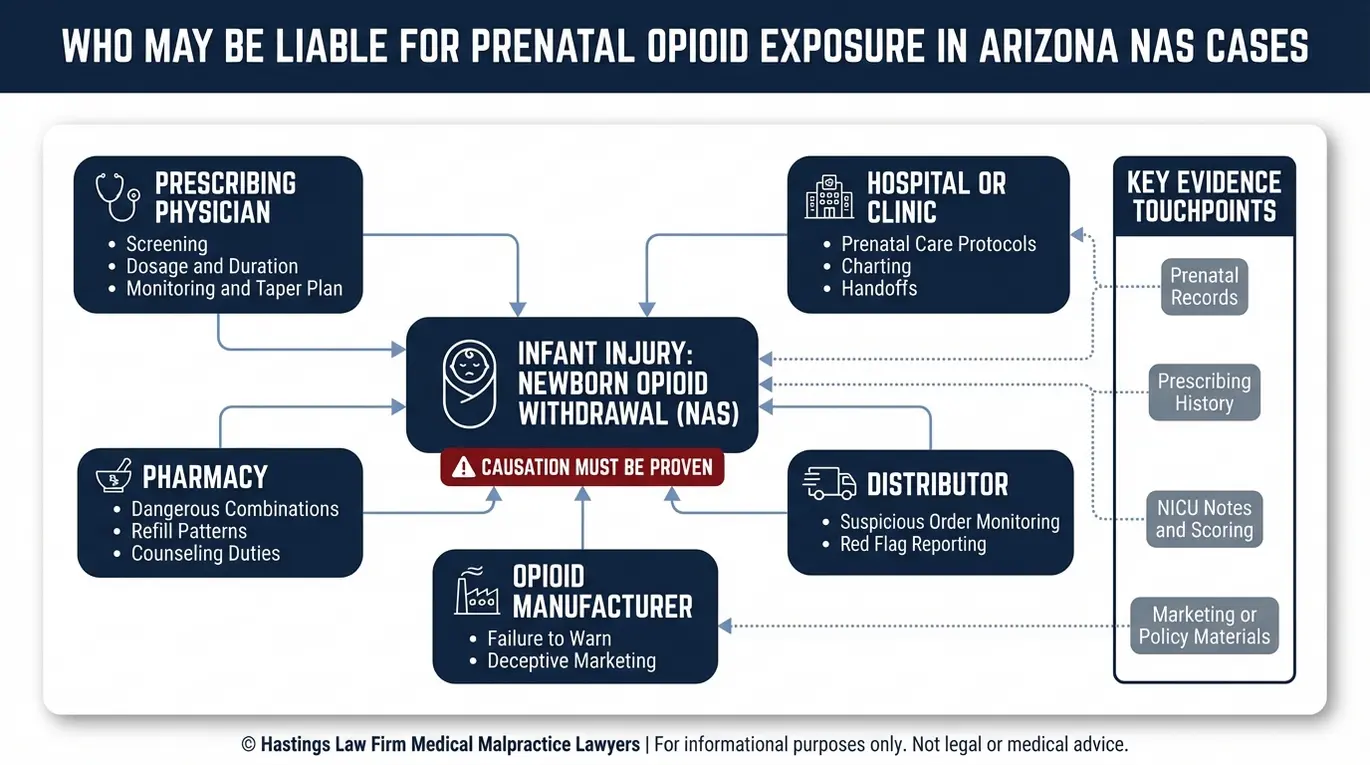
Liability is established by proving that a medical provider deviated from the standard of care by prescribing dangerous opioids during pregnancy without proper monitoring, or that a pharmaceutical company engaged in deceptive marketing practices. Establishing liability essentially means determining who is legally responsible for the harm your child sustained.
On the medical side, we examine whether proving medical negligence is possible based on the evidence. For example, we investigate if the prescribing physician failed to screen for addiction history, prescribed opioids such as oxycodone or hydrocodone without adequate safeguards when safer alternatives were available, or neglected to implement a safe weaning protocol. In utero opioid exposure, meaning the baby’s direct contact with opioids through the mother’s bloodstream during pregnancy, is the central medical fact. When that exposure resulted from a medical provider’s own treatment decisions, the standard of care demands that the provider took proper precautions.
On the pharmaceutical and distribution side, we investigate whether drug distributors failed to monitor red flags in prescribing volume, or whether manufacturers misrepresented the addiction potential of their products.
Our team focuses exclusively on medical negligence cases, which allows us to dedicate all our resources to complex injury claims. We trace the entire chain from manufacturer to bedside by reviewing prenatal care records, pharmacy dispensing logs, prescriber histories, hospital protocols, and internal communications. An opioid birth injury attorney at Hastings Law Firm works with board-certified medical experts to determine exactly where the breakdown occurred and who bears responsibility.
Contact the Arizona Birth Injury Attorneys at Hastings Law Firm Today for Help
Your child deserves answers, and so do you. If your baby was diagnosed with Neonatal Abstinence Syndrome or required NICU treatment for opioid withdrawal after birth, the medical and prescribing decisions that led to that moment deserve a thorough, independent review.
Hastings Law Firm was built for cases like this. Our team includes in-house nurse consultants who analyze clinical records and former defense attorneys who previously worked for the hospital systems we now hold institutions accountable for their actions. We prepare every claim from day one as if it will go to a jury, because that level of preparation is what it takes to secure a fair outcome.
As your Arizona newborn opioid withdrawal lawyer, we operate on a contingency fee basis, meaning you pay no attorney fees or costs unless we recover compensation for your family. The consultation is free and confidential. Contact us today so we can review your child’s medical records, explain your legal options, and help you take the first step toward securing your child’s future.
Frequently Asked Questions About Newborn Opioid Withdrawal in Arizona


This content was researched and written by the Hastings Law Firm editorial team, which includes attorneys, medical professionals, and experienced researchers. Our writing is informed by internal knowledge and practical experience, and we cross-check critical details against authoritative sources cited throughout. Every piece undergoes human-led fact-checking and legal review. Because legal and medical information can change, if you spot an error, please contact us. Learn more about our content standards and review process on our editorial policy page.

Tommy Hastings, founder of Hastings Law Firm, is a board-certified personal injury trial lawyer dedicated exclusively to healthcare injury cases. Since 2001, he has represented injured patients and families in litigation against major hospital systems, pharmaceutical companies, and negligent healthcare providers nationwide. He has handled numerous high-profile cases that have drawn national media attention and resulted in multi-million dollar recoveries. He draws on that experience in his writing, helping readers understand how these cases work and what options may be available to them.
