


Arizona Neurologist Malpractice Lawyer
Neurologist and neurosurgeon errors can cause lasting brain or spinal cord harm that changes daily life and creates uncertainty about what went wrong. These cases often involve disputes about whether the provider met the standard of care, whether a diagnostic delay or medication mismanagement worsened the outcome, or whether a surgical mistake caused permanent damage. The process can feel technical and overwhelming, especially when records and expert opinions conflict. If you or a loved one were harmed or worse due to neurologist or neurosurgeon malpractice in Arizona, contact Hastings Law Firm for a free, confidential case review.

Last Updated: July 27, 2026
Trusted Legal Representation for Physician Negligence in Arizona
When a neurologist or neurosurgeon makes an error, the consequences can affect every part of your life. Brain and spinal cord injuries are often permanent, and the uncertainty that follows can feel overwhelming. You may not be sure what went wrong, but you know something did. That instinct matters, and you deserve answers.
At Hastings Law Firm, founded by board-certified trial attorney Tommy Hastings, we focus exclusively on medical malpractice. Our team includes experienced trial attorneys, former defense lawyers, and in-house medical professionals who understand both the medicine and the law behind neurological injury cases. As a dedicated Arizona neurologist malpractice lawyer team, we have the resources and knowledge to investigate what happened and hold the responsible parties accountable.
If you believe a neurologist or neurosurgeon caused harm to you or someone you love, we are here to help. Contact us for a free, confidential case evaluation to learn where you stand.

Distinguishing Between Neurologist and Neurosurgeon Negligence
Neurologist malpractice typically involves diagnostic failures or medication management errors related to the brain and nervous system, while neurosurgeon malpractice often centers on physical errors during invasive procedures on the spine or brain. Understanding this distinction matters because the type of doctor involved shapes the legal theory behind your claim.
Many people search for a “brain doctor” without fully knowing if they were treated by a neurologist or a neurosurgeon. A neurologist diagnoses and manages conditions like epilepsy, multiple sclerosis, Parkinson’s disease, and stroke using non-surgical methods. A neurosurgeon performs operations on the brain, spine, and peripheral nerves. Both are specialists who treat the nervous system, but their duties and the ways they can fall short look very different.
Confusion between these roles often complicates the initial stages of a lawsuit. Patients may not immediately realize which provider is responsible for their injury until a legal team reviews the medical records. Invasive procedures performed by surgeons carry different risks than the pharmacological management provided by neurologists.
The standard of care is the level of treatment a reasonably competent specialist in the same field would have provided under similar circumstances. For a neurologist, this typically involves accurate diagnosis, proper medication management, and timely referrals. Medication management is the process of selecting, prescribing, and monitoring drugs for neurological conditions. Therapeutic drug monitoring, the practice of regularly checking blood levels of medications like anti-seizure drugs to prevent toxicity, is a core part of that responsibility.
For a neurosurgeon, the standard of care focuses on surgical planning, technique, and post-operative monitoring. The stakes in both specialties are exceptionally high. Unlike muscle or bone, the nervous system has a limited ability to repair itself. Errors in either specialty can produce permanent damage. Accountability is essential.
When a provider fails to meet these rigorous standards, the resulting harm is legally defined as medical negligence. This is a specific tort that requires precise evidence to prove in court. A neurologist malpractice lawyer evaluates which standard applies to your case and identifies where the provider fell short.
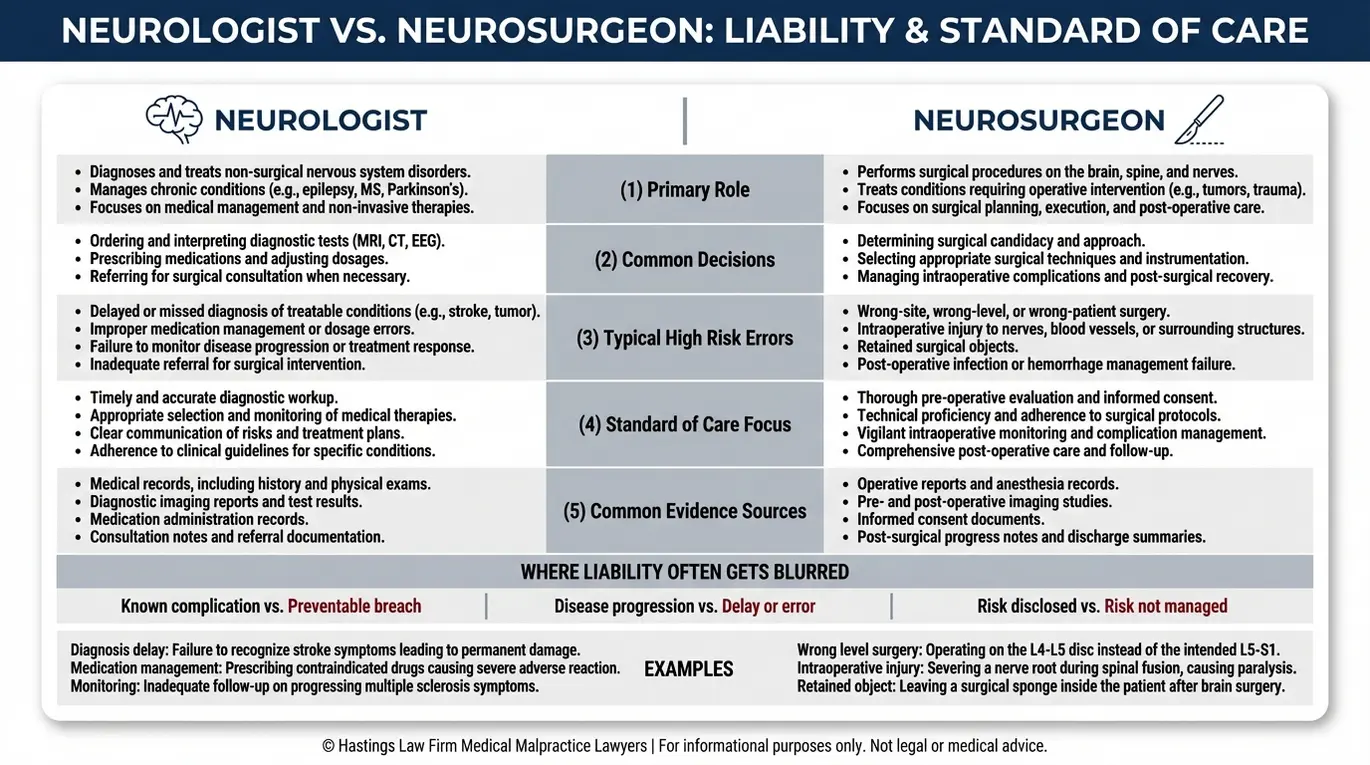
Here is a general comparison of how responsibilities differ between these two specialties:
| Neurologist | Neurosurgeon | |
|---|---|---|
| Primary Role | Diagnoses and medically manages brain and nervous system disorders | Performs surgical procedures on the brain, spine, and nerves |
| Common Conditions Treated | Epilepsy, MS, stroke, migraines, Parkinson’s | Brain tumors, spinal stenosis, herniated discs, aneurysms |
| Typical Treatment Methods | Medications, imaging interpretation, EEG analysis, referrals | Surgical intervention, implantable devices, post-operative care |
| Common Malpractice Claims | Misdiagnosis, delayed diagnosis, medication errors, failure to refer | Wrong-site surgery, nerve damage, retained surgical instruments, lack of informed consent |
Regardless of whether your case involves malpractice claims against neurologists or a surgical error by a neurosurgeon, an Arizona neurological injury attorney can help determine who is responsible and what evidence is needed to prove it.
Common Errors Committed by Arizona Neurologists and Neurosurgeons
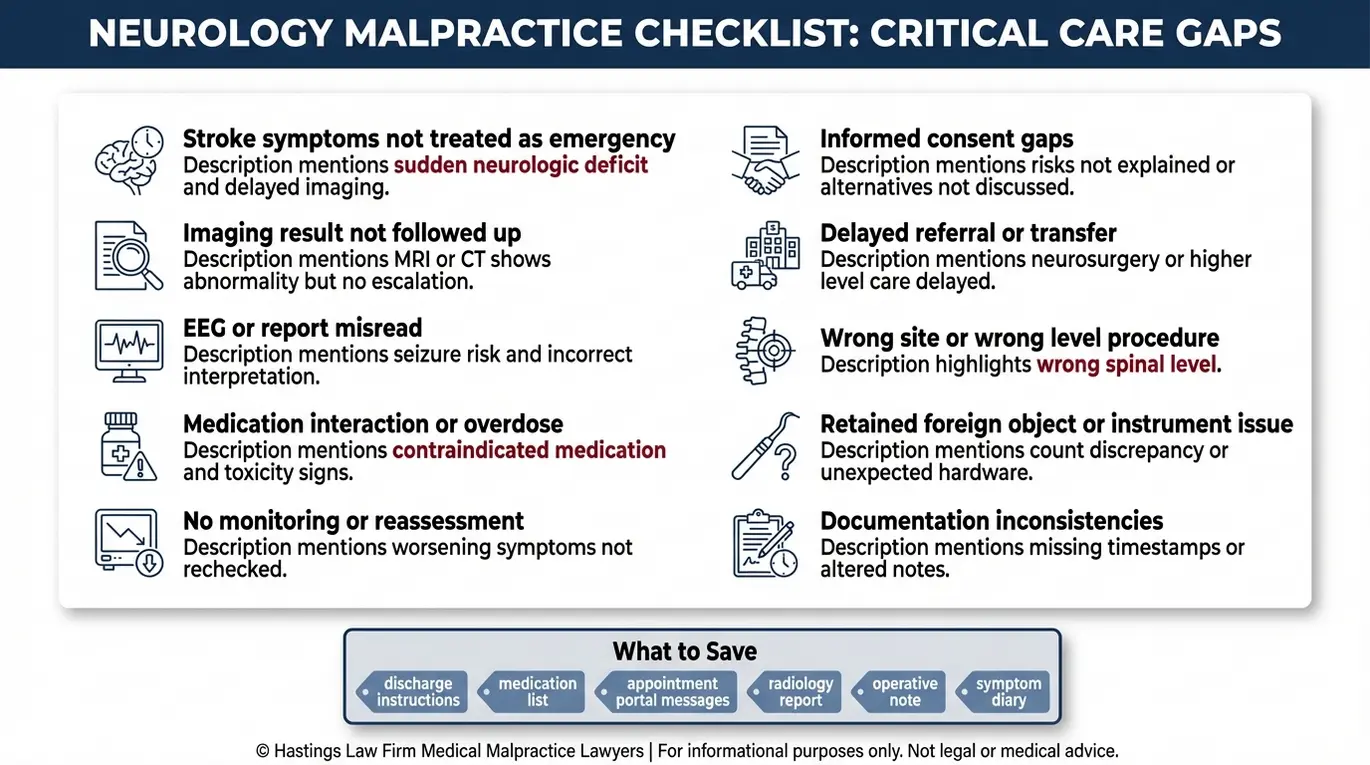
Common errors in these specialties include the failure to timely diagnose strokes or tumors, misinterpreting EEGs or MRIs, prescribing contraindicated medications that cause toxicity, and surgical mistakes such as operating on the wrong spinal level. These errors can lead to catastrophic, irreversible harm. Because these errors cause life-altering damage, the Arizona Constitution, Article 2, Section 31, ensures that patients have the right to seek full legal redress without legislative caps on damages.
Diagnostic Failures
One of the most frequent bases for a claim against a neurologist is a missed or delayed diagnosis. In Arizona, common diagnostic errors in these specialties include the failure to diagnose strokes or tumors. A qualified neurologist malpractice lawyer in Arizona can identify these breaches.
Stroke cases are a prime example. According to the National Center for Biotechnology Information’s overview of ischemic stroke, tissue plasminogen activator (tPA), a clot-dissolving medication, must generally be administered within a narrow window after symptom onset to be effective. The tPA treatment window is the specific timeframe in which a clot-dissolving drug must be administered. When a neurologist fails to recognize stroke symptoms or delays ordering imaging, that window can close. This leaves the patient with permanent brain damage that may have been preventable.
Brain tumors misdiagnosed as chronic migraines represent another pattern we see. If a neurologist does not order appropriate imaging when symptoms escalate or change, a treatable condition can progress to a stage where options become severely limited.
Medication Errors
Neurologists manage powerful medications for seizure disorders, chronic pain, and movement disorders. In Arizona malpractice cases, medication errors can include dangerous interactions, failing to monitor blood levels for toxicity, or overprescribing controlled substances.
The University of Arizona Rural Health Professions Program has documented the serious impact of opioid-related morbidity in Arizona communities, underscoring how medication mismanagement can cause widespread harm. Our firm has direct experience in this area. Founder Tommy Hastings secured a $10 million verdict against operators of a pill mill in a nationally recognized case involving dangerous overprescription.
Surgical Errors
Neurosurgical errors in Arizona hospitals can be devastating. Wrong-level spinal surgery, where the surgeon operates on the incorrect vertebra, is a known and preventable mistake. Retained foreign objects, nerve damage from improper technique, and inadequate post-operative monitoring are other examples that may support a claim when suing a neurologist or neurosurgeon.
High-Risk Diagnostic Tests and Invasive Procedures
Certain neurological diagnostic procedures carry inherent risks that require proper informed consent and careful technique. A lumbar puncture, commonly called a spinal tap, involves inserting a needle into the spinal canal to collect fluid. Complications can include severe headaches, infection, or nerve damage if performed incorrectly.
A cerebral angiogram, a procedure that threads a catheter through blood vessels to image the brain’s arteries, carries risks of stroke or arterial damage. When a provider fails to explain these risks adequately or performs the procedure below the accepted standard, it may constitute malpractice.
If you have noticed any of the following after neurological care, it may be worth having your case reviewed by neurology malpractice attorneys:
- New or worsening neurological symptoms that were not present before treatment
- A diagnosis that was later found to be wrong or significantly delayed
- Unexpected complications after a procedure that were never discussed with you
- Symptoms of medication toxicity, such as confusion, tremors, or organ dysfunction
- Surgical outcomes inconsistent with what was described before the operation
- A second opinion that contradicts the original neurologist’s findings or treatment plan
An Arizona malpractice lawyer for brain injuries can evaluate your medical records and determine whether these red flags point to a breach in the standard of care.
The Hastings Law Firm Difference
Results matter, but what truly sets us apart is how we achieve them. Every verdict, every settlement, and every Arizona courtroom victory comes from one guiding promise: To treat each client’s fight for justice as if it were our own.
This balance of skill, experience, and empathy reflects our core philosophy that justice should not only compensate the injured, but also make health care safer nationwide.

Proving Liability and the Battle of the Experts
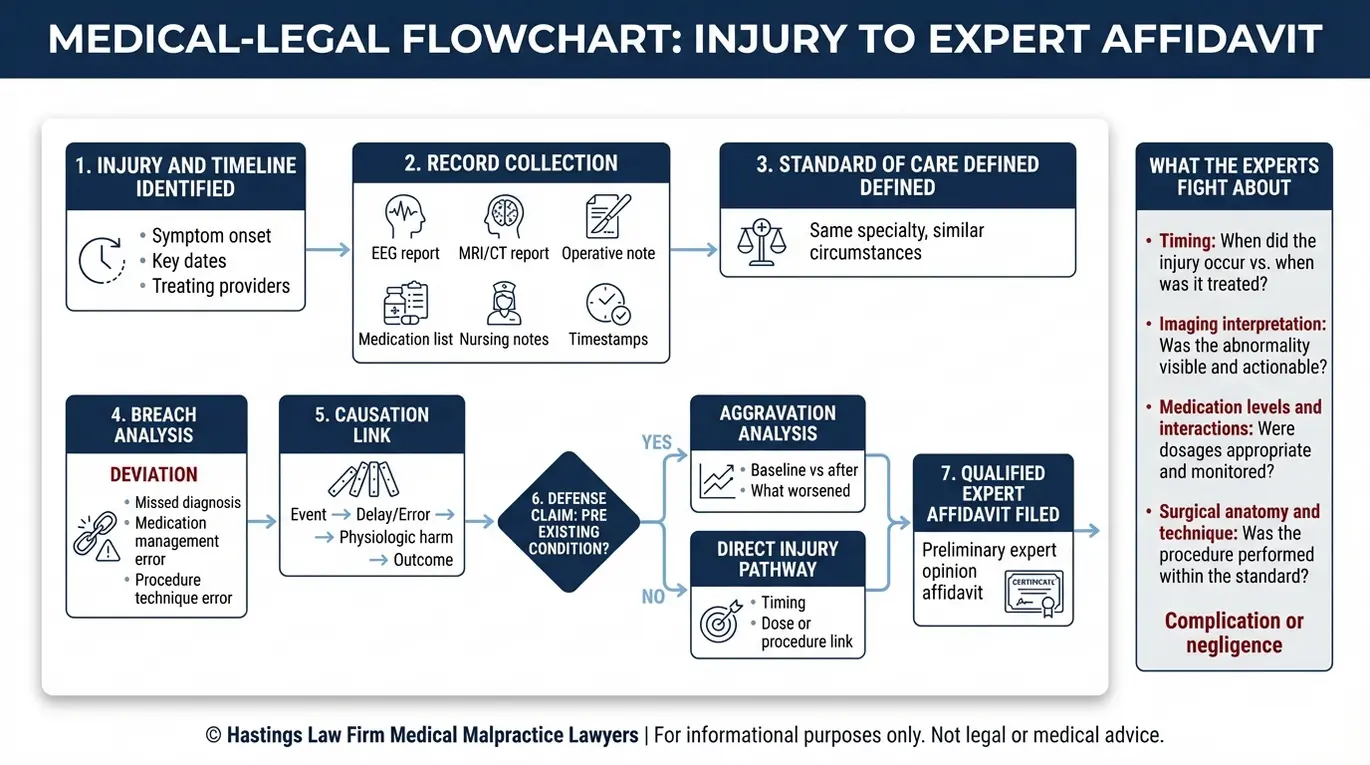
Proving liability requires establishing that the neurologist deviated from the accepted medical standard of care, confirmed by expert testimony from a similarly qualified specialist who certifies the breach directly caused the patient’s injury. This is the foundation of every neurology malpractice case. Thorough preparation makes the difference. Liability is established when the medical professional’s actions fall below the accepted standard for their field.
The Affidavit of Merit
Arizona law sets a specific requirement before a medical malpractice lawyer can move a lawsuit forward. Under Arizona Revised Statutes § 12-2603, the patient must obtain a preliminary expert opinion affidavit, sometimes called a certificate of merit. This document, often referred to as a medical expert affidavit, must come from a medical professional who practices or has recently practiced in the same specialty as the defendant.
The expert must certify, based on a review of the available evidence, that the standard of care was breached and that the breach caused injury. This statute prevents frivolous lawsuits but places a burden on valid patients to secure high-quality testimony immediately. A generic medical expert is often insufficient; the court requires a specialist with comparable training to the defendant.
This requirement exists to screen out claims that lack medical support. For patients, it means we must identify and retain a qualified neurology or neurosurgery expert early in the process. At Hastings Law Firm, our national network of medical experts allows us to match each case with a specialist whose credentials align with the specific issues involved.
Causation Challenges
Proving that a neurologist deviated from the standard of care is only half the equation. In an Arizona neurology lawsuit, you must also prove causation, legally known as proximate cause, meaning the deviation is what actually caused or worsened your injury. Defense attorneys often focus much of their effort here.
In neurology cases, they often argue that the patient’s underlying condition, such as epilepsy, multiple sclerosis, or a degenerative spinal disorder, is responsible for the outcome. If a patient has a history of migraines, the defense may claim a missed tumor diagnosis did not alter the outcome because the symptoms were indistinguishable.
Overcoming this requires showing that specific “red flag” symptoms appeared and were ignored. Our legal and medical team works to isolate what changed and when. We build detailed timelines using medical records, imaging results, an electroencephalogram (an EEG, which records electrical activity in the brain), magnetic resonance imaging (MRI scans that produce detailed images of the brain and spine), and clinical notes. This allows our experts to identify whether the injury was consistent with disease progression or resulted from a specific act or omission.
The “Battle of the Experts”
Neurology malpractice cases frequently come down to conflicting expert opinions. The defense will present their own specialist who may testify that the treatment was appropriate. Our team anticipates this.
Because our attorneys include former defense counsel who understand how these arguments are built, we prepare our experts to address counterarguments directly. Proving neurologist negligence requires not just a credible expert, but one who can clearly explain the medicine to a jury in terms that make sense.
Juries are often faced with highly technical medical jargon. Our role is to simplify these concepts, using visual aids and clear analogies to demonstrate exactly how the standard of care was violated. That ability to translate complex neuroscience into a persuasive narrative is central to how we approach every case as your neurology malpractice counsel.
Maximizing Compensation Under Arizona Law
Patients harmed by neurologist malpractice in Arizona can recover economic damages for medical bills and lost wages, as well as non-economic damages for pain and suffering, with no constitutional cap limiting the amount a jury can award. Arizona stands apart from many states in this regard. The Arizona Constitution expressly prohibits the legislature from placing a cap on damages in personal injury or wrongful death cases.
For catastrophic brain and spinal cord injuries, where lifetime care costs can reach millions of dollars, this protection is significant. Securing fair neurology error compensation requires a detailed approach to quantifying these lifelong impacts. Recoverable economic damages include measurable financial losses like hospital bills and missed income.
Recoverable damages in neurology cases may include:
- Past and future medical expenses, including surgeries, rehabilitation, and ongoing neurological care
- Lost wages and lost earning capacity if the injury affects your ability to work
- The cost of a life care plan, which projects future care needs for patients with permanent disabilities
- Pain and suffering, including physical discomfort and emotional distress
- Loss of enjoyment of life, particularly when cognitive changes alter personality, memory, or independence
- Wrongful death damages for families who have lost a loved one due to neurological negligence
One of the most challenging aspects of damages in neurology cases involves valuing “invisible” injuries. Cognitive decline, personality changes, chronic pain, and loss of independence are not always visible from the outside, but they profoundly affect the patient and their family. The loss of executive function, which is the ability to plan, focus, and multitask, can destroy a career even if the patient looks healthy.
We use day-in-the-life videos and testimony from colleagues to demonstrate how these deficits have altered the patient’s reality. An Arizona neurologist malpractice lawyer works with neuropsychologists and life care planners to document these losses in a way that reflects their true impact.
A life care plan is not just a medical bill estimate. It is a comprehensive analysis created by rehabilitation experts. It accounts for inflation, medical advancements, and the specific needs of the patient, such as home modifications, specialized transportation, and 24-hour nursing care. Without this detailed projection, a settlement may run out years before the patient’s needs are met. The Arizona Attorney General’s Life Care Planning resources outline the framework used to calculate long-term care needs for individuals with permanent disabilities.
Contact the Arizona Doctor Malpractice Attorneys at Hastings Law Firm Today for Help
Neurological injuries are among the most life-altering consequences of medical negligence. Challenging the institutions and providers responsible requires a firm with the medical knowledge, legal experience, and trial preparation to see it through.
Hastings Law Firm is built for exactly these cases. With a Phoenix office, a team of in-house medical professionals, and former defense attorneys who know how hospitals and insurers respond to claims, we are prepared to stand with you from the first consultation through trial if necessary.
We work on a contingency fee basis, which means you pay no attorney fees or costs unless we secure a recovery for you. There is no financial risk in reaching out.
If you or a loved one suffered a brain or spinal cord injury due to a neurologist’s or neurosurgeon’s error, time matters. Evidence can deteriorate and legal deadlines apply. Contact us today for a free, confidential case evaluation. Let us help you find the answers you deserve.
Frequently Asked Questions About Neurologist Malpractice in Arizona


This content was researched and written by the Hastings Law Firm editorial team, which includes attorneys, medical professionals, and experienced researchers. Our writing is informed by internal knowledge and practical experience, and we cross-check critical details against authoritative sources cited throughout. Every piece undergoes human-led fact-checking and legal review. Because legal and medical information can change, if you spot an error, please contact us. Learn more about our content standards and review process on our editorial policy page.

Tommy Hastings, founder of Hastings Law Firm, is a board-certified personal injury trial lawyer dedicated exclusively to healthcare injury cases. Since 2001, he has represented injured patients and families in litigation against major hospital systems, pharmaceutical companies, and negligent healthcare providers nationwide. He has handled numerous high-profile cases that have drawn national media attention and resulted in multi-million dollar recoveries. He draws on that experience in his writing, helping readers understand how these cases work and what options may be available to them.
