


Arizona Neonatologist Malpractice Lawyer
Written by: Hastings Law Firm | Reviewed by: Tommy Hastings | Updated: July 27, 2026
A newborn injury in the NICU can leave families overwhelmed and searching for clear answers about what went wrong. Neonatologist malpractice allegations often involve preventable breakdowns in medication dosing, respiratory management, or timely recognition of dangerous changes in an infant condition. When critical warning signs are missed or treatment is delayed, the harm can be severe and lasting, affecting a child health and long term needs. If you or a loved one were harmed or worse due to neonatologist malpractice in Arizona, contact Hastings Law Firm for a free, confidential case review.
Top Rated Arizona Neonatologist Malpractice Lawyers
What You Should Know About NICU Doctor Negligence Claims in Arizona:
- Lasting harm can result when NICU care falls below the medical standard of care for critically ill or premature infants.
- Severe and permanent injury can follow when oxygen deprivation is not recognized and treated quickly with cooling therapy.
- Serious complications can occur when ventilator management or intubation is performed incorrectly, leading to oxygen deprivation or lung damage.
- Dangerous overdoses can happen when weight based medication dosing is miscalculated, especially when decimal point errors occur.
- Rapid deterioration can occur when infections or metabolic problems are not diagnosed and treated promptly.
- Recovery options can be limited when the wrong responsible party is targeted, since hospital responsibility can depend on whether a neonatologist is an employee or an independent contractor.
- Financial recovery can be shaped by lifetime care needs, since damages may account for long term medical care, therapy, and lost earning capacity.
- Options can be lost if action is delayed, since records and electronic monitoring data can be overwritten or destroyed over time.
- Early expert review can be required in Arizona, which can affect whether a claim can move forward.
- Claims involving public hospitals can be barred quickly, since stricter notice requirements apply to public entities in Arizona.

A Healthcare Focused Law Firm
When your newborn is harmed in the neonatal intensive care unit (NICU), a facility designed to protect the most fragile patients, the experience can feel like a profound betrayal of trust. You placed your child’s life in the hands of a neonatologist, a physician specially trained to treat critically ill and premature infants, and something went wrong. The confusion, grief, and uncertainty that follow are overwhelming, and you deserve honest answers about what happened.
At Hastings Law Firm, we focus exclusively on medical malpractice. Our team is led by Tommy Hastings, a board-certified trial lawyer with over two decades of experience in complex medical negligence cases. He is board-certified in Personal Injury Trial Law by the Texas Board of Legal Specialization, a distinction held by very few attorneys. We work alongside in-house nurse consultants and a national network of medical experts to evaluate whether your child’s injury was preventable.
If you believe your baby was harmed by negligent care in the NICU, we welcome you to contact us for a free, confidential case evaluation. There are no fees unless we recover compensation for your family. Our firm is committed to uncovering the truth and ensuring your child’s future financial security is protected.
Common Errors Committed by Neonatologists in Arizona Hospitals
Neonatologist malpractice occurs when a specialist deviates from the standard of care through medication errors, failure to diagnose infections like sepsis, or improper management of respiratory equipment. An Arizona neonatal malpractice attorney evaluates claims across several categories of NICU error. Below are the most common types we investigate.
Medication Mistakes and Dosage Calculation Errors
Newborns require precise weight-based dosing, meaning drug amounts are calculated based on the infant’s weight in milligrams per kilogram (mg/kg). Because a premature infant may weigh just one or two pounds, even a small mathematical error can deliver a dangerously concentrated dose. Dosage calculations are particularly unforgiving in this setting; a decimal point error can result in a tenfold overdose.
Medication errors in the NICU often involve antibiotics, sedatives, or intravenous fluids that are administered at adult-scaled quantities or at the wrong rate. These mistakes often happen during shift changes or emergencies, yet they remain strictly preventable.
Respiratory Management Failures
Many NICU patients depend on mechanical ventilation to breathe. Neonatologists manage breathing support for infants through various mechanical means. The ventilator must be calibrated to precise ventilator settings, including the fraction of inspired oxygen (FiO2), positive end-expiratory pressure (PEEP), and tidal volume, which together control how much air and oxygen the infant’s lungs receive.
Ventilator errors or intubation errors, such as placing the tube in the esophagus instead of the trachea, can lead to lung damage, oxygen deprivation, or respiratory distress syndrome (RDS). Prolonged exposure to improper oxygen levels can also cause retinopathy of prematurity or bronchopulmonary dysplasia. When a neonatologist fails to monitor or adjust these settings as the infant’s condition changes, the consequences can be severe and permanent.
Failure to Diagnose Infections and Metabolic Conditions
Premature and critically ill newborns are at high risk for sepsis, a life-threatening response to infection that can lead to organ failure within hours. Neonatologists are trained to recognize early warning signs, including temperature instability, changes in heart rate, and feeding intolerance. When these signs are dismissed or attributed to other causes, the infection can progress rapidly. Unlike adults, infants cannot communicate their distress, making clinical vigilance essential.
Hypoglycemia, or dangerously low blood sugar, is another condition that requires prompt diagnosis and treatment. If left unaddressed, it can cause seizures and brain injury. A failure to order timely blood glucose monitoring or to act on abnormal results may represent a breach of the neonatologist’s duty of care. Prompt intervention with glucose gel or IV dextrose is the standard, and missing this window is often negligent.
Understanding Hypoxic Ischemic Encephalopathy and Cooling Therapy Protocols
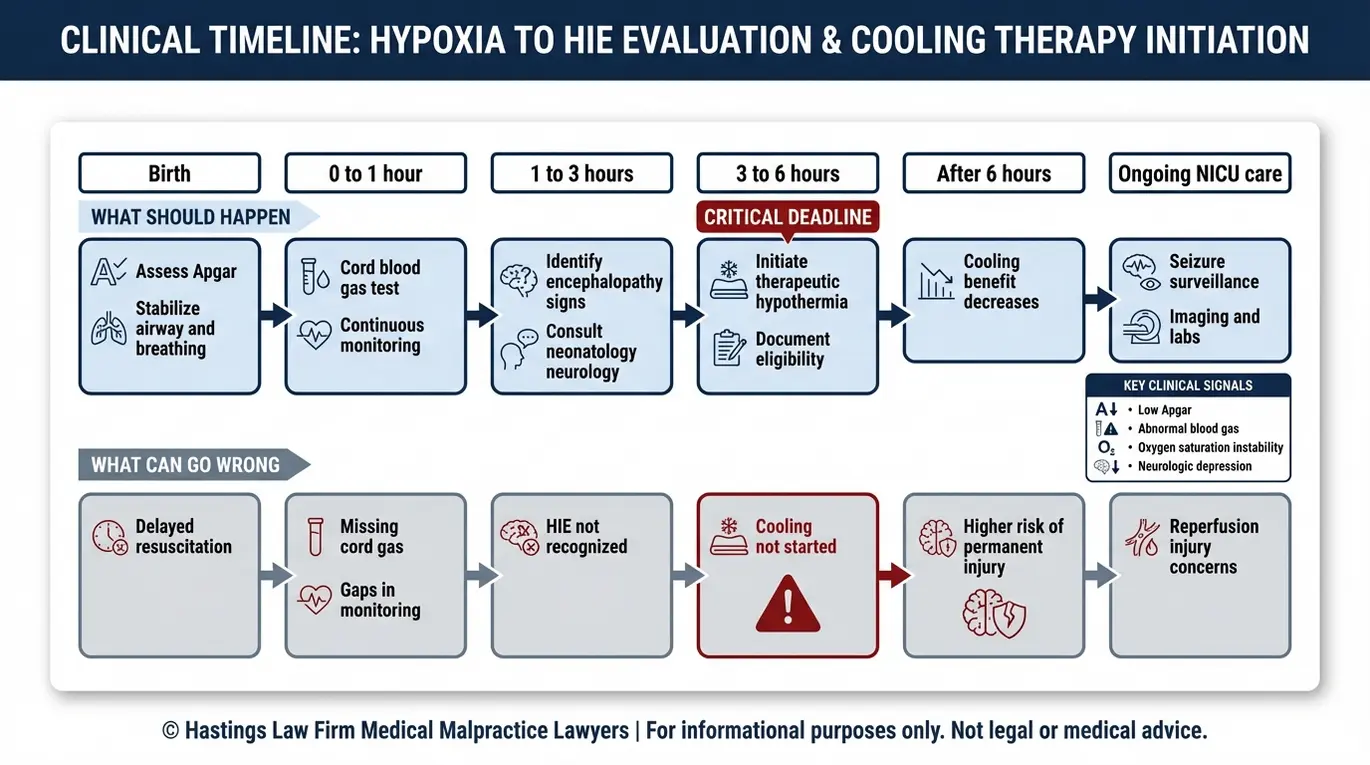
HIE, or hypoxic-ischemic encephalopathy, is a type of brain injury caused by oxygen deprivation that requires immediate intervention with therapeutic hypothermia within six hours to minimize permanent damage. It is one of the most time-sensitive emergencies a NICU team will face, and delays in recognition or treatment are a frequent basis for malpractice claims reviewed by a NICU negligence lawyer in Arizona.
How HIE Develops
HIE occurs when a newborn’s brain does not receive enough oxygen and blood flow during or shortly after birth. Monitoring failures, such as the misinterpretation of fetal heart tracings or delayed evaluation of cord blood gas test results, can allow hypoxia to go undetected. Similarly, low Apgar scores often provide early indicators that oxygen deprivation has occurred.
The brain cells, starved of oxygen, begin to die, leading to swelling and further injury. This primary phase of injury is often followed by a latent phase where the metabolism recovers partially before a secondary phase of energy failure occurs. This secondary phase is what therapeutic hypothermia aims to prevent.
The Six-Hour Window for Cooling Therapy
Therapeutic hypothermia, commonly called therapeutic hypothermia, is the standard treatment for moderate to severe HIE. The protocol involves lowering the infant’s core body temperature to around 33.5°C for 72 hours to slow the cascade of cellular damage in the brain. By slowing the metabolic rate, the treatment reduces the release of excitatory neurotransmitters and free radicals that kill neurons.
According to the National Center for Biotechnology Information’s resource on Neonatal Therapeutic Hypothermia, this treatment must be initiated within the first six hours of life to be effective. That six-hour window is not flexible. When a NICU team fails to recognize HIE indicators, delays obtaining necessary tests, or does not have cooling therapy equipment available, the opportunity for intervention may be lost entirely. Transporting the infant to a higher-level NICU must happen immediately if the birth facility cannot provide cooling.
Reperfusion Injury
Even after oxygen is restored, the process of re-establishing blood flow to damaged brain tissue can cause a secondary wave of injury known as reperfusion injury. This occurs during the recovery phase of a neonatal brain injury. Expert witnesses in these cases analyze whether the medical team managed this phase appropriately. Improper rewarming or inadequate monitoring during and after cooling can compound the original harm.
The Hastings Law Firm Difference
Results matter, but what truly sets us apart is how we achieve them. Every verdict, every settlement, and every Arizona courtroom victory comes from one guiding promise: To treat each client’s fight for justice as if it were our own.
This balance of skill, experience, and empathy reflects our core philosophy that justice should not only compensate the injured, but also make healthcare safer nationwide.

Establishing Liability and the Medical Standard of Care
To prove liability, your legal team must demonstrate that the neonatologist breached the accepted medical standard of care and that this breach directly caused your child’s specific injury. This requires more than showing that a bad outcome occurred. It means building an evidence-based case that connects the physician’s actions or inactions to the harm your child suffered.
Defining the Duty of Care
A neonatologist’s duty of care begins the moment they assume responsibility for treating your infant. This relationship can be established through a direct admission to the NICU, a consultation request, or on-call coverage. Once that duty exists, the physician is held to the standard of care expected of a reasonably competent neonatologist practicing under similar circumstances. This standard is not based on perfection, but on what a prudent specialist would do in the same situation.
Proving the Breach
Proving a breach means showing that the neonatologist failed to act in a way that a qualified peer would have acted given the same clinical information. We examine medical records, nursing notes, laboratory results, and monitor logs to identify where warning signs appeared.
Key evidence often includes Apgar scores, which assess a newborn’s heart rate, breathing, muscle tone, reflexes, and skin color, and cord blood gas tests. If these metrics indicated distress and the doctor failed to intervene, that inaction may constitute negligence.
We also look for expert testimony to substantiate these claims. A qualified expert witness must testify that the care provided fell below the standard. In some cases, systemic issues like understaffing or physician fatigue may have contributed to the error, and those factors become part of the investigation as well.
Under Arizona law, A.R.S. § 12-2603 requires that a preliminary expert opinion affidavit be filed early in the litigation. This means a qualified medical expert must review the case and confirm that there is a supportable basis for claiming the neonatologist breached the standard of care. Our team works with a national network of neonatal specialists to meet this requirement.
To build a case as a malpractice lawyer for neonatologist errors, we must establish the legal elements of malpractice:
- Duty: The neonatologist had a physician-patient relationship with the infant.
- Breach: The neonatologist’s care fell below the accepted standard.
- Causation: The breach directly caused the injury, rather than an unavoidable complication or pre-existing condition.
- Damages: The infant suffered measurable harm, whether physical, developmental, or financial.
Each of these elements requires supporting evidence, and the failure to prove even one can prevent recovery.
Investigating the Claim Against the Physician Versus the Hospital
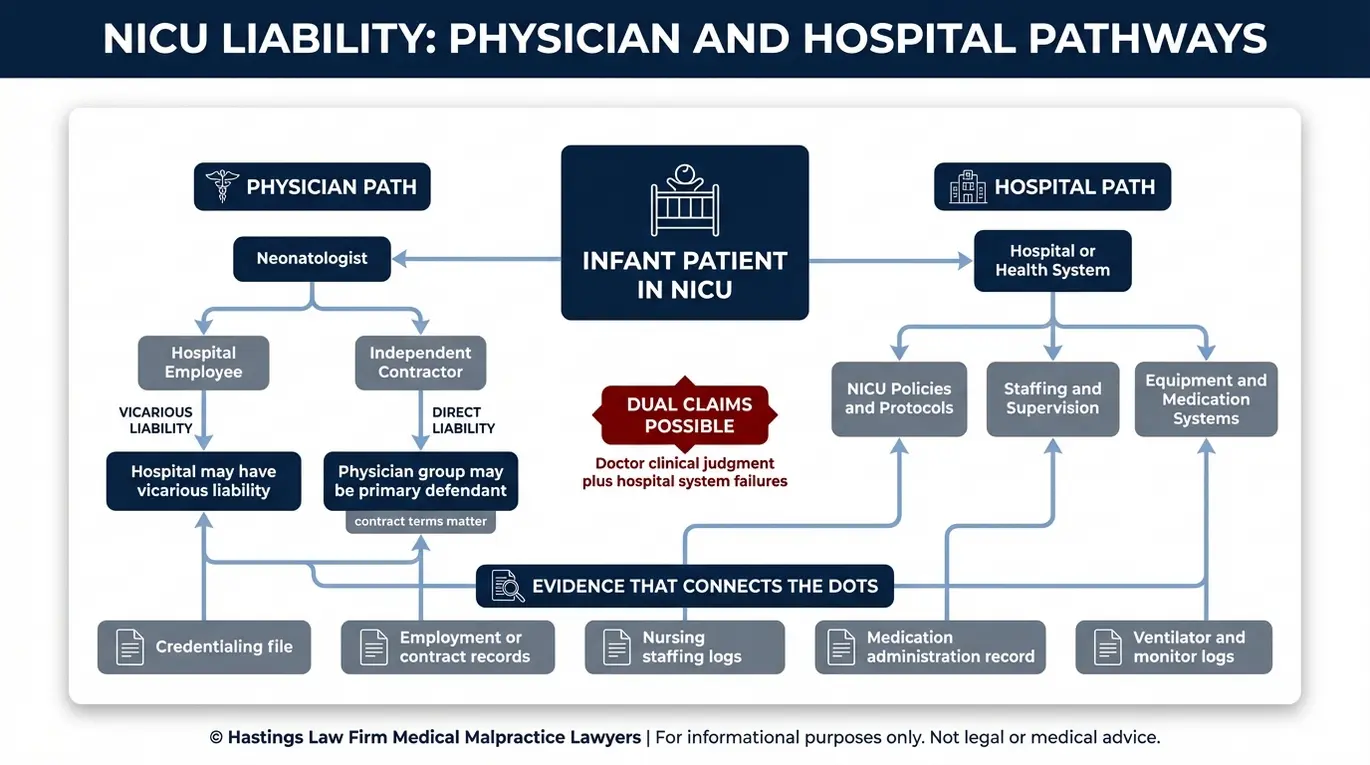
Liability often depends on whether the neonatologist is a direct hospital employee or an independent contractor, and this distinction affects how the lawsuit is filed and who may be responsible for paying damages. As an Arizona neonatologist negligence attorney team, one of the first things we investigate is the employment relationship between the physician and the facility.
Employment Status and Why It Matters
Many neonatologists are not employed directly by the hospital where they practice. Instead, they may work through a contracted physician group that provides NICU staffing. If the neonatologist is an independent contractor, the hospital may argue that it is not liable for the physician’s clinical decisions.
If the neonatologist is a hospital employee, the hospital can be held responsible under a legal doctrine called vicarious liability, which means an employer bears responsibility for the negligent acts of its employees performed within the scope of their job. Determining this status often requires reviewing employment contracts and hospital bylaws.
Pursuing Dual Claims
In many neonatal malpractice cases, there may be grounds to pursue claims against both the hospital and the physician. The neonatologist may be liable for clinical judgment errors, categorized as doctor negligence, while the hospital may bear separate responsibility for hospital negligence. Hospital negligence often involves systemic failures like inadequate NICU staffing, broken equipment, credentialing unqualified staff, or lack of established protocols for emergencies.
| Factor | Hospital Liability | Independent Contractor Liability |
|---|---|---|
| Employment relationship | Direct employee of the facility | Contracted through a separate physician group |
| Legal basis | Vicarious liability for employee conduct | Liability generally falls on the physician or their group |
| Common evidence examined | Staffing records, policies, training protocols | Physician contracts, credentialing documents, billing records |
| Typical claim focus | Systemic failures (staffing, equipment, protocols) | Clinical judgment errors by the individual physician |
Identifying the correct parties early in the process is important. Filing against the wrong entity, or missing a responsible party, can weaken or limit the claim. By distinguishing between institutional failure and individual provider error, we maximize the potential for full recovery.
Calculating Lifetime Damages and Life Care Planning
Damages in neonatal cases are calculated by projecting the lifetime cost of medical care, therapy, and lost earning capacity required for a child with permanent disabilities. Because these injuries often affect a child for decades, the financial analysis must account for needs that will extend well into adulthood. Working with an Arizona neonatologist malpractice law firm experienced in long-term damage modeling provides the necessary expertise for these projections.
Economic Damages
Economic damages represent the measurable financial costs of the injury. For a child with a serious NICU-related injury, these may include:
- Past and future surgeries, hospitalizations, and physician visits
- 24-hour or part-time nursing care and in-home support
- Physical, occupational, and speech therapy over the child’s lifetime
- Adaptive equipment such as wheelchairs, communication devices, and home modifications
- Future medical expenses tailored to the specific disability
- Lost future earning capacity if the child’s disability prevents employment as an adult
These figures are often substantial. To manage them effectively, families often use structured settlements, which provide tax-free periodic payments over the child’s life rather than a single lump sum.
Non-Economic Damages
Non-economic damages compensate for pain and suffering, loss of enjoyment of life, and the emotional toll on the child and their family. Arizona’s Constitution protects the right of juries to determine these awards without artificial caps, allowing full compensation based on the facts of each case.
The Role of Life Care Plans
A life care plan is a detailed financial roadmap created by medical and economic experts that projects every anticipated expense related to the child’s condition over their expected lifespan. These plans are supported by clinical evidence and may reference guidelines like the Standards of Practice for Pediatric Palliative Care published by the Alliance for Care at Home to ensure they reflect current best practices in pediatric care.
A well-constructed life care plan is often the single most influential piece of evidence in determining the size of a settlement or jury award. It translates your child’s daily needs into concrete numbers that a jury can understand and act on, covering everything from wheelchair replacements to annual therapy evaluations.
Arizona Statute of Limitations for Infant Injury Claims
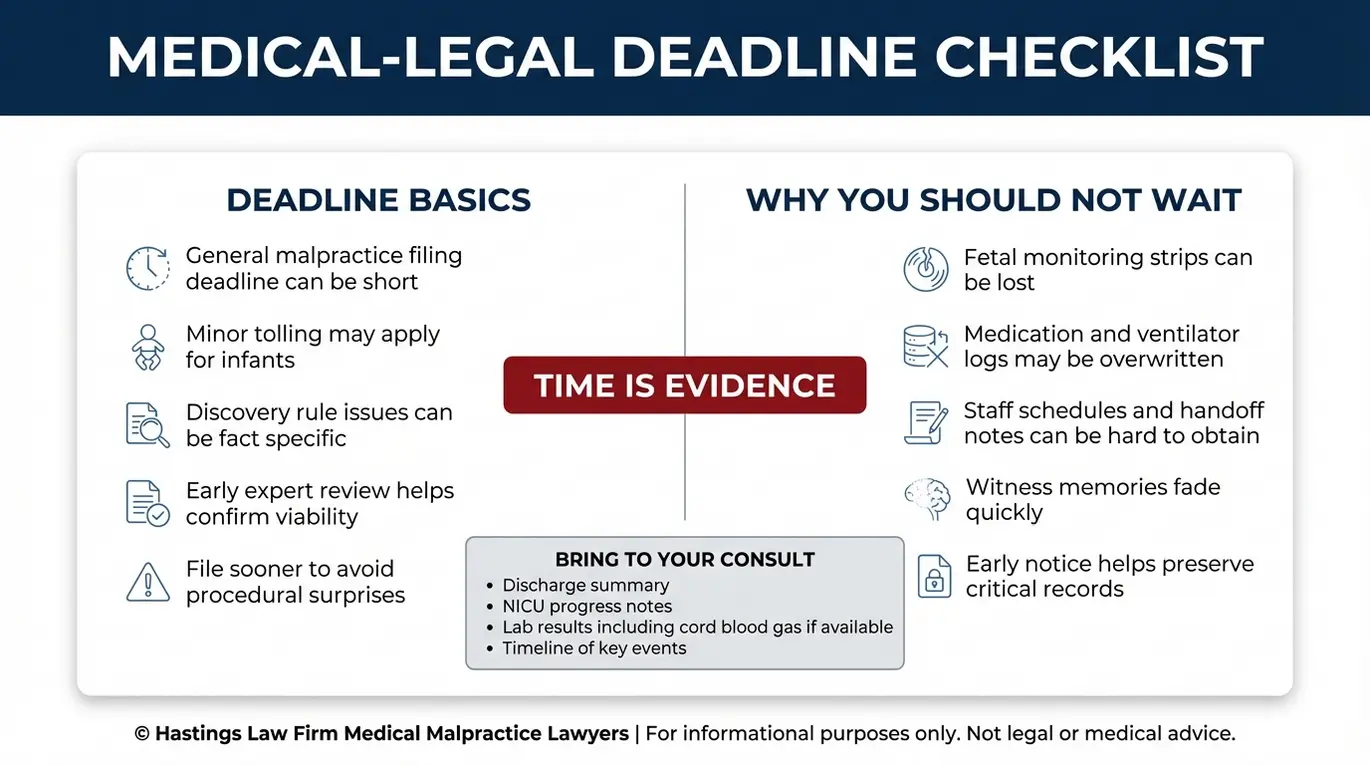
While Arizona generally requires medical malpractice claims to be filed within two years of the injury, cases involving minors may be tolled, meaning the filing deadline is paused, until the child turns 18. However, parents should still pursue claims much sooner to protect the integrity of their case. An Arizona birth injury malpractice lawyer can help you understand your specific deadlines and act before critical evidence is lost.
The General Rule
For adults, Arizona law sets a two-year statute of limitations for medical malpractice claims. This clock typically starts on the date the injury occurred or the date it was reasonably discovered, a principle known as the discovery rule.
The Exception for Minors
Because infants and young children cannot advocate for themselves, Arizona tolls the statute of limitations for minors. This means the two-year filing period may not begin until the child turns 18, giving them until age 20 to bring a claim. While tolling the statute of limitations provides legal protection, it does not protect the evidence your case depends on.
Why Waiting Can Harm Your Case
Even though the law may allow more time, medical records, electronic fetal monitor strips, NICU logs, and staffing schedules can be lost, overwritten, or destroyed over time. Witnesses move, retire, or forget details. Filing early allows your legal team to issue preservation letters, secure records, and depose key medical staff while their recollections are still fresh. The legal deadline is a maximum, not a recommended timeline.
Hospitals may also change ownership or insurance carriers over the course of 18 years, complicating the process of identifying the liable party. Evidence degradation is the enemy of a successful lawsuit. Electronic metadata on fetal monitoring strips can be essential for proving tampering or timing errors, and this data is easily lost if not preserved immediately. Acting promptly gives your legal team the best opportunity to build a strong, evidence-supported case, even if the statute of limitations technically permits a longer wait.
Contact the Arizona Doctor Malpractice Attorneys at Hastings Law Firm Today for Help
If your child was injured in the NICU and you suspect the care they received fell short, you deserve clear answers about what happened and whether it could have been prevented. At Hastings Law Firm, finding the truth is our starting point for every case.
Our team, which includes former defense attorneys, in-house nurse consultants, and board-certified patient advocates, investigates every case with the same rigor we would bring to trial. That preparation is not hypothetical. We build each case from day one as though it will go before a jury, and that approach is what drives fair outcomes for the families we represent.
Your consultation is free, confidential, and led by a patient advocate who understands both the medical and legal issues involved. You pay no attorney fees or costs unless we secure a recovery for your family. Contact Hastings Law Firm today and let us review what happened and explain your options.
Frequently Asked Questions About Neonatologist Malpractice in Arizona


This content was researched and written by the Hastings Law Firm editorial team, which includes attorneys, medical professionals, and experienced researchers. Our writing is informed by internal knowledge and practical experience, and we cross-check critical details against authoritative sources cited throughout. Every piece undergoes human-led fact-checking and legal review. Because legal and medical information can change, if you spot an error, please contact us. Learn more about our content standards and review process on our editorial policy page.

Tommy Hastings, founder of Hastings Law Firm, is a board-certified personal injury trial lawyer dedicated exclusively to healthcare injury cases. Since 2001, he has represented injured patients and families in litigation against major hospital systems, pharmaceutical companies, and negligent healthcare providers nationwide. He has handled numerous high-profile cases that have drawn national media attention and resulted in multi-million dollar recoveries. He draws on that experience in his writing, helping readers understand how these cases work and what options may be available to them.
