


Arizona Infant Herpes C-Section Error Lawyer
Written by: Hastings Law Firm | Reviewed by: Tommy Hastings | Updated: July 27, 2026
Neonatal herpes simplex virus infection can be a life altering injury when HSV exposure during delivery is not properly managed. The risk is known during pregnancy, and careful screening, communication, and delivery planning are central to protecting an infant. When active lesions or prodromal symptoms are present, allowing a vaginal delivery can expose a newborn to serious harm with lasting medical and developmental consequences. Families often face uncertainty, grief, and major care needs after a preventable transmission. If you or a loved one were harmed or worse due to an infant herpes C section error in Arizona, contact Hastings Law Firm for a free, confidential case review.

Legal Help for Preventable Neonatal HSV Transmission in Arizona
What You Should Know About Neonatal HSV Transmission Claims in Arizona:
- Lifelong medical and developmental consequences can follow neonatal HSV when transmission occurs during delivery and treatment is delayed.
- A preventable neonatal HSV infection can be linked to a failure to prioritize a Cesarean delivery when active lesions or prodromal symptoms are present.
- Options for recovery can narrow if Arizona filing time limits are missed, even when exceptions may apply for injuries to minors.
- Financial strain can be substantial when a child needs long term care, therapy, and support after a preventable birth related infection.
- Disputes over responsibility can turn on whether the standard of care was met for managing known HSV risk during labor and delivery.
- Accountability can be harder to establish without qualified expert support, since Arizona requires an early sworn expert statement in malpractice cases.
- Clarity about what happened can depend on whether the mother HSV history and delivery findings were documented and communicated to the labor and delivery team.
- A missed opportunity to reduce transmission risk may be indicated when admission exams for lesions were not performed or recorded.
- A preventable exposure risk may be suggested when suppressive antiviral therapy was not offered during pregnancy despite a known HSV history.
- Causation questions often depend on detailed medical records that connect delivery decisions to the infant infection.

A Healthcare Focused Law Firm
Learning that your newborn has been diagnosed with a neonatal herpes simplex virus infection, a potentially life-threatening condition caused by exposure to HSV during birth, can feel overwhelming and deeply unfair. Genital herpes, a sexually transmitted infection caused by HSV-1 or HSV-2, is a known and manageable risk during pregnancy. When a medical team fails to take the right precautions, including performing a Cesarean section when indicated, a preventable infection can change your child’s life.
If you believe your baby contracted herpes because of a medical error during delivery, you are not wrong to ask questions. An Arizona infant herpes C-section error lawyer at Hastings Law Firm can review your medical records, explain what should have happened, and help you understand your legal options. The consultation is free, and you pay nothing unless we recover for your family.
Medical Negligence Involving Failure to Perform C-Sections
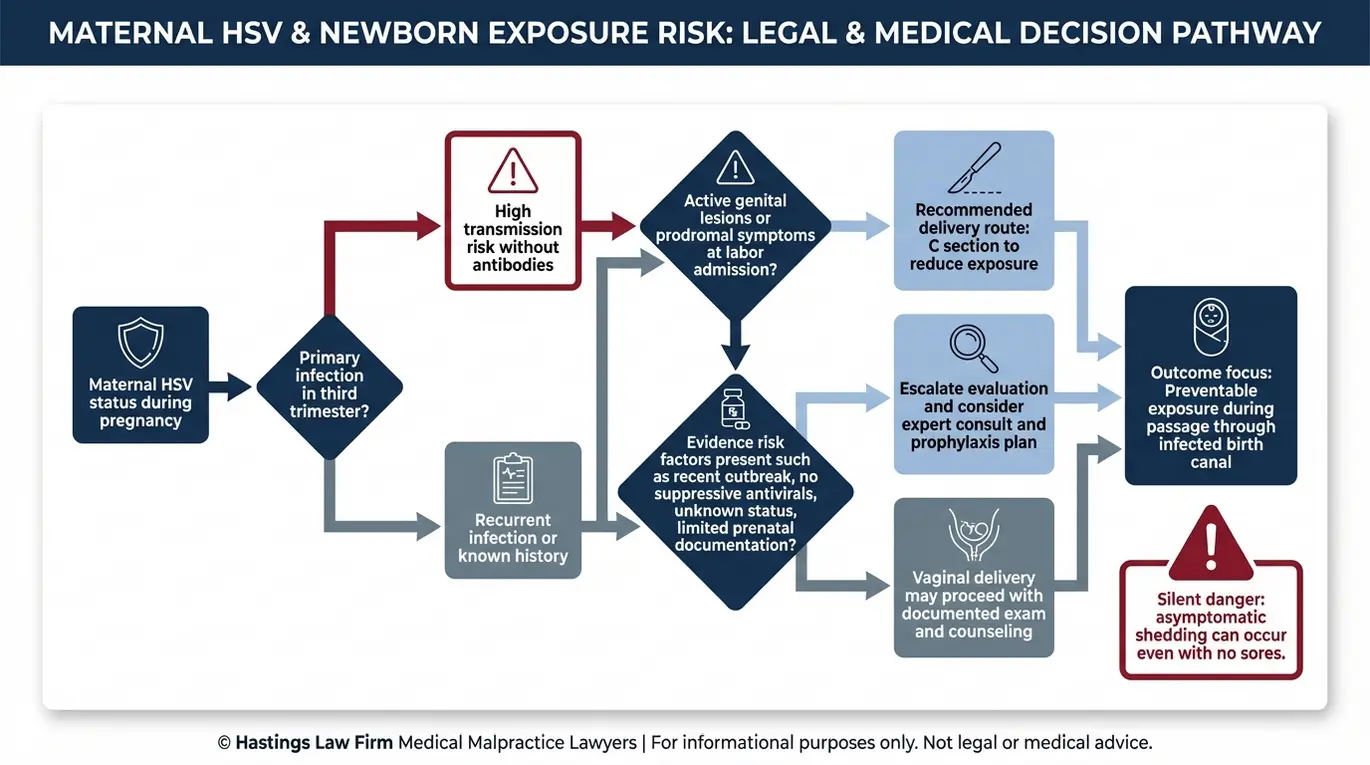
Medical negligence occurs when an OB-GYN fails to adhere to the standard of care, such as not offering a Cesarean section when active HSV lesions or prodromal symptoms are present during labor. The standard of care is the level of treatment a reasonably competent physician would provide under similar circumstances. The standard of care is the medical requirement that providers must follow to protect patients. One well-established example is not offering a Cesarean section when active HSV lesions or prodromal symptoms, such as tingling, burning, or pain that signal an oncoming outbreak, are present during labor.
The Management of Genital Herpes in Pregnancy: ACOG Practice Bulletin Number 220 makes the clinical expectations clear. When a mother has signs of active genital herpes at the time of delivery, a C-section is the recognized method for reducing transmission risk to the infant. A vaginal delivery under these conditions exposes the baby to a serious and preventable danger. Physicians must prioritize this surgical intervention over vaginal birth to uphold the standard of care and ensure infant safety.
As an Arizona birth injury attorney team, we review cases for specific failures that may constitute a breach of duty. Common examples of negligent actions include:
- Failing to perform a physical examination of the birth canal for active lesions upon hospital admission
- Ignoring or overlooking a documented maternal history of genital herpes
- Not prescribing suppressive antiviral therapy, such as valacyclovir (Valtrex) or acyclovir, starting around 36 weeks of pregnancy to reduce viral shedding before delivery. This prophylactic measure is important for minimizing the risk of recurrence during labor.
- Proceeding with a vaginal delivery despite visible lesions or reported prodromal symptoms
- Failing to document or communicate the mother’s HSV status to the labor and delivery team
Any of these failures can form the basis of a medical malpractice claim. Under Arizona Revised Statutes § 12-542, families generally have two years to file a claim, though exceptions may apply for injuries to minors. If you suspect a C-section error led to your child’s infection, contacting a C-section error lawyer early protects both your evidence and your legal rights.
Understanding Neonatal HSV Transmission Risks During Childbirth
Neonatal HSV is most commonly transmitted during a vaginal delivery when an infant passes through an infected birth canal, exposing them to the virus through direct contact with lesions or asymptomatic shedding. Intrapartum transmission is the passing of an infection from mother to baby during the birth process. This process, known as intrapartum transmission, poses severe risks to the newborn. The baby comes into direct contact with active lesions or with the virus itself through asymptomatic viral shedding, where the virus is present on the skin’s surface even without visible sores.
Not all maternal HSV infections carry equal risk. Key factors that influence the likelihood of transmission include:
- Primary versus recurrent infection: A mother who acquires genital herpes for the first time late in pregnancy, particularly in the third trimester, poses the highest risk. According to data from the National Center for Biotechnology Information, the transmission rate during a primary maternal infection can reach 30 to 50 percent because the mother has not yet developed antibodies to pass to the baby.
- Recurrent outbreaks: Women with a known history of HSV-1 or HSV-2 have a lower, but still present, transmission risk, especially if an active outbreak occurs at the time of labor.
- Asymptomatic shedding: Research published by the JAMA Network on genital herpes shedding patterns confirms that the virus can shed without any visible symptoms. Thorough maternal history-taking, prenatal antiviral therapy, and careful examination at delivery are important steps in an infant herpes lawyer’s review of a case.
When these high-risk factors are present and a vaginal delivery is still allowed to proceed, the resulting infection may represent a preventable medical error.
Specific Risks of Third-Trimester Primary Infection
Acquiring herpes for the first time in the third trimester, known as a third-trimester primary HSV infection, is medically distinct from a recurrent outbreak. At this stage, the mother’s immune system has not had time to produce sufficient HSV antibodies, specifically the maternal HSV antibodies (transplacental IgG) that cross the placenta and offer some degree of protection to the baby.
Without this passive immunity, the newborn faces a far greater viral load during delivery. Late-pregnancy primary infections require aggressive monitoring, antiviral medication, and strong consideration for a planned Cesarean delivery well before labor begins.
The Hastings Law Firm Difference
Results matter, but what truly sets us apart is how we achieve them. Every verdict, every settlement, and every Arizona courtroom victory comes from one guiding promise: To treat each client’s fight for justice as if it were our own.
This balance of skill, experience, and empathy reflects our core philosophy that justice should not only compensate the injured, but also make healthcare safer nationwide.

Long-Term Complications and Damages from Neonatal Herpes
Untreated or delayed treatment of neonatal HSV can lead to catastrophic outcomes, including cerebral palsy, intellectual disabilities, seizures, and disseminated disease affecting multiple organs. Neonatal herpes is a serious viral infection in newborns that can lead to permanent brain damage or organ failure. The specific outcome depends largely on which form of the disease develops.
Neonatal HSV typically presents in one of three categories:
| Classification | What It Affects | Potential Outcomes |
|---|---|---|
| SEM Disease (Skin, Eye, and Mouth) | Localized to the skin, eyes, and mucous membranes | Generally favorable if treated promptly with IV acyclovir; delays can allow progression to more severe forms |
| CNS Disease (Central Nervous System) | The brain and spinal cord, causing encephalitis or meningoencephalitis | Seizures, developmental delays, intellectual disabilities, cerebral palsy |
| Disseminated Disease | Multiple organs, including the liver, lungs, and heart | Sepsis-like illness; often fatal without immediate IV acyclovir; survivors may face permanent organ damage |
A study published in PMC on neonatal HSV epidemiology and outcomes confirms that even with modern treatment, CNS and disseminated disease carry significant mortality and long-term morbidity rates. Because permanent CNS damage is often irreversible, early detection is important.
For families affected by these outcomes, a medical malpractice attorney in Arizona can help pursue damages that reflect the true scope of the harm. These may include the cost of lifelong medical care, therapy and rehabilitation, lost future earning capacity, and pain and suffering. Parents face an immense emotional and financial burden when a preventable injury alters their child’s entire life trajectory, and the goal is to secure the financial resources your child will need.
Proving Liability and Seeking Justice in Arizona
To succeed in an Arizona medical malpractice claim, a plaintiff must prove through expert testimony that the healthcare provider violated the standard of care and that this violation directly caused the infant’s HSV infection. Arizona law requires plaintiffs to file a preliminary expert opinion affidavit, often called an Affidavit of Merit, as outlined in Arizona Revised Statutes § 12-2603.
This document is a sworn statement from a medical expert confirming that a healthcare provider was likely negligent. At Hastings Law Firm, our in-house medical staff and national expert network handle this process. As your Arizona C-section error lawyer, we work to connect the failure to perform a Cesarean section directly to your child’s infection, using detailed medical records to meet the burden of proof that Arizona courts require. Our consultations are free, and families pay no fees or costs unless we win.
Contact the Arizona Birth Injury Attorneys at Hastings Law Firm Today for Help
If your child suffered a preventable herpes infection because a doctor failed to manage a known HSV risk or perform a timely C-section, you deserve honest answers about what happened and what comes next.
Founded by board-certified trial attorney Tommy Hastings, our firm focuses exclusively on medical malpractice. Our team includes in-house nurses, former defense attorneys, and board-certified trial lawyers who understand both the medicine and the law behind these cases. Our lawyers have experience anticipating defense tactics because we understand how hospital legal teams operate. We prepare every case as though it is going to trial, and that preparation allows us to negotiate from a position of strength on your family’s behalf.
Contact our Arizona medical malpractice team for a free, confidential case review. There is no cost to speak with us, and no fee unless we recover compensation for your family. Let us help you find answers and protect your child’s future.
Frequently Asked Questions About Infant Herpes C-Section Error in Arizona


This content was researched and written by the Hastings Law Firm editorial team, which includes attorneys, medical professionals, and experienced researchers. Our writing is informed by internal knowledge and practical experience, and we cross-check critical details against authoritative sources cited throughout. Every piece undergoes human-led fact-checking and legal review. Because legal and medical information can change, if you spot an error, please contact us. Learn more about our content standards and review process on our editorial policy page.

Tommy Hastings, founder of Hastings Law Firm, is a board-certified personal injury trial lawyer dedicated exclusively to healthcare injury cases. Since 2001, he has represented injured patients and families in litigation against major hospital systems, pharmaceutical companies, and negligent healthcare providers nationwide. He has handled numerous high-profile cases that have drawn national media attention and resulted in multi-million dollar recoveries. He draws on that experience in his writing, helping readers understand how these cases work and what options may be available to them.
