


Arizona Infant Arterial Ischemic Stroke Lawyer
Written by: Hastings Law Firm | Reviewed by: Tommy Hastings | Updated: July 27, 2026
Perinatal arterial ischemic stroke can leave a newborn with lasting neurological harm when blood flow to the brain is blocked around the time of birth. Families often face uncertainty about whether warning signs were missed, whether imaging was ordered promptly, and whether delays allowed preventable injury to worsen. The topic also involves how liability is evaluated when care falls below accepted standards and how long term needs are considered through life care planning and damages. If you or a loved one were harmed or worse due to infant arterial ischemic stroke malpractice in Arizona, contact Hastings Law Firm for a free, confidential case review.

Top Rated Malpractice Attorneys for Neonatal Injuries in Arizona
What You Should Know About Neonatal Stroke Misdiagnosis Claims in Arizona:
- Long term disability can follow a perinatal arterial ischemic stroke when blood flow to a newborn brain is blocked around the time of birth.
- Preventable brain injury can worsen when warning signs are not treated as urgent and diagnostic imaging is delayed.
- Mislabeling seizures as benign jitteriness can delay appropriate evaluation and treatment.
- Liability disputes can turn on whether a provider breach of the accepted standard of care directly caused or worsened the injury.
- Responsibility can extend beyond one clinician when hospital negligence involves staffing or safety protocol failures.
- Compensation can be shaped by a Life Care Plan that projects lifetime medical care therapy and adaptive support needs.
- Recovery can include economic losses such as future treatment and lost earning capacity and non economic harms such as pain and suffering.
- Options for non economic damages in Arizona can be broader because the article states there is no cap in most medical malpractice cases.
- Diagnostic clarity can depend on MRI with diffusion weighted imaging as the gold standard while CT may be used first to rule out bleeding.
- Access to timely neuroimaging can vary by hospital location and disparities in care can affect outcomes.

A Healthcare Focused Law Firm
Learning that your newborn has suffered a stroke is overwhelming. You may be searching for answers about what happened, whether the medical team acted appropriately, and what your child’s future will look like. These are fair questions, and you deserve honest, informed guidance.
Founded by board-certified trial lawyer Tommy Hastings in 2005, Hastings Law Firm focuses exclusively on medical malpractice. Our team includes experienced attorneys, in-house nurse consultants, and former defense lawyers who understand how hospitals respond to these claims. If your infant was diagnosed with an arterial ischemic stroke and you suspect a medical error, our Arizona infant arterial ischemic stroke lawyer can review the medical records to help you understand your legal options.
Contact us for a free, confidential case evaluation. There is no fee unless we recover compensation for your family.
Understanding Perinatal Arterial Ischemic Stroke and Birth Injuries
Perinatal Arterial Ischemic Stroke, often called PAIS, occurs when blood flow to a newborn’s brain is blocked by a clot or a narrowing artery around the time of birth, potentially leading to permanent neurological damage or cerebral palsy. This interruption can cause lasting harm to the child’s developing brain.
Unlike strokes in adults, which are frequently tied to lifestyle factors like high blood pressure or smoking, PAIS typically results from conditions related to pregnancy, delivery, or the infant’s developing vascular system. According to research published by Symptomatic Neonatal Arterial Ischemic Stroke With Prenatal and Postnatal Neuroimaging, many neonatal strokes involve the Middle Cerebral Artery (MCA), one of the brain’s primary blood vessels. Since the MCA supplies a significant portion of the cerebral hemisphere, blockages here can result in extensive motor and cognitive deficits. Recognizing the risks during the perinatal window, which is the period from 28 weeks gestation to 28 days after birth, is important for medical providers, as the window for effective intervention is often narrow.
The underlying mechanism usually involves thromboembolism, a pathological process where thrombosis, a blood clot forming inside a vessel, or an embolism, a clot traveling from elsewhere in the body, obstructs circulation. In newborns, these clots can originate from the placenta, the umbilical vessels, or the infant’s own immature circulatory system. This blockage can result in permanent neurological damage that affects motor skills and cognitive development.
Understanding the type of stroke is critical because the cause, treatment, and legal implications differ. An infant stroke attorney can help determine whether the medical team’s response matched what the diagnosis required.
| Feature | Ischemic Stroke | Hemorrhagic Stroke | Perinatal Arterial Ischemic Stroke (PAIS) |
|---|---|---|---|
| Mechanism | Blood clot blocks an artery | A blood vessel ruptures and bleeds into the brain | Clot blocks an artery during the perinatal window (28 weeks gestation through 28 days after birth) |
| Common Cause | Thrombosis or embolism | Vascular malformation, clotting disorders, trauma | Placental clots, umbilical vessel issues, birth-related factors |
| Typical Presentation | Seizures, lethargy, asymmetric movement | Sudden neurological decline, apnea, bulging fontanelle | Seizures (often within 12–72 hours of birth), favoring one side |
| Primary Imaging | MRI with diffusion-weighted imaging (DWI) | CT scan for rapid hemorrhage detection | MRI is the gold standard for confirming diagnosis |
| Common Outcomes | Hemiparesis, developmental delays | Variable; depends on severity and location | Cerebral palsy, epilepsy, cognitive impairment |
A PAIS lawyer in Arizona can work with medical experts to determine whether the type of stroke your child experienced was identifiable, and whether earlier intervention could have reduced the harm.

Identifying Symptoms and Diagnostic Errors in Newborns
Unlike adults who show “FAST” signs, infants with strokes typically present with seizures, lethargy, or favor one side of the body, which requires immediate imaging (MRI) to prevent further brain injury. Newborns cannot report symptoms, so the medical team must recognize subtle clinical signs and respond with immediate diagnostic imaging.
Diffusion-weighted magnetic resonance imaging (DWI-MRI), a specialized type of MRI that detects restricted water movement in damaged brain tissue, is considered the gold standard for confirming neonatal stroke. As outlined by the Neuroimaging in Perinatal Stroke and Cerebrovascular Disease resource, early imaging is essential to determining the type, location, and extent of brain injury. A CT scan may be used first to rule out active bleeding, but MRI provides far more detailed information about ischemic damage.
When a medical team fails to order appropriate imaging after observing warning signs, the delay can allow preventable brain injury to progress. A neonatal stroke misdiagnosis lawyer evaluates whether the standard of care required earlier testing and whether the delay contributed to the child’s outcome.
Warning signs that should prompt immediate evaluation in a newborn include:
- Seizures or repetitive abnormal movements
- Prolonged lethargy or difficulty waking
- Apnea (pauses in breathing)
- Hypotonia (low muscle tone) or limb weakness on one side
- Poor feeding or difficulty latching
- Abnormal eye movements
Research also raises concerns about equity in neonatal care. A study from Washington University Digital Commons on racial and geographic disparities in neonatal brain care found that access to timely neuroimaging can vary based on hospital location. Separately, findings published through the Maternal Race Ethnicity Hypertension and Risk for Stroke During Delivery Admission study highlight that certain populations face higher stroke-related risks during delivery. An Arizona birth injury attorney can investigate whether systemic gaps affected the care your child received.
Common Misdiagnoses in Infant Care
Neonatal stroke symptoms are frequently mistaken for other conditions. Neonatal seizures, which are sudden abnormal electrical discharges in a newborn’s brain, are sometimes dismissed as jitteriness. This is a term for benign neonatal tremors that are usually harmless and self-resolving. The distinction matters because jitteriness can often be stopped by gently holding the limb, while true seizures cannot.
Other misdiagnoses include hypoxic-ischemic encephalopathy (a related but distinct form of anoxic brain injury), simple reflux, or general fussiness. Each misdiagnosis represents a potential delay in treatment, and our medical-legal team examines the clinical timeline to determine whether providers should have recognized the signs sooner.

The Hastings Law Firm Difference
Results matter, but what truly sets us apart is how we achieve them. Every verdict, every settlement, and every Arizona courtroom victory comes from one guiding promise: To treat each client’s fight for justice as if it were our own.
This balance of skill, experience, and empathy reflects our core philosophy that justice should not only compensate the injured, but also make healthcare safer nationwide.

Establishing Liability for Infant Stroke Malpractice
To establish liability in an infant stroke case, a plaintiff must show that a medical provider breached the accepted standard of care, and that this breach directly caused or worsened the child’s injury. The standard of care refers to the level of treatment a reasonably competent medical professional would have provided under similar circumstances.
In Arizona, medical malpractice claims are governed by Arizona Revised Statutes Title 12, which sets out the procedural requirements for filing a civil action. A medical malpractice lawyer for infant stroke cases must identify what a prudent obstetrician, neonatologist, or nurse would have done at each decision point, and then demonstrate a breach of duty where the care fell short.
Medical professionals owe a duty of care to their patients to act with diligence and skill. Causation is the second critical element. It is not enough to show that a mistake was made. The legal team must prove that the specific error directly led to the stroke or made the outcome worse.
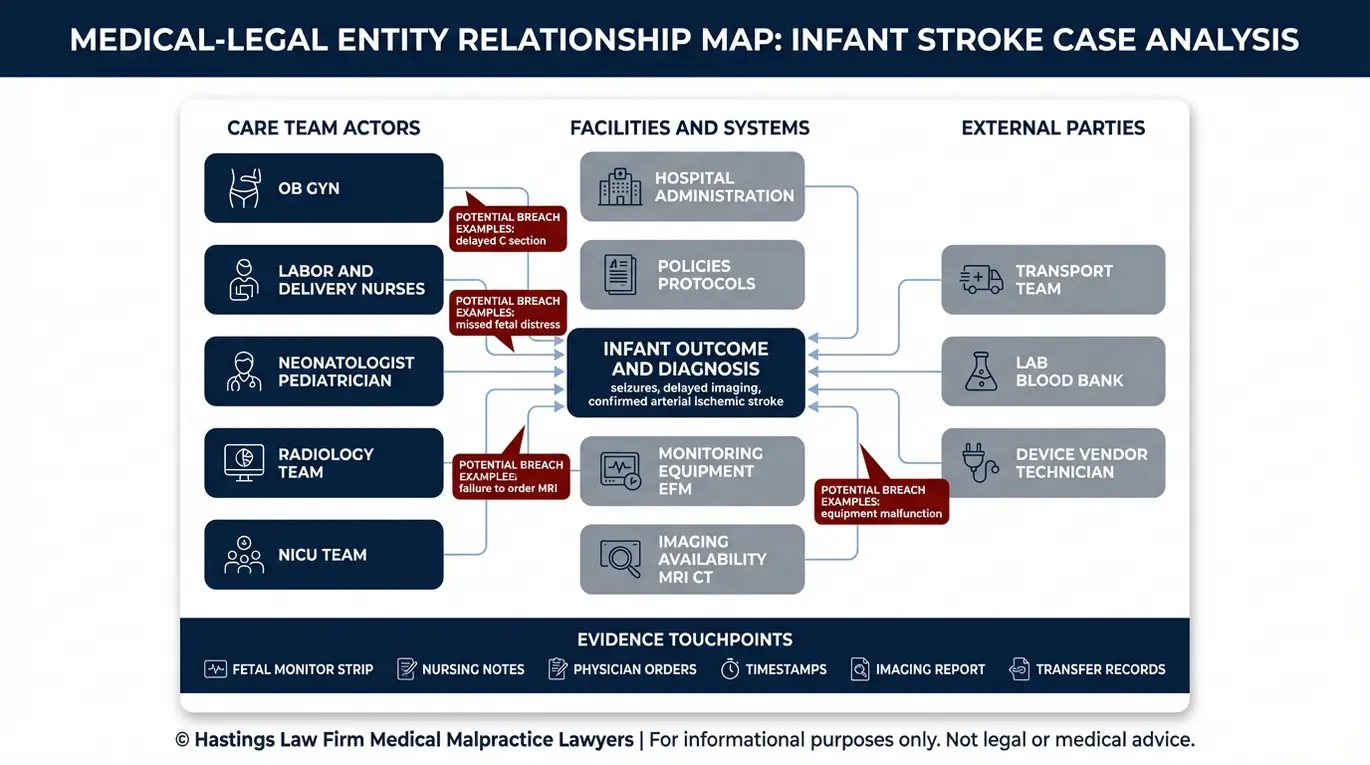
This might include failing to respond to a nonreassuring fetal heart rate (FHR) tracing, which is an abnormal pattern on fetal monitoring that signals the baby is in distress. It could also involve delaying an emergency cesarean delivery (C-section), a surgical procedure used to expedite birth when vaginal delivery is unsafe.
Claims involving hospital negligence often include allegations that the facility failed to enforce safety protocols or maintain adequate staffing. Our firm uses a national network of medical experts to provide objective reviews and credible testimony for these cases.
Parties that may bear liability in an infant stroke case include:
- The delivering obstetrician or midwife
- Neonatologists or pediatric neurologists who failed to diagnose
- Nursing staff who did not escalate warning signs
- The hospital or birthing center as an institution
- Third-party technicians responsible for diagnostic equipment errors
- Laboratories that mishandled or delayed critical test results
At Hastings Law Firm, our team includes former defense attorneys who understand how hospitals and their insurers respond to these claims. As a Phoenix medical negligence attorney team, we build a detailed medical timeline, work with qualified experts, and prepare every case as if it will go to trial. That preparation puts our clients in the strongest possible position, whether the case resolves through negotiation or before a jury.
Calculating Compensation and Life Care Plans for Disabled Children
Compensation in infant stroke cases often centers on a Life Care Plan, a detailed projection of the lifetime costs associated with raising a child who has a permanent disability. Because PAIS can cause conditions like hemiparesis, which is weakness on one side of the body, cerebral palsy, or epilepsy, these plans frequently account for decades of medical care, therapy, and adaptive support.
The stakes in these cases are incredibly high, as the costs of care accumulate over the child’s entire life. Economic damages may include future medical treatment, prescription medications, physical and occupational therapy, specialized schooling, assistive devices, home modifications, and lost future earning capacity. A Life Care Plan allows families to account for 24-hour nursing care, wheelchair replacements, and communication technology. Qualified experts, such as economists and vocational specialists, calculate these figures to ensure the settlement accounts for inflation in healthcare costs and the child’s specific prognosis.
Non-economic damages address the injury’s personal toll: pain and suffering, loss of enjoyment of life, and the emotional impact on the child and family. Arizona does not cap non-economic damages in most medical malpractice cases, which means a jury can assess the full weight of what the family has endured.
When pursuing infant stroke compensation in Arizona, a single case can involve projected costs in the millions. Our team works with life care planners, economists, and medical specialists to build a complete picture of your child’s needs, both now and for the rest of their life, ensuring no aspect of their future care is overlooked.
Contact the Arizona Birth Injury Attorneys at Hastings Law Firm Today for Help
If your child was diagnosed with an arterial ischemic stroke and you believe the medical team failed to act appropriately, you do not have to face this alone. The answers you are looking for may be in the medical records, and our team knows how to find them.
Hastings Law Firm operates on a contingency fee basis, which means you pay no attorney fees or costs unless we recover compensation for your family. Every case we take is prepared from day one as though it will go to trial, because that level of preparation is what it takes to hold medical providers accountable and pursue full recovery for your child’s future.
We are here to listen, investigate, and explain your options. Contact us today for a free, confidential case evaluation. Let us help you find the answers your family deserves.
Frequently Asked Questions About Infant Arterial Ischemic Stroke in Arizona


This content was researched and written by the Hastings Law Firm editorial team, which includes attorneys, medical professionals, and experienced researchers. Our writing is informed by internal knowledge and practical experience, and we cross-check critical details against authoritative sources cited throughout. Every piece undergoes human-led fact-checking and legal review. Because legal and medical information can change, if you spot an error, please contact us. Learn more about our content standards and review process on our editorial policy page.

Tommy Hastings, founder of Hastings Law Firm, is a board-certified personal injury trial lawyer dedicated exclusively to healthcare injury cases. Since 2001, he has represented injured patients and families in litigation against major hospital systems, pharmaceutical companies, and negligent healthcare providers nationwide. He has handled numerous high-profile cases that have drawn national media attention and resulted in multi-million dollar recoveries. He draws on that experience in his writing, helping readers understand how these cases work and what options may be available to them.
