


Arizona Necrotizing Fasciitis Malpractice Lawyer
Written by: Hastings Law Firm | Reviewed by: Tommy Hastings | Updated: July 27, 2026
Necrotizing fasciitis is a fast moving infection where delays in recognition and urgent treatment can lead to permanent disfigurement, amputation, organ damage, or fatal outcomes. Many claims focus on what happened after symptoms appeared, including missed warning signs, misdiagnosis as a minor skin infection, and delays in imaging, surgical consultation, debridement, or transfer to a capable facility. These situations can leave survivors facing extensive medical care, lost income, and lasting trauma. If you or a loved one were harmed or worse due to necrotizing fasciitis malpractice in Arizona, contact Hastings Law Firm for a free, confidential case review.

Trusted Arizona Medical Attorneys for Necrotizing Fasciitis Negligence Claims
What You Should Know About Delayed Necrotizing Fasciitis Diagnosis Claims in Arizona:
- Outcomes can become catastrophic when necrotizing fasciitis is not treated as a time sensitive emergency.
- Permanent disfigurement, amputation, organ damage, and death are linked in the text to delayed or missed diagnosis and delayed debridement.
- Liability often turns on whether warning signs were present and whether providers failed to act on information that should have raised suspicion.
- Recovery can be reduced when the infection is misdiagnosed as a minor skin infection and the patient is discharged with oral antibiotics.
- Options can narrow when transfer and handoff delays occur at facilities that cannot perform emergency debridement.
- Harm can follow routine procedures when sterile technique, instrument handling, or indicated prophylactic antibiotics are not properly managed.
- Compensation can include economic losses such as medical bills, lost wages, prosthetics, and long term care needs.
- Compensation can include non economic losses tied to pain, suffering, scarring, and psychological trauma.
- Damages are not capped in Arizona for personal injury and wrongful death under the Arizona Constitution.
- Recovery can be reduced by comparative negligence findings when multiple parties share responsibility for delays in seeking care.

A Healthcare Focused Law Firm
When a bacterial infection spreads rapidly and the medical team fails to act in time, the consequences can be life-altering. Necrotizing fasciitis is one of the most time-sensitive emergencies in medicine, and a delayed or missed diagnosis can mean the difference between a full recovery and permanent disfigurement, amputation, or death. If you or a loved one suffered serious harm because a doctor failed to recognize the warning signs, you deserve answers and a legal team that understands both the medicine and the law.
Hastings Law Firm focuses exclusively on medical negligence cases and was founded by Tommy Hastings, a board-certified trial lawyer. As a team of Arizona necrotizing fasciitis malpractice lawyers, we investigate these claims from day one with the goal of being trial-ready if the case must go before a jury. Contact us for a free, confidential case evaluation so we can review what happened and explain your options.
Understanding Necrotizing Fasciitis and Medical Negligence
Necrotizing fasciitis is a rapidly progressing bacterial infection that destroys soft tissue and fascia, the connective tissue layer surrounding muscles, nerves, and blood vessels; medical negligence occurs when providers fail to recognize its speed and delay the urgent surgical debridement required to save a patient’s life or limb.
Often called flesh-eating bacteria, necrotizing fasciitis is typically caused by organisms like Group A Streptococcus or Staphylococcus aureus, and is often polymicrobial. According to the Centers for Disease Control and Prevention (CDC), these bacteria can spread along the fascia at an alarming rate. It is a medical emergency that demands immediate intervention rather than a “wait and see” approach.
From a legal standpoint, a malpractice claim does not allege that the doctor caused the infection itself, but focuses on the response after symptoms appeared. If a physician had the information needed to suspect necrotizing fasciitis and failed to act, the resulting tissue necrosis, organ damage, or death may have been preventable. We focus our investigation on this gap between what a provider should have done and what they actually did.
The Rapid Escalation from Vague Symptoms to Necrosis
One of the most dangerous features of necrotizing fasciitis is its temporal progression. A patient may initially feel flu-like symptoms: fever, body aches, and pain near a wound. Within hours, the infection can advance beneath the skin, destroying tissue as it spreads.
Tissue necrosis, the death of living cells and tissue, can progress so quickly that a patient who walked into an ER in the morning may be in Septic shock by evening. Septic shock occurs when the body’s response to the infection causes a dangerous drop in blood pressure, leading to organ failure and death. This timeline is the core evidence in many lawsuits.
Recognizing Symptoms: When Doctors Should Suspect Infection
Doctors must differentiate necrotizing fasciitis from minor skin infections by looking for “pain out of proportion” to the visible injury, rapid spreading of redness, and signs of systemic toxicity like fever or hypotension. When these red flags appear, failing to rule out conditions like cellulitis or an abscess can lead to permanent disfigurement and scarring.
The hallmark symptom is pain out of proportion; this severe, escalating pain mismatches the wound’s appearance. Swelling spreads rapidly, often with fluid-filled blisters (bullae) and crepitus, a crackling sensation under the skin caused by gas. Systemic signs like high fever, confusion, and low blood pressure indicate the body is losing containment. According to the North Dakota Department of Health and Human Services Necrotizing Fasciitis Factsheet, early recognition is critical.
Warning signs that should prompt immediate evaluation for necrotizing fasciitis:
- Severe pain that seems far worse than the wound appears
- Redness or swelling that spreads visibly over minutes to hours
- Skin that feels hot, tight, or swollen beyond the wound borders
- Blisters, bullae, or darkening of the skin
- Crepitus (crackling sensation under the skin)
- Fever, chills, or vomiting
- Confusion, dizziness, or signs of altered mental status
- Rapid heart rate or low blood pressure
Why Clinicians Discount Patient Pain Reports
Clinicians often dismiss a patient’s severe pain reports regarding potential infections, attributing them to low pain tolerance, anxiety, or drug-seeking behavior. This bias causes dangerous delays. The standard of care requires considering the full clinical picture. For a necrotizing fasciitis malpractice lawyer in Arizona, records often contrast nursing notes of escalating distress with physician notes reflecting routine assessment.

The Hastings Law Firm Difference
Results matter, but what truly sets us apart is how we achieve them. Every verdict, every settlement, and every Arizona courtroom victory comes from one guiding promise: To treat each client’s fight for justice as if it were our own.
This balance of skill, experience, and empathy reflects our core philosophy that justice should not only compensate the injured, but also make healthcare safer nationwide.

Diagnostic Failures: Differentiating Cellulitis from Necrotizing Fasciitis
A common malpractice error involves misdiagnosing necrotizing fasciitis as simple cellulitis or an abscess, resulting in a discharge home with oral antibiotics instead of immediate hospitalization for IV antibiotics and surgery. This diagnostic failure can cost a patient hours they cannot afford to lose.
When a patient presents with redness, swelling, and pain, the initial differential diagnosis often includes both cellulitis and necrotizing fasciitis. Physicians sometimes stop at the most common explanation without ruling out the most dangerous possibility. Cellulitis is a surface-level skin infection that typically responds to antibiotics, while necrotizing fasciitis attacks deeper tissue.
The testing standards for distinguishing these conditions are well established. When lab results are ambiguous, imaging such as CT scans or MRI can reveal gas in the tissue or deep fascial involvement. Elevated white blood cell counts, abnormally low sodium, and rising creatinine levels should all trigger alarm. A 10-year retrospective review published in Oxford Academic reinforced that delayed diagnosis of necrotizing fasciitis at the point of first clinical contact remains a significant factor in poor outcomes.
When imaging and labs remain inconclusive, the standard of care often calls for surgical exploration, sometimes referred to as the “finger test.” While a biopsy can confirm the diagnosis, surgeons typically use this bedside procedure to examine the fascia directly. If the fascia is gray, non-bleeding, or separates easily, immediate debridement and broad-spectrum antibiotics are required.
| Feature | Cellulitis | Necrotizing Fasciitis |
|---|---|---|
| Pain Level | Moderate, proportional to appearance | Severe, “out of proportion” to wound |
| Skin Changes | Redness, warmth | Blisters, purple/black discoloration, crepitus |
| Progression | Gradual over days | Rapid over hours |
| Systemic Signs | Mild or absent | Fever, confusion, low blood pressure, sepsis |
| Response to Oral Antibiotics | Typically improves | No improvement or worsens |
| Required Treatment | Oral or IV antibiotics | Emergency surgical debridement + IV antibiotics |
We examine whether the treating physician conducted an adequate differential diagnosis or simply defaulted to the most common explanation.

The Critical Window: Why Delayed Debridement Is Malpractice
Surgical debridement, the removal of infected and dead tissue, is the only definitive treatment for necrotizing fasciitis; failing to consult a surgeon immediately or delaying the procedure to transfer a patient can be considered medical malpractice if it leads to preventable tissue loss.
Antibiotics alone cannot stop this infection. Once the bacteria begin destroying tissue, blood flow to the affected area is cut off, which means even the strongest IV antibiotics cannot reach the site of the infection. The Infectious Diseases Society of America (IDSA) practice guidelines emphasize that surgical debridement should not be delayed while waiting for a definitive diagnosis. If necrotizing fasciitis is suspected, the hospital should mobilize the operating room.
The concept of the “golden window” applies directly here. Research consistently shows that every hour of delay in surgical debridement increases both the mortality rate and the risk of amputation. A patient who receives surgery within the first several hours of symptom recognition has a significantly better chance of survival and limb preservation than one who waits twelve or twenty-four hours while providers try additional rounds of antibiotics.
Inter-department transfer failures are another area our Arizona surgical negligence attorney team examines closely. In cases where a smaller facility or rural Arizona clinic does not have the surgical resources to perform debridement, the standard of care typically requires stabilization and immediate transfer to a trauma center or hospital with the appropriate capabilities. Delays during the transfer process, whether from slow communication or incomplete handoffs, can cause the infection to progress beyond salvageable limits.
Iatrogenic Risks: Infection Following Routine Surgery
Not every necrotizing fasciitis case begins with an outside wound. In some situations, the infection develops after a routine procedure, such as a cesarean section, abdominal surgery, or liposuction. This is known as an iatrogenic infection, meaning it was introduced during medical treatment itself.
Post-operative infections caused by organisms like Staphylococcus aureus can develop when sterile technique is not properly maintained, surgical instruments are contaminated, or prophylactic antibiotics are not administered as indicated. When a patient develops necrotizing fasciitis at or near a surgical site, the investigation focuses on whether the hospital followed infection prevention protocols and whether providers recognized the post-operative signs early enough to intervene.
Proving Liability: The Standard of Care in Arizona
To prove a necrotizing fasciitis claim in Arizona, a patient must demonstrate that a reasonably prudent physician would have suspected the infection earlier based on the presenting symptoms and that this failure directly caused additional harm. This is the framework that applies to every Arizona medical malpractice lawyer’s case evaluation.
We first establish that a duty of care existed, which is typically satisfied the moment a doctor-patient relationship is formed. We then prove a breach of the standard of care, the accepted level of treatment that a reasonably competent provider in the same specialty would have delivered under similar circumstances. In necrotizing fasciitis cases, this often means showing that the signs of a deep tissue infection were present and that the physician either missed them or failed to act on them.
Causation is often the most contested element. The “but-for” test applies here; this means that the injury would not have happened if the medical professional had acted properly. Defense attorneys may argue that the infection was too aggressive to stop regardless of timing. Our team counters this by constructing a detailed medical timeline with expert support to show exactly when intervention should have occurred and what the outcome would likely have been.
Common theories of liability in these cases include:
- Failure to include necrotizing fasciitis in the differential diagnosis
- Misdiagnosis as cellulitis or abscess and discharge with oral antibiotics
- Delay in ordering imaging, labs, or surgical consultation
- Failure to transfer the patient to a facility capable of performing emergency debridement
- Failure to recognize and respond to post-operative infection signs
- Inadequate post-surgical monitoring leading to undetected progression
Under the Arizona Revised Statutes, lawsuits suing for necrotizing fasciitis must meet specific procedural requirements, including the filing of expert affidavits. Our legal team manages every aspect of this process.
Case Results: Compensation for Necrotizing Fasciitis Survivors
Patients who survive necrotizing fasciitis in Arizona may recover economic damages for past and future medical bills, lost wages, and prosthetics, as well as non-economic damages for pain, suffering, and permanent disfigurement. The scope of these losses is often staggering and requires a comprehensive legal approach to ensure all future needs are met.
Economic damages cover the tangible, measurable financial impact of the injury. Survivors frequently require multiple surgeries, including repeated debridements, skin grafts, and in severe cases, amputation. Long-term rehabilitation, prosthetic devices, home modifications, rehab costs, and ongoing wound care can generate expenses that extend across a lifetime. Lost earning capacity is also a significant component, especially for patients who can no longer perform their previous work due to limb loss or chronic pain.
Non-economic damages address the suffering that does not come with a receipt. The psychological trauma of disfigurement, scarring, and the loss of a limb affects every aspect of daily life. Survivors often experience depression, anxiety, post-traumatic stress, and a diminished ability to enjoy activities they once valued. Arizona law recognizes these losses as compensable, and under the Arizona Constitution, juries retain the right to determine the full value of these damages without arbitrary caps.
When a patient dies from sepsis or complications related to necrotizing fasciitis, surviving family members, such as a spouse, children, or parents, may pursue a wrongful death claim. These necrotizing fasciitis lawsuit settlements and verdicts account for the family’s loss of companionship, financial support, and the emotional toll of losing someone to a preventable medical failure. Securing these damages is essential for families facing sudden financial instability after a tragic loss.
How Our Arizona Attorneys Investigate These Claims
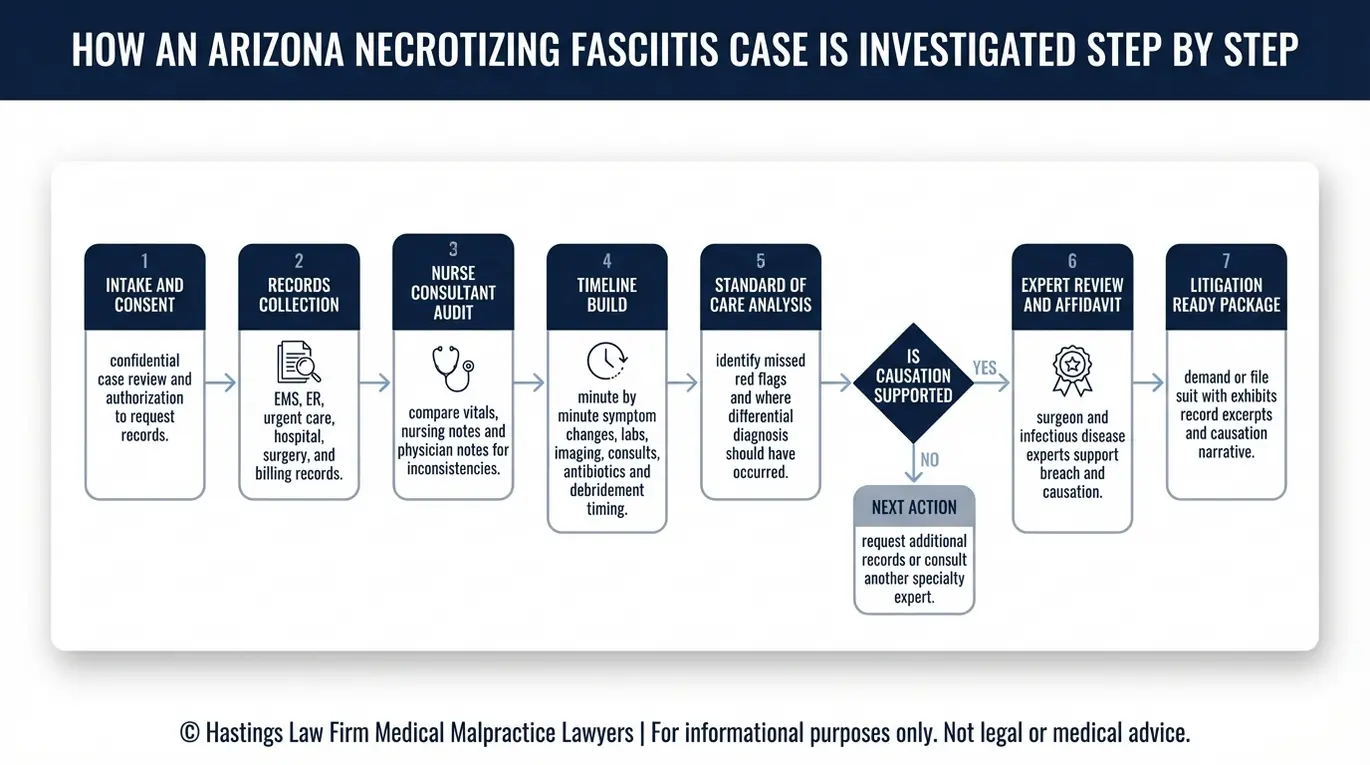
Hastings Law Firm employs a ‘Trial-Ready’ litigation strategy, utilizing nurse consultants to audit medical records and securing expert testimony to construct a definitive timeline of the negligence. This proactive approach ensures we are prepared for court from the moment we take your case.
The process begins with a free, confidential evaluation led by one of our patient advocates. Our team includes former defense attorneys, board-certified patient advocates, and hospital nurses who previously worked for the systems we now challenge. During this initial consultation, we listen to what happened, review available records, and assess whether the facts support a viable claim.
Once we accept a case, our medical team conducts a medical records review to identify inconsistencies that often reveal a breakdown in care. In necrotizing fasciitis cases, these inconsistencies can be telling. Nursing notes may document escalating pain, worsening skin changes, or dropping vital signs while physician entries reflect a routine treatment plan for a minor skin infection. These gaps between what the bedside staff observed and what the treating physician documented are often the strongest evidence we have.
We work with our national network of expert physicians, including infectious disease specialists and surgeons, to reconstruct what should have happened at each decision point. This expert analysis forms the foundation of the causation argument, connecting the delay to the harm.
As a Phoenix necrotizing fasciitis lawyer team, we handle every aspect of litigation, from filing to discovery to depositions. Our clients pay no attorney fees or costs unless we recover compensation on their behalf. That contingency fee structure means you can focus on healing while we focus on the case.
Contact the Arizona Healthcare Malpractice Attorneys at Hastings Law Firm Today for Help
If you or a loved one suffered devastating consequences because of a delayed diagnosis of necrotizing fasciitis, you are not alone in this. These cases involve complex medicine and aggressive defense strategies, and you deserve a legal team that understands both.
Hastings Law Firm represents patients and families in Phoenix and across Arizona who have been harmed by medical negligence. Our attorneys, nurse consultants, and medical experts work together to uncover the truth, build the evidence, and hold the responsible parties accountable.
You pay nothing unless we win. Contact us today for a free case evaluation. Let us review your records, explain your legal options, and help you take the first step toward answers and accountability.
Frequently Asked Questions About Necrotizing Fasciitis Malpractice in Arizona


This content was researched and written by the Hastings Law Firm editorial team, which includes attorneys, medical professionals, and experienced researchers. Our writing is informed by internal knowledge and practical experience, and we cross-check critical details against authoritative sources cited throughout. Every piece undergoes human-led fact-checking and legal review. Because legal and medical information can change, if you spot an error, please contact us. Learn more about our content standards and review process on our editorial policy page.

Tommy Hastings, founder of Hastings Law Firm, is a board-certified personal injury trial lawyer dedicated exclusively to healthcare injury cases. Since 2001, he has represented injured patients and families in litigation against major hospital systems, pharmaceutical companies, and negligent healthcare providers nationwide. He has handled numerous high-profile cases that have drawn national media attention and resulted in multi-million dollar recoveries. He draws on that experience in his writing, helping readers understand how these cases work and what options may be available to them.
