


Arizona Monoamniotic Twins Cord Entanglement Lawyer
Monoamniotic twin pregnancies carry a high risk of umbilical cord entanglement, and missed diagnosis or inadequate monitoring can lead to severe oxygen deprivation injuries or worse. Early ultrasound classification and careful inpatient surveillance are described as central to reducing sudden cord compression events. The discussion also highlights how misreading fetal heart rate patterns or delaying a cesarean delivery during distress can turn a manageable high risk pregnancy into a preventable tragedy. If you or a loved one were harmed or worse due to monoamniotic twins cord entanglement malpractice in Arizona, contact Hastings Law Firm for a free, confidential case review.

Last Updated: July 27, 2026
Trusted Legal Advocacy for Complex Birth Injury Cases in Arizona
Losing a child or watching your baby struggle for survival after a preventable birth complication is a pain that words cannot capture. If your monoamniotic twins suffered harm from cord entanglement, you may wonder if the medical team did everything they should have. That question deserves an honest, thorough answer.
At Hastings Law Firm, we focus exclusively on medical malpractice, and we understand the medical and emotional weight of these cases. Our team includes in-house nurse consultants, former hospital nurses, and former defense attorneys who know how to investigate whether the standard of care was met during a high-risk twin pregnancy.
If you need an Arizona monoamniotic twins cord entanglement lawyer, we can review what happened and explain your options in a free, confidential consultation. You pay nothing unless we recover compensation on your behalf.

Diagnosing Monoamniotic Twins and Cord Entanglement Risks
Monoamniotic twins share a single amniotic sac and placenta, creating a severe risk of umbilical cord entanglement that requires early diagnosis via ultrasound to prevent fetal injury or death. Often called MoMo twins, this configuration means the babies share one sac and one placenta. This creates a situation where the two umbilical cords become intertwined, knotted, or wrapped around each other.
Because there is no dividing membrane to separate the babies, their cords float freely in the same space. This means that as the twins move, their cords can loop, tangle, and compress each other’s blood supply. The risk is not theoretical; cord entanglement occurs in a majority of monoamniotic pregnancies and is a leading cause of perinatal mortality in this group.
Identifying this type of pregnancy early, ideally in the first trimester, determines the planning for monitoring and delivery. An ultrasound examination that evaluates chorionicity (confirming a monochorionic pregnancy where the twins share a placenta) and amnionicity (whether they share an amniotic sac) should be performed early. Color Doppler ultrasound can help confirm cord relationships and detect entanglement before it becomes life-threatening. According to the Twin Pregnancy Practice Guidelines from the University of Cincinnati, accurate determination of chorionicity and amnionicity is the foundation for appropriate prenatal care.
When a provider fails to correctly classify the pregnancy, the consequences can be devastating. A lawyer experienced in monoamniotic twin injuries can examine whether the diagnostic workup met the standard of care.
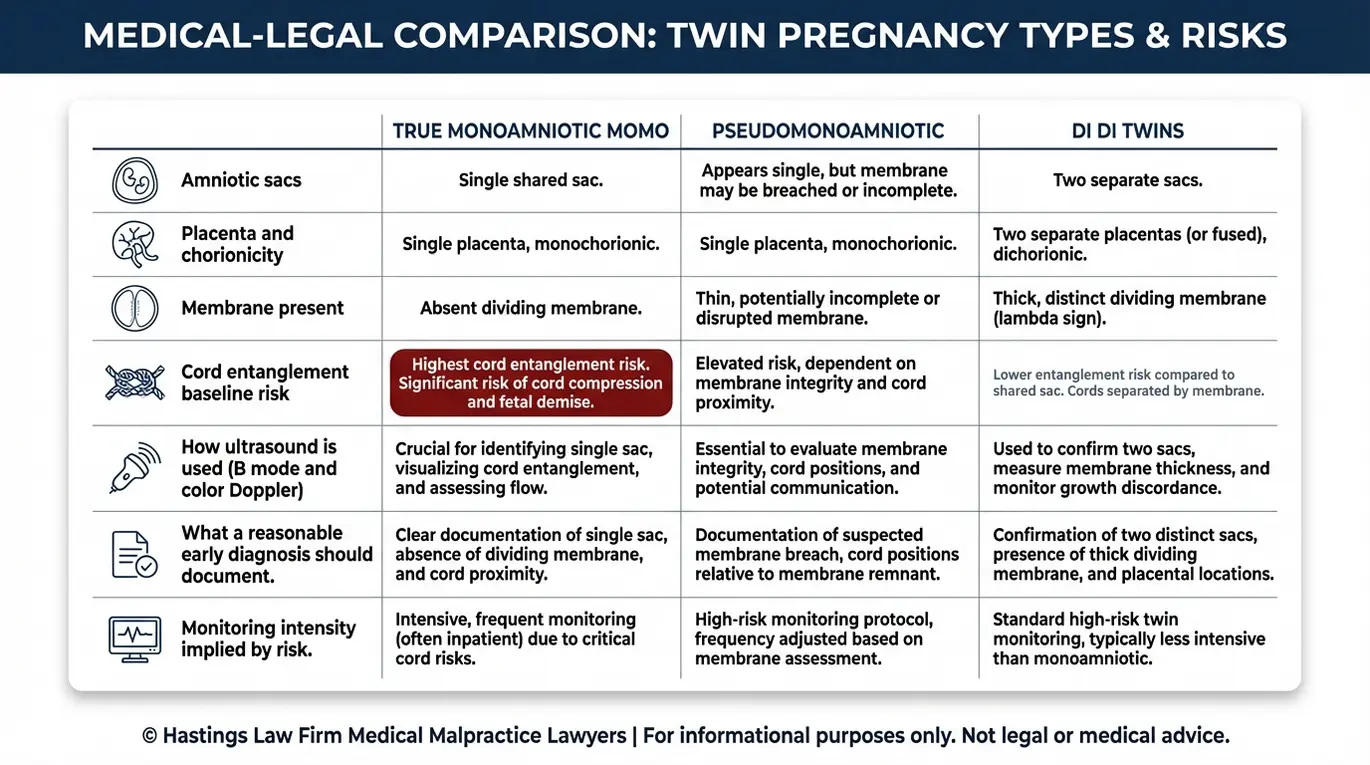
| Feature | True Monoamniotic (MoMo) | Pseudomonoamniotic | Dichorionic-Diamniotic (Di-Di) |
|---|---|---|---|
| Placenta | Shared (one) | Shared (one) | Separate (two) |
| Amniotic Sac | Shared (one); no membrane | Originally separate; membrane ruptured or invisible | Separate (two); thick membrane |
| Cord Entanglement Risk | Very high | Elevated | Very low |
| Required Monitoring Level | Inpatient from 24 to 28 weeks | High-risk surveillance | Standard twin protocol |
| Typical Delivery Timing | Planned cesarean at 32 to 34 weeks | Case-dependent | Often 37 to 38 weeks |
Distinguishing True Monoamniotic from Pseudomonoamniotic Twins
One of the most dangerous diagnostic errors in twin pregnancies is confusing true monoamniotic twins with pseudomonoamniotic twins. Establishing a correct differential diagnosis, which is the process of distinguishing between two or more conditions that share similar signs, is critical. Pseudomonoamniotic twins, which originally had a thin dividing membrane that ruptured or became too difficult to see on B-mode ultrasound, can create the appearance of a shared sac. While both constitute a high-risk pregnancy, true monoamniotic twins face the highest danger because no membrane ever existed to limit cord movement.
Misidentifying the type of twin pregnancy can lead to a fatally inadequate monitoring plan. A pregnancy incorrectly classified as dichorionic-diamniotic (Di-Di), where each twin has its own placenta and sac, may receive only routine outpatient care instead of the intensive surveillance that a monoamniotic pregnancy demands.
An Arizona cord entanglement attorney can work with maternal-fetal medicine experts to determine whether the pregnancy was correctly classified and whether the monitoring plan matched the actual risk.
Proving Negligence in the Management of MoMo Pregnancies
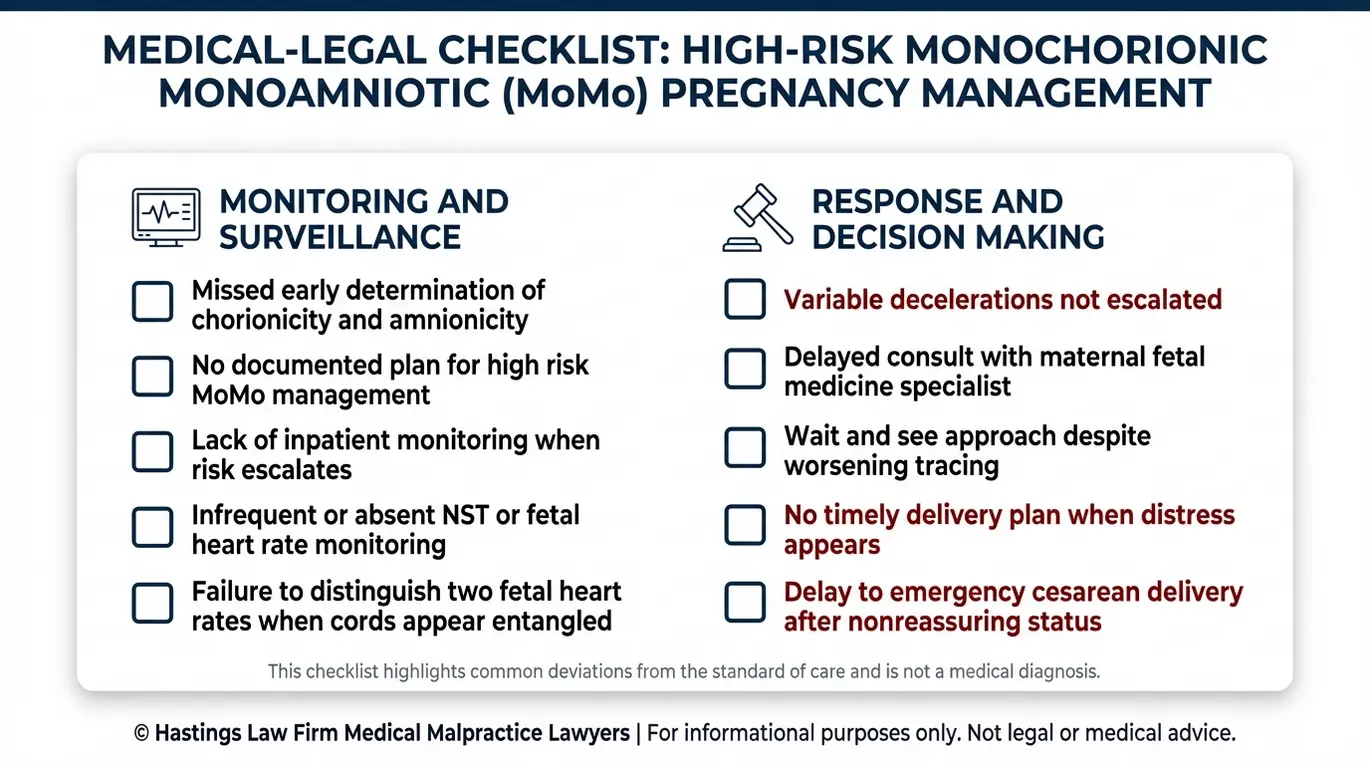
Negligence often occurs when a doctor fails to order inpatient monitoring or ignores signs of fetal distress, such as variable decelerations on a heart rate monitor, leading to preventable cord accidents. These failures can turn a manageable high-risk monoamniotic pregnancy into a preventable tragedy.
The standard of care for monoamniotic twin pregnancies typically requires hospital admission for inpatient monitoring beginning between 24 and 28 weeks of gestational age. This is because the risk of sudden cord compression is unpredictable and can progress to injury or intrauterine demise within minutes. A retrospective cohort study on perinatal mortality and delivery timing in monoamniotic twins published in PubMed underscores the relationship between monitoring intensity and perinatal outcomes.
During inpatient monitoring, the medical team should perform regular non-stress tests (NSTs), which are assessments that track each baby’s heart rate in response to movement. One challenge specific to MoMo pregnancies is distinguishing two separate fetal heart rates within a tangled cord mass. Doppler technology can help differentiate the signals, and failure to do so may mean that dangerous changes in one twin’s heart rate go undetected.
Variable decelerations, sudden drops in fetal heart rate often caused by cord compression, are a critical warning sign. As explained in the PubMed overview of variable decelerations, these patterns can indicate that the cord is being intermittently squeezed. Ignoring or misreading these patterns during fetal heart rate monitoring may constitute a breach of the standard of care.
A negligence claim in a MoMo pregnancy case typically involves examining whether the medical team met these monitoring obligations:
- Admitted the patient for inpatient monitoring by 24 to 28 weeks
- Performed frequent or continuous non-stress tests to track both fetal heart rates
- Used Doppler to accurately distinguish between the two heart rate signals
- Recognized and responded to variable decelerations promptly
- Consulted or referred to a maternal-fetal medicine specialist when the challenges of the pregnancy required it
- Had an emergency cesarean delivery plan in place for signs of acute distress
An Arizona birth injury attorney with experience in MoMo twin cases can retain qualified experts to review the monitoring records and determine whether the care provided fell below what the standard required.
The Hastings Law Firm Difference
Results matter, but what truly sets us apart is how we achieve them. Every verdict, every settlement, and every Arizona courtroom victory comes from one guiding promise: To treat each client’s fight for justice as if it were our own.
This balance of skill, experience, and empathy reflects our core philosophy that justice should not only compensate the injured, but also make health care safer nationwide.

Failure to Timely Deliver and Cord Compression Injuries
If cord compression is detected, the standard of care dictates an immediate delivery plan; failure to perform a C-section during signs of distress constitutes malpractice if it results in injury or death.
Cord compression, occurring when the tangled or knotted umbilical cords tighten enough to restrict blood flow, cuts off oxygen and nutrients to one or both babies. The progression from loose umbilical cord entanglement to dangerous occlusion can happen gradually or suddenly. Understanding this progression is central to any delayed C-section claim:
- Loose entanglement: Cords are intertwined but blood flow remains adequate. Monitoring detects intermittent variable decelerations.
- Increasing compression: As the twins grow or shift, the cords tighten. Decelerations become more frequent and severe. This is the window where intervention can prevent lasting harm.
- Severe occlusion: Blood flow is critically restricted. Prolonged fetal distress leads to oxygen deprivation, which can cause brain injury, cerebral palsy, or intrauterine demise, which is the death of a baby before delivery.
National and international guidelines published in the American Journal of Obstetrics and Gynecology generally support a planned cesarean delivery between 32 to 34 weeks. This typically follows a course of corticosteroids to support lung development. This is a planned delivery, scheduled in advance to avoid reaching the point where an emergency becomes necessary.
An emergency cesarean delivery, by contrast, is performed urgently when monitoring reveals acute distress that cannot wait. The distinction matters legally. If a provider had the opportunity to deliver at a planned time based on established guidelines and did not, or if the team failed to move to an emergency cesarean when monitoring showed deteriorating heart rate patterns, that delay can form the basis of a malpractice claim.
An Arizona malpractice lawyer for twins can analyze the timeline between the first signs of distress and the moment of delivery, working with experts to determine whether the response was timely or whether preventable harm resulted from inaction.

Seeking Compensation for Preventable Birth Injuries and Loss
Families may recover damages for medical costs, lifelong disability care, and pain and suffering if it is proven that the medical team deviated from the standard of care regarding monoamniotic twin management. The specific compensation depends on the nature and severity of the harm.
For surviving infants, the financial impact of a cord entanglement injury can be staggering. Babies born with oxygen deprivation injuries often require extended stays in the NICU, followed by years of specialized therapy, adaptive equipment, and around-the-clock care. Conditions like cerebral palsy that result from prematurity or prolonged fetal distress may require lifelong support.
While distinct complications like congenital anomalies (physical birth defects) or TRAP sequence (a rare condition where one twin lacks a heart) can affect the perinatal outcome, compensation claims typically focus on preventable errors. Research from Michigan Medicine found that one in six families spent more than $5,000 on delivery costs alone. This figure does not account for the high costs of a complex NICU stay or long-term disability care.
When one or both twins do not survive, families may pursue a wrongful death claim. Perinatal mortality, the death of a baby around the time of birth, including intrauterine demise, carries profound emotional consequences alongside the financial ones.
Damages in these cases may include:
- Past and future medical expenses, including NICU care, surgeries, and rehabilitation
- Cost of long-term or lifelong disability support and assistive care
- Loss of earning capacity for a child with permanent impairment
- Wrongful death damages if one or both twins died due to negligent care
- Pain and suffering endured by the child
- Emotional distress, grief, and psychological trauma experienced by the parents
- Loss of companionship and parental relationship
An Arizona wrongful death lawyer or birth injury attorney experienced in cord accident cases can assess the full scope of damages and work to hold the responsible parties accountable.
Why Arizona Families Trust Hastings Law Firm
Hastings Law Firm offers a trial-ready approach with no upfront costs, ensuring that grieving families have the resources to challenge large hospital systems and insurance carriers. We do not prepare cases with settlement as the first goal. Instead, we build each case as though it will go before a jury, which strengthens every negotiation and signals to defense teams and insurance carriers that we are serious about full accountability.
Our national expert network includes maternal-fetal medicine specialists who can evaluate fetal monitoring strips, ultrasound records, and delivery timelines with the precision these cases demand. Tommy Hastings is board-certified in Personal Injury Trial Law by the Texas Board of Legal Specialization, a distinction held by less than 2% of attorneys. We also employ Board Certified Patient Advocates and nurse consultants who review clinical data from the beginning to identify gaps in care.
We operate on a contingency fee basis, meaning families pay no attorney fees or costs unless we secure a recovery. Every case begins with a free, confidential evaluation led by a patient advocate who understands the medical details of your situation. As an experienced medical malpractice lawyer in Arizona, Tommy Hastings and his team are committed to giving families the answers and advocacy they deserve.
Contact the Arizona Birth Injury Attorneys at Hastings Law Firm Today for Help
Arizona law limits the time you have to file a medical malpractice claim, and critical evidence like fetal monitoring strips and medical records can become harder to obtain as time passes. Taking the first step now helps protect your family’s rights and ensures that the facts of your case are preserved.
We understand the medical complexity of monoamniotic twin cord entanglement cases, and we handle every investigation with both empathy and the thoroughness these claims require. Our team will review your records, consult with qualified experts, and give you an honest assessment of your options.
Contact our Arizona monoamniotic twins cord entanglement lawyer today to request a free case review. There is no cost and no obligation. You pay nothing unless we recover compensation for your family.
Frequently Asked Questions About Monoamniotic Twins Cord Entanglement in Arizona


This content was researched and written by the Hastings Law Firm editorial team, which includes attorneys, medical professionals, and experienced researchers. Our writing is informed by internal knowledge and practical experience, and we cross-check critical details against authoritative sources cited throughout. Every piece undergoes human-led fact-checking and legal review. Because legal and medical information can change, if you spot an error, please contact us. Learn more about our content standards and review process on our editorial policy page.

Tommy Hastings, founder of Hastings Law Firm, is a board-certified personal injury trial lawyer dedicated exclusively to healthcare injury cases. Since 2001, he has represented injured patients and families in litigation against major hospital systems, pharmaceutical companies, and negligent healthcare providers nationwide. He has handled numerous high-profile cases that have drawn national media attention and resulted in multi-million dollar recoveries. He draws on that experience in his writing, helping readers understand how these cases work and what options may be available to them.
