


Arizona Vasa Previa Diagnosis Failure Lawyer
Written by: Hastings Law Firm | Reviewed by: Tommy Hastings | Updated: July 27, 2026
Undiagnosed vasa previa can turn labor into a sudden emergency when unprotected fetal blood vessels cross the cervix and tear during membrane rupture. The condition is often detectable during pregnancy when clinicians recognize risk factors and use appropriate ultrasound imaging with color Doppler. When screening or follow up is missed, families may face catastrophic blood loss, oxygen deprivation, lifelong disability, or worse. Understanding how the medical standard of care applies can clarify whether preventable errors occurred. If you or a loved one were harmed or worse due to a missed vasa previa diagnosis in Phoenix, Arizona, contact Hastings Law Firm for a free, confidential case review.

Top Rated Arizona Birth Injury Attorneys for Undiagnosed Vasa Previa
What You Should Know About Undiagnosed Placental Vessel Risk Claims in Arizona:
- Catastrophic outcomes can follow when vasa previa is not identified before labor because fetal vessels can rupture during membrane rupture.
- Preventable loss can occur when known risk factors are missed because the standard of care calls for early recognition and appropriate diagnostic imaging.
- Options can be limited when Arizona rules affect how certain healthcare related payments are handled as evidence in malpractice claims.
- Severe lifelong injury can result even when a baby survives because rapid blood loss and oxygen deprivation can cause permanent neurologic harm.
- Accountability can turn on whether transvaginal ultrasound with color Doppler was used because transabdominal ultrasound alone may not reliably show vessels crossing the cervix.
- Disputes often focus on whether warning signs were acted on because vaginal bleeding with fetal heart rate changes can indicate fetal bleeding.
- A separate basis for negligence can arise after a confirmed diagnosis because a planned cesarean management approach is described as well established.
- Recovery can depend on expert testimony because causation must be shown between the deviation from the standard of care and the injury.
- Compensation can reflect long term needs because the article describes economic losses and non economic losses tied to severe birth injury.
- Case clarity can depend on prenatal records because documentation of risk factors and imaging decisions may show whether follow up testing was pursued.

A Healthcare Focused Law Firm
The loss of a child or the discovery of a preventable brain injury is a profound tragedy for any family. When doctors miss known risk factors and fail to order the necessary tests, families are often left with questions and a sense of injustice.
The medical community has had the tools to detect this condition for years. When those tools are not used, families pay the price. An Arizona vasa previa diagnosis failure lawyer can help you understand what happened, determine whether the standard of care was met, and explain what legal options may be available.
At Hastings Law Firm, our team of attorneys, former defense lawyers, and in-house medical professionals focuses exclusively on medical malpractice. If you believe your baby’s injury or death was caused by a missed vasa previa diagnosis, we invite you to contact our Phoenix office for a free, confidential case evaluation.
Understanding Vasa Previa and the Medical Standard of Care
Vasa previa is a rare but critical obstetric complication where unprotected fetal blood vessels run through the amniotic membranes and cross over the cervix, the lower opening of the uterus. Unlike vessels that are safely embedded within the umbilical cord or the placenta itself, these exposed vessels sit directly in the path of delivery. Consulting a vasa previa lawyer in Arizona is often the first step for families seeking answers.
This positioning creates an immediate and life-threatening danger. When the amniotic sac ruptures, whether naturally or during medical intervention, those unprotected vessels can tear open. Because these are fetal blood vessels carrying the baby’s blood supply, even a small amount of blood loss can be catastrophic. An undiagnosed vasa previa attorney understands these risks well.
Here is what makes this condition so dangerous:
- Fetal blood volume is extremely small. A full-term baby has roughly 80 milliliters of blood per kilogram of body weight. Losing even 50 to 100 milliliters can lead to fetal hemorrhage, a rapid and often fatal loss of the baby’s blood supply.
- Fetal blood is different from maternal blood. Vaginal bleeding during labor may be dismissed as maternal in origin. But darker blood, or bleeding that coincides with changes in fetal heart rate, can indicate the baby is the one bleeding. If these signs were missed, an Arizona birth injury lawyer can investigate.
- The window to act is measured in minutes. Once a vessel tears, the baby can bleed out before an emergency delivery is completed.
According to research published in PubMed Central on vasa previa, prenatal detection is the key to preventing fetal death. The standard of care requires obstetricians to identify risk factors early and order the appropriate diagnostic imaging. When a doctor fails to screen, diagnose, or plan for vasa previa in a high-risk pregnancy, that failure may constitute medical malpractice under Arizona law. A vasa previa malpractice attorney can review these failures.
Arizona families considering legal action should also be aware that Arizona Revised Statutes § 12-565 governs how healthcare-related evidence, including collateral source payments, is handled in malpractice claims. An Arizona vasa previa diagnosis failure lawyer can explain how these rules affect your case.
Identifying Risk Factors Missed by Arizona Obstetricians
Doctors must screen for vasa previa in high-risk pregnancies involving IVF, low-lying placentas, or multiple gestations. Risk factors are specific patient conditions that alert doctors to the need for closer monitoring. These are not obscure medical findings. They are well-documented risk factors that appear regularly in prenatal records, and any competent obstetrician should recognize them. An Arizona vasa previa attorney can assess if these were overlooked.
Research from PubMed Central on assisted reproductive technology and placental abnormalities confirms the strong association between IVF pregnancies and conditions like velamentous cord insertion, where the umbilical cord attaches to the fetal membranes instead of directly into the placenta. These abnormal insertion leaves blood vessels unprotected and is one of the primary precursors to vasa previa. A vasa previa malpractice lawyer frequently sees these indicators in case files.
These obstetric markers are documented during routine prenatal visits to help doctors identify potential complications. The following risk factors should prompt additional diagnostic testing during prenatal care:
- In vitro fertilization (IVF), a process where eggs are fertilized outside the body and implanted in the uterus, is associated with higher rates of placental and cord abnormalities.
- Velamentous cord insertion, visible on routine ultrasound, where the cord meets the membranes rather than the placental mass.
- Bilobed or succenturiate placenta, conditions where the placenta develops with an extra lobe connected by vessels that may cross the cervix.
- Placenta previa or low-lying placenta, where the placenta partially or fully covers the cervical opening.
- Multiple gestations, such as twin or triplet pregnancies, which increase the likelihood of abnormal placental development.
- Prior uterine surgery, including previous cesarean sections, which can affect how the placenta implants.
When any of these risk factors appear in a patient’s chart, the standard of care requires the treating physician to order targeted imaging. Skipping that step, or failing to document why further testing was not pursued, can represent a clear breach of the medical standard. A failure to diagnose vasa previa case often hinges on these documented risks.
A failure to diagnose vasa previa attorney in Arizona can review prenatal records to determine whether your care team identified and acted on these warning signs. Trust an experienced Phoenix vasa previa lawyer to guide you.

The Hastings Law Firm Difference
Results matter, but what truly sets us apart is how we achieve them. Every verdict, every settlement, and every Arizona courtroom victory comes from one guiding promise: To treat each client’s fight for justice as if it were our own.
This balance of skill, experience, and empathy reflects our core philosophy that justice should not only compensate the injured, but also make healthcare safer nationwide.

The Critical Role of Ultrasound and Color Doppler in Diagnosis
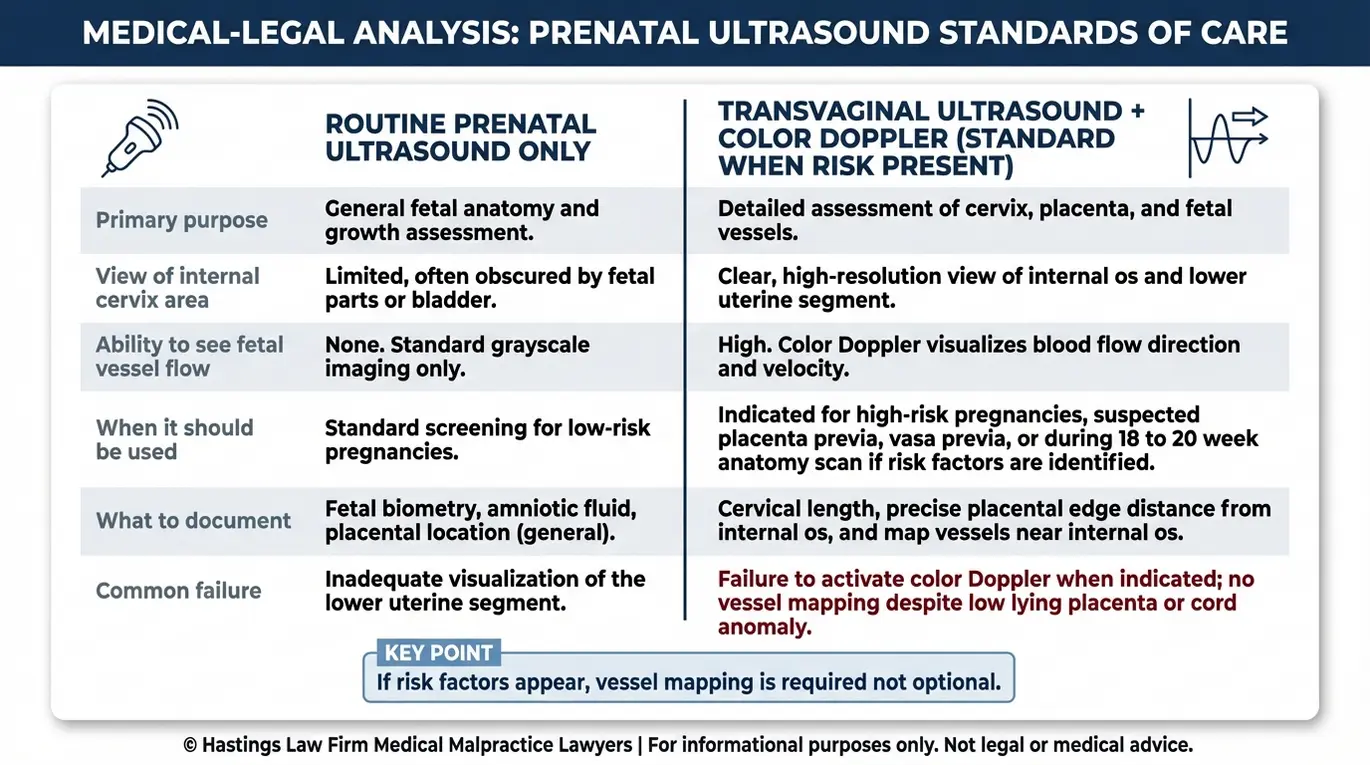
The standard of care requires the use of transvaginal ultrasound combined with color Doppler imaging to detect vasa previa during the mid-trimester anatomy scan. A transvaginal ultrasound is an imaging test performed through the birth canal for a clearer view. This is not an experimental or optional protocol. It is the accepted diagnostic approach supported by maternal-fetal medicine guidelines. A missed diagnosis attorney can evaluate if your provider followed these rules.
Ultrasound imaging is the primary tool used to monitor fetal development and placental health throughout pregnancy. The mid-trimester anatomy scan, typically performed between 18 and 20 weeks of gestation, is the primary opportunity to identify vasa previa before it becomes a delivery emergency. A standard transabdominal ultrasound can reveal placental position and cord insertion.
To confirm whether fetal vessels are crossing the cervix, a transvaginal ultrasound is often necessary. This is an internal imaging approach that provides a closer and more detailed view of the cervical area. An Arizona birth injury attorney knows that transabdominal scans alone are often insufficient.
Color Doppler imaging, a technology that overlays color onto the ultrasound image to visualize the direction and speed of blood flow within vessels, takes this a step further. Without activating color Doppler, a sonographer may see membranes near the cervix but miss the vessels running through them entirely. This is a common finding for a vasa previa lawyer in Arizona.
Research from the Texas Medical Center Library on vasa previa prenatal diagnosis supports the use of a 5-centimeter measurement threshold from the internal os to guide clinical decision-making when vessels are detected near the cervix.
| Diagnostic Method | What It Shows | Limitation |
|---|---|---|
| Standard transabdominal ultrasound | Placental location, cord insertion site, fetal anatomy | Cannot reliably visualize vessels crossing the internal cervical os |
| Transvaginal ultrasound | Detailed view of the cervix and lower uterine segment | Identifies structural proximity but may not confirm active blood flow |
| Transvaginal ultrasound with color Doppler | Blood flow patterns within vessels near or crossing the cervix | Requires the sonographer to activate the Doppler mode and know what to look for |
If a sonographer identifies a low-lying placenta or velamentous cord insertion and does not map the vessels using color Doppler, that omission can be the basis of a prenatal ultrasound negligence claim. An undiagnosed vasa previa lawyer uses these discrepancies to prove negligence. An Arizona vasa previa diagnosis failure lawyer can work with maternal-fetal medicine experts to determine whether the imaging protocol met the standard of care in your case.
Consequences of Diagnosis Failure and Emergency Negligence
Failure to diagnose vasa previa often leads to vessel rupture upon labor, causing fetal bradycardia, severe hypoxia, and potential stillbirth. Negligence in these cases occurs when a medical professional fails to act on warning signs, leading to injury. The difference between a diagnosed and an undiagnosed case is often the difference between life and death. An Arizona infant brain injury attorney understands the gravity of this oversight.
According to a systematic review published in PubMed on perinatal mortality and vasa previa, prenatal detection results in survival rates of approximately 95 to 97 percent. When vasa previa goes undiagnosed and membranes rupture during labor, fetal mortality can reach 40 to 60 percent. That gap represents one of the most dramatic disparities in obstetric outcomes, and it is almost entirely preventable. A vasa previa malpractice claim seeks to address this preventability.
The chain of harm typically follows a predictable sequence. When membranes rupture, which doctors refer to as rupture of membranes (ROM) or the moment the water breaks, unprotected fetal vessels tear. The baby begins losing blood rapidly, often causing vaginal bleeding.
Fetal heart rate monitoring shows fetal distress indicated by sudden bradycardia, a dangerously slow heart rate in the baby. An emergency C-section may be ordered, but in many cases, the time required to mobilize a surgical team and deliver the baby is longer than the baby can survive without adequate blood flow and oxygen. Our Arizona vasa previa diagnosis failure lawyer often reviews monitoring strips showing this distress.
Babies who survive undiagnosed vasa previa may face severe, lifelong injuries, including:
- Hypoxic-ischemic encephalopathy (HIE), brain damage caused by oxygen deprivation during or around birth.
- Cerebral palsy, a permanent neurological condition affecting movement, coordination, and muscle tone.
- Cognitive and developmental disabilities requiring lifelong support and specialized education.
- Organ damage to the kidneys, heart, or other systems caused by prolonged asphyxia.
Families dealing with these outcomes should consult a birth injury lawyer in Phoenix. For families who lost a child, a vasa previa wrongful death lawyer in Arizona can pursue accountability on their behalf.
The Necessity of Planned C-Section Management
When vasa previa is diagnosed before delivery, there is a clear and well-established treatment protocol. A planned cesarean section is a scheduled surgical birth performed to avoid the risks of labor. This planned cesarean section prevents the rupture of unprotected vessels.
The clinical timeline for managing diagnosed vasa previa typically includes hospital admission between 30 and 34 weeks of gestation for continuous monitoring. During this period, the mother receives antenatal corticosteroids, medications that accelerate fetal lung development in case early delivery becomes necessary. Delivery is then scheduled between 34 and 35 weeks, before the risk of spontaneous membrane rupture increases.
Failure to implement this management plan after a confirmed diagnosis is a separate and actionable form of negligence. If your medical team diagnosed vasa previa but did not follow through with hospitalization, corticosteroid administration, or scheduled delivery, an Arizona birth injury lawyer can evaluate whether the treatment plan fell below the accepted standard.

Proving Malpractice and Pursuing Compensation in Arizona
To win a malpractice claim in Arizona, a plaintiff must prove the obstetrician deviated from the accepted medical standard, directly causing the infant’s injury or death. Medical malpractice occurs when a healthcare provider fails to follow the accepted standard of care, resulting in harm. This requires establishing four legal elements (duty, breach, causation, and damages) and satisfying the burden of proof. Malpractice claims focus on whether the medical care provided was equivalent to what another competent doctor would have done in the same situation.
An Arizona medical malpractice lawyer guides families through these complex requirements. The duty element is typically clear. An obstetrician who accepts a patient for prenatal care assumes a duty to provide treatment consistent with the medical standard of care. Breach means the doctor failed to meet that standard, whether by not screening for vasa previa, not ordering color Doppler imaging, or not planning a cesarean delivery after diagnosis.
When suing for vasa previa negligence, establishing duty is important. Causation requires expert testimony showing that the baby’s injury or death would not have occurred if the doctor had acted appropriately. Securing compensation for birth injury requires this causal link.
Recoverable compensation in an Arizona vasa previa malpractice case may include economic losses like the cost of lifetime medical care, rehabilitative therapy, special education, adaptive equipment, and lost future earning capacity. We also account for life-care planning needs and non-economic losses such as pain and suffering. An Arizona vasa previa attorney fights for maximum recovery. For wrongful death claims, families may also recover funeral expenses and loss of companionship.
Our firm handles these cases on a contingency fee basis. You pay no attorney fees or costs unless we secure a recovery for your family. This structure removes the financial barrier that often prevents families from pursuing the accountability they deserve. Contact a vasa previa negligence lawyer to learn more.
Why Choose Hastings Law Firm for Your Arizona Case
Hastings Law Firm offers a unique combination of trial-tested aggression and medical insider knowledge, utilizing board-certified patient advocates to fight for families. Our legal team includes former defense attorneys who previously represented hospitals, giving us direct insight into how the other side builds its case. Our in-house medical staff, including board-certified patient advocates and nurse consultants, reviews every record with clinical precision. Finding the best vasa previa lawyer in Arizona means choosing a firm with this level of expertise.
We prepare every case from day one as though it will go before a jury. This trial-ready approach is a methodology that forces insurance carriers and defense counsel to engage with the full weight of the evidence. This preparation often leads to fair settlement offers without the need for trial.
The Hastings Difference:
- Exclusive focus on medical malpractice. We do not divide our attention across unrelated practice areas.
- In-house medical professionals who analyze records, identify charting inconsistencies, and perform medical reconstruction of clinical timelines.
- A national network of medical experts across every relevant specialty, including maternal-fetal medicine and neonatology.
- A proven track record of holding negligent providers accountable even against well-funded opposition.
- A Phoenix office providing local access to Arizona families, supported by the firm’s national litigation resources. The Hastings Law Firm Phoenix office is dedicated to your case.
Founder Tommy Hastings, a board-certified trial attorney and 2025 inductee into the American Board of Trial Advocates, has dedicated his career to cases exactly like these. His ability to translate complex medical evidence into clear, persuasive arguments for juries is one of the reasons families across the country trust our firm. Trust an Arizona medical negligence attorney with a proven history. Our Phoenix birth injury firm prepares every case to win.
Contact the Arizona Birth Injury Attorneys at Hastings Law Firm Today for Help
Vasa previa is a detectable condition. When it is found early, babies survive at rates above 95 percent. When it is missed, families are left with devastating, preventable losses. If your family is facing this reality, you deserve answers about what happened and why.
Our Arizona vasa previa diagnosis failure lawyers are here to listen and to help you understand whether the care you received met the standard your baby deserved. The consultation is free, confidential, and carries no obligation.
Contact our Arizona Vasa Previa Diagnosis Failure Lawyer today at Hastings Law Firm to schedule your risk-free case evaluation. Reach out to our Phoenix birth injury firm; you pay nothing unless we win.
Frequently Asked Questions About Vasa Previa Diagnosis Failure in Arizona


This content was researched and written by the Hastings Law Firm editorial team, which includes attorneys, medical professionals, and experienced researchers. Our writing is informed by internal knowledge and practical experience, and we cross-check critical details against authoritative sources cited throughout. Every piece undergoes human-led fact-checking and legal review. Because legal and medical information can change, if you spot an error, please contact us. Learn more about our content standards and review process on our editorial policy page.

Tommy Hastings, founder of Hastings Law Firm, is a board-certified personal injury trial lawyer dedicated exclusively to healthcare injury cases. Since 2001, he has represented injured patients and families in litigation against major hospital systems, pharmaceutical companies, and negligent healthcare providers nationwide. He has handled numerous high-profile cases that have drawn national media attention and resulted in multi-million dollar recoveries. He draws on that experience in his writing, helping readers understand how these cases work and what options may be available to them.
