


Arizona Infant Congenital Heart Disease Misdiagnosis Lawyer
A missed or delayed diagnosis of an infant congenital heart defect can turn a period of apparent newborn health into a sudden emergency, with risks that can include brain injury, organ damage, or worse. Arizona care standards described here emphasize prenatal imaging, careful newborn exams, and pulse oximetry screening before discharge, yet errors can still occur when tests are skipped, results are misread, or symptoms are dismissed. Understanding how these failures happen can help families make sense of what went wrong. If you or a loved one were harmed or worse due to a missed or delayed infant congenital heart defect diagnosis in Arizona, contact Hastings Law Firm for a free, confidential case review.

Last Updated: July 27, 2026
Trial-Ready Arizona Malpractice Attorneys for Undiagnosed Infant Heart Defects
When your baby receives a diagnosis of a congenital heart defect that should have been caught sooner, the weight of that revelation is difficult to describe. You may feel a confusing mix of fear for your child’s future and frustration that the medical professionals you trusted did not act when it mattered most. Those feelings are valid, and you deserve clear answers about what happened and what you can do next.
As an Arizona infant congenital heart disease diagnosis failure lawyer, Hastings Law Firm focuses exclusively on medical malpractice litigation. Our team, led by board-certified trial attorney Tommy Hastings, understands how these diagnostic failures happen, and we know how to investigate them. If your child was harmed by a missed or delayed heart defect diagnosis, we can review what happened and explain your legal options in a free, confidential evaluation.

Common Congenital Heart Defects Missed by Pediatricians
Congenital heart defects (CHDs), which are structural problems with the heart that are present at birth, are among the most common birth defects in the United States. They range from small holes in the heart walls to life-threatening malformations of major blood vessels. While many CHDs are detectable through prenatal ultrasound or newborn screening, certain critical conditions like Tetralogy of Fallot or Transposition of the great arteries are still missed when providers fail to follow proper protocols.
As an Arizona infant heart defect lawyer knows, the distinction between critical and non-critical defects matters enormously. Critical congenital heart disease (CCHD), a group of heart defects that require surgical intervention or catheter-based procedures within the first days or year of life, demands immediate recognition. Without timely treatment, CCHD can cause organ damage, brain injury, or death. According to the Centers for Disease Control and Prevention’s clinical screening guidance, newborn screening with pulse oximetry can help identify CCHD before an infant becomes visibly symptomatic.
Non-critical defects, such as small ventricular septal defects (VSDs), may not require immediate surgery but still demand monitoring. The danger arises when a provider assumes a baby is healthy based on appearance alone.
One reason these diagnoses get missed is what clinicians sometimes call the “silent period.” Some babies with serious heart defects appear completely healthy in the first hours or days after birth. During this window, the infant’s circulation is still transitioning from fetal patterns, and low oxygen levels or abnormal blood flow may not yet produce visible symptoms like cyanosis, a bluish tint to the skin, lips, or nail beds.
If a baby is discharged before this transition completes, the defect may go undetected until the child crashes at home. This deceptive period of apparent health is why adherence to screening protocols is so important. When providers rely on a quick glance rather than thorough testing, they gamble with a child’s safety.
Conditions like Coarctation of the aorta and Hypoplastic left heart syndrome are particularly susceptible to being overlooked when physical exams are brief or incomplete. A missed heart defect diagnosis in these cases can mean the difference between a planned surgical repair and an emergency room crisis. A congenital heart disease attorney can help determine if these signs were missed due to negligence.
| Defect Type | Classification | Commonly Missed Symptoms |
|---|---|---|
| Tetralogy of Fallot | Critical (CCHD) | Cyanosis during feeding or crying, heart murmur |
| Transposition of the Great Arteries | Critical (CCHD) | Severe cyanosis within hours of birth, rapid breathing |
| Hypoplastic Left Heart Syndrome | Critical (CCHD) | Gray or blue skin color, weak pulse, poor feeding |
| Coarctation of the Aorta | Critical (CCHD) | Weak or absent femoral pulses, high blood pressure in arms |
| Ventricular Septal Defect (VSD) | Non-Critical (varies by size) | Heart murmur, poor weight gain, sweating during feeds |

The Standard of Care: Mandatory Screening Protocols in Arizona
The medical standard of care in Arizona requires a multi-layered approach to detecting heart defects. This includes anatomy ultrasounds during the second trimester, fetal echocardiography for high-risk pregnancies, and mandatory pulse oximetry screening for all newborns before hospital discharge. When any of these steps is skipped or performed inadequately, the failure to diagnose congenital heart disease may constitute medical malpractice and grounds for an infant heart defect lawsuit.
Here is a breakdown of the required screenings and where missed opportunities commonly occur:
Prenatal Screening
The 20-week anatomy scan is the first major checkpoint. During this ultrasound, the sonographer should evaluate the fetal heart’s structure, including the four chambers and outflow tracts. If the scan reveals any abnormality, or if the mother has risk factors such as a family history of heart defects or diabetes, the standard of care typically calls for a referral to Maternal-Fetal Medicine for a fetal echocardiogram. This specialized ultrasound of the baby’s heart provides detailed images of cardiac structure and blood flow. When an obstetrician fails to make that referral, a critical window for early diagnosis and surgical planning can be lost.
Newborn Evaluation
After delivery, a thorough physical examination should include listening carefully for heart murmurs and checking femoral pulses in both legs. Weak or absent femoral pulses can be an early indicator of Coarctation of the aorta. These exams take only minutes, but when they are rushed or incomplete, subtle signs of congenital heart disease can go unrecognized.
Pulse Oximetry Mandate
Arizona mandates CCHD screening using pulse oximetry, a non-invasive test measuring oxygen saturation, before discharge. This detects hypoxemia, or dangerously low blood oxygen levels, early. The Arizona Department of Health Services Newborn Screening Guide outlines the state’s laboratory and screening requirements for all birthing facilities.
- 20-week anatomy ultrasound evaluating fetal heart structure
- Referral for fetal echocardiogram when risk factors are present
- Thorough newborn physical exam including femoral pulse check and cardiac auscultation
- Mandatory pulse oximetry (CCHD screening) before hospital discharge
- Follow-up evaluation if any screening result is abnormal or borderline
Why Pulse Oximetry Fails (The “False Negative” Trap)
Pulse oximetry is valuable but has limitations, often producing false negatives where oxygen levels appear normal despite a defect. This non-invasive test measures oxygen levels in the blood and is a standard newborn screening tool. Because oxygen levels may appear adequate in these cases, the test can miss defects like a large VSD.
Relying solely on pulse oximetry when other clinical signs are present, such as a heart murmur or feeding difficulties, can fall below the standard of care. Hypoxemia may not register on the monitor, but a careful physical exam and attentive clinical judgment should prompt further evaluation. When a provider treats a passing pulse oximetry result as a clean bill of health despite concerning findings, that gap in judgment is exactly what an Arizona medical malpractice lawyer will investigate.

The Hastings Law Firm Difference
Results matter, but what truly sets us apart is how we achieve them. Every verdict, every settlement, and every Arizona courtroom victory comes from one guiding promise: To treat each client’s fight for justice as if it were our own.
This balance of skill, experience, and empathy reflects our core philosophy that justice should not only compensate the injured, but also make health care safer nationwide.

How Negligence Occurs: Failure to Diagnose Heart Defects
Negligence in infant heart defect cases typically occurs when providers fail to perform indicated tests, misinterpret ultrasound imaging, dismiss parental concerns about symptoms like cyanosis or lethargy, or discharge an infant before completing mandatory screenings. These are not abstract scenarios. In cases of infant heart conditions, failure to diagnose heart defects represents patterns we see repeatedly in the cases families bring to our firm.
- Radiology Errors: During prenatal ultrasounds, sonographers and radiologists are expected to capture and correctly interpret the four-chamber view, a standard ultrasound image that shows all four chambers of the heart and can reveal major structural abnormalities. They should also evaluate the outflow tracts, which carry blood from the heart to the body and lungs. Misreading or failing to obtain these views can mean a defect like Transposition of the great arteries goes completely undetected until after birth. The American Society of Echocardiography’s guidelines for fetal echocardiogram performance set clear expectations for the quality and scope of these evaluations.
- Failure to Refer: When risk factors are present, obstetricians are expected to refer the mother for a fetal echocardiogram. A PubMed review on fetal echocardiography indications highlights the ongoing clinical consensus around referral triggers, including family history of CHD, maternal diabetes, and abnormal findings on routine ultrasound. When a referral is not made despite these indicators, a preventable diagnostic gap can occur.
- Dismissal of Symptoms: Some of the most preventable tragedies involve providers who overlook what parents are telling them. Soft signs like diaphoresis (excessive sweating during feeding), poor weight gain, or episodes of cyanosis, a bluish tint to the skin, can all suggest an underlying cardiac problem. When a pediatrician or neonatologist attributes these symptoms to normal newborn behavior without further workup, the delay in diagnosis can allow a treatable condition to become a medical emergency. When parents consider suing for missed heart condition negligence, these dismissed concerns are often central evidence.
The Danger of Premature Discharge
Discharging an infant less than 24 hours after birth carries specific risks for heart defect detection. During the fetal-to-newborn circulation transition, the process in which a baby’s cardiovascular system shifts from relying on the placenta to functioning independently, certain defects remain hidden. Blood flow patterns that masked the problem in utero may take hours or even days to change enough for symptoms to appear.
If an infant is sent home before this transition is complete, defects that would have been caught by continued monitoring or repeat screening may go undetected. Rapid deterioration can follow, sometimes within hours of discharge. When a hospital’s discharge timing prevents the completion of required screenings, that decision becomes a central issue in any infant heart defect lawsuit. An infant wrongful death attorney Arizona parents trust will closely examine discharge records and the timing of all screening tests to determine whether the standard of care was met.
Proving Malpractice: Our Investigation Process
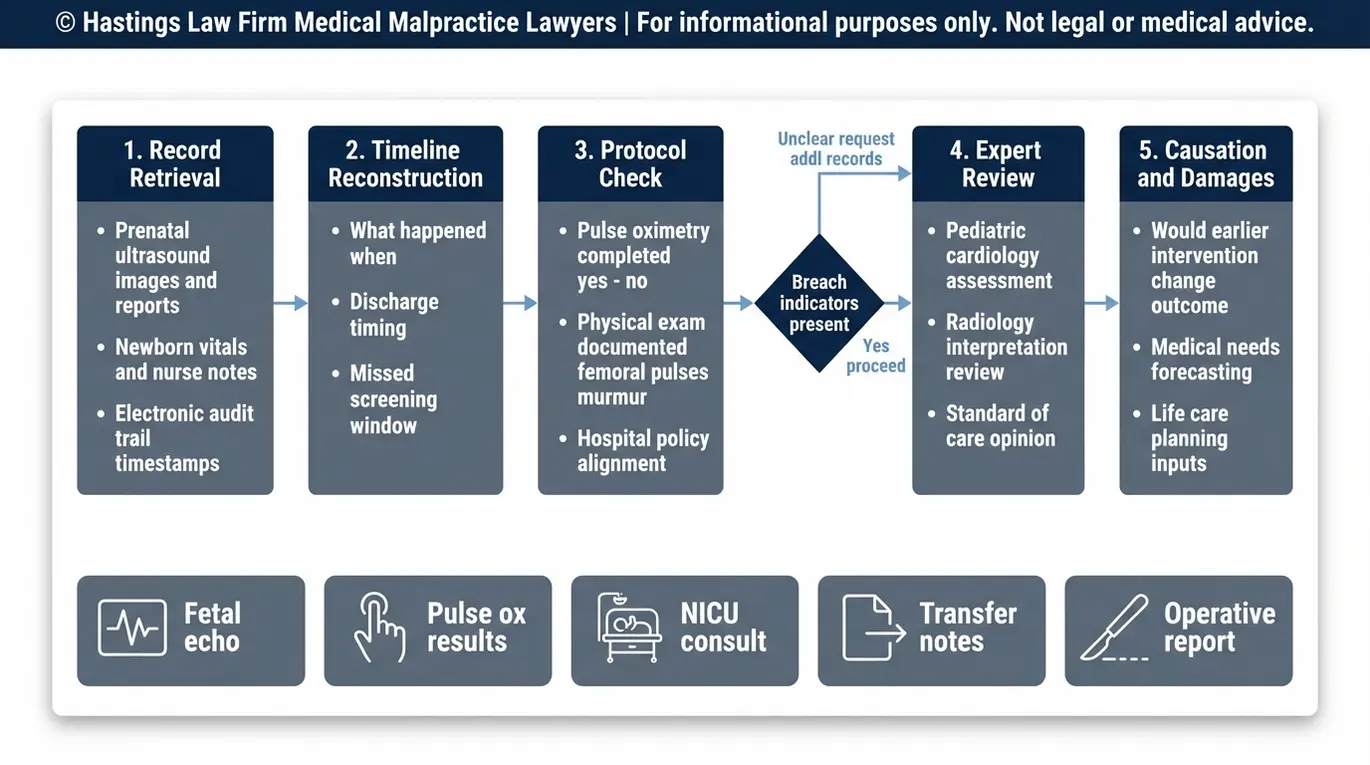
To prove a diagnosis failure claim, we use a structured forensic investigation that includes obtaining all prenatal and neonatal records, reconstructing the timeline of care, analyzing adherence to hospital protocols, engaging pediatric cardiology experts, and calculating the lifetime cost of care for the child. This process is designed to build the strongest possible foundation, whether the case resolves through settlement or goes to a jury.
As a congenital heart defect malpractice law firm, Hastings Law Firm prepares every case from day one as though it will go to trial. Our team includes in-house nurse consultants and Board Certified Patient Advocates who work alongside our attorneys, ensuring every medical negligence attorney on our team has the clinical insight needed to identify exactly where the standard of care was breached.
Here is how we approach each phase:
- Step 1: Record Retrieval. We obtain the complete medical file, including electronic health records, audit trails, nursing notes, fetal monitoring strips, and imaging studies. The audit trail is especially important because it shows when entries were made, modified, or accessed, which can reveal gaps or inconsistencies in the documented care.
- Step 2: Expert Review. We engage independent pediatric cardiologists and other qualified specialists to review the records and assess whether the provider’s actions met the standard of care. These experts evaluate imaging quality, interpret screening results, and identify specific points where a diagnosis should have been made.
- Step 3: Policy Analysis. We compare what happened to what the hospital’s own policies required. If a facility had a CCHD screening protocol and it was not followed, that internal inconsistency strengthens the case. The Arizona Supreme Court’s opinion in CV-23-0152-PR addresses relevant standards for medical negligence claims in the state and informs how we frame breach-of-duty arguments.
- Step 4: Causation Analysis. Establishing that negligence occurred is only half the equation. We must also prove that earlier intervention, such as surgical repair within days rather than weeks, would have prevented the brain injury, organ damage, or death. Our medical experts build a causation timeline showing the difference between the care that was provided and the care that should have been provided.
- Step 5: Damages Calculation. For children who survive with lasting injuries, we work with life care planners and economists to project the full cost of future medical needs, including surgeries, cardiac monitoring, therapies, and home nursing. An Arizona birth injury lawyer addresses these long-term needs when a child faces permanent cardiac complications.
Compensation for Long-Term Care and Wrongful Death
Families affected by a missed heart defect diagnosis may be entitled to compensation for missed heart diagnosis damages covering both immediate medical costs and the long-term consequences of the delay. For families in Arizona, the types of damages available depend on the specifics of the case, but they generally fall into two categories.
Economic Damages
These cover the measurable financial costs tied to the injury. In heart defect cases, economic damages often include past and future surgeries, cardiac medications, home nursing care, rehabilitation, assistive devices, and lost earning capacity if the child’s disabilities limit future employment. A life care plan, developed by medical and economic experts, is typically used to project these costs across the child’s expected lifespan.
Economic damages also account for the inflationary costs of medical care over a lifetime. Specialized equipment, such as home oxygen concentrators or mobility aids, must be replaced periodically. Vocational training may be required if the child’s physical limitations prevent them from entering the workforce in a standard capacity. Compensation for a missed heart diagnosis must reflect the reality that many of these children will need specialized cardiac care for the rest of their lives.
Non-Economic Damages
These address the human cost of the injury: the child’s physical pain and suffering, loss of enjoyment of life, and the emotional distress experienced by the parents and family. Arizona non-economic damages recognize that the harm extends well beyond hospital bills.
Wrongful Death
When a delayed or missed diagnosis results in an infant’s death, parents may pursue a wrongful death claim. While no heart defect birth injury settlement can undo that loss, a wrongful death action can provide financial stability for the family and hold the responsible providers accountable. These claims can include funeral and burial costs, loss of the child’s companionship, and the grief and suffering of the surviving parents.
Contact the Arizona Birth Injury Attorneys at Hastings Law Firm Today for Help
No amount of money can undo what a missed diagnosis has put your family through. However, financial security is essential for your child’s future medical needs, and accountability matters for the safety of other families.
The Arizona birth injury attorneys at Hastings Law Firm represent families across the state in cases involving congenital heart defect diagnosis failures. As Arizona infant congenital heart disease diagnosis failure lawyers, our team has the medical knowledge, expert network, and trial preparation that these cases demand. Our team includes former defense attorneys and hospital nurses who previously worked for the systems they now challenge.
There is no fee unless we recover compensation for you. If your infant was harmed by a missed or delayed heart defect diagnosis, contact us for a free, confidential case evaluation. A patient advocate will listen to your story, review your situation, and help you understand your options.
Frequently Asked Questions About Infant Congenital Heart Disease Misdiagnosis in Arizona


This content was researched and written by the Hastings Law Firm editorial team, which includes attorneys, medical professionals, and experienced researchers. Our writing is informed by internal knowledge and practical experience, and we cross-check critical details against authoritative sources cited throughout. Every piece undergoes human-led fact-checking and legal review. Because legal and medical information can change, if you spot an error, please contact us. Learn more about our content standards and review process on our editorial policy page.

Tommy Hastings, founder of Hastings Law Firm, is a board-certified personal injury trial lawyer dedicated exclusively to healthcare injury cases. Since 2001, he has represented injured patients and families in litigation against major hospital systems, pharmaceutical companies, and negligent healthcare providers nationwide. He has handled numerous high-profile cases that have drawn national media attention and resulted in multi-million dollar recoveries. He draws on that experience in his writing, helping readers understand how these cases work and what options may be available to them.
