


Arizona Infant Congenital CMV Diagnosis Failure Lawyer
Written by: Hastings Law Firm | Reviewed by: Tommy Hastings | Updated: July 27, 2026
A missed or delayed congenital CMV diagnosis can leave families facing lifelong challenges tied to preventable gaps in prenatal care. Liability concerns often focus on whether an OB GYN recognized risk factors, took reported symptoms seriously, and followed up on concerning ultrasound findings with appropriate testing and counseling. When CMV is overlooked, a child can suffer lasting harm that affects hearing, vision, brain development, and daily functioning, creating major care needs and financial strain. If you or a loved one were harmed or worse due to infant congenital CMV diagnosis failure in Arizona, contact Hastings Law Firm for a free, confidential case review.

Top Rated Arizona Medical Malpractice Attorneys for CMV Claims
What You Should Know About Cytomegalovirus Screening Misdiagnosis Claims in Arizona:
- Lifelong disability and intensive care needs can follow a missed congenital CMV diagnosis because the infection can cause permanent injury to hearing, vision, and brain development.
- Options for accountability can narrow if Arizona filing deadlines are missed because strict time limits can permanently bar a legal remedy.
- A missed diagnosis can be harder to detect early because a pregnant mother may have mild or no symptoms while the fetus is harmed.
- Preventable exposure risks can go unaddressed when CMV prevention counseling is not provided to higher risk pregnant women who work around young children.
- A missed opportunity for earlier intervention can occur when maternal symptoms are dismissed without CMV serologic testing.
- A missed opportunity for earlier detection can occur when abnormal ultrasound findings are documented but not followed with CMV focused evaluation.
- Disputes about whether care met the standard of care can turn on whether clinical signs or risk factors should have triggered further evaluation.
- Proving negligence can depend on expert testimony addressing whether timely CMV testing and intervention could have changed the outcome.
- Evidence can become harder to obtain over time because records can be lost and memories can fade.
- Key records can shape what happened because prenatal notes, lab orders, ultrasound reports, and nursing records may show whether concerns were recognized and addressed.

A Healthcare Focused Law Firm
When your child has been diagnosed with disabilities linked to congenital cytomegalovirus, the weight of that news can feel unbearable. You may be wondering whether your doctor missed something, whether earlier testing could have changed the outcome, and what options your family has now.
These are the right questions to ask. An Arizona missed congenital CMV lawyer can help you find the answers by examining your prenatal records, consulting medical experts, and determining whether your providers met the standard of care.
At Hastings Law Firm, founder Tommy Hastings and our team of trial attorneys, former defense lawyers, and in-house medical professionals focus exclusively on medical malpractice. If your family is facing this situation, we welcome you to contact us for a free, confidential case evaluation. There is no fee unless we recover compensation for you.
Understanding Congenital CMV and Medical Liability
Congenital CMV liability arises when an OB-GYN or healthcare provider fails to screen for, diagnose, or treat a maternal cytomegalovirus infection according to the standard of care, directly resulting in harm to the newborn. Medical liability in these cases hinges on whether a doctor followed established protocols to protect the patient and child. Congenital CMV (cCMV) is a viral infection passed from mother to baby. To understand how these claims work, it helps to understand the infection itself. An Arizona CMV malpractice attorney can explain that to understand liability, one must understand the virus.
Congenital cytomegalovirus, often called cCMV, is the most common viral infection passed from mother to baby during pregnancy. According to the Minnesota Department of Health, CMV is a widespread virus in the herpes family that most healthy adults carry without knowing it.
The danger arises during pregnancy, when the virus can cross the placenta through vertical transmission, meaning it passes directly from the mother’s bloodstream to the developing fetus. This transmission can cause serious and permanent injury to the baby’s brain, hearing, and vision.
The standard of care, the accepted level of treatment that a reasonably competent physician would provide under similar circumstances, does not always require universal CMV screening for every pregnant patient. But when a mother presents with specific symptoms, reports known risk factors, or when ultrasound findings raise concern, the standard of care typically requires the physician to investigate maternal infections.
OB-GYN negligence and medical negligence in CMV cases usually take one of two forms: a failure to inform the mother about CMV risks and prevention, or a failure to order appropriate testing when clinical signs warranted it. An Arizona CMV malpractice attorney examines whether your doctor had enough information to act and whether their decision not to test fell below the accepted standard. A lawyer for CMV birth injury can also evaluate whether earlier diagnosis would have opened the door to treatment or closer monitoring that may have reduced harm to your child.
Qualified attorneys for CMV claims know that failing to act is a critical error. If you suspect your providers overlooked warning signs during pregnancy, an Arizona missed congenital CMV lawyer can review the full medical timeline and help you understand whether a claim exists. Trusting an experienced Arizona cytomegalovirus lawyer is essential. Your CMV birth injury lawyer in Arizona will look for these failures and pursue the recovery your family deserves.
Common Errors Committed by Doctors in CMV Cases
Common medical errors include dismissing maternal flu-like symptoms as minor viruses, failing to order serological testing when indicated, and neglecting to inform pregnant women about hygiene precautions to prevent CMV acquisition. Medical negligence in CMV cases involves specific failures in diagnostic protocols. Legal teams often determine negligence by comparing a doctor’s actions to what another competent provider would have done in the same situation. These errors can take different forms, but they tend to follow recognizable patterns.
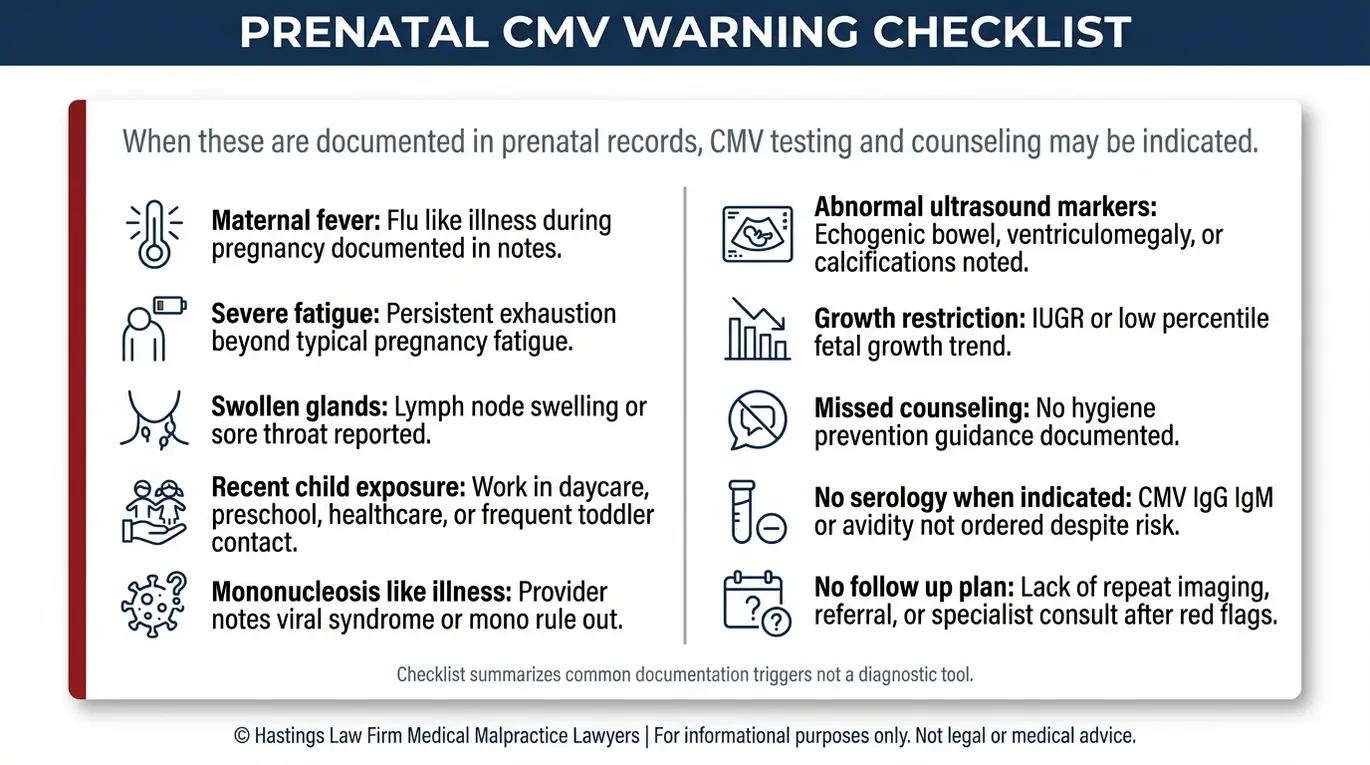
Dismissal of Maternal Symptoms. One of the most frequent failures involves overlooking a mother’s reported symptoms. Fever, swollen glands, prolonged fatigue, and body aches during pregnancy can all signal a cytomegalovirus infection. This form of CMV misdiagnosis often occurs when providers overlook clinical indicators during exams.
According to the Centers for Disease Control and Prevention (CDC), most people with CMV show few or no symptoms, which can lead doctors to attribute a pregnant patient’s complaints to a routine cold or general pregnancy discomfort. When a physician dismisses these symptoms without ordering CMV serologic testing, which includes IgM, IgG, and IgG avidity blood tests used to determine whether a CMV infection is recent or past, a critical diagnostic window may close. An Arizona CMV negligence attorney can help families identify these lapses.
Ultrasound Oversights. Prenatal ultrasounds can reveal soft markers that suggest a viral infection in the fetus. Findings like echogenic bowel, a condition where the fetal intestine appears unusually bright on ultrasound, or intracranial calcifications and growth restriction should prompt further investigation. When these findings are documented but not followed up with prenatal testing or diagnostic testing for CMV, it may represent a missed opportunity to identify the infection before birth. Consulting a lawyer for undiagnosed CMV is the first step in addressing this negligence.
Failure to Warn About CMV Prevention. Pregnant women who work in daycares, schools, or healthcare settings face a higher risk of CMV exposure. A missed CMV diagnosis lawyer can evaluate whether the physician failed to counsel at-risk mothers about basic prevention steps to prevent maternal infections, such as handwashing after contact with young children’s saliva or urine. Our attorney for CMV birth injuries investigates these oversights thoroughly.
Signs a doctor may have missed a CMV diagnosis:
- Maternal flu-like symptoms during pregnancy were attributed to a common cold without testing
- Abnormal ultrasound findings such as echogenic bowel or calcifications were not investigated
- No CMV serologic testing was ordered despite known risk factors or reported symptoms
- The mother was not educated about CMV transmission risks, especially if she worked with young children
- Prenatal records show no documentation of CMV discussion or screening rationale
An Arizona missed congenital CMV lawyer reviews these records to identify where the standard of care may have been breached and whether infection mismanagement contributed to your child’s injuries. An Arizona lawyer for cytomegalovirus malpractice understands the nuances of these medical records and can pinpoint exactly where the error occurred. An Arizona birth injury lawyer for CMV provides the expertise needed to reach a resolution for your family.
The Hastings Law Firm Difference
Results matter, but what truly sets us apart is how we achieve them. Every verdict, every settlement, and every Arizona courtroom victory comes from one guiding promise: To treat each client’s fight for justice as if it were our own.
This balance of skill, experience, and empathy reflects our core philosophy that justice should not only compensate the injured, but also make healthcare safer nationwide.

The Devastating Impact of Missed CMV on Newborns
Untreated congenital CMV can cause catastrophic long-term injuries, including sensorineural hearing loss, vision impairment, microcephaly, cerebral palsy, and severe cognitive developmental delays. Because these conditions often require specialized care throughout a child’s life, accurately projecting future costs is an important part of a legal claim. cCMV affects brain and sensory development in newborns. Complications such as prematurity, low birth weight, and neonatal sepsis often accompany the diagnosis, adding to the medical complexity.
Some children are born with obvious signs of infection. Others appear healthy at birth but develop problems months or even years later. Sensorineural hearing loss (SNHL), a type of permanent hearing loss caused by damage to the inner ear or auditory nerve, is the single most common disability linked to congenital CMV.
A review published in PubMed Central on congenital CMV as a leading cause of pediatric hearing loss confirms that cCMV is one of the top non-genetic causes of childhood hearing impairment. In some cases, hearing loss is progressive, meaning it worsens over time and may not be detected until the child misses speech milestones.
Microcephaly, a condition where the baby’s head is significantly smaller than expected due to abnormal brain development, can lead to seizures, intellectual disability, and motor impairment. Children with neonatal brain damage from CMV may also experience vision problems, developmental delays, and difficulty with basic self-care throughout their lives. An Arizona CMV malpractice lawyer will seek the full compensation needed to cover these extensive needs.
The financial burden on families is enormous. A life care plan for a child with severe congenital CMV injuries may include cochlear implants, speech therapy, occupational therapy, specialized education, and full-time caregiving well into adulthood. Families often require modified vehicles, home accessibility renovations, and respite care to manage the daily demands of a disabled child. Your attorney for cytomegalovirus birth defects can help quantify these costs.
| Injury Type | Long-Term Impact | Estimated Lifetime Cost Category |
|---|---|---|
| Sensorineural Hearing Loss | Speech delays, cochlear implants, ongoing audiological care | High |
| Microcephaly / Brain Damage | Seizures, intellectual disability, motor impairment | Very High |
| Vision Impairment | Corrective procedures, adaptive education, assistive technology | Moderate to High |
| Cerebral Palsy | Physical therapy, mobility aids, personal care assistance | Very High |
| Cognitive / Developmental Delays | Special education, behavioral therapy, vocational support | High |
A lawyer for CMV birth defects can work with life care planners and medical economists to calculate the true cost of your child’s future needs. An Arizona CMV injury attorney ensures these projected expenses are accounted for in any claim. A skilled CMV birth injury attorney in Arizona advocates for your child’s future security.
How the Maternal Immune System Masks CMV
One reason congenital CMV is so frequently overlooked is that the mother’s immune system often controls the virus well enough that she feels fine, or only mildly ill, while the fetus suffers significant harm. This disconnect between the mother’s experience and the baby’s exposure is central to many missed diagnoses.
During a primary CMV infection in pregnancy, meaning the mother contracts the virus for the first time while pregnant, the risk of transmission to the fetus is highest.
Even a non-primary CMV infection, where the virus reactivates or a new strain is acquired in someone who was previously infected, can cause fetal injury. The mother’s immune response may suppress her own symptoms effectively, a process of immune system adaptation, creating the false impression that nothing is wrong. This can mask dangerous maternal infections that require attention.
Physicians cannot rely on the absence of dramatic maternal symptoms to rule out CMV. When risk factors or subtle clinical signs are present, the standard of care requires further evaluation, not reassurance alone.
Proving Medical Malpractice in CMV Infection Cases
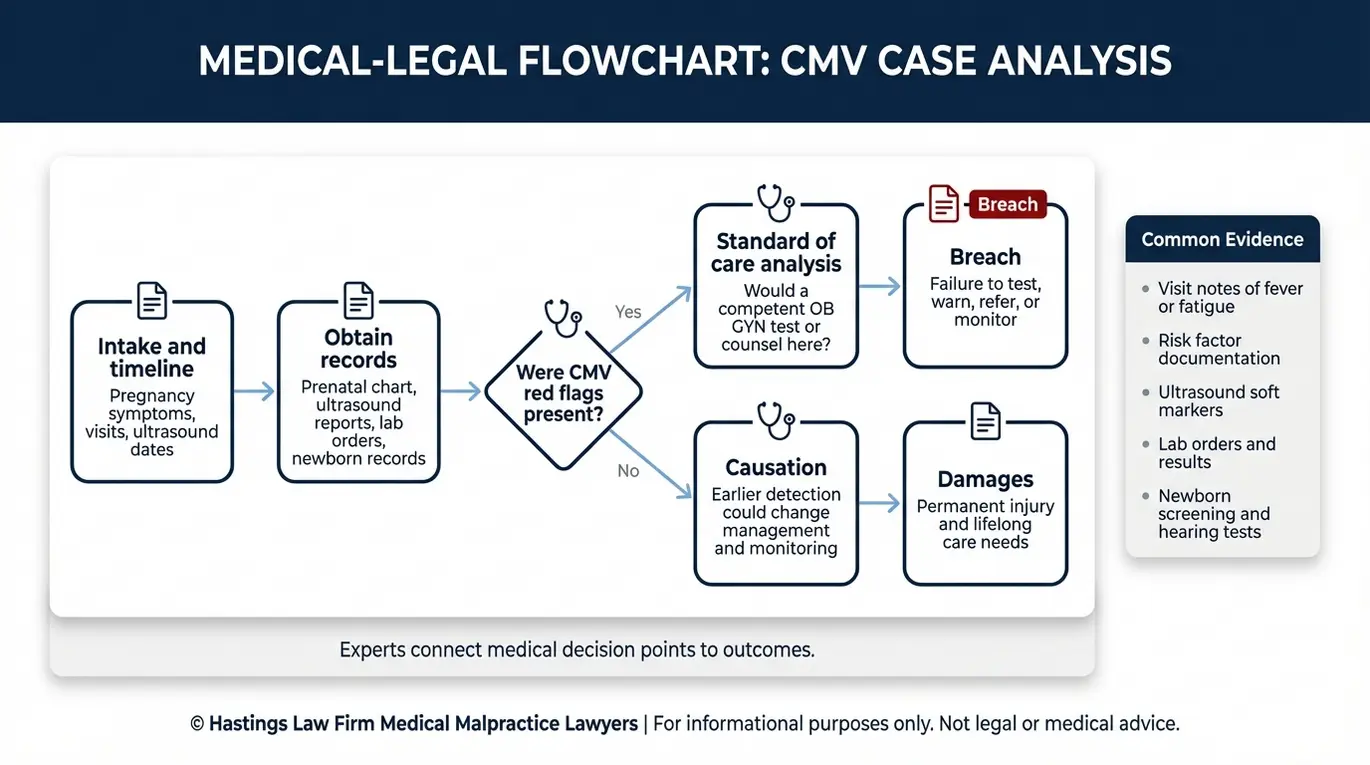
Proving malpractice requires expert testimony to establish that a competent physician would have ordered CMV testing based on the mother’s history or ultrasound findings, and that timely intervention could have changed the outcome. Establishing medical negligence in cCMV cases follows specific legal standards. To successfully prove negligence, the legal team must demonstrate that a medical error directly caused the child’s injuries. Like all medical malpractice claims, a birth injury lawsuit involving congenital CMV must satisfy four legal elements. A lawyer for CMV medical malpractice understands these complex elements.
The elements of proof in a CMV malpractice claim:
- Duty: The treating physician had a professional obligation to monitor and protect the health of both the mother and the developing baby throughout pregnancy.
- Breach: The physician failed to order appropriate testing, such as CMV polymerase chain reaction (PCR) testing of the newborn’s saliva or urine within the first 21 days of life, or failed to investigate maternal symptoms and abnormal ultrasound findings that should have triggered a workup.
- Causation: Had the infection been diagnosed in time, treatment options were available. Research published in Frontiers in Microbiology on anti-CMV therapy discusses antiviral medications such as valganciclovir, an oral antiviral used to treat symptomatic congenital CMV in newborns, which may improve hearing and developmental outcomes when administered early.
- Damages: The child sustained permanent injuries, including hearing loss, developmental delays, brain damage, or other disabilities requiring ongoing care.
An Arizona missed congenital CMV lawyer builds the case by reconstructing the medical timeline from prenatal visits through delivery and newborn care. Your Arizona CMV birth injury counsel will gather the evidence needed to establish proving CMV negligence. We review office visit notes, lab orders, ultrasound reports, and nursing records to identify where the standard of care was not met. Our in-house medical staff, including nurse practitioners and Board Certified Patient Advocates, assists in analyzing clinical data to pinpoint breakdowns in care.
Proving negligence also depends on qualified medical experts who can testify about what a reasonably competent OB-GYN or pediatrician would have done under the same circumstances. An attorney for missed CMV knows what to look for in expert reports. Hastings Law Firm maintains a national network of specialists who provide objective case reviews and credible testimony in every pediatric malpractice claim. Trust an Arizona cytomegalovirus negligence lawyer to handle the legal burden.
Arizona Statute of Limitations for CMV Birth Injury Claims
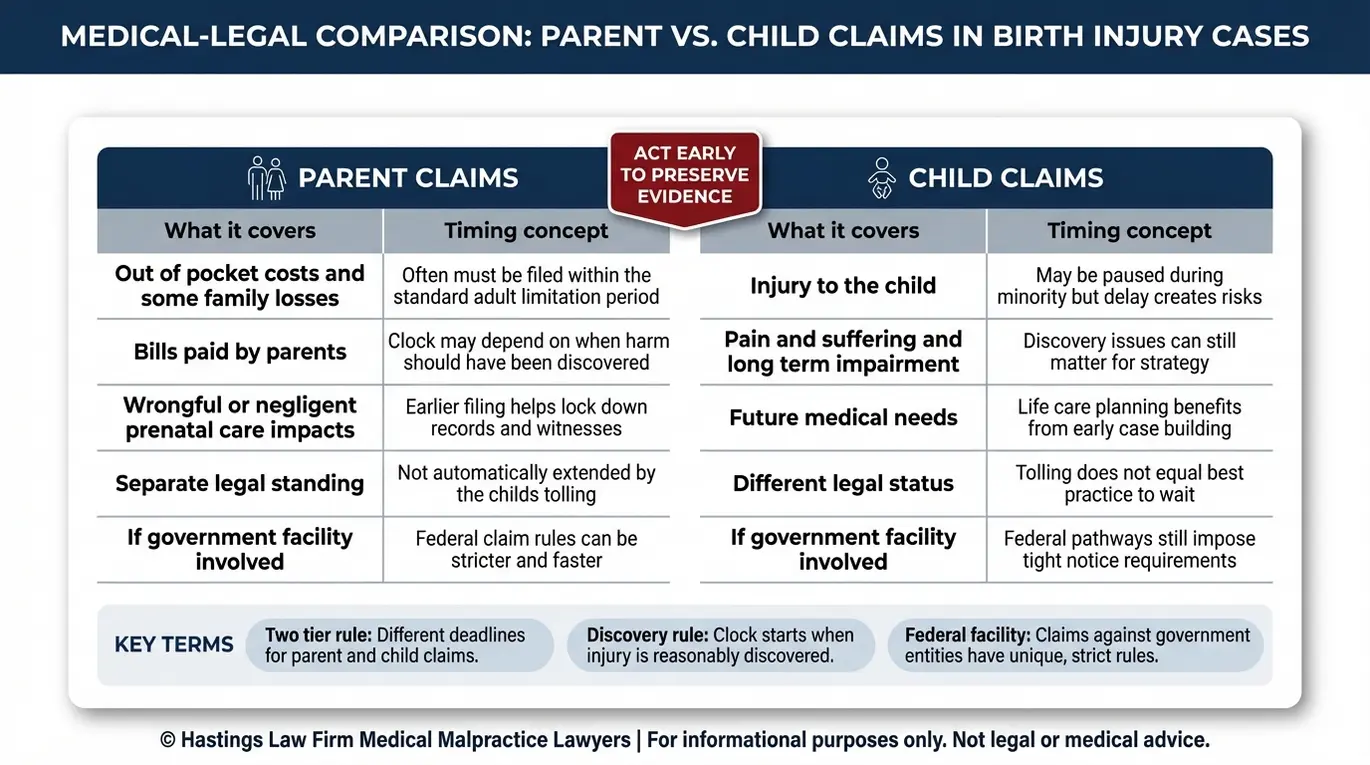
In Arizona, the statute of limitations for birth injuries is complex; generally, parents have two years to file for their own damages, while the child’s claim is tolled (paused) until they turn 18, though early filing is critical to preserve evidence. Arizona legal deadlines for medical malpractice depend on whose damages are being claimed. These deadlines are strict, and missing them can permanently bar a family from seeking a legal remedy.
The Two-Tier Rule
Arizona applies a two-tiered statute of limitations depending on who is bringing the claim. Under Arizona Revised Statutes § 12-542, parents generally have two years from the date of injury, or from when the injury reasonably should have been discovered, to file claims for their own losses, such as medical expenses and emotional distress. Arizona filing deadlines are strictly enforced by the courts.
Under Arizona Revised Statutes § 12-502, minors receive tolling protection, meaning the statute of limitations is paused until the child turns 18. At that point, the standard two-year filing period begins to run. This gives the child until age 20 to file their own claim for pain and suffering, disability, and loss of future earning capacity. A CMV lawyer Arizona can guide you through this.
| Claim Type | Filing Deadline | Key Trigger |
|---|---|---|
| Parent’s Claim (medical bills, emotional distress) | 2 years from injury or discovery | Date of injury or when negligence reasonably should have been discovered |
| Child’s Claim (pain, suffering, disability) | Tolled until age 18, then 2 years | Child’s 18th birthday |
| Federal Facility (FTCA) | Administrative claim within 2 years; strict procedural requirements | Date of injury at a government-run facility |
The Discovery Rule
This rule is especially relevant in congenital CMV cases. The discovery rule application determines when the legal clock begins based on when parents learned of the injury. Because hearing loss and developmental delays may not become apparent for months or years after birth, the clock may not start until the family reasonably should have known the injury was connected to medical negligence. A CMV lawyer in Arizona can evaluate when your discovery date likely began.
Federal and State Differences
If your care was provided at a federally funded clinic, VA hospital, or military facility, the Federal Tort Claims Act imposes shorter and stricter procedural deadlines that differ from Arizona’s state filing rules. Different rules apply if the injury occurred at a government facility. Missing these federal windows can permanently bar your claim. An Arizona CMV malpractice attorney can explain exceptions.
Regardless of tolling protections, evidence degrades over time. Medical records can be lost, witnesses relocate, and memories fade. Contacting an Arizona medical malpractice lawyer early gives your legal team the best opportunity to build a strong case. A lawyer for CMV cases in Arizona ensures timely filing.
Why Choose Hastings Law Firm for Your Arizona CMV Case
Hastings Law Firm offers a unique combination of board-certified trial advocacy, in-house medical expertise, and a compassionate, client-centric approach that treats your family as partners in the pursuit of justice. We are dedicated exclusively to medical malpractice litigation, providing a focused legal perspective. Every member of our team, from attorneys to nurse consultants, focuses exclusively on medical malpractice.
Trial-Ready From Day One
We provide trial-ready advocacy and prepare every case as though it will go before a jury. This level of preparation, including detailed medical reconstruction, expert analysis, and full litigation strategy, signals to defense attorneys and insurance carriers that we will not accept less than a fair resolution. Our team includes former defense attorneys who previously represented hospitals, giving us direct insight into how the other side builds its case. We strive to be the best CMV attorney option for your family.
In-House Medical Professionals
Our staff includes nurse practitioners and Board Certified Patient Advocates who review your medical records, interpret clinical data, and help identify exactly where care fell short. This medical-legal collaboration is central to how we build CMV negligence claims.
Board-Certified Leadership
Founder Tommy Hastings is Board Certified in Personal Injury Trial Law by the Texas Board of Legal Specialization. He has secured millions in recoveries for families affected by neurological injuries and birth injuries, and his ability to translate complex medical evidence into clear, persuasive arguments has earned the trust of clients and juries across the country. We believe in transparency and restoring trust.
No Fee Unless We Recover for You
We handle every case on a contingency fee basis. You pay no attorney fees and no upfront costs. If we don’t secure a recovery, you owe us nothing. This structure ensures that every family has access to top-level legal representation, regardless of their financial situation. As an Arizona CMV birth injury lawyer, we advocate for your recovery.
If you are looking for an Arizona missed congenital CMV lawyer who will treat your family as a partner and prepare your case with the thoroughness it deserves, we are ready to listen. Our lawyer for cytomegalovirus claims is dedicated to results. Choose a top Arizona CMV lawyer with a proven track record. An attorney for CMV malpractice at our firm is ready to help.
Contact the Arizona Birth Injury Attorneys at Hastings Law Firm Today for Help
If your child was born with injuries related to congenital CMV that your doctor may have failed to diagnose, you deserve clear answers about what happened and what your options are. The path forward starts with understanding whether the care you received met the standard your family was owed.
Hastings Law Firm offers a free, confidential case evaluation with no obligation. Our team of trial attorneys, former defense lawyers, and in-house medical professionals will review your records and explain whether a claim may exist. Contact an Arizona Infant Congenital CMV Diagnosis Failure Lawyer at our firm to begin your investigation.
You pay nothing unless we recover compensation for your family. Contact our Arizona birth injury lawyers today by calling our office or completing our online form. Let us help you take the first step toward accountability and your child’s future security.
Frequently Asked Questions About Infant Congenital CMV Diagnosis Failure in Arizona


This content was researched and written by the Hastings Law Firm editorial team, which includes attorneys, medical professionals, and experienced researchers. Our writing is informed by internal knowledge and practical experience, and we cross-check critical details against authoritative sources cited throughout. Every piece undergoes human-led fact-checking and legal review. Because legal and medical information can change, if you spot an error, please contact us. Learn more about our content standards and review process on our editorial policy page.

Tommy Hastings, founder of Hastings Law Firm, is a board-certified personal injury trial lawyer dedicated exclusively to healthcare injury cases. Since 2001, he has represented injured patients and families in litigation against major hospital systems, pharmaceutical companies, and negligent healthcare providers nationwide. He has handled numerous high-profile cases that have drawn national media attention and resulted in multi-million dollar recoveries. He draws on that experience in his writing, helping readers understand how these cases work and what options may be available to them.
