


Arizona Infant Brain Anomaly Misdiagnosis Lawyer
Written by: Hastings Law Firm | Reviewed by: Tommy Hastings | Updated: July 27, 2026
A missed or delayed diagnosis of an infant brain anomaly can leave families facing unexpected medical needs, overwhelming uncertainty, and lasting emotional strain. Diagnostic failures can happen during prenatal screening when imaging or blood work is misread or not followed up, or during labor and delivery when fetal distress is not recognized in time. The difference between a wrongful birth claim and a birth injury claim often turns on when the condition existed and what information was disclosed. If you or a loved one were harmed or worse due to infant brain anomaly misdiagnosis in Arizona, contact Hastings Law Firm for a free, confidential case review.
Top Rated Arizona Malpractice Attorneys for Undiagnosed Brain Defects
What You Should Know About Infant Brain Abnormality Misdiagnosis Claims in Arizona:
- Lifelong medical needs and major care costs can follow when a brain anomaly is missed in prenatal care or when fetal distress is not recognized during labor.
- Options and potential damages can change based on whether the claim is framed as wrongful birth or birth injury.
- Accountability may extend beyond an OB GYN because radiologists and imaging staff can contribute to missed findings.
- Recovery can be limited if key filing requirements are not met because Arizona requires an early expert affidavit in medical malpractice cases.
- Financial recovery often focuses on long term support needs because these cases can involve decades of ongoing care.
- A missed follow up after abnormal screening results can be central because prenatal diagnostics are intended to flag serious concerns early.
- A delayed response to concerning fetal monitoring patterns can be pivotal because oxygen deprivation during labor can cause permanent brain injury.
- Cooling therapy after birth can strongly indicate an acute hypoxic event because it is used to reduce brain damage after oxygen loss.
- Case clarity often depends on complete records because prenatal charts, imaging reports, fetal monitoring strips, delivery logs, and NICU documentation are repeatedly referenced as key evidence.

A Healthcare Focused Law Firm
Learning that your child’s brain anomaly may have been missed or misdiagnosed by a medical provider is deeply unsettling. You trusted your care team to monitor your pregnancy and delivery, and when that trust is broken, the emotional weight can feel impossible to carry. You are not alone, and your instinct that something went wrong deserves to be taken seriously.
At Hastings Law Firm, we focus exclusively on medical malpractice, including cases where prenatal or perinatal diagnostic failures lead to devastating outcomes for infants and their families. Our team of attorneys, nurse consultants, and medical experts understands both the medicine and the law behind these cases. If you believe your child’s brain condition was missed or mismanaged, an Arizona infant brain anomaly misdiagnosis lawyer at our firm can review what happened and explain your options in a free, confidential consultation.
Understanding Infant Brain Anomalies and Diagnostic Failures
A failure to diagnose a brain anomaly occurs when medical providers miss structural defects during prenatal screening or fail to identify signs of acute brain trauma during labor and delivery. These diagnostic failures can deprive families of the chance to prepare, seek early treatment, or make informed decisions about their pregnancy.
In a legal context, “brain anomaly” covers two broad categories. The first involves structural brain malformations, also called congenital brain malformations, which are conditions that develop during fetal growth. The second involves acquired brain injuries, such as hypoxic-ischemic encephalopathy (HIE), which result from complications like undiagnosed fetal distress during labor.
Common types of infant brain anomalies include:
- Hydrocephalus: An abnormal buildup of fluid in the brain’s ventricles, often detectable on imaging.
- Neural tube defects: A group of conditions where the brain or spinal cord does not form properly in early pregnancy.
- Spina bifida: A specific neural tube defect where the spinal column does not close completely.
- Congenital structural defects: Other malformations affecting the brain’s size, shape, or development.
Parents rely heavily on prenatal testing to understand their baby’s health. Maternal serum screening, a blood test that measures certain protein levels during pregnancy, is one of the earliest tools used to flag potential problems. When providers follow the medical standard of care, imaging and blood work can detect many of these conditions well before birth.
Advanced high-resolution ultrasounds and fetal MRIs allow specialists to visualize minute details of brain development. Interpreting these images correctly requires vigilance; a missed measurement or an overlooked shadow on a scan can mean the difference between early intervention and a surprise diagnosis at birth. An infant brain anomaly lawyer in Arizona can help determine whether your providers met that standard or fell short.
Wrongful Birth vs. Birth Injury Claims in Arizona
Wrongful birth claims allege that a provider’s failure to warn parents of a defect deprived them of reproductive choice, while birth injury claims allege that medical negligence during labor or delivery caused or worsened a condition. Both fall under medical malpractice, but they involve different legal theories, different types of evidence, and different categories of damages. Determining liability is central to these claims.
A wrongful birth claim applies when a genetic or structural condition, like spina bifida, existed before delivery but was not identified or disclosed during prenatal care. The core allegation is that the parents were denied the information they needed to make informed decisions. Had they been properly warned, they could have prepared differently or made different reproductive choices.
A birth injury claim, by contrast, applies when a medical provider’s actions or inactions during labor and delivery caused a preventable brain injury, such as cerebral palsy resulting from prolonged oxygen deprivation. Here, the focus is on what happened in the delivery room and whether the medical team responded appropriately to warning signs like fetal distress. While wrongful birth cases hinge on showing that parents would have chosen differently with accurate information, birth injury cases focus on the physical harm caused by negligence.
An Arizona infant brain injury attorney can help families identify which legal pathway applies, because the distinction affects how damages are calculated and what evidence is needed. In some cases, both claims may overlap. A misdiagnosis lawyer for brain anomalies will evaluate the full timeline of care, from prenatal visits through delivery, to determine where the breakdown occurred.
| Element | Wrongful Birth | Birth Injury |
|---|---|---|
| Legal Theory | Provider failed to diagnose/disclose a known defect, depriving parents of informed choice | Provider’s negligence during care caused or worsened a brain injury |
| Typical Damages | Extraordinary child-rearing costs, emotional distress, lost reproductive choice | Lifetime medical costs, lost earning capacity, pain and suffering |
| Key Evidence | Prenatal screening records, ultrasound reports, genetic test results | Fetal monitoring strips, delivery records, NICU documentation |
The Hastings Law Firm Difference
Results matter, but what truly sets us apart is how we achieve them. Every verdict, every settlement, and every Arizona courtroom victory comes from one guiding promise: To treat each client’s fight for justice as if it were our own.
This balance of skill, experience, and empathy reflects our core philosophy that justice should not only compensate the injured, but also make healthcare safer nationwide.

Failure to Detect Brain Defects in Prenatal Screenings
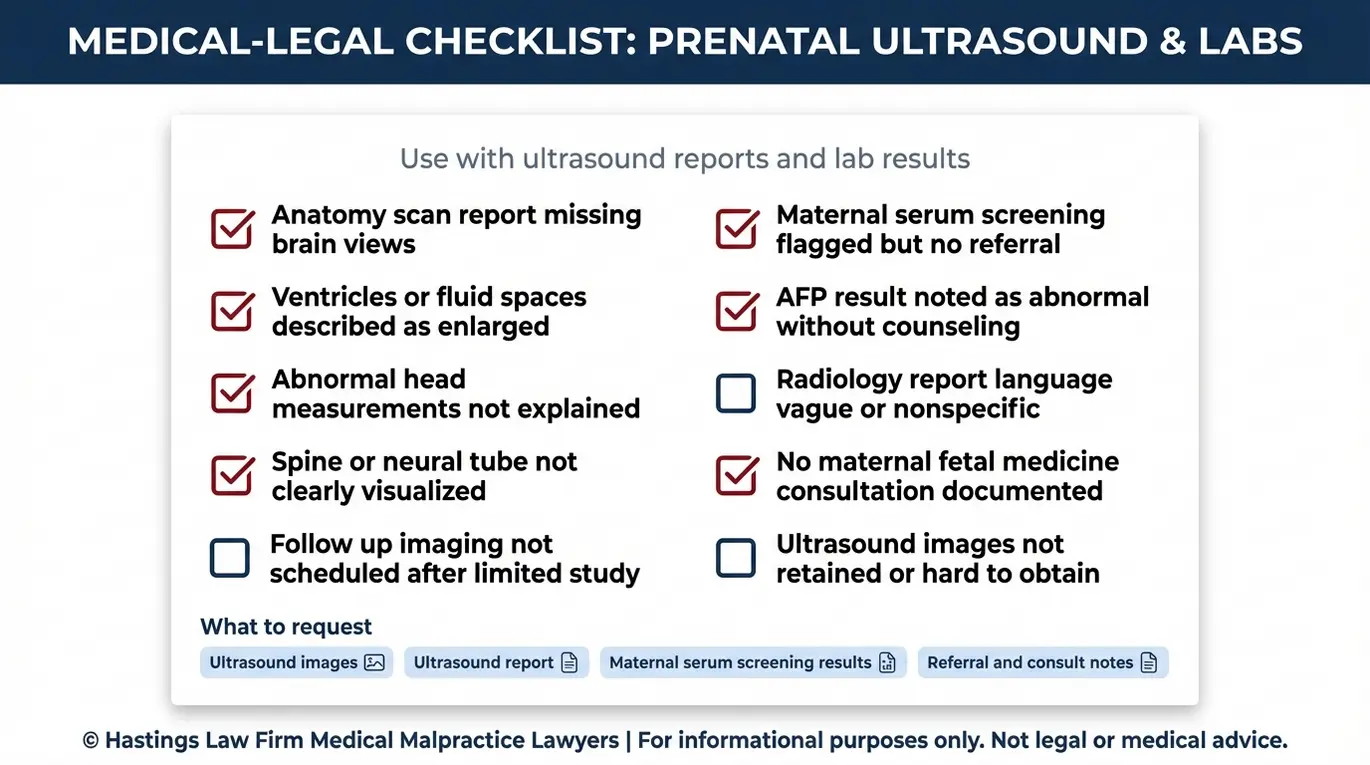
Malpractice, or medical negligence, may occur if a radiologist or OB/GYN fails to adhere to the standard of care when interpreting ultrasounds or acting on abnormal maternal serum screening results. Prenatal diagnostics exist specifically to catch problems early, and when providers overlook clear findings, families lose the chance to plan or intervene.
The anatomy scan, a detailed ultrasound typically performed around 20 weeks of pregnancy, is one of the most important diagnostic tools for identifying neural tube defects and other structural brain conditions. During this scan, the provider should carefully measure the baby’s head, evaluate brain structures, and check for fluid buildup or other abnormalities.
Blood tests also provide early warning signs. Alpha-fetoprotein (AFP), a protein produced by the developing baby, is measured through maternal serum screening. According to MedlinePlus, elevated AFP levels can indicate neural tube defects or other serious conditions. When AFP results come back abnormal, the standard of care generally requires follow-up testing.
This diagnostic test and others exist to catch issues early, often followed by high-resolution ultrasound or amniocentesis. Recent research published in Frontiers in Pediatrics has even explored the use of artificial intelligence to improve prenatal detection of neural tube defects, underscoring how detectable many of these conditions are with proper screening.
A lawyer for missed brain defect diagnosis will look for red flags that may have been overlooked, including:
- Abnormal head circumference measurements on ultrasound
- Visible fluid buildup in the brain ventricles
- Elevated or abnormal AFP levels without follow-up testing
- Incomplete or poor-quality ultrasound imaging
- Failure to refer for advanced imaging after an inconclusive scan
- Missing or incomplete documentation in prenatal records
Liability of Radiologists and Non-Physician Staff
Diagnostic imaging interpretation is a specialized medical task where errors can have lifelong consequences. Liability in these cases often extends beyond the OB/GYN. The radiologist who interpreted the imaging may bear responsibility if they missed findings that a competent peer would have identified. Technicians who captured poor-quality images, making it impossible for anyone to read them accurately, may also contribute to a failure in the standard of care. We review the full chain of medical records to determine every provider whose actions, or inactions, may have contributed to the missed diagnosis.
Misdiagnosis of Fetal Distress Leading to Brain Injury
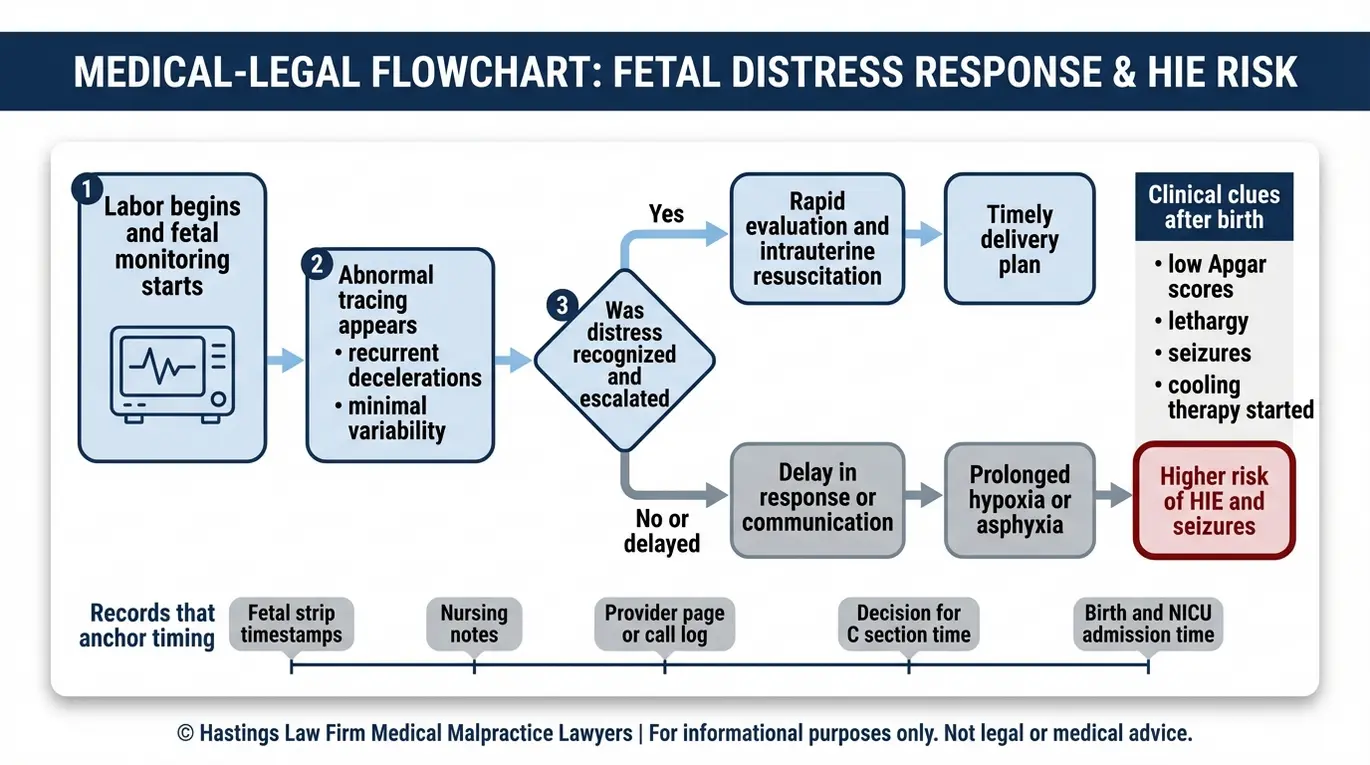
Failure to recognize signs of fetal distress, such as heart rate decelerations, can lead to delayed intervention and permanent hypoxic brain injury. Fetal monitoring is used to ensure the baby is tolerating the stress of labor. Medical teams must remain vigilant, monitoring heart rates for irregularities that suggest the baby is struggling. When a baby’s brain is deprived of oxygen during labor, the damage can begin within minutes, and the consequences can last a lifetime.
Electronic fetal monitoring (EFM), the continuous tracking of a baby’s heart rate during labor, is the primary tool used to detect distress. Fetal heart rate decelerations, drops in the baby’s heart rate during or between contractions, can signal that the baby is not getting enough oxygen. When these patterns appear, the medical team is expected to act quickly. That response may include repositioning the mother, administering oxygen, or proceeding with an emergency cesarean section (C-section).
Here is how the progression from fetal distress to brain injury can unfold when warning signs are missed:
- Fetal monitoring shows concerning patterns: Late or variable decelerations appear on the EFM strip.
- Medical team fails to interpret or act on the data: The significance of the tracings is overlooked or downplayed.
- Oxygen deprivation begins (hypoxia): The baby’s brain starts receiving insufficient oxygen.
- Prolonged oxygen loss leads to asphyxia: Without intervention, oxygen deprivation worsens.
- Brain cells are damaged: The result can be hypoxic-ischemic encephalopathy (HIE), which is brain damage caused by lack of oxygen and blood flow.
- Newborn shows distress signs: Seizures, lethargy, low Apgar scores, and difficulty breathing may appear shortly after birth.
A lawyer for infant brain misdiagnosis will reconstruct the timeline of labor using fetal monitoring strips, nursing notes, and delivery records to identify where and when the standard of care may have been breached. As an Arizona birth defect attorney experienced in these cases, we know that even small gaps in response time can have irreversible consequences.
Cooling Therapy as Evidence of Negligence
If a baby receives therapeutic hypothermia, commonly called cooling therapy, immediately after birth, it is strong clinical evidence that an acute hypoxic event occurred. Cooling therapy works by lowering the newborn’s body temperature to slow brain damage after oxygen deprivation, or hypoxia, the condition where the brain receives insufficient oxygen. This treatment must be started within six hours of birth to be effective and helps mitigate the severity of Hypoxic-Ischemic Encephalopathy (HIE).
When a medical team initiates cooling therapy, it can support the argument for causation, confirming the link between the labor events and the injury. It raises the question of whether fetal monitoring should have prompted earlier intervention. We review medical records, NICU charts, and cooling therapy protocols as part of our investigation into what the care team knew and when they knew it.
Proving Medical Negligence in Arizona Brain Defect Cases
Proving negligence requires establishing that the provider breached the standard of care and that this breach directly caused the injury or the loss of reproductive choice. In Arizona, the standard of care is the level of treatment that a reasonably competent medical professional in the same specialty would have provided under similar circumstances.
The burden of proof rests on the family bringing the claim. According to the Arizona Revised Jury Instructions on Medical Negligence, the patient must show that the provider’s conduct fell below accepted medical standards and that this failure was a direct cause of the harm. Causation links the breach directly to the injury.
Building a strong case requires thorough medical records: prenatal charts, ultrasound images and reports, fetal monitoring strips, delivery logs, and NICU documentation. Proving misdiagnosis with an Arizona lawyer at our firm involves a deep forensic review. Our in-house medical staff, including nurse practitioners and board-certified patient advocates, reviews this clinical data alongside our attorneys to identify exactly where the standard of care may have been violated.
Arizona Preliminary Expert Opinion Affidavit
In Arizona, this affidavit is an early screening tool to ensure only cases with medical merit proceed. Arizona law under A.R.S. §12-2602 requires claimants in medical malpractice cases to file a preliminary expert opinion affidavit. This affidavit is a sworn statement from a qualified medical expert confirming that the provider’s care fell below the accepted standard.
Failing to file this document correctly, or on time, can result in dismissal of the entire case. Our team works with a national network of top-tier medical experts to ensure this critical procedural requirement is handled properly from the start.
Securing Compensation for Lifetime Care
Compensation in these cases often includes coverage for past and future medical bills, extraordinary child-rearing costs, and non-economic damages for pain and suffering. Because many brain anomaly and birth injury cases involve conditions that require decades of ongoing care, accurately projecting future costs is essential.
Arizona law distinguishes between ordinary child-rearing expenses and extraordinary costs tied to the condition, like specialized therapies and nursing. Life-care planners work alongside our legal team to calculate these costs over the child’s expected lifespan. Research published by PubMed Central on survival and mortality in cerebral palsy indicates that many individuals with cerebral palsy live well into adulthood. As a result, a care plan must often account for 50 or more years of support.
Compensation for infant brain anomalies in Arizona may include:
- Past and future medical expenses, including surgeries, medications, and rehabilitation
- Costs of specialized education and developmental therapies
- Home modifications and adaptive equipment
- Full-time or part-time nursing and attendant care
- Pain and suffering experienced by the child
- Emotional distress and loss of parental enjoyment
Families should be aware that Arizona’s statute of limitations for medical malpractice is generally two years under A.R.S. §12-542, so taking timely action to preserve your claim is important.
Contact the Arizona Birth Injury Attorneys at Hastings Law Firm Today for Help
If your child was born with a brain condition that you believe should have been caught earlier, or if a delivery complication led to a preventable brain injury, we want to hear from you. Contact an Arizona infant brain anomaly misdiagnosis lawyer at Hastings Law Firm for a free, confidential case evaluation.
Our team includes former defense attorneys who understand the tactics hospitals and insurers use, in-house medical professionals who can interpret your child’s records, and a national network of experts ready to support your case. Founded by board-certified trial attorney Tommy Hastings, our firm has spent nearly two decades holding negligent providers accountable and restoring trust for families who were failed by the healthcare system.
Time matters in these cases. Evidence can deteriorate and memories fade, so the sooner we can review your records, the stronger your case can be. You pay no attorney fees unless we recover compensation on your behalf. Call our Phoenix office or reach out online to speak with a patient advocate today.
Frequently Asked Questions About Infant Brain Anomaly Misdiagnosis in Arizona


This content was researched and written by the Hastings Law Firm editorial team, which includes attorneys, medical professionals, and experienced researchers. Our writing is informed by internal knowledge and practical experience, and we cross-check critical details against authoritative sources cited throughout. Every piece undergoes human-led fact-checking and legal review. Because legal and medical information can change, if you spot an error, please contact us. Learn more about our content standards and review process on our editorial policy page.

Tommy Hastings, founder of Hastings Law Firm, is a board-certified personal injury trial lawyer dedicated exclusively to healthcare injury cases. Since 2001, he has represented injured patients and families in litigation against major hospital systems, pharmaceutical companies, and negligent healthcare providers nationwide. He has handled numerous high-profile cases that have drawn national media attention and resulted in multi-million dollar recoveries. He draws on that experience in his writing, helping readers understand how these cases work and what options may be available to them.
