


Arizona Misread Lab Results Lawyer
Written by: Hastings Law Firm | Reviewed by: Tommy Hastings | Updated: July 27, 2026
Misread lab results and other testing errors can derail care when a sample is mislabeled, contaminated, mishandled, or reported incorrectly. These mistakes can lead to delayed diagnosis, unnecessary treatment, and worsening illness, especially when critical values are missed or alerts are overlooked in electronic records. Responsibility may involve the ordering clinician, a hospital, an outside laboratory, or others involved in testing and reporting. If you or a loved one were harmed or worse due to misread lab results in Arizona, contact Hastings Law Firm for a free, confidential case review.
Trusted Arizona Medical Attorneys for Laboratory Error Malpractice Claims
What You Should Know About Laboratory Error Malpractice Claims in Arizona:
- Harm can escalate when lab errors lead to delayed diagnosis or unnecessary treatment.
- Recovery options can depend on where the breakdown occurred, such as before testing, during testing, or after results are reported.
- Liability can extend beyond the ordering physician to hospitals, independent laboratories, pathologists, or equipment manufacturers.
- Accountability can become disputed when specimens are sent to outsourced reference laboratories and facilities deny responsibility.
- Severe outcomes can follow false negative results that allow illness to progress.
- Unnecessary harmful treatment can follow false positive results that indicate disease when none exists.
- Missed critical values can occur when electronic record alerts are overlooked due to alert fatigue or poor interface design.
- Compensation can include economic losses and non economic harms, and Arizona law does not cap damages for personal injury or wrongful death.
- Legal options can be lost if filing is delayed beyond the applicable time limit.
- Access to medical records can be important when evaluating what happened to a specimen and how results were communicated.

A Healthcare Focused Law Firm
When a doctor orders lab work, you trust that the results will be accurate and that your treatment plan will be based on reliable information. But lab errors happen more often than most people realize, and the consequences can be severe. An interpretive error, where a physician or pathologist misreads or misinterprets what the results actually show, can lead to a missed diagnosis or unnecessary treatment. Breakdowns in the specimen chain of custody, the documented handling of your sample from collection through analysis, can mean your results belong to someone else entirely.
If you suspect a lab mistake changed the course of your care, you are not imagining things. Founded by board-certified trial lawyer Tommy Hastings, our firm is dedicated to representing patients harmed by medical negligence. As an experienced Arizona misread lab results lawyer, Hastings Law Firm can review your records, trace what went wrong, and explain whether you have a valid claim. Contact us for a free, confidential case evaluation.
Common Types of Laboratory and Diagnostic Testing Errors
Laboratory errors occur when medical professionals fail to properly collect, analyze, or interpret diagnostic tests, leading to incorrect treatment plans or delayed diagnoses. These mistakes can affect any type of test, from routine blood work and urinalysis to tissue biopsies and pathology results.
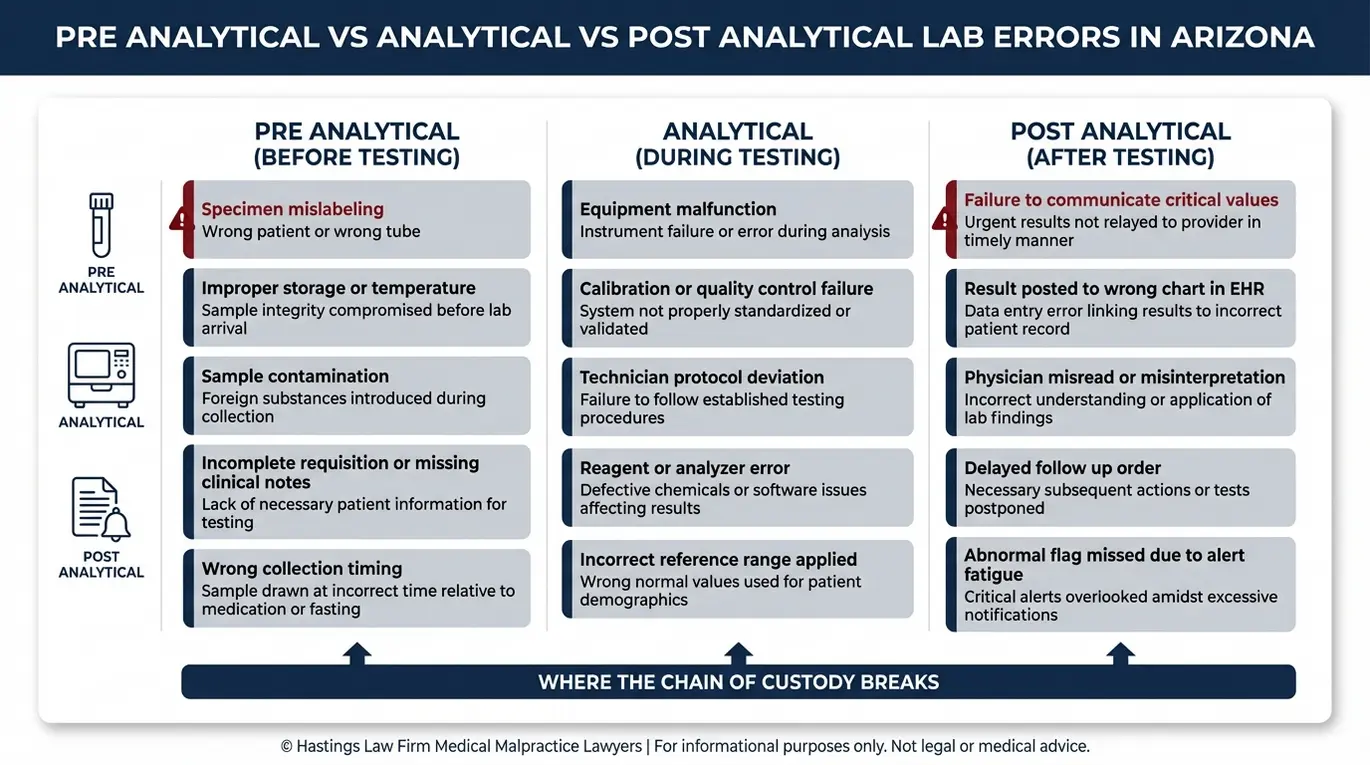
According to research published in Preanalytical Errors in Clinical Laboratory Testing at a Glance (PubMed Central), a significant majority of lab errors occur before the sample even reaches the testing equipment. Errors in laboratory testing generally fall into three categories based on when they occur in the testing lifecycle:
- Pre-Analytical Errors (Before Testing): These happen during sample collection, handling, or transport. Specimen mislabeling, the tagging of a patient’s sample with the wrong name or identifier, is one of the most common and dangerous mistakes. Sample contamination, the introduction of foreign substances or bacteria that corrupt the specimen, can also produce unreliable results. Improper storage or delays in transport fall into this category as well.
- Analytical Errors (During Testing): These occur in the lab itself. Equipment malfunctions, calibration failures, or technician mistakes during the testing phase can produce inaccurate readings across blood tests, imaging, or tissue analysis.
- Post-Analytical Errors (After Testing): Even when a test is performed correctly, the results still need to reach the right physician and be interpreted accurately. Failures at this stage include miscommunication of critical values, clerical or data entry errors in reporting, or a physician misreading what the report actually shows.
A misread lab results attorney can help determine exactly where in this chain the breakdown occurred and whether the error meets the legal threshold for negligence. If you believe a lab mistake affected your diagnosis or treatment, a lawyer for lab errors can investigate the full timeline from sample collection to clinical decision.
Causes of Critical Lab Errors in Arizona Healthcare Facilities
Most lab errors stem from systemic issues such as understaffing, fatigue, equipment failure, misinterpretation, or flaws in electronic health record (EHR) interfaces that obscure critical alerts. Arizona’s major hospital systems process an enormous volume of diagnostic tests every day, and when speed is prioritized over the medical standard of care, the rules defining safe practice, patients bear the risk.
The consequences depend on the type of error. A false negative, a test result that incorrectly shows no disease when disease is actually present, allows conditions like cancer to progress. A false positive, a result that incorrectly indicates disease when none exists, leads to unnecessary, harmful treatment like chemotherapy.
| Cause | How It Happens | Potential Patient Impact |
|---|---|---|
| Understaffing / High Volume | Technicians process too many samples under time pressure | Mislabeled or cross-contaminated specimens |
| Equipment Malfunction | Aging or poorly maintained analyzers produce inaccurate readings | False positives or false negatives on critical tests |
| Data Entry / Clerical Errors | Results are entered into the wrong patient chart or transcribed incorrectly | Treatment based on another patient’s lab values |
| EHR Interface Flaws | Abnormal results are buried in cluttered digital dashboards | Physicians miss flags that require immediate action |
| Technician Error | Improper technique during sample processing or analysis | Unreliable results across blood work, biopsies, or cultures |
The Role of Electronic Health Record Fatigue
Hospitals rely on EHR systems to route results, but these platforms are not foolproof. Alert fatigue, the tendency for clinicians to dismiss digital notifications after constant alerts, is a common problem. Physicians desensitized to warnings may miss a critical value, a lab result so far outside the normal range that it signals an immediate threat to health.
Poor interface design compounds the problem. If a critical abnormal result looks the same on screen as a routine notification, the failure to communicate results becomes a system-level issue. Arizona lab error counsel can examine EHR logs and audit trails to determine whether abnormal results were flagged, delivered, and acknowledged by the treating provider.

The Hastings Law Firm Difference
Results matter, but what truly sets us apart is how we achieve them. Every verdict, every settlement, and every Arizona courtroom victory comes from one guiding promise: To treat each client’s fight for justice as if it were our own.
This balance of skill, experience, and empathy reflects our core philosophy that justice should not only compensate the injured, but also make healthcare safer nationwide.

Liability for Misread Results and Outsourced Lab Errors
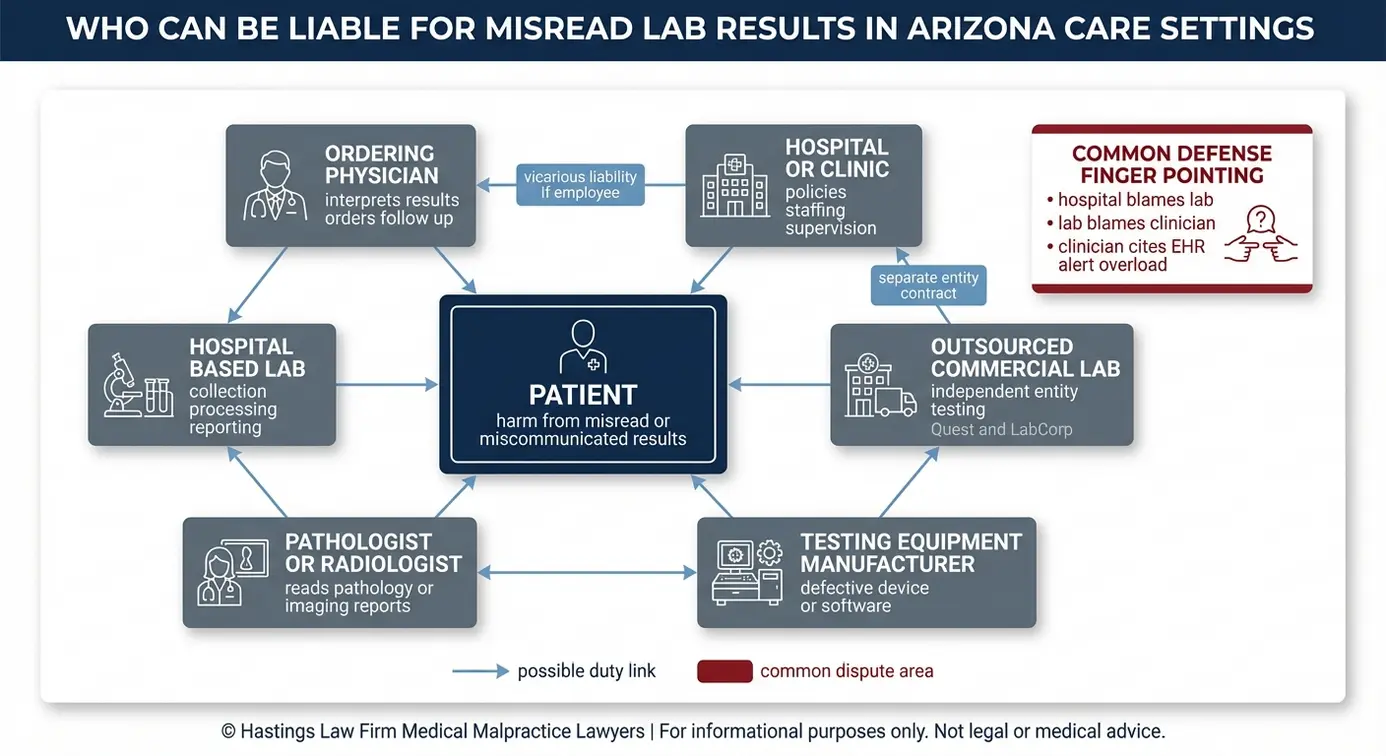
Liability may extend beyond the ordering physician to include the hospital, independent commercial laboratories, pathologists, or even the manufacturer of defective testing equipment. Identifying every responsible party is essential to building a strong claim.
Many Arizona hospitals send specimens to a reference laboratory, an outsourced or third-party laboratory that performs the analysis off-site. Companies like Quest Diagnostics and LabCorp are third-party laboratories that process millions of tests annually, covering blood work, pathology, and other diagnostic testing. When the mistake happens at an independent lab rather than a hospital-owned department, the hospital may argue it is not responsible for the third party’s negligence.
Our firm uses over 20 years of experience to help patients identify all responsible parties in these complex situations. The legal concept of vicarious liability becomes important when determining who is responsible for an error. This legal principle allows you to hold a hospital responsible for the negligence of its employees. A pathology report, the formal document summarizing the laboratory’s findings and interpretation, may pass through several hands before a clinical decision is made.
An Arizona misread lab results lawyer can trace the chain of responsibility and determine whether the hospital, the lab, the pathologist, or the equipment manufacturer should be named in your claim. An attorney for diagnostic errors will examine contracts, referral patterns, and reporting protocols to identify all potentially liable parties.
Recoverable Damages for Diagnostic Negligence
Victims of laboratory malpractice can recover compensation for economic losses like medical bills and lost wages, as well as non-economic damages for pain, suffering, and the progression of untreated illness. The Arizona Constitution, Article 2, Section 31, prohibits caps on damages for personal injury or death, meaning juries in Arizona can award the full value of what was lost.
Recoverable damages may include:
- Current and future medical bills, particularly when the error allowed a condition to worsen and now requires more aggressive or prolonged treatment
- Lost wages and loss of earning capacity if the injury affected your ability to work
- Pain and suffering, including the emotional toll of living with a condition that could have been caught earlier
- Loss of enjoyment of life when the error permanently altered your daily activities or independence
- Wrongful death damages for families who lost a loved one because a treatable condition went undetected
Legal help for misread labs involves understanding the full scope of harm, including long-term impacts on health, income, and quality of life.
Contact the Arizona Healthcare Malpractice Attorneys at Hastings Law Firm Today for Help
You may feel like the healthcare system holds all the information while you are left with unanswered questions and real consequences. That imbalance is exactly what Hastings Law Firm was built to address. Our team includes in-house nurse consultants and former defense attorneys who know how hospitals and labs handle these situations internally, and we use that insight to uncover the truth about what happened to your sample.
As an Arizona misread lab results lawyer, we prepare every case from day one to be trial-ready for a jury. That posture is backed by thorough investigation, qualified medical experts, and detailed record analysis. Our Phoenix malpractice team is ready to help you understand your options.
There is no fee unless we recover compensation for you. If a lab error changed your diagnosis, delayed your treatment, or cost someone you love their life, contact Hastings Law Firm for a free, confidential case evaluation. Let us help you find the answers you deserve.
Frequently Asked Questions About Misread Lab Results in Arizona


This content was researched and written by the Hastings Law Firm editorial team, which includes attorneys, medical professionals, and experienced researchers. Our writing is informed by internal knowledge and practical experience, and we cross-check critical details against authoritative sources cited throughout. Every piece undergoes human-led fact-checking and legal review. Because legal and medical information can change, if you spot an error, please contact us. Learn more about our content standards and review process on our editorial policy page.

Tommy Hastings, founder of Hastings Law Firm, is a board-certified personal injury trial lawyer dedicated exclusively to healthcare injury cases. Since 2001, he has represented injured patients and families in litigation against major hospital systems, pharmaceutical companies, and negligent healthcare providers nationwide. He has handled numerous high-profile cases that have drawn national media attention and resulted in multi-million dollar recoveries. He draws on that experience in his writing, helping readers understand how these cases work and what options may be available to them.
