


Arizona Misoprostol Induction Error Lawyer
Misoprostol, also known as Cytotec, is sometimes used to induce labor, and errors in dosing, timing, monitoring, or informed consent can lead to severe harm to a mother or baby. The medication is often used off label for induction, which increases the importance of careful safety practices and clear communication about risks. When care falls below the accepted standard, families may face lasting medical needs, emotional trauma, and major financial strain. If you or a loved one were harmed or worse due to a Misoprostol induction error in Arizona, contact Hastings Law Firm for a free, confidential case review.

Last Updated: July 27, 2026
Secure Legal Help for Cytotec Labor Induction Injuries in Arizona
When your family enters a hospital for the birth of a child, you trust that every medication given during labor has been carefully chosen and properly administered. If that trust was broken by the negligent use of Misoprostol (Cytotec) during induction, you may be left with serious questions and even more serious injuries. You deserve honest answers about what went wrong and whether a medical provider’s decisions fell below the accepted standard of care.
Hastings Law Firm focuses exclusively on medical malpractice, including labor and delivery errors involving dangerous drug administration. Our team of attorneys, in-house nurse consultants, and medical experts understands both the clinical and legal details of Cytotec induction cases. If your family was harmed by a Misoprostol induction error in Arizona, an Arizona Misoprostol induction error lawyer from our firm is here to help you understand your options. Contact our Arizona office for a free, confidential case evaluation. You pay no fees unless we recover compensation on your behalf.

What Constitutes a Misoprostol (Cytotec) Induction Error?
A Misoprostol induction error occurs when medical providers negligently administer Cytotec for labor induction, often using the drug off-label, and the result is uterine hyperstimulation, uterine rupture, or fetal distress tied to improper dosing or inadequate monitoring.
Misoprostol, sold under the brand name Cytotec, is a medication originally developed and FDA-approved to prevent stomach ulcers. Its use for labor induction is considered off-label use, meaning it is prescribed for a purpose not specifically approved by the FDA. This medication helps start labor by softening the cervix. While off-label prescribing is legal and common in medicine, it places a heightened responsibility on the provider to follow strict safety protocols.
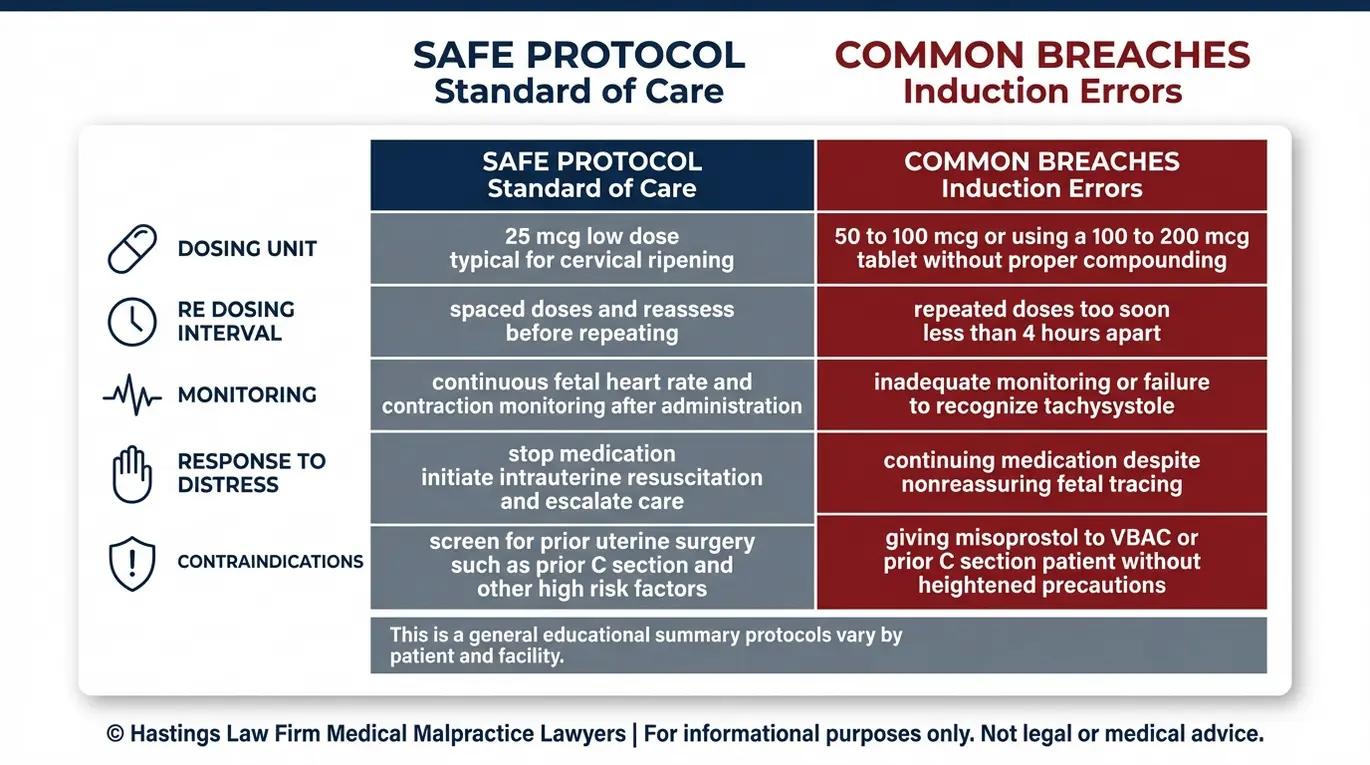
The standard of care for Misoprostol induction generally requires starting at a low dose, often 25 micrograms (mcg), and carefully timing each subsequent dose. The provider must continuously monitor both the mother and baby for signs of adverse drug events, including overly strong or frequent contractions.
An Arizona Misoprostol induction error lawyer evaluates whether the provider met these requirements. Errors we commonly investigate include:
- Administering a dose higher than the recommended starting amount
- Failing to wait the required interval between doses
- Neglecting continuous fetal heart rate monitoring after administration
- Not obtaining proper informed consent, which means the doctor did not explain the specific risks of using Cytotec for induction before giving the drug
Informed consent is a core element of these cases. The Arizona Supreme Court addressed the scope of a physician’s disclosure obligations in Francisco v. Affiliated Urologists, reinforcing that patients must receive adequate information about the risks associated with a proposed treatment. When a provider uses a medication off-label during labor and delivery, the duty to inform the patient becomes even more important. If you were never told that Cytotec was being used off-label or warned of the risks involved, that failure may support a claim of medical negligence.
Types of Negligence Involving Misoprostol Administration
Negligence in Cytotec induction cases often involves administering an excessive dosage (such as 50mcg or 100mcg instead of the recommended 25mcg), dosing too frequently (less than four hours apart), or failing to stop the drug when signs of fetal distress appear on the monitor.
Dosage errors are among the most common issues a Misoprostol malpractice lawyer investigates. Cytotec tablets are manufactured in 100mcg and 200mcg sizes. Because the recommended starting dose for labor induction is typically 25mcg, the tablet must be accurately divided or compounded by the hospital pharmacy. Negligence often involves wrong dosage errors, such as using a full tablet without proper preparation, which can expose the mother and baby to a dangerously high dose.
Monitoring failures occur when nursing staff or physicians do not adequately track the fetal heart rate after administration. Uterine tachysystole, a condition where the uterus contracts too frequently, meaning more than five contractions in ten minutes, is a known risk of Misoprostol. Research published on uterine tachysystole in a survey of CAOG members highlights ongoing ambiguity in how providers define and respond to uterine hyperstimulation and uterine rupture risks. A breach of duty can occur when staff fail to recognize or act on these warning signs.
Contraindication errors represent some of the most serious failures. A contraindication is a medical reason why a specific drug should not be used because it could harm the patient. Administering Misoprostol to a patient attempting a vaginal birth after cesarean (VBAC) carries a significantly elevated risk of uterine rupture. According to the clinical resource on Misoprostol from the NCBI Bookshelf, prior uterine surgery is a recognized contraindication. Providers must also avoid dangerous drug combinations by carefully managing concurrent oxytocin use.
| Category | Standard of Care | Common Breach |
|---|---|---|
| Dosage | Start at 25mcg or lower | Administering 50mcg, 100mcg, or a full tablet |
| Timing | Wait at least 4 hours between doses | Redosing in under 4 hours |
| Monitoring | Continuous fetal heart rate monitoring | Intermittent or absent monitoring after dosing |
| Contraindications | Do not use for patients with prior uterine surgery | Administering Cytotec to VBAC patients |
Under ARS § 12-542, Arizona law sets a two-year statute of limitations for personal injury claims, which includes medication error and induction negligence cases. An Arizona Misoprostol induction error lawyer can help determine when the clock started for your specific situation.
The Hastings Law Firm Difference
Results matter, but what truly sets us apart is how we achieve them. Every verdict, every settlement, and every Arizona courtroom victory comes from one guiding promise: To treat each client’s fight for justice as if it were our own.
This balance of skill, experience, and empathy reflects our core philosophy that justice should not only compensate the injured, but also make health care safer nationwide.

Injuries and Complications Caused by Cytotec Errors
Improper use of Cytotec can trigger uterine hyperstimulation and uterine rupture, massive maternal hemorrhage, and hypoxic-ischemic encephalopathy (HIE) in the infant caused by oxygen deprivation.
Understanding the chain of causation is central to any Cytotec injury case. When used for labor induction, Misoprostol works by softening the cervix and causing contractions.
When Misoprostol causes contractions that are too strong or too frequent, the uterus may not relax enough between contractions to allow normal blood flow to the placenta. This can starve the baby of oxygen. If the oxygen deprivation is severe or prolonged, the result can be permanent brain damage or death.
Maternal injuries linked to Cytotec errors may include:
- Uterine rupture, a life-threatening tear in the uterine wall that can cause catastrophic internal bleeding
- Emergency hysterectomy, permanently ending the ability to have future children
- Severe hemorrhage requiring blood transfusions
- Amniotic fluid embolism, where birth-related material enters the mother’s blood
Infant injuries that an Arizona Misoprostol induction error lawyer may investigate include:
- Hypoxic-ischemic encephalopathy (HIE), a form of brain damage caused when oxygen supply to the brain is interrupted during labor
- Cerebral palsy and other permanent neurological conditions
- Seizure disorders
- Fetal death or stillbirth
Each of these adverse drug events carries lifelong consequences. In cases involving infant brain injury, the damages extend across an entire lifetime of medical care, therapy, and lost quality of life. When an induction error results in death, the family may have grounds for a wrongful death claim.

Determining Liability: Who Is Responsible for the Error?
Liability in a Cytotec induction error case may extend to several licensed health care providers: the prescribing obstetrician who ordered an unsafe dose or ignored contraindications, the labor and delivery nurse who failed to monitor or halt the drug, and the hospital that did not enforce safe induction protocols.
Physician liability is examined when the doctor made the decision to induce with Misoprostol under circumstances where it was not safe. This includes prescribing the drug to a VBAC patient or ordering a dose that exceeded accepted guidelines. An Arizona Misoprostol induction error lawyer reviews the physician’s orders, timing notes, and clinical rationale to evaluate whether physician prescribing errors occurred.
Nursing and hospital liability often centers on what happened after the drug was given. Fetal heart rate monitoring, also called cardiotocography (CTG), is the electronic tracking of the baby’s heart rate and the mother’s contractions during labor. If the nursing staff continued administering doses despite signs of fetal distress, a sign that the baby is not receiving enough oxygen, on the monitor, or if the hospital lacked clear protocols for Cytotec use, the institution itself may bear responsibility. Our team includes former hospital nurses and former defense attorneys who know how to identify gaps in charting and protocol compliance.
Pharmacy liability can arise if the hospital pharmacy dispensed an incorrect dosage unit. While less common in labor and delivery settings, it remains a potential source of pharmacy malpractice that we evaluate during our investigation.
Compensation for Families Affected by Induction Errors
Families may recover economic damages for past and future medical care, including lifetime care costs for a child with a disability, along with lost wages and non-economic damages for pain, suffering, and loss of quality of life.
Lifetime care costs for a child with cerebral palsy or HIE-related brain injury can reach into the millions of dollars. These costs include ongoing physical, occupational, and speech therapy; adaptive equipment; home modifications; and in-home nursing care. An Arizona Misoprostol induction error lawyer works with life care planners and economists to document the full scope of future medical costs.
Wrongful death damages may apply if the induction error led to the loss of a mother or infant. Under Arizona Revised Statutes (ARS) § 12-542, surviving family members can seek compensation for funeral costs, loss of companionship, lost future earnings, and emotional suffering.
Non-economic damages cover the pain, trauma, and diminished quality of life that no medical bill can capture. Arizona’s Constitution prohibits caps on personal injury and wrongful death damages, so juries can award the full amount they determine is appropriate for the family’s losses.
Recoverable damages in Misoprostol induction cases typically include:
- Past and future medical expenses
- Lifetime care, therapy, and equipment costs
- Lost income and diminished earning capacity
- Pain and suffering
- Emotional distress and loss of enjoyment of life
- Wrongful death damages for surviving family members
Arizona Statute of Limitations for Birth Injury Claims
In Arizona, the standard statute of limitations for medical malpractice is two years from the date of injury under ARS § 12-542. For birth injuries involving minors, the filing deadline may be extended, giving families additional time to bring a claim.
The standard rule requires adults injured during labor and delivery to file a lawsuit within two years of the date the injury occurred. Missing this deadline can permanently bar the claim, regardless of how strong the evidence may be. The Arizona statute of limitations strictly governs these timelines.
Exceptions for minors can change the timeline significantly. When the injured party is a child, Arizona law may toll, or pause, the statute of limitations. This distinction is important because many birth injuries, particularly brain injuries like HIE and cerebral palsy, may not be fully diagnosed until months or years after delivery.
Claims against government-run hospitals carry much shorter deadlines. If the birth took place at a public facility, the family may be required to file a notice of claim within 180 days. Missing this deadline can eliminate the right to pursue the case entirely.
The Role of Expert Witnesses in Cytotec Cases
Arizona law, specifically ARS § 12-2603, requires that a medical malpractice claim be supported by a preliminary expert opinion affidavit. This document is a sworn statement from a qualified doctor certifying that the provider’s conduct fell below the standard of care before the lawsuit can proceed. Expert witnesses are medical professionals who provide an independent analysis of the care provided to establish what the standard of care required. An Arizona Misoprostol induction error lawyer works with board-certified obstetricians and neonatologists to provide expert witness testimony that connects the medication error to the injury. At Hastings Law Firm, our national expert network allows us to identify and retain the right specialist for each case.

Contact the Arizona Birth Injury Attorneys at Hastings Law Firm Today for Help
If your family was harmed during a Cytotec induction, you are not alone, and you do not have to figure this out by yourself. Hastings Law Firm was built for cases like this. Our entire team, including attorneys, nurse consultants, and medical experts, is dedicated exclusively to medical malpractice. We understand the clinical details of Misoprostrostol induction errors, and we know how to hold the responsible parties accountable.
Our founding attorney, Tommy Hastings, is a board-certified trial lawyer (Texas Board of Legal Specialization) who has spent over two decades representing families affected by medical negligence. Every case we accept is prepared from day one as if it will go to trial, which gives us a strong position in settlement negotiations and in the courtroom.
We represent families on a contingency fee basis. You pay no attorney fees or costs unless we recover compensation for you. If you believe a Misoprostol induction error harmed you or your child, contact our Phoenix office for a free, confidential case evaluation. Let us review what happened and explain your options.
Frequently Asked Questions About Misoprostol Induction Error in Arizona


This content was researched and written by the Hastings Law Firm editorial team, which includes attorneys, medical professionals, and experienced researchers. Our writing is informed by internal knowledge and practical experience, and we cross-check critical details against authoritative sources cited throughout. Every piece undergoes human-led fact-checking and legal review. Because legal and medical information can change, if you spot an error, please contact us. Learn more about our content standards and review process on our editorial policy page.

Tommy Hastings, founder of Hastings Law Firm, is a board-certified personal injury trial lawyer dedicated exclusively to healthcare injury cases. Since 2001, he has represented injured patients and families in litigation against major hospital systems, pharmaceutical companies, and negligent healthcare providers nationwide. He has handled numerous high-profile cases that have drawn national media attention and resulted in multi-million dollar recoveries. He draws on that experience in his writing, helping readers understand how these cases work and what options may be available to them.
