


Arizona Medical Spa Malpractice Lawyer
Written by: Hastings Law Firm | Reviewed by: Tommy Hastings | Updated: July 27, 2026
Medical spa procedures can cause serious harm when providers fail to follow accepted medical standards. Injuries can leave lasting physical changes and emotional distress, especially when risks were not clearly explained or proper supervision was missing. Arizona med spas are expected to operate under physician oversight and use appropriately licensed practitioners, and problems can involve technique errors, poor sanitation, or unsafe products. Understanding who may be responsible and what evidence matters can help clarify next steps. If you or a loved one were harmed or worse due to medical spa negligence in Arizona, contact Hastings Law Firm for a free, confidential case review.
Trusted Legal Representation for MedSpa Negligence in Arizona
What You Should Know About MedSpa Negligence Claims in Arizona:
- Lasting disfigurement and corrective treatment needs can follow negligent med spa procedures when medical standards are not met.
- Responsibility can extend beyond the person performing the procedure when supervision and oversight at the facility are inadequate.
- Options for recovery can expand when a med spa uses counterfeit injectables or unapproved devices because the risk of severe complications increases.
- The ability to recover compensation can be lost if Arizona time limits are missed.
- Compensation can cover both financial losses and personal harms such as medical costs, lost wages, pain and suffering, and emotional distress.
- A claim can be harder to prove when the issue is only dissatisfaction with appearance rather than a clear deviation from accepted care.
- Consent disputes can become central when risks, alternatives, or expected outcomes were not adequately explained before treatment.
- A signed waiver may not prevent accountability for negligence or gross misconduct.
- Medical and payment records can be essential evidence because Arizona law gives patients a right to obtain them.
- Comparative fault can reduce the amount recovered when a patient is found to have contributed to the injury.

A Healthcare Focused Law Firm
When a cosmetic procedure at a medical spa causes unexpected harm, the physical and emotional toll can be overwhelming. You may be dealing with pain, visible scarring, or complications you were never warned about, all from a procedure that was supposed to be routine. These injuries are not just “bad results.” When a provider fails to meet accepted medical standards, it may be medical malpractice.
An experienced Arizona medical spa malpractice lawyer can help you understand what went wrong, who may be responsible, and what options are available to you. At Hastings Law Firm, our team focuses exclusively on medical malpractice. Our in-house medical staff, including nurse practitioners and board-certified patient advocates, reviews every case alongside our attorneys to identify where the standard of care may have been violated.
If you or a loved one was injured during a med spa procedure, we can review what happened and explain your options in a free, confidential consultation.
What Qualifies as a Medical Spa in Arizona?
An Arizona medical spa is a hybrid facility that offers medical-grade aesthetic procedures under the required supervision of a licensed physician or medical director. Med spas differ from traditional day spas because they offer medical treatments instead of non-medical services like facials, massages, and basic skincare.
A med spa performs procedures that carry real medical risk: Botox injections, dermal fillers, laser treatments, chemical peels, and similar services. Because these are medical procedures, they are held to a medical standard of care, meaning the level of treatment a reasonably competent provider would deliver under similar circumstances.
Arizona’s regulatory framework imposes specific requirements on these facilities:
- A licensed medical director, the physician ultimately responsible for clinical oversight, must supervise the medical services provided.
- Physician supervision and delegation, the legal authority for a doctor to assign certain procedures to qualified staff, must comply with state medical board rules.
- Practitioners performing procedures must hold appropriate licensure as defined under Arizona Revised Statutes § 32-1401.
The duty of care at a med spa is no different from any other medical setting. When that duty is breached, and a patient is harmed as a result, a med spa injury attorney can help determine if Arizona medical spa regulations were violated.
Common Injuries from Negligent Med Spa Procedures
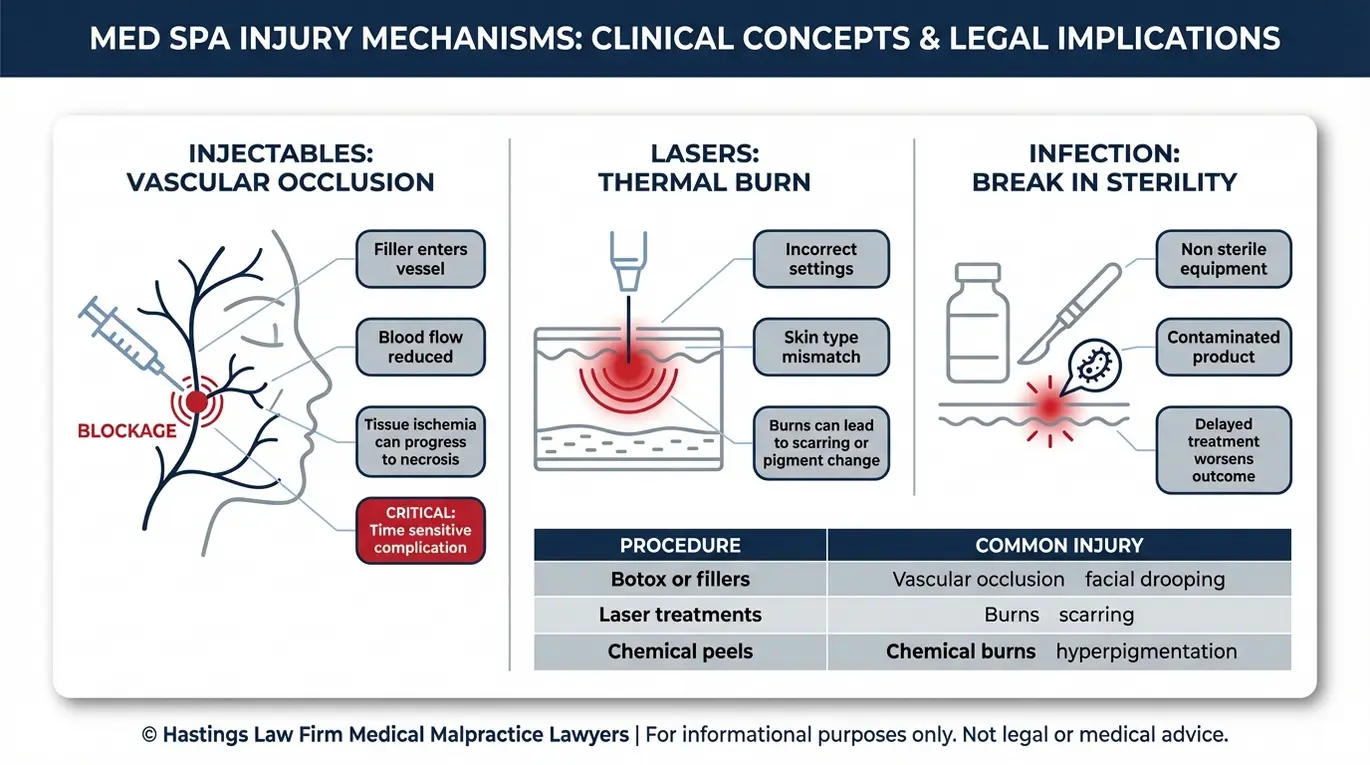
Cases of med spa negligence can result in serious complications, including chemical burns, vascular occlusion from improperly placed fillers, permanent scarring, and nerve damage that may require corrective surgery. These injuries often go far beyond what patients are told to expect.
Injectables like Botox and dermal fillers carry specific risks when administered incorrectly. Vascular occlusion, a condition where filler material blocks a blood vessel and cuts off blood supply to surrounding tissue, can lead to tissue necrosis (tissue death) and permanent disfigurement. According to a peer-reviewed guideline for the management of hyaluronic acid filler-induced vascular occlusion published in PubMed Central, early recognition and treatment are critical, yet many med spa practitioners lack the training to identify or respond to this emergency. Botox injected in the wrong location or at the wrong dosage can cause ptosis, commonly called facial drooping, where the eyelid or brow sags noticeably.
Laser treatments and chemical peels present their own dangers. A laser set to the wrong intensity can cause deep burns, lasting scars, and hyperpigmentation (skin darkening). This occurs if a provider fails to assess the patient’s Fitzpatrick skin type, a classification of how skin responds to ultraviolet (UV) light exposure. Research published by PubMed Central on cosmetic laser use in the U.S. highlights ongoing concerns about underqualified operators performing these procedures.
Infection is another significant risk. Unsterile equipment, contaminated products, or failure to follow proper sanitation protocols can introduce bacteria into treatment sites, leading to serious and sometimes systemic infections.
Under Arizona Revised Statutes § 12-2294, patients have the right to obtain their medical and payment records, which can be essential evidence in building a claim with a cosmetic procedure negligence lawyer.
| Procedure | Potential Injury |
|---|---|
| Botox Injections | Facial drooping (ptosis), muscle paralysis, allergic reaction |
| Dermal Fillers (HA Fillers) | Vascular occlusion, tissue necrosis, infection, scarring |
| Laser Hair Removal / Skin Treatments | Burns, hyperpigmentation, permanent scarring |
| Chemical Peels | Chemical burns, nerve damage, disfigurement |
| Injectables (General) | Infection from unsterile technique, allergic reaction |
The Hastings Law Firm Difference
Results matter, but what truly sets us apart is how we achieve them. Every verdict, every settlement, and every Arizona courtroom victory comes from one guiding promise: To treat each client’s fight for justice as if it were our own.
This balance of skill, experience, and empathy reflects our core philosophy that justice should not only compensate the injured, but also make healthcare safer nationwide.

Liability: Who Is Responsible for a Med Spa Injury?
Liability in a med spa injury case often extends beyond the individual who performed the procedure. An Arizona medical spa malpractice lawyer will examine every party in the chain of care to determine who bears legal responsibility.
The Injector or Esthetician
An esthetician (a licensed skincare professional) or nurse injector who performs a procedure is directly responsible for using proper technique, correct dosages, and appropriate protocols. If the person holding the needle or operating the laser lacked the skill or training to do so safely, that is direct negligence.
The Medical Director
Every med spa is required to operate under the oversight of a medical director, the licensed physician who authorizes and supervises medical procedures at the facility. In many cases, these directors are “absentee,” meaning they lend their medical license to the business but rarely, if ever, set foot in the facility. This creates a negligent supervision claim. Under the Arizona Administrative Code R4-16-402, which governs the delegation and supervision of procedures performed by medical assistants, physicians who delegate medical procedures have a duty to ensure proper oversight. When they fail to do so, they can be held liable alongside the facility.
The Facility and Its Owners
Med spa owners who hire unqualified staff, fail to verify credentials, or neglect training may face liability for negligent hiring. If you were injured at an Arizona med spa because the person performing your procedure was not properly trained or licensed, you may be able to sue a med spa in Arizona and its ownership for the harm you suffered.
Counterfeit Products and Unregulated Sourcing
A growing and particularly dangerous problem involves med spas using counterfeit botulinum toxin (commonly called “fake Botox”), knock-off dermal fillers, or unregulated devices sourced from black-market suppliers. These products are medical supplies not approved for safe use. They are purchased at a fraction of the cost of FDA-approved alternatives, and patients are rarely told the difference.
Counterfeit injectables can contain unknown or dangerous substances that cause severe allergic reactions, tissue necrosis (the death of skin and underlying tissue), and unpredictable complications. When a facility knowingly uses unapproved or counterfeit products on patients, the liability for cosmetic injuries increases significantly for every party involved.
Proving Malpractice and Lack of Informed Consent
An experienced medical malpractice attorney knows that proving med spa negligence requires demonstrating that the provider breached the accepted standard of care and that this breach directly caused your injuries. A bad cosmetic outcome alone is not enough. The question is whether the provider did something no competent professional in their position would have done, or failed to do something any competent professional would have.
An expert witness, typically a physician or specialist in the same field, reviews the medical evidence and offers an opinion on whether the standard was met. Our firm maintains a national network of qualified medical experts who provide objective case analysis and credible testimony.
Informed consent is another critical element. Before any procedure, a provider must explain the real risks, alternatives, and expected outcomes so the patient can make a genuine decision. If your provider glossed over the consent form, failed to disclose known complications, or never explained risks specific to your Fitzpatrick skin type (a classification of skin response to ultraviolet light), that failure can strengthen your claim. Failing to disclose the nature of a Hyaluronic acid dermal filler (HA filler), a substance used to restore volume, also invalidates informed consent.
We also examine whether deceptive advertising played a role. Some med spas use heavily edited or stock “before and after” images to attract patients. When a patient consents to a procedure based on misleading representations, the validity of that consent may be in question.
Compensation for Cosmetic Injuries and Disfigurement
If you were harmed by med spa negligence, you may be entitled to recover both economic and non-economic damages. Recoverable compensation for med spa injury cases falls under compensatory damages, which may include:
- Medical bills and corrective surgery costs, which are often significantly higher than the original procedure
- Lost wages from missed work during treatment and recovery
- Pain and suffering tied to the physical injury and ongoing discomfort
- Emotional distress, including depression or anxiety caused by visible disfigurement
- Permanent scarring or disfigurement, which carries its own category of damages reflecting the long-term impact on quality of life
In cases involving egregious misconduct, such as knowingly using counterfeit products or operating without any physician supervision, punitive damages may also be available. Punitive damages go beyond compensation and are intended to penalize conduct that reflects an “evil mind,” meaning the defendant acted with intent to harm, spite, or in an outrageous manner that created a substantial risk of harm to others.
Arizona Statute of Limitations for Med Spa Injuries
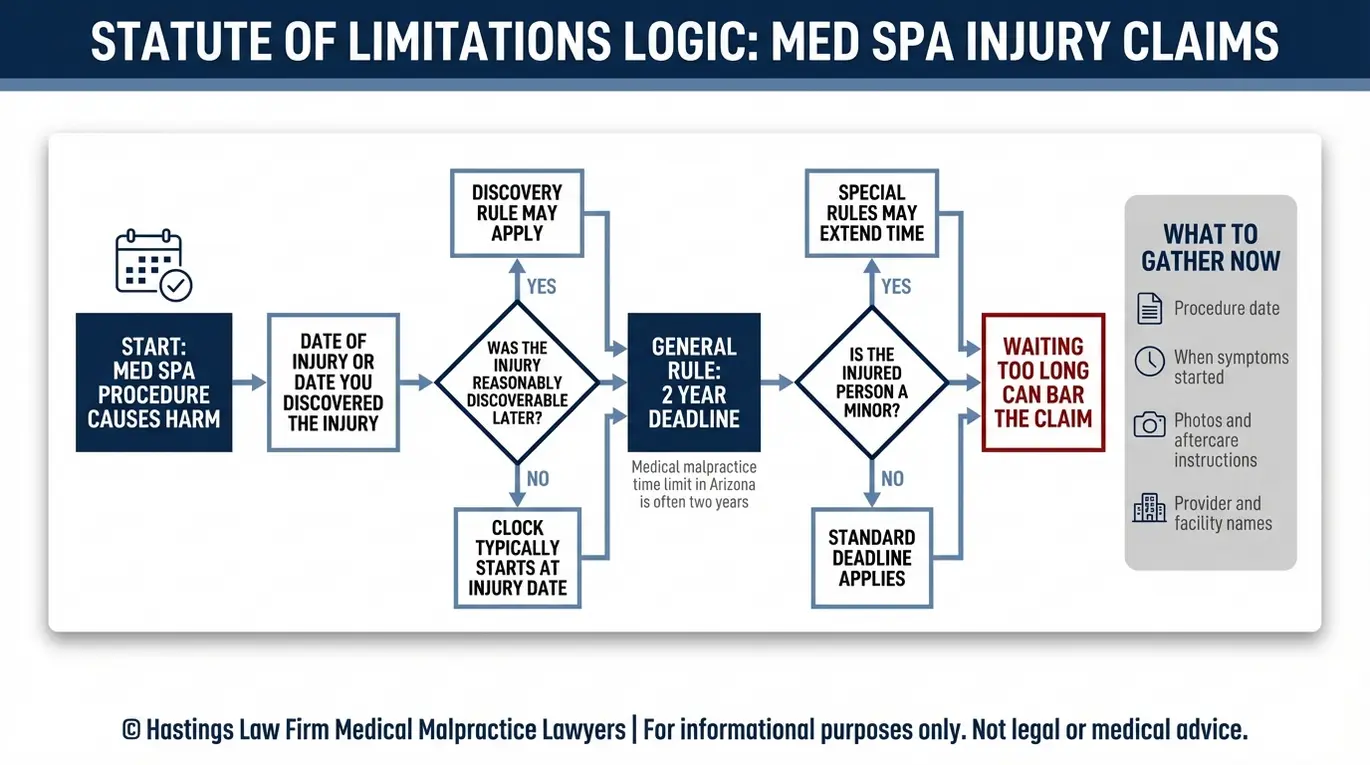
Time limit: The Arizona statute of limitations for medical malpractice is generally two years from the date the injury occurred or was discovered. Under Arizona Revised Statutes § 12-542, failing to file within this window can permanently bar your ability to recover compensation.
Some med spa injuries, like scarring from a laser burn, are immediately obvious. Others, such as tissue damage from vascular occlusion or complications from counterfeit products, may not become apparent right away. Arizona’s “discovery rule” may extend the filing deadline when the injury was not and could not have been immediately known. Exceptions also exist for minors. Because these legal time limits are strict, speaking with an attorney early protects your right to pursue a claim.
Contact the Arizona Healthcare Malpractice Attorneys at Hastings Law Firm Today for Help
Injuries from a med spa procedure can leave lasting physical and emotional scars. If you believe negligence caused your harm, you deserve answers about what happened and who is responsible.
Hastings Law Firm focuses exclusively on medical malpractice. Our legal and medical team, including former defense attorneys, nurse practitioners, and board-certified patient advocates, works together to build cases that hold negligent providers accountable. Founded by board-certified trial attorney Tommy Hastings, our firm has the resources and experience to take on med spas, medical directors, and the systems behind them.
We handle cases on a contingency fee basis, meaning you pay no attorney fees or costs unless we recover compensation for you. If you or a loved one was injured at a med spa in Arizona, contact our Phoenix med spa malpractice lawyer team today for a free, confidential case evaluation. Let us help you find the answers you deserve.
Frequently Asked Questions About Medical Spa Malpractice in Arizona


This content was researched and written by the Hastings Law Firm editorial team, which includes attorneys, medical professionals, and experienced researchers. Our writing is informed by internal knowledge and practical experience, and we cross-check critical details against authoritative sources cited throughout. Every piece undergoes human-led fact-checking and legal review. Because legal and medical information can change, if you spot an error, please contact us. Learn more about our content standards and review process on our editorial policy page.

Tommy Hastings, founder of Hastings Law Firm, is a board-certified personal injury trial lawyer dedicated exclusively to healthcare injury cases. Since 2001, he has represented injured patients and families in litigation against major hospital systems, pharmaceutical companies, and negligent healthcare providers nationwide. He has handled numerous high-profile cases that have drawn national media attention and resulted in multi-million dollar recoveries. He draws on that experience in his writing, helping readers understand how these cases work and what options may be available to them.
