


Arizona Medical Lab Testing Malpractice Lawyer
Written by: Hastings Law Firm | Reviewed by: Tommy Hastings | Updated: July 27, 2026
Medical lab testing errors can derail care when results are mislabeled, misread, delayed, or routed to the wrong record. The fallout can include missed or delayed diagnosis, unnecessary treatment, and lasting physical and emotional harm. Understanding where a breakdown occurred in specimen handling, analysis, or reporting can clarify who may be responsible, including a hospital, an independent lab, or a treating clinician. These situations are often confusing and deeply personal, especially when answers come late. If you or a loved one were harmed or worse due to medical lab testing malpractice in Arizona, contact Hastings Law Firm for a free, confidential case review.

Trusted Legal Representation for Lab Error Negligence in Arizona
What You Should Know About Medical Test Result Negligence Claims in Arizona:
- Life changing harm can follow a lab mistake because inaccurate or delayed results can drive missed diagnosis or unnecessary treatment.
- Responsibility can be disputed because fault may rest with a hospital lab, an independent laboratory, or an ordering clinician depending on how testing and reporting were handled.
- Options can narrow if action is delayed because Arizona time limits can turn on when an error was discovered rather than when the test occurred.
- Recovery can include financial and personal losses because Arizona recognizes economic damages and non economic damages tied to medical negligence.
- Wrongful death damages may be available because a lab error can prevent timely diagnosis or treatment and lead to a fatal outcome.
- Outcomes can worsen when reporting systems fail because critical results may not reach the treating physician in time.
- Proving a claim can depend on specialized review because disputes often focus on whether the lab followed CLIA standards or internal protocols.
- Access to key information can shape what is provable because patients have a right to obtain their protected health information.
- Case clarity can hinge on technical records because specimen tracking and electronic transmission logs can show where communication broke down.
- Accountability can turn on laboratory quality documentation because calibration logs, proficiency testing results, and training records may indicate whether standards were met.

A Healthcare Focused Law Firm
When a medical lab makes an error with your test results, the consequences can be devastating. A missed diagnosis, unnecessary treatment, or months of lost time can change the course of your health and your life. These cases are deeply personal, and the confusion that follows a lab mistake can leave you wondering what went wrong and who is responsible.
As an Arizona medical lab testing malpractice lawyer, Hastings Law Firm focuses exclusively on medical negligence. Our team includes in-house medical professionals and former defense attorneys who understand how labs operate, where errors happen, and how to uncover the truth in your medical records. If you believe a laboratory error caused you or a loved one harm, we can review what happened and explain your options in a free, confidential consultation.
Common Types of Medical Lab Testing Errors and Failures
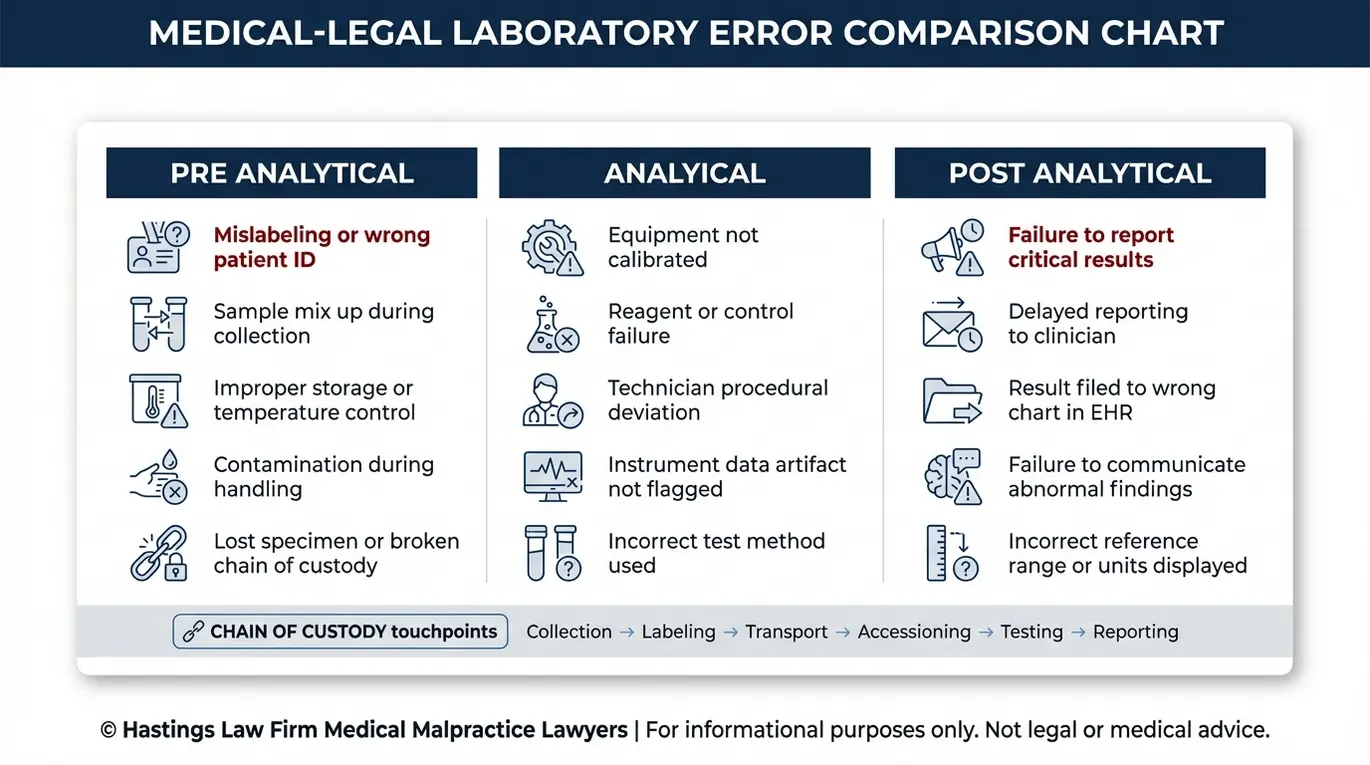
Medical lab errors typically fall into three categories: pre-analytical mistakes like mislabeling or lost specimens, analytical errors during the testing process itself, or post-analytical failures such as delaying the report of critical results to the treating physician. Each type of failure creates a different path of harm, and identifying where the breakdown occurred is essential for a lab error attorney building a strong case.
Pre-Analytical Errors
Pre-analytical errors, meaning mistakes that occur before testing even begins, are among the most common and most preventable failures in laboratory testing. These include:
- Mislabeling or misidentification of samples: A patient’s blood draw or tissue sample is tagged with the wrong name, medical record number, or barcode, leading to results being attributed to the wrong person.
- Lost or mishandled specimens: Biological samples such as blood, urine, or tissue are lost during transport, improperly stored, or left unrefrigerated, compromising their integrity.
- Chain of custody failures: Chain of custody, the documented tracking of a specimen from the moment it leaves the patient to the moment it is analyzed, can render results unreliable if broken.
- Cross-contamination: Improper handling allows for contaminated samples or cross-contamination, producing inaccurate data.
Research from the Agency for Healthcare Research and Quality (PSNet) has shown that electronic patient identification for sample labeling significantly reduces “wrong blood in tube” errors, yet many facilities still rely on manual processes prone to human mistake.
Analytical Errors
Analytical errors, mistakes that occur during the actual testing phase when instruments or technicians process the lab sample, can include equipment malfunction from failure to properly calibrate machines, reagent degradation, or a technician misreading a slide under a microscope. While less frequent than pre-analytical mistakes, analytical errors can be harder to detect and often produce subtly incorrect results that go unquestioned.
Post-Analytical Errors
Even when the lab produces an accurate result, the information must reach the right doctor at the right time. Post-analytical failures in reporting medical results include misfiled reports, delayed communication of critical findings, or results that are entered into the wrong patient’s electronic health record. These failures can be just as harmful as a flawed test.
Distinguishing Organizational vs. Analytical Lab Error Categories
An important distinction in lab malpractice cases is whether the error stemmed from a systemic failure in hospital or laboratory procedures, or from a specific technician’s individual mistake. A systemic failure might involve outdated protocols, inadequate staffing, or broken equipment maintenance schedules. A technician error might involve misreading a slide or skipping a calibration step. As a medical lab testing malpractice lawyer in Arizona, we investigate both the individual actions and the institutional policies to determine whether the standard of care was met at every level. Arizona’s constitution, under Article 2, Section 31, preserves the right to recover damages for personal injuries caused by such failures.
The Severe Impact of Misread Test Results and Delayed Diagnosis
Misread results lead to one of two dangerous outcomes: false negatives that delay life-saving treatment, or false positives that cause unnecessary and harmful medical interventions. Either scenario may fundamentally alter a patient’s prognosis and quality of life. Our firm examines misread results to understand how a diagnostic error changed the course of your care.
A false-negative result
A false-negative result, which occurs when a test incorrectly indicates that a patient is healthy, can lead to misdiagnosis. For example, pathology results from a misread biopsy or Pap smear may fail to identify cancerous cells, allowing the disease to progress from an early, treatable stage to an advanced one. By the time the correct diagnosis is made, the patient may face far more aggressive treatment or a significantly reduced chance of survival.
A false-positive result
A false-positive result tells a patient they have a condition they do not actually have. This can lead to unnecessary surgery or chemotherapy that carries serious risks for a disease the patient never had.
| Type of Error | Example | Potential Consequence |
|---|---|---|
| False-negative biopsy | Cancer cells missed on tissue sample | Disease progresses to advanced stage |
| False-negative Pap smear | Cervical abnormalities not flagged | Delayed cancer diagnosis |
| False-positive mammogram | Normal tissue misread as malignant | Unnecessary mastectomy or chemotherapy |
| Misinterpreted MRI or CT scan | Radiologist misreads imaging | Wrong treatment plan or missed condition |
Misread tests, such as radiology errors involving the misinterpretation of X-rays, CT scans, MRIs, and mammograms, present their own set of challenges. A radiologist who overlooks a subtle finding on an MRI or misreads a mammogram may set off a chain of incorrect clinical decisions, often requiring the intervention of a medical testing negligence attorney. The National Academies report on improving diagnosis in health care identified diagnostic error as the next critical frontier for patient safety, underscoring just how widespread these failures remain.
Tracking and Closed-Loop Test Result Reporting System Failures
Sometimes the lab correctly identifies a problem, but the information never reaches the treating physician. This is known as a failure in closed-loop test result reporting, the system designed to confirm that every test ordered is completed, reviewed, and acted upon. A critical value, which is a test result so abnormal it requires immediate clinical attention, may sit in a queue, get lost during an electronic handoff, or simply never trigger the alert it should.
Under Arizona’s two-year statute of limitations (A.R.S. § 12-542), the clock for filing a claim related to these communication failures may not start until the patient discovers the error. This makes it important to consult an Arizona lab malpractice lawyer as soon as you suspect something was missed.
The Hastings Law Firm Difference
Results matter, but what truly sets us apart is how we achieve them. Every verdict, every settlement, and every Arizona courtroom victory comes from one guiding promise: To treat each client’s fight for justice as if it were our own.
This balance of skill, experience, and empathy reflects our core philosophy that justice should not only compensate the injured, but also make healthcare safer nationwide.

Proving Negligence and Standard of Care in Lab Disputes
Proving negligence requires demonstrating that the laboratory deviated from accepted Clinical Laboratory Improvement Amendments (CLIA) standards or its own internal protocols, and that this deviation directly caused the patient’s injury. This is the core of every case for an Arizona medical lab testing malpractice lawyer, and it demands both medical and legal expertise.
Establishing Duty
A laboratory owes a duty of care to every patient whose specimen it handles, even if lab personnel never meet the patient face to face. The standard of care generally requires following proper laboratory procedures for collection, processing, analysis, and reporting.
Breach of Duty
To show that the lab breached its duty in a medical testing case, we rely on expert testimony from qualified professionals, such as board-certified pathologists or laboratory directors, who can review the original blood tests, tissue samples, biopsy slides, or imaging data. This is why a lab malpractice attorney in Arizona will often engage early expert involvement to evaluate whether the error was a known and accepted risk of the procedure or a clear failure of skill or protocol. Under A.R.S. § 12-2603, Arizona requires a preliminary expert opinion affidavit to be served with the plaintiff’s initial disclosures, certifying that a viable basis for the claim exists.
Causation
The final element is proving causation to connect the lab error directly to a worsened outcome. This may involve showing that a missed diagnosis on a biopsy, for example, allowed a treatable condition to become life-threatening. In some cases, this is analyzed through a “loss of chance” framework, where the question is whether the error reduced the patient’s likelihood of a better result.
Evidence we typically gather in Arizona medical lab testing malpractice cases includes:
- Original test specimens, slides, and raw data
- Laboratory accreditation records and CLIA compliance history
- Proficiency testing results, which are periodic assessments that measure a lab’s accuracy against standardized benchmarks
- Equipment calibration and maintenance logs
- Internal quality assurance reports
- Staff training and credentialing records
- Electronic health record transmission logs
Regulatory Standards and CLIA Compliance as Evidence
The Clinical Laboratory Improvement Amendments (CLIA), federal regulations that set quality standards for all laboratory testing performed on human specimens, provide the baseline. A lab’s failure to meet CLIA requirements, whether related to proficiency testing, personnel qualifications, or quality control, can be strong evidence that the standard of care was not met. As an Arizona medical lab testing malpractice lawyer, our team examines CLIA compliance records as a foundational part of every investigation.

Identifying Liability Between Hospitals and Independent Labs
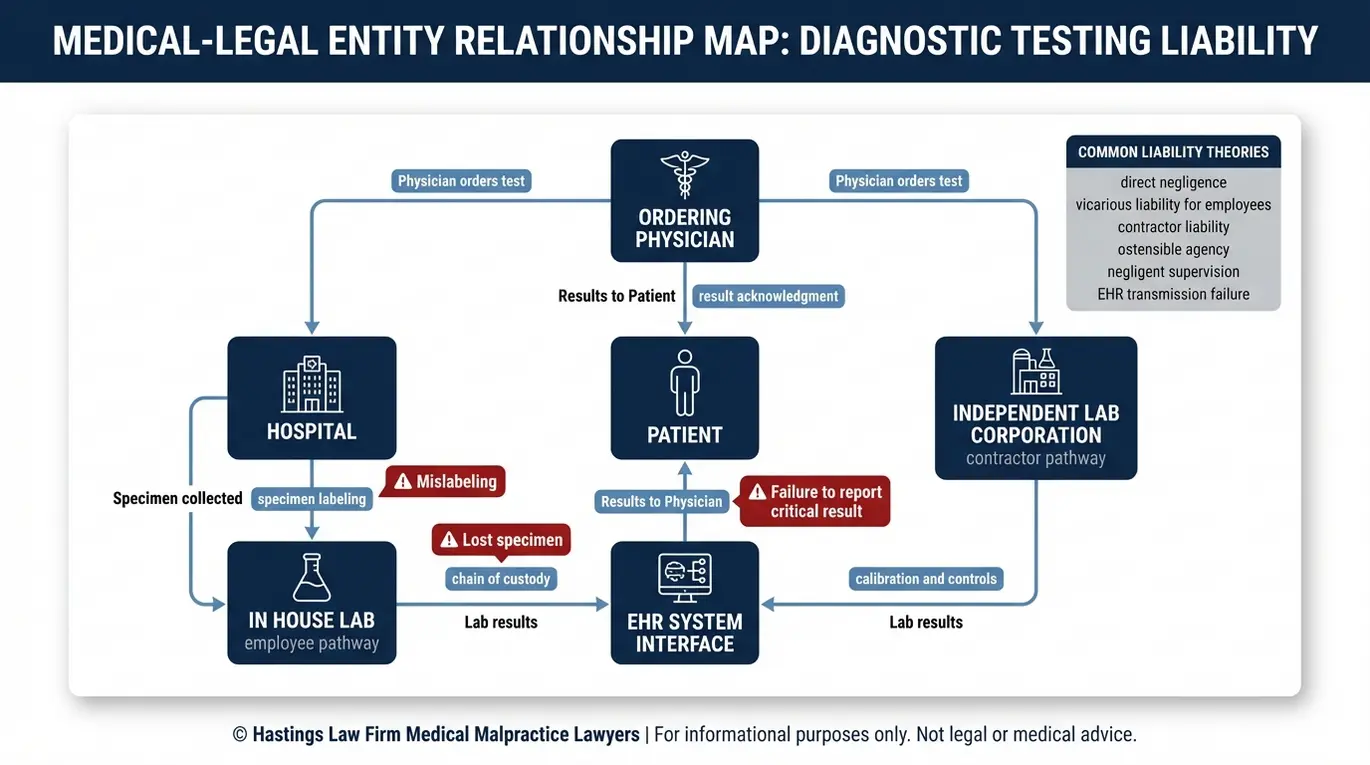
Liability may fall on the hospital if the lab is operated in-house, on an independent corporation like Quest Diagnostics or LabCorp if the work was outsourced, or on the ordering physician if they failed to properly interpret the report. Determining liability often requires a careful review of contracts, employment relationships, and data transmission records.
When a hospital operates its own lab, the hospital generally bears responsibility for the actions of its lab employees. But when testing is outsourced to a third-party lab, that company may be an entirely separate legal entity with its own liability. In some situations, a legal theory called “ostensible agency” applies if the patient reasonably believed the lab was part of the hospital’s care team.
The ordering physician also has responsibilities. If the lab produces an accurate result but the doctor misreads or ignores the report, the liability shifts from a data error to an interpretation error. Under 45 CFR § 164.524, patients have the right to access their own protected health information, which can be a valuable tool for a testing error lawyer when investigating what was communicated and when.
Electronic health record (EHR) system failures add another layer. A laboratory information system (LIS), the software that manages lab data and transmits results to clinical systems, creates a digital paper trail. When interfaces between these systems malfunction, causing a failure to report results or misdiagnosis, critical data can be lost, delayed, or routed to the wrong provider. A medical lab testing malpractice lawyer experienced in these technical details can trace exactly where the breakdown occurred.
Recoverable Damages for Diagnostic Error Victims in Arizona
Patients harmed by lab errors in Arizona can recover economic damages for medical bills and lost wages, as well as non-economic damages for pain, suffering, and the emotional toll of a missed or delayed diagnosis. Recoverable damages represent the legal remedy used to restore financial security to those impacted by medical negligence.
Economic damages cover the measurable financial losses caused by the error. This often includes the cost of additional treatment that would not have been necessary if the correct diagnosis had been made on time. For example, treating late-stage cancer is significantly more expensive and invasive than treating early-stage disease. Lost income, reduced earning capacity, and ongoing rehabilitation costs are also recoverable.
Non-economic damages address the harm that does not have a receipt attached to it: physical pain, emotional distress, loss of enjoyment of life, and the anxiety of living with a condition that could have been caught sooner.
Wrongful death damages may be available when a family has lost a loved one because a lab error prevented timely diagnosis or treatment. These claims can include compensation for funeral expenses, loss of companionship, and the financial support the family has lost.
Founded by board-certified trial lawyer Tommy Hastings, our firm works with medical and financial experts to document the full scope of harm. We ensure that every category of loss is accounted for to support your future financial security.
Contact the Arizona Healthcare Malpractice Attorneys at Hastings Law Firm Today for Help
Lab testing errors are technically complex cases that require both medical knowledge and legal skill. At Hastings Law Firm, our team of attorneys, nurse consultants, and former defense lawyers investigates these claims from day one with the preparation needed to take a case to trial. We maintain a national network of laboratory and pathology experts who can evaluate exactly where the standard of care was breached.
Our Phoenix office is ready to serve you, and we handle all upfront investigation costs. You pay no attorney fees unless we recover compensation on your behalf through a case evaluation and legal action.
If you or a loved one was harmed by a laboratory error, contact our team for a free, confidential case evaluation. As a dedicated Arizona medical lab testing malpractice lawyer, we can review your records, identify what went wrong, and explain the legal options available to you.
Frequently Asked Questions About Medical Lab Testing Malpractice in Arizona


This content was researched and written by the Hastings Law Firm editorial team, which includes attorneys, medical professionals, and experienced researchers. Our writing is informed by internal knowledge and practical experience, and we cross-check critical details against authoritative sources cited throughout. Every piece undergoes human-led fact-checking and legal review. Because legal and medical information can change, if you spot an error, please contact us. Learn more about our content standards and review process on our editorial policy page.

Tommy Hastings, founder of Hastings Law Firm, is a board-certified personal injury trial lawyer dedicated exclusively to healthcare injury cases. Since 2001, he has represented injured patients and families in litigation against major hospital systems, pharmaceutical companies, and negligent healthcare providers nationwide. He has handled numerous high-profile cases that have drawn national media attention and resulted in multi-million dollar recoveries. He draws on that experience in his writing, helping readers understand how these cases work and what options may be available to them.
