


Arizona Medical Geneticist Malpractice Lawyer
Written by: Hastings Law Firm | Reviewed by: Tommy Hastings | Updated: July 27, 2026
Errors in genetic testing and counseling can shape medical care and family planning in lasting ways. Medical geneticist malpractice may involve missed screening recommendations, misread results, or laboratory mistakes that lead to false reassurance or delayed care. Because these cases rely on specialized science and detailed records, understanding what happened often depends on how results were ordered, interpreted, and communicated. Arizona law also treats these claims differently in ways that can affect what options remain. If you or a loved one were harmed or worse due to medical geneticist malpractice in Arizona, contact Hastings Law Firm for a free, confidential case review.
Trusted Legal Representation for Healthcare Negligence in Arizona
What You Should Know About Genetic Testing Error Claims in Arizona:
- Life changing harm can follow genetic testing mistakes because results can drive major medical and reproductive decisions.
- A missed opportunity for early intervention can occur when a geneticist fails to recommend appropriate screening based on family history.
- False reassurance can result from misinterpreted genetic findings, including misclassification of a harmful variant or a VUS.
- Incorrect clinical decisions can follow lab and technical failures such as specimen labeling errors or sample contamination.
- A failure to diagnose can occur when a likely condition is left off the differential diagnosis list and needed testing is not ordered.
- Options in Arizona can be limited if an early expert support requirement is not met in a medical malpractice claim.
- Compensation can include long term medical care costs, emotional distress, and lost income when genetic errors cause lasting injury.
- Recovery for pain and suffering is not capped in Arizona standard medical malpractice cases.
- A loss of chance claim may be available when delayed diagnosis narrows the window for effective treatment.
- Disputes often turn on detailed documentation such as lab reports, raw genetic data, and equipment maintenance logs.

A Healthcare Focused Law Firm
When a medical geneticist, a physician who specializes in diagnosing and managing inherited conditions, makes an error, the consequences can affect your family for generations. The same is true when a genetic counselor, a healthcare professional trained to assess hereditary risk and guide patients through testing decisions, fails to recommend appropriate screening or misinterprets results.
These are not typical medical malpractice cases. They involve highly specialized science, complex laboratory processes, and life-altering decisions about care, treatment, and family planning. If you suspect an error occurred during genetic testing or counseling, you deserve a legal team that understands both the medicine and the law.
Led by founder Tommy Hastings, a board-certified trial attorney, our team brings in-house medical professionals and a national network of genetic specialists to evaluate exactly what went wrong. Contact us for a free, confidential case review to understand your options.
Common Errors Committed by Medical Geneticists and Labs
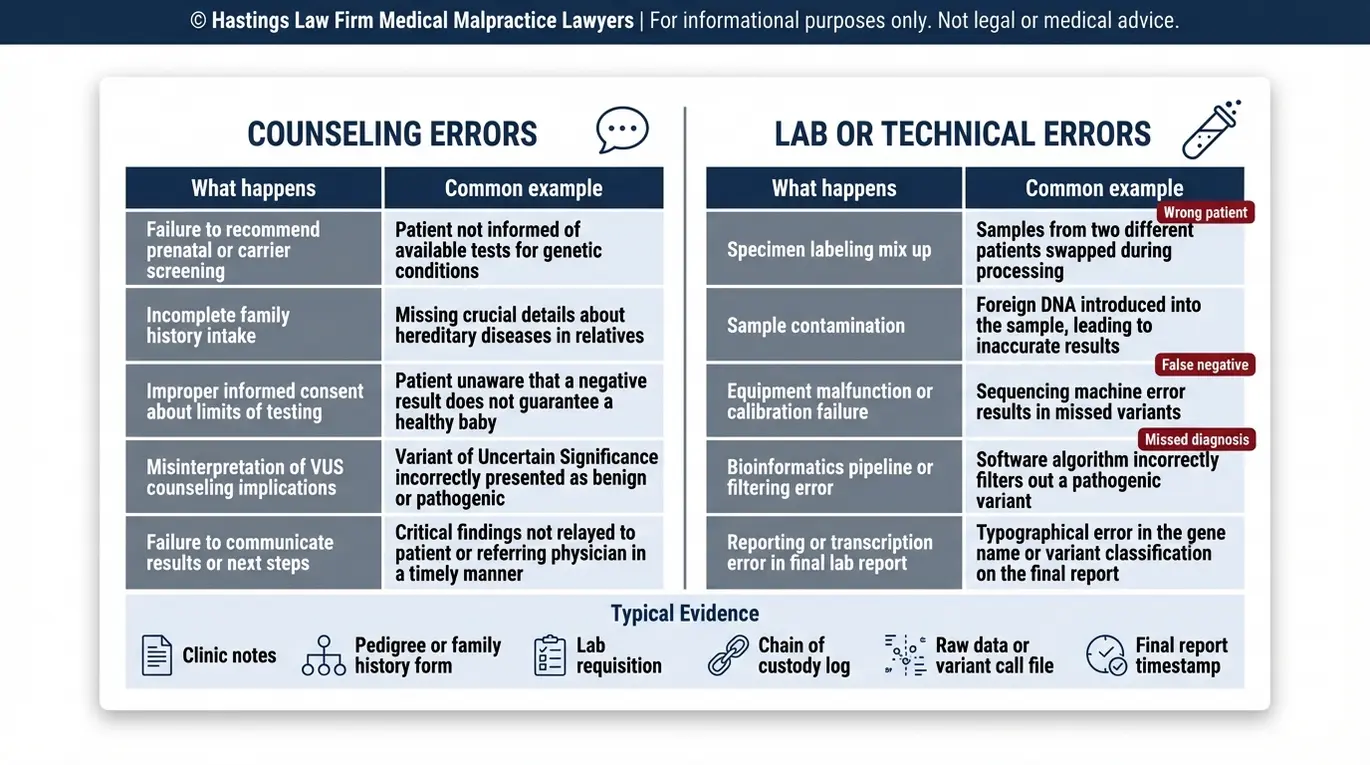
Genetic malpractice occurs when a healthcare provider, counselor, or laboratory deviates from the standard of care during the screening, interpretation, or communication of genetic data. These diagnostic testing errors generally fall into two categories: failures in clinical counseling and failures in laboratory testing itself.
Counseling failures happen on the provider side. A genetic testing error attorney often reviews claims where a geneticist or counselor failed to recommend prenatal screening or carrier testing when a patient’s family history clearly warrants it. They may also fail to communicate results in a timely or accurate way, leaving patients without the information they need to make informed medical or reproductive decisions.
Interpretation errors sit at the intersection of clinical judgment and laboratory science. A provider may incorrectly classify a pathogenic variant, a genetic change known to cause disease, as harmless. They may also misread a Variant of Uncertain Significance (VUS), a genetic change whose clinical impact is not yet fully understood, leading to false reassurance. Resources like the ClinVar database maintained by the National Center for Biotechnology Information exist to improve classification, yet misinterpretation still occurs, often triggering malpractice regarding genetic screening litigation.
Lab and technical failures involve the physical handling of samples and equipment. Specimen labeling mix-ups, sample contamination, and equipment malfunctions can all produce false results. The U.S. Food and Drug Administration’s MAUDE database contains reports of adverse events tied to genetic sequencing devices, showing that these technical breakdowns are well-documented.
| Error Category | Examples | Typical Impact |
|---|---|---|
| Counseling Errors | Failure to recommend screening, inadequate family history review, failure to communicate results | Missed opportunity for early intervention or informed reproductive choice |
| Lab/Technical Errors | Specimen labeling mistakes, sample contamination, equipment malfunction | False negative or false positive results leading to incorrect clinical decisions |
The Critical Role of the Differential Diagnosis List
When evaluating a patient, a geneticist is expected to develop a differential diagnosis list, an organized ranking of possible genetic conditions based on the patient’s symptoms, family history, and test results. This list guides which conditions to rule out.
If a geneticist fails to include a likely condition on this list, a failure to diagnose may occur, and appropriate diagnostic testing may never be ordered. Medical records should reflect a thorough, logical process. When our team reviews a case, we examine whether the differential was complete and whether the standard of care required testing that was never performed.
Proving Negligence Against Arizona Geneticists
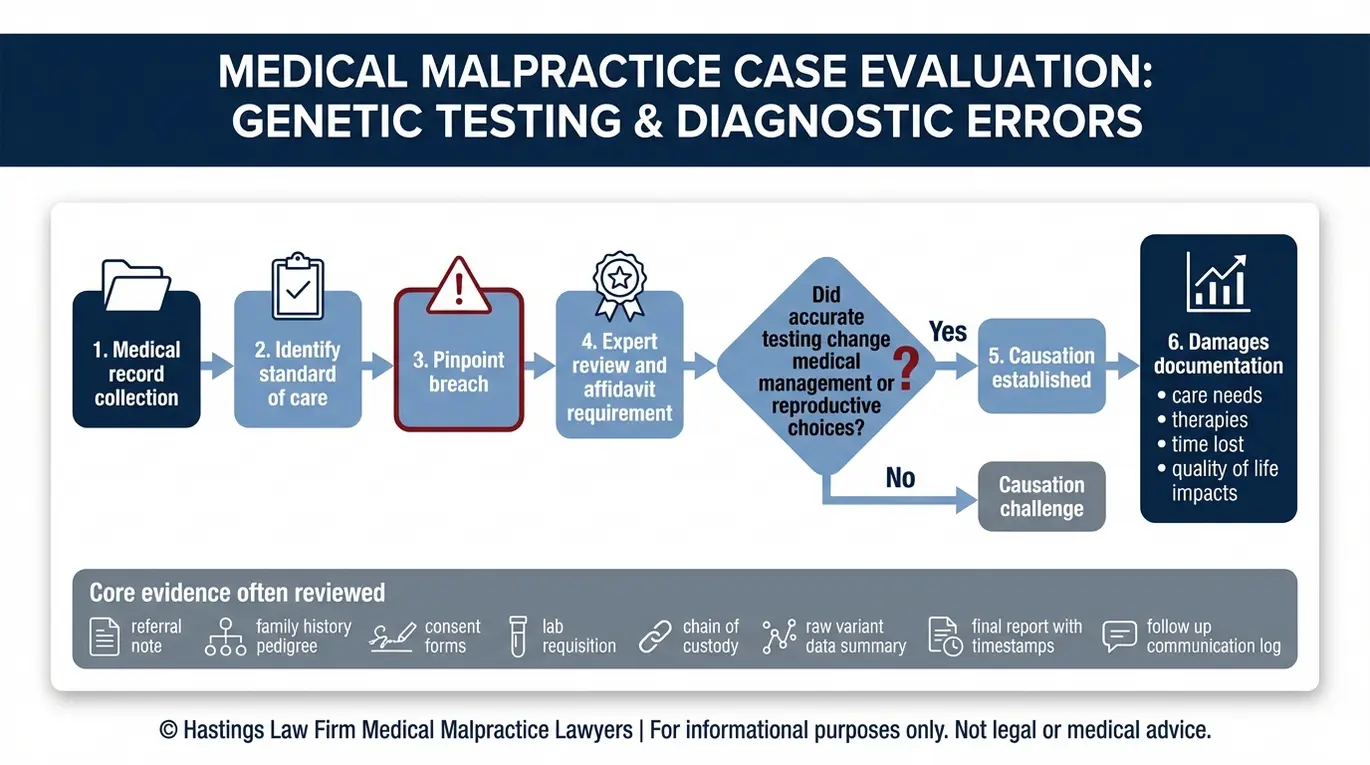
To win a claim in Arizona, the plaintiff must prove that the geneticist or counselor failed to act as a reasonably prudent specialist would have under similar circumstances, directly causing the injury.
The Arizona Supreme Court reinforced this framework in *Francisco v. Affiliated Urologists*, clarifying how courts evaluate standard of care disputes. An experienced Arizona genetic malpractice lawyer uses this and related case law to build a clear evidentiary foundation.
When suing a geneticist in Phoenix or statewide, Arizona law also requires an early step many families do not expect. Under A.R.S. § 12-2603, you must serve a preliminary expert opinion affidavit confirming that your claim has merit along with your initial disclosures after the lawsuit is filed. This expert must practice in the same specialty as the provider you are suing.
Here is what our medical records review evaluates to satisfy the burden of proof and establish negligence:
- Whether the provider ordered appropriate testing, such as carrier screening (testing to identify whether a parent carries a gene for a recessive disorder) or whole genome sequencing (WGS), a method that analyzes a patient’s entire DNA for abnormalities
- What a competent geneticist would have detected given the technology available at the time
- Whether accurate results would have changed the medical management or reproductive choices available to the family
- Complete medical records, lab reports, raw genetic data, and equipment maintenance logs
- Qualified expert witness testimony from board-certified geneticists
Our in-house nurse consultants and former defense attorneys know exactly where to look in the records and how to anticipate the arguments the other side will raise.
The Hastings Law Firm Difference
Results matter, but what truly sets us apart is how we achieve them. Every verdict, every settlement, and every Arizona courtroom victory comes from one guiding promise: To treat each client’s fight for justice as if it were our own.
This balance of skill, experience, and empathy reflects our core philosophy that justice should not only compensate the injured, but also make healthcare safer nationwide.

Compensation for Life-Altering Genetic Consequences
Damages in genetic malpractice cases often cover the lifetime cost of medical care for a child born with a disability, along with compensation for the parents’ emotional distress and lost income.
Economic damages may include future medical expenses, the cost of specialized therapy, 24-hour care, and adaptive medical equipment required for the condition. These figures can be substantial when projected across a lifetime.
Non-economic damages address the pain, suffering, and loss of enjoyment of life experienced by the family. Arizona does not cap non-economic damages in standard medical malpractice cases, allowing juries to assess the full weight of the harm.
Claims may also involve wrongful birth or wrongful life theories, which require a medical geneticist malpractice attorney to handle. A lawyer for genetic testing errors can also pursue justice if wrongful death or a delayed diagnosis resulted from sample contamination, the introduction of foreign substances into a sample, or specimen labeling, the process of identifying samples.
The Window of Opportunity in Genetic Conditions
Many genetic conditions respond best to early intervention. When a delayed diagnosis eliminates or narrows that window, the patient may suffer more severe symptoms or lose access to treatments that could have improved their quality of life.
A false negative genetic test result, a test that incorrectly shows no abnormality when one exists, can create a dangerous false sense of security. Families proceed without the monitoring or treatment their child actually needs.
The law may recognize what is called a “loss of chance” for a better outcome when a delay limits medical options. Our team works with genetic specialists to document what early intervention could have achieved and the specific prognosis impact of the delay.
Contact the Arizona Doctor Malpractice Attorneys at Hastings Law Firm Today for Help
If a genetic testing error, a missed diagnosis, or a counseling failure has changed your family’s path, you do not have to sort through the science and the legal process alone.
Hastings Law Firm focuses exclusively on medical malpractice. Our team includes in-house medical professionals, former defense attorneys who understand how hospitals and labs build their cases, and a national network of genetic experts. As Arizona medical geneticist malpractice attorneys, we have the resources to investigate what happened and determine whether negligence played a role.
Every case evaluation is free, confidential, and carries no obligation. We work on a contingency fee basis, so you pay no attorney fees unless we recover compensation for your family.
Call us today or request a case evaluation online. Let us help you find the answers you deserve.
Frequently Asked Questions About Medical Geneticist Malpractice in Arizona


This content was researched and written by the Hastings Law Firm editorial team, which includes attorneys, medical professionals, and experienced researchers. Our writing is informed by internal knowledge and practical experience, and we cross-check critical details against authoritative sources cited throughout. Every piece undergoes human-led fact-checking and legal review. Because legal and medical information can change, if you spot an error, please contact us. Learn more about our content standards and review process on our editorial policy page.

Tommy Hastings, founder of Hastings Law Firm, is a board-certified personal injury trial lawyer dedicated exclusively to healthcare injury cases. Since 2001, he has represented injured patients and families in litigation against major hospital systems, pharmaceutical companies, and negligent healthcare providers nationwide. He has handled numerous high-profile cases that have drawn national media attention and resulted in multi-million dollar recoveries. He draws on that experience in his writing, helping readers understand how these cases work and what options may be available to them.
