


Arizona Medical Burn Lawyer
Written by: Hastings Law Firm | Reviewed by: Tommy Hastings | Updated: July 27, 2026
A burn injury during medical care can leave lasting physical pain, scarring, and emotional distress, especially when it appears preventable. Surgical fires, chemical exposure, MRI related heating, and laser procedures can cause serious harm when safety protocols are missed or equipment is mishandled. Some burns are known risks, but malpractice concerns arise when care falls below accepted standards and directly causes injury. Delayed onset burns can also complicate recognition of what went wrong. If you or a loved one were harmed or worse due to medical burn malpractice in Arizona, contact Hastings Law Firm for a free, confidential case review.
Trusted Arizona Medical Attorneys for Surgical Burn Malpractice Claims
What You Should Know About Surgical Burn Injury Malpractice Claims in Arizona:
- Recovery can turn on whether a burn was preventable rather than a known complication of treatment.
- Severe harm can result when operating room fire safety steps break down around ignition sources, fuels, and oxygen delivery.
- Liability can extend beyond one clinician because surgical burn events often involve shared responsibilities across a care team and a facility.
- Options can remain available even when a defense claims partial patient fault because Arizona uses a pure comparative negligence standard.
- Compensation can include both financial losses and non financial harm such as disfigurement and psychological trauma.
- Long term costs can be substantial because burn care may require multiple procedures and extended rehabilitation.
- A delayed connection between symptoms and a prior procedure can affect when a claim is treated as discoverable, especially with radiation related burns.
- The ability to pursue recovery can be lost if the filing deadline is missed under Arizona law.
- Proof can depend on whether key facility materials are preserved, including operative documentation, anesthesia records, and equipment logs.

A Healthcare Focused Law Firm
Suffering a burn injury during a medical procedure can feel like an unthinkable betrayal. You trusted your care team, and something went terribly wrong. If you or a loved one experienced a burn during surgery, an MRI, a laser treatment, or from chemical exposure in a healthcare setting, you may have questions about what happened and whether anyone is being held responsible.
At Hastings Law Firm, we focus exclusively on medical malpractice. Under the leadership of founder Tommy Hastings, a board-certified trial attorney, we investigate cases with a high level of medical and legal sophistication. Our legal team includes former defense attorneys and in-house medical professionals who understand both the clinical details and the legal strategies needed to build these cases.
As an experienced Arizona medical burn lawyer team, we prepare every case as if it will go to trial. We do not collect a fee unless we recover compensation for you. If a medical burn has changed your life or the life of someone you love, we can review what happened and explain your options in a free, confidential consultation.
When Surgical Burns Constitute Medical Malpractice in Arizona
Medical malpractice occurs when a burn injury results from a healthcare provider’s failure to follow the accepted standard of care, the level of treatment a reasonably competent professional would have provided under similar circumstances. Neglecting fire safety protocols in the operating room, improperly handling chemical agents, causing thermal burns with equipment, or failing to calibrate devices correctly can all cross this legal threshold.
Not every burn that occurs during medical treatment qualifies as malpractice. Some procedures carry inherent risks, and a poor outcome alone does not prove negligence. The distinction lies in whether the injury was preventable. If a provider’s conduct fell below the duty of care owed to the patient, and that breach directly caused the burn, the legal elements of a malpractice claim may be satisfied. This requires establishing a breach of duty, causation, and a clear link between the provider’s actions and the harm.
Many patients struggle with this distinction because of what is sometimes called the “White Coat Effect.” Years of conditioning to defer to medical authority can lead people to accept a provider’s explanation that a burn was simply a “known complication.” Patients may even blame themselves for not asking enough questions beforehand. But a known complication is not the same as a preventable error. If proper safety steps were skipped or equipment was mishandled, the injury may have been avoidable, regardless of what appears on a consent form.
An iatrogenic burn, a burn caused by a medical treatment itself, and a laser burn, tissue damage from an improperly aimed or calibrated medical laser, both warrant careful legal analysis. The key question an Arizona medical burn attorney investigates is whether the provider’s conduct fell short of accepted medical practice.
As outlined by the National Center for Biotechnology Information’s review of medical error reduction and prevention, systemic failures in protocols and communication are among the leading drivers of preventable medical injuries. The first step in validating a claim involves a thorough review of medical records, operative reports, and facility safety procedures to determine whether negligence occurred.
Delayed Presentation of Radiation Burns
Not all burn injuries are immediately apparent. Radiation burns, clinically known as radiation dermatitis, can develop days or even weeks after a procedure. This latency period, the gap between the exposure and the visible onset of symptoms, creates a unique challenge. A patient may not connect their worsening skin condition to a prior medical treatment, which can delay both diagnosis and the pursuit of a legal claim. Because of this delayed presentation, radiation burns require special attention during the investigation to establish when the injury reasonably should have been discovered.
Common Causes of Preventable Medical Burns in Arizona Hospitals
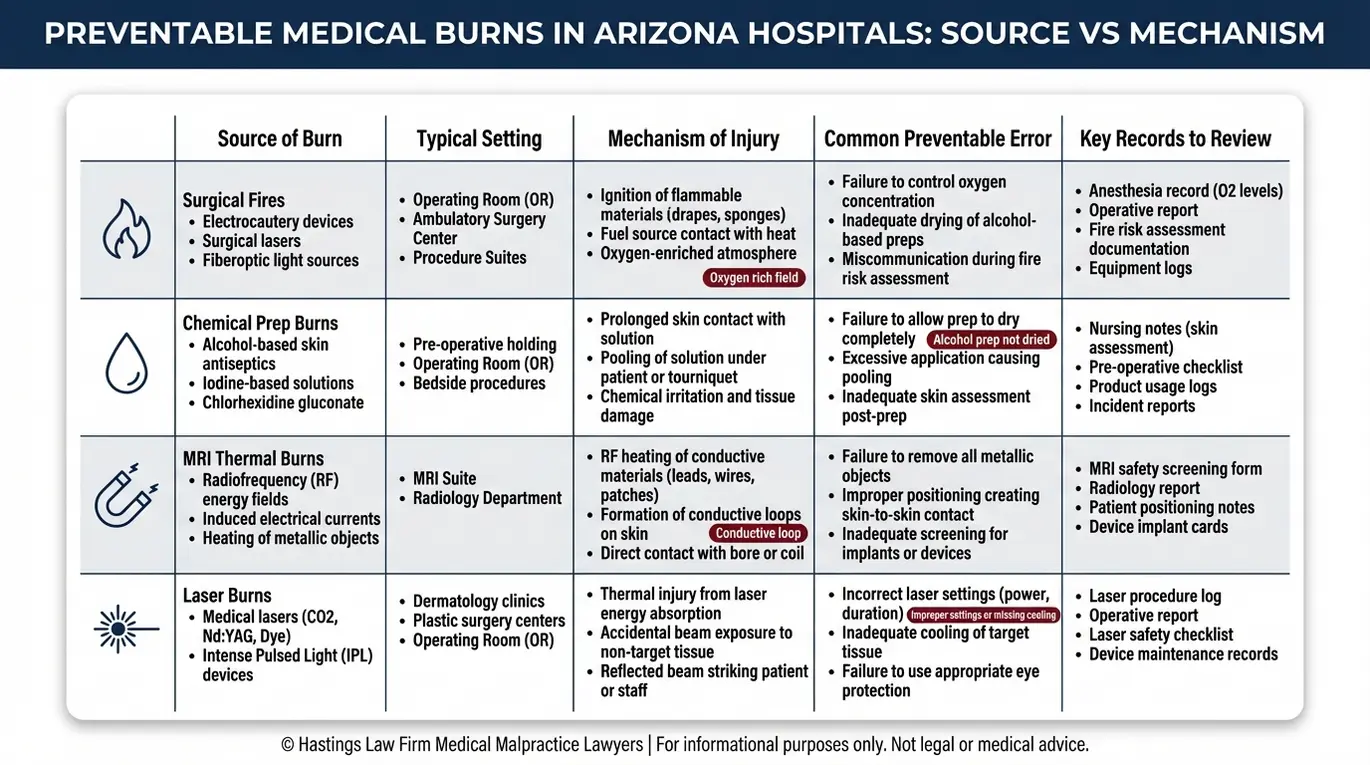
Preventable medical burns typically stem from surgical fires caused by cautery tools, chemical burns from improperly removed prep solutions, or thermal injuries from overheated equipment like MRI machines or lasers. Understanding the specific mechanism is essential for building a strong legal case, as each burn type points to different failures and responsible parties. Our team investigates preventable medical burns by examining the specific protocols in place at the time of the injury.
The Fire Triangle in the Operating Room
Surgical fires remain one of the most alarming yet preventable events in modern medicine. Every operating room contains the three elements of the fire triangle: an ignition source, a fuel source, and an oxidizer. An electrosurgical unit (ESU), a device using electrical current to cut tissue, is the common ignition source. Surgical drapes, alcohol-based prep solutions, and body hair act as fuel, while anesthesia-administered oxygen and nitrous oxide serve as oxidizers.
The risk escalates dramatically with oxygen pooling, the accumulation of oxygen-enriched gas beneath surgical drapes near the patient’s head and neck. If an ESU is activated near this oxygen-enriched pocket, a flash fire can erupt in an instant. The ECRI’s Top 10 Health Technology Hazards for 2025 identifies fire risk from supplemental oxygen and related energy hazards as persistent safety threats in healthcare facilities.
Chemical burns occur when harsh antiseptic prep solutions, such as chlorhexidine or iodine-based agents, are allowed to pool beneath a patient during surgery. These chemicals are designed to sterilize the skin, but prolonged contact with pooled solution can cause significant tissue damage. Proper protocol requires allowing the solution to dry completely to prevent pooling. When missed, patients may suffer preventable burns.
MRI burns, more precisely called radiofrequency heating injuries, happen when conductive materials form a loop during imaging. Magnetic resonance imaging (MRI) uses powerful magnets and radio waves to create detailed images of the body. Crossed monitoring wires, metal fibers in clothing, or improperly positioned coils can heat rapidly inside the MRI’s magnetic field, causing localized thermal burns. The UCSF Department of Radiology’s guide to standardizing MRI safety outlines protocols designed to prevent exactly these injuries.
Laser burns result from incorrect power settings, lack of proper skin cooling, or failure to use appropriate protective measures during dermatological or surgical laser procedures. Medical lasers use concentrated light to treat tissue, but they require precise calibration. When operators do not calibrate equipment for the patient’s skin type and tissue density, the results can range from superficial burns to deep tissue damage.
A burn injury lawyer in Phoenix will examine the specific mechanism at issue to identify where the protocol broke down. Here is a quick reference comparing the most common sources:
| Source of Burn | Mechanism of Injury | Typical Preventability |
|---|---|---|
| Surgical Fire (ESU) | Ignition of oxygen-enriched environment by electrical current | Preventable with proper O₂ management and draping protocols |
| Chemical Burn | Antiseptic pooling beneath the patient during prep | Preventable with correct application and drying procedures |
| MRI Burn | Radiofrequency heating of conductive materials or loops | Preventable with proper screening and patient positioning |
| Laser Burn | Incorrect settings or absent skin cooling | Preventable with calibration and operator training |
Arizona follows a pure comparative negligence standard under A.R.S. § 12-2505, meaning a medical malpractice burn lawyer can pursue a claim even if the defense tries to assign partial fault to the patient. In most surgical burn cases, this defense has little traction because the patient is typically under anesthesia and unable to contribute to the error.
The Hastings Law Firm Difference
Results matter, but what truly sets us apart is how we achieve them. Every verdict, every settlement, and every Arizona courtroom victory comes from one guiding promise: To treat each client’s fight for justice as if it were our own.
This balance of skill, experience, and empathy reflects our core philosophy that justice should not only compensate the injured, but also make healthcare safer nationwide.

Establishing Liability for Surgical Fires and Chemical Burns
Proving liability requires demonstrating that the medical team failed to control ignition sources or chemical agents, often established through expert review of operative reports and anesthesia logs. Liability refers to the legal responsibility one party has for the harm caused to another. Because surgical burns frequently involve multiple providers and overlapping responsibilities, identifying who is liable demands a detailed reconstruction of what happened in the treatment setting.
A surgical burn attorney examines each member of the care team and the institution itself. The ASPR TRACIE technical assistance document on surgical fire risk assessments highlights that responsibility for fire prevention is shared across the surgical team, meaning liability can attach to more than one party.
The potentially liable parties in a medical malpractice burn case include:
- The surgeon or anesthesiologist: The surgeon controls the ESU or laser, while the anesthesiologist manages oxygen delivery. Both share responsibility for coordinating to minimize fire risk. When one fails to communicate about oxygen concentration near an ignition source, that breakdown may constitute negligence.
- The hospital or facility: Hospitals have a duty to maintain equipment, enforce safety protocols, and adequately train staff. If an ESU malfunctioned because of deferred maintenance, or if staff were never trained on fire response procedures, the institution itself may bear liability.
- A medical device manufacturer: In some cases, the burn results not from human error but from a defective product. A cautery tool that sparks unpredictably or a laser with faulty calibration sensors may give rise to a product liability claim against the manufacturer.
At Hastings Law Firm, our team includes in-house nurses and former defense attorneys who know how hospitals document these events internally. As your hospital burn lawyer, we examine operative notes, incident reports, equipment logs, and anesthesia records to build a clear picture of what went wrong. This is often established through expert testimony regarding operative reports and anesthesia logs to confirm who bears responsibility.
Liability Distinctions for Med Spas
Burn injuries from laser treatments at med spas raise different liability questions than those occurring in hospitals. In a hospital, a licensed physician typically operates or directly supervises laser equipment. At a med spa, a non-licensed aesthetician may perform the procedure with limited or no physician oversight. If an unlicensed operator causes a laser burn, the supervising physician and the business entity may both face vicarious liability. The legal standard applied to these settings can differ significantly, and our team investigates the licensing, supervision, and training records involved to determine the appropriate claims.

Compensation for Victims of Medical Burn Injuries
Patients who have suffered medical burns may recover compensation for economic damages like revision surgeries and lost wages, as well as non-economic damages for the physical pain, disfigurement, and psychological trauma associated with the injury. A burn injury compensation attorney evaluates the full scope of harm to pursue a recovery that accounts for both current and future needs.
Medical costs often represent the largest economic category. Burn treatment is rarely a single procedure. Patients may require debridement, the surgical removal of dead or damaged tissue to promote healing, followed by skin grafting, a procedure in which healthy skin is transplanted to cover the wound site. Beyond these initial surgeries, patients often face expenses for specialized pressure garments to minimize scarring, long-term pain management, and extended physical therapy to restore mobility in affected joints. Future medical care planning must also account for potential complications like infections or contractures that require additional intervention.
Non-economic damages reflect the suffering that does not come with a receipt. Visible scarring and disfigurement from a medical burn can affect a person’s self-image, relationships, and mental health. The psychological impact of disfigurement, including pain and suffering, anxiety, depression, and emotional distress, is a recognized category of harm in Arizona malpractice claims. Survivors often endure chronic physical pain and sensitivity in the scarred areas, limiting their ability to enjoy hobbies or perform daily tasks. These intangible losses are central to the claim, acknowledging that the injury went beyond financial cost to alter the quality of the patient’s life.
Loss of earning capacity applies when the burn injury prevents a patient from returning to their previous employment or limits their ability to work. This calculation looks beyond immediate lost wages to consider the long-term effect on the patient’s career trajectory and income potential.
Every burn case is different, and the specific damages depend on the severity, location, and long-term consequences of the injury. Our team works with medical and financial experts to document these losses thoroughly.
Arizona Statute of Limitations for Medical Injury Claims
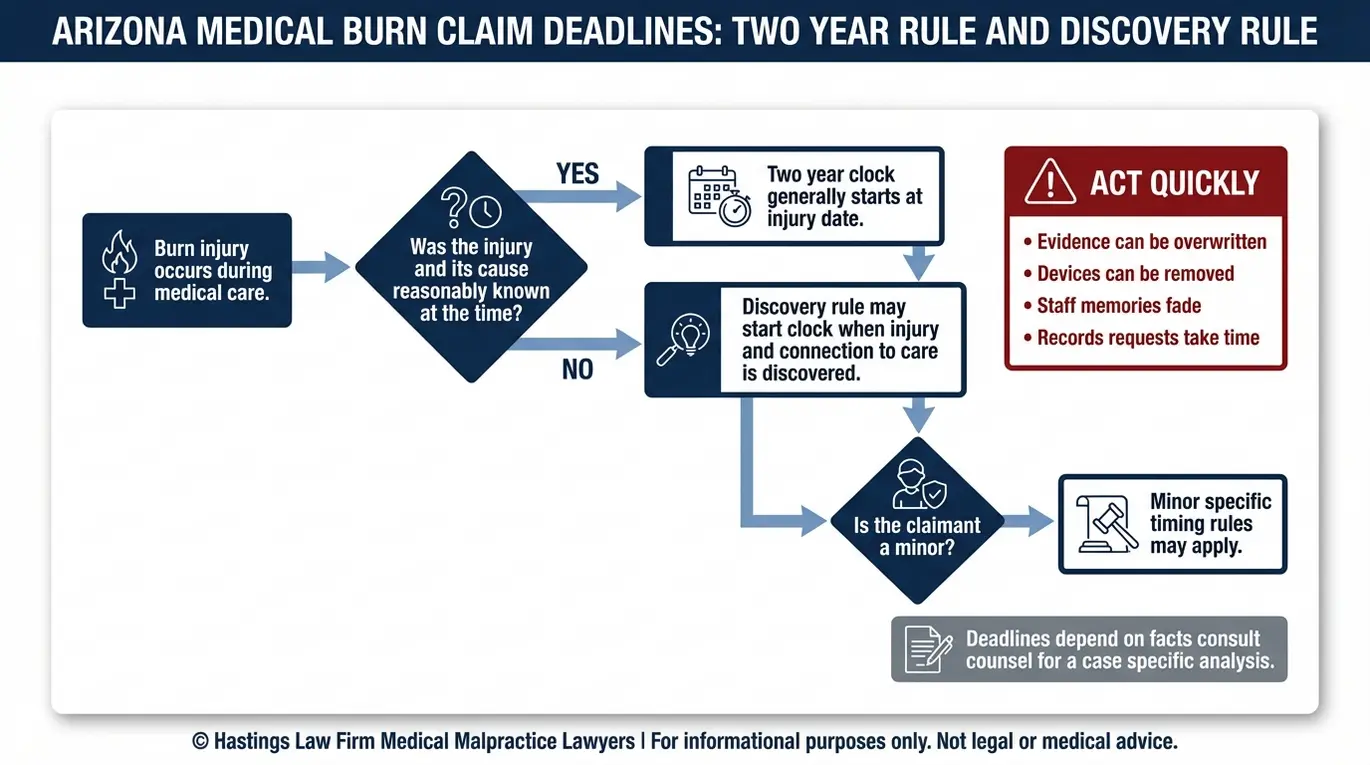
In Arizona, medical malpractice claims generally must be filed within two years from the date of the injury under A.R.S. § 12-542. The discovery rule may extend this timeline if the burn or its cause was not immediately apparent, which is particularly relevant for radiation burns that develop weeks after treatment. This rule prevents patients from losing their right to sue simply because the negligence was concealed or latent during the statutory period.
⚠️ Time-sensitive: Missing the filing deadline can permanently bar your claim, regardless of how strong the evidence is. Contact an attorney as soon as possible to protect your rights.
For minors, Arizona law provides additional time, as the statute of limitations may be tolled until the child reaches the age of majority. Even with these exceptions, critical evidence, such as operative logs, equipment data, and incident reports, can be altered, archived, or destroyed as time passes. Early legal involvement allows your attorney to send preservation demands to the facility, ensuring the records and devices needed to prove your case remain intact.
Contact the Arizona Healthcare Malpractice Attorneys at Hastings Law Firm Today for Help
A medical burn can leave lasting physical and emotional scars, and you deserve answers about what happened and why. At Hastings Law Firm, our entire team of attorneys, nurses, and patient advocates is dedicated to one thing: holding negligent medical providers accountable for preventable injuries.
As your Arizona medical burn lawyer, we prepare every case with the depth and rigor needed to take it before a jury. Our in-house medical staff reviews your records, our national expert network provides independent analysis, and our former defense attorneys know exactly how the other side will try to minimize your claim.
There is no fee unless we recover compensation for you. If a burn injury during a medical procedure has affected your life or the life of someone you love, reach out for a free, confidential case evaluation. We are ready to listen, review your situation, and help you understand the path forward.
Frequently Asked Questions About Medical Burn in Arizona


This content was researched and written by the Hastings Law Firm editorial team, which includes attorneys, medical professionals, and experienced researchers. Our writing is informed by internal knowledge and practical experience, and we cross-check critical details against authoritative sources cited throughout. Every piece undergoes human-led fact-checking and legal review. Because legal and medical information can change, if you spot an error, please contact us. Learn more about our content standards and review process on our editorial policy page.

Tommy Hastings, founder of Hastings Law Firm, is a board-certified personal injury trial lawyer dedicated exclusively to healthcare injury cases. Since 2001, he has represented injured patients and families in litigation against major hospital systems, pharmaceutical companies, and negligent healthcare providers nationwide. He has handled numerous high-profile cases that have drawn national media attention and resulted in multi-million dollar recoveries. He draws on that experience in his writing, helping readers understand how these cases work and what options may be available to them.
