


Arizona Maternal Hypotension Epidural Error Lawyer
Maternal hypotension after an epidural can cause a sudden drop in a mother’s blood pressure that reduces oxygen delivery to the fetus. When monitoring is missed or treatment is delayed, fetal distress can escalate quickly and lead to permanent brain injury and lifelong complications. Understanding warning signs, expected monitoring, and timely intervention can clarify whether an epidural related complication was preventable. Clear medical records and fetal monitoring data often shape what can be proven about timing and cause. If you or a loved one were harmed or worse due to maternal hypotension from an epidural error in Arizona, contact Hastings Law Firm for a free, confidential case review.

Last Updated: July 27, 2026
Trial-Ready Arizona Birth Injury Attorneys for Epidural Complications
When your child suffers a preventable injury during delivery, finding answers can feel overwhelming. If you believe something went wrong after the placement of an epidural, you deserve a legal team that understands the medical details. This regional anesthesia is injected into the epidural space around the spinal cord to block pain during labor. At Hastings Law Firm, we focus exclusively on medical malpractice, and our team includes in-house nurses and former defense attorneys who know how to investigate anesthesia-related birth injuries. If your family is dealing with the aftermath of an epidural complication, an Arizona maternal hypotension epidural error lawyer from our team is here to review what happened and explain your options in a free, confidential consultation.

Understanding Maternal Hypotension and Epidural Malpractice
Maternal hypotension is a sudden drop in the mother’s blood pressure, often triggered by epidural anesthesia, that can restrict blood flow to the fetus and cause permanent brain injury if not immediately corrected. Maternal hypotension involves a sudden drop in blood pressure. This is one of the most well-documented risks of epidural administration, and it is exactly why the medical team is required to monitor and respond without delay.
Here is how it happens. The epidural works by blocking the sympathetic nerves, part of the nervous system that helps regulate blood vessel tone and blood pressure. When those nerves are blocked (a process called sympathetic blockade), blood vessels dilate and blood pressure can fall rapidly. According to the UCSF Pain Management Education program, this vasodilation is a known pharmacological effect of epidural anesthesia.
The danger to the baby is direct. When a mother’s blood pressure crashes, the placenta can no longer deliver adequate oxygen to the fetus. This can trigger fetal distress within minutes. On the monitor, you may see a rapid decline in the baby’s heart rate, a sign that the oxygen supply has been cut off.
Warning signs of maternal hypotension during labor include:
- Sudden nausea or vomiting shortly after the epidural is placed
- The mother feeling lightheaded, dizzy, or faint
- A rapid or sustained drop in maternal blood pressure readings
- A sudden deceleration or drop in fetal heart rate on the monitor
- The mother reporting difficulty breathing or a feeling of pressure in the chest
If these signs appeared and the medical team did not act quickly, the consequences for the baby can be severe. As an Arizona maternal hypotension lawyer, we investigate whether the anesthesiologist or care team failed to recognize and correct the blood pressure drop before it caused harm. Medical negligence in these moments is not a matter of bad luck.
It may be a failure to follow well-established safety protocols. If you are searching for an epidural error attorney, our team can help you understand whether what happened during your delivery meets the legal threshold for a maternal hypotension malpractice claim.

Critical Standard of Care for Administering Epidurals
The standard of care requires anesthesiologists to pre-load IV fluids, continuously monitor maternal blood pressure every few minutes, and immediately administer vasopressors such as ephedrine or phenylephrine if hypotension occurs. The standard of care refers to the accepted level of treatment that a medical professional must provide. These are not optional best practices. They are baseline requirements that any competent anesthesia provider must follow.
Pre-Procedure Protocols
Before placing an epidural, the anesthesiologist or nurse anesthetist typically administers an IV fluid bolus, a rapid infusion of fluids designed to increase the mother’s blood volume and reduce the risk of a blood pressure crash. Failing to provide adequate fluids can reduce an important safety buffer.
Continuous Monitoring Requirements
After the epidural is placed, blood pressure must be checked frequently, typically every one to two minutes for the first 15 to 20 minutes. Fetal heart rate monitoring should be continuous throughout. A “set it and forget it” approach, where the anesthesia provider walks away without close observation, can constitute a monitoring error. A recent review published in PubMed Central on managing spinal anesthesia-induced hypotension reinforces that early detection and rapid intervention are the foundation of safe neuraxial anesthesia practice.
Immediate Intervention
When a blood pressure drop is detected, the standard of care calls for the immediate use of vasopressors, medications like phenylephrine or ephedrine that quickly raise blood pressure. Any delay in administering these drugs, even by a few minutes, can allow fetal distress to progress.
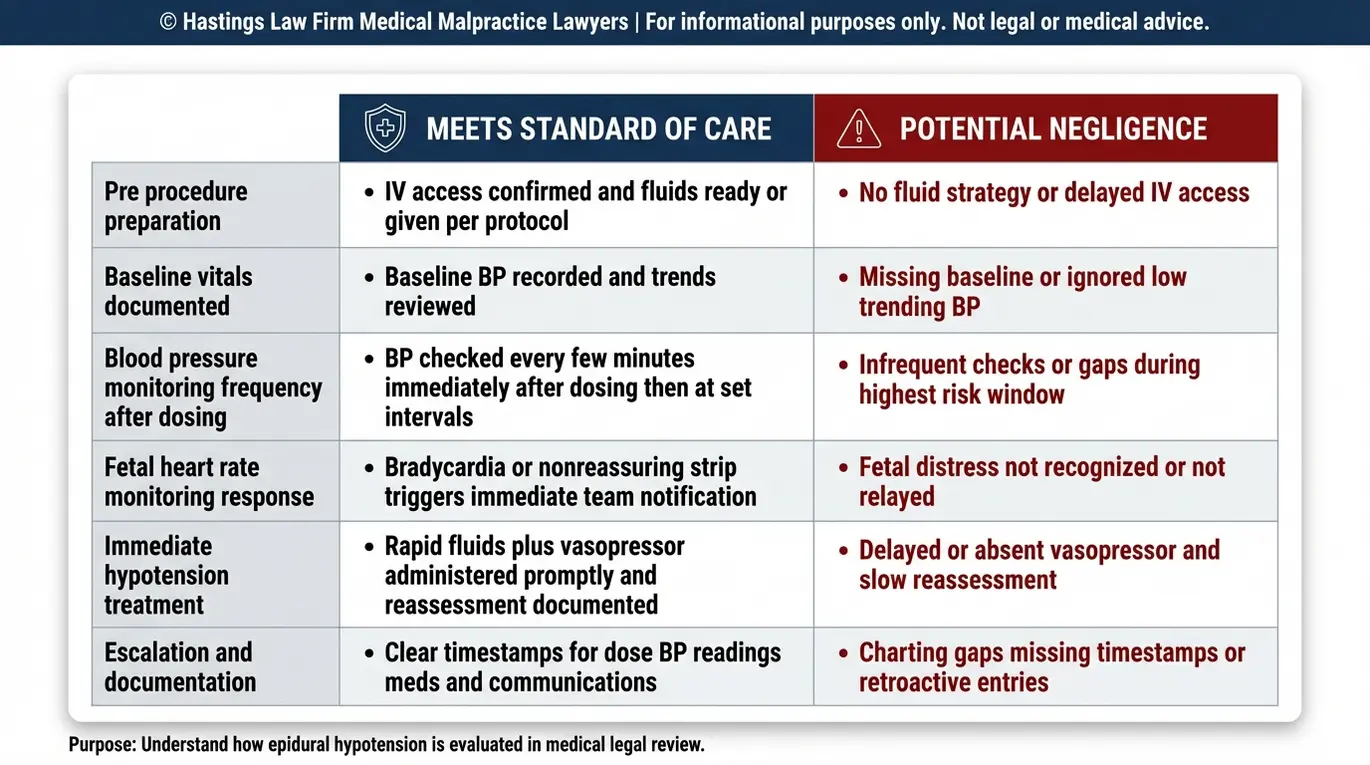
An epidural error lawyer in Arizona evaluates whether these protocols were followed and where the breakdown occurred. The comparison below outlines what the standard of care in anesthesia cases requires versus what may indicate negligence.
| Standard of Care | Potential Negligence |
|---|---|
| IV fluid pre-loading before epidural placement | No fluid bolus given, or given too late |
| Blood pressure checked every 1–2 minutes for 15–20 minutes post-dosing | Infrequent monitoring or gaps in recorded readings |
| Vasopressors immediately available and administered at first sign of hypotension | Delayed response or failure to have medications at bedside |
| Continuous electronic fetal heart rate monitoring | Gaps in fetal monitoring strips or late recognition of decelerations |
| Anesthesia provider remains at bedside during critical monitoring window | Provider leaves the room or is attending to other patients |
If your child suffered a birth injury after an epidural, an Arizona birth injury counsel can determine whether these standards were met or violated.
The Hastings Law Firm Difference
Results matter, but what truly sets us apart is how we achieve them. Every verdict, every settlement, and every Arizona courtroom victory comes from one guiding promise: To treat each client’s fight for justice as if it were our own.
This balance of skill, experience, and empathy reflects our core philosophy that justice should not only compensate the injured, but also make health care safer nationwide.

Injuries Caused by Uncorrected Maternal Hypotension
Prolonged maternal hypotension deprives the fetus of oxygen, causing conditions like hypoxic-ischemic encephalopathy, cerebral palsy, fetal acidosis, and permanent brain damage. Fetal injuries occur when the baby’s oxygen supply is interrupted by a medical complication. The severity depends on how long the oxygen deprivation lasted and how quickly the medical team intervened. This can lead to permanent brain damage.
Hypoxic-Ischemic Encephalopathy (HIE)
HIE is a brain injury caused by a combination of reduced oxygen (fetal hypoxia, meaning the baby is not receiving enough oxygen) and restricted blood flow. When the mother’s blood pressure drops and stays low, uteroplacental perfusion, the flow of oxygenated blood through the placenta to the baby, slows or stops. Without that flow, the baby’s brain cells begin to die. HIE can range from mild to severe, and in the most serious cases, it results in lifelong disability.
Fetal Acidosis
When the baby’s oxygen supply is cut off, waste products like lactic acid build up in the blood. This condition, fetal acidosis, is measurable through cord blood gas tests taken at birth. It provides direct evidence of the oxygen deprivation the baby experienced.
Long-Term Consequences
The effects of uncorrected maternal hypotension can follow a child for life:
- Cerebral palsy, affecting movement, coordination, and muscle control
- Seizure disorders requiring lifelong medication management
- Cognitive and developmental delays
- Paralysis or impaired motor function
- Need for 24-hour care, adaptive equipment, and ongoing therapy
- Reduced life expectancy in severe cases
An Arizona maternal hypotension epidural error lawyer helps families connect these outcomes to the specific failures that occurred during delivery. As a birth injury attorney, our role is to establish that the fetal hypoxia was not an unavoidable event but the result of a preventable medical error.
Unique Challenges in Proving Causation for HIE
Hospitals and defense teams often argue that the child’s injury was genetic, congenital, or unavoidable. This is one of the most common defenses in HIE cases, and it can be deeply frustrating for families who watched their baby decline in real time.
The key to overcoming this defense lies in the electronic fetal monitoring (EFM) strips, the continuous recordings of the baby’s heart rate during labor. Fetal bradycardia, a sustained slowing of the fetal heart rate, captured on these strips can pinpoint the exact moment when the baby began losing oxygen. When that timing aligns with a documented drop in maternal blood pressure after the epidural, it creates a powerful chain of evidence. Our medical experts and fetal heart rate monitoring specialists review these records to determine whether the injury happened during the hypotension event, not before or after.
Identifying Liable Parties in Anesthesia Errors
Liability in epidural error cases often extends beyond the anesthesiologist to include the hospital for inadequate staffing, the nurse anesthetist for monitoring failures, and the nursing staff for failing to alert doctors of fetal distress. Liability depends on identifying where the breakdown in care occurred.
The Anesthesiologist
The Anesthesiologist may be liable for improper dosing, failure to pre-load fluids, or a delayed response to a blood pressure drop. If the anesthesiologist was not present during the critical monitoring window after the epidural was placed, that absence alone can support a medical malpractice claim.
The CRNA (Certified Registered Nurse Anesthetist)
The CRNA (Certified Registered Nurse Anesthetist) is often the provider who actually administers the epidural. Under Arizona Revised Statutes § 32-1634.04, CRNAs operate under specific scope-of-practice guidelines. If a nurse anesthetist was left unsupervised or failed to follow monitoring protocols, both the individual and the supervising physician may share liability.
The Hospital
The Hospital can be held responsible for systemic failures. Understaffing, inadequate training, lack of available medications at the bedside, or assigning too many patients to a single anesthesia provider are all institutional decisions that can contribute to an anesthesia error.
Potential liable parties in an epidural error may include:
- The attending anesthesiologist who ordered or supervised the epidural
- The CRNA who administered the medication and monitored the patient
- Labor and delivery nurses who failed to report signs of fetal distress
- The hospital or birthing center for staffing or protocol failures
- The obstetric team if they failed to act on reported complications
Suing an anesthesiologist in Arizona, or a hospital, requires identifying every party whose actions or inactions contributed to the injury. Our team examines the full chain of responsibility to build the strongest possible case.
Recoverable Damages in Arizona Birth Injury Cases
Families can recover economic damages for past and future medical care, lost earning capacity, and life care planning costs, as well as non-economic damages for pain, suffering, and loss of quality of life. Recoverable damages are financial awards meant to compensate families for their losses. In cases involving the most severe birth injuries, these figures can be substantial because the costs extend across the child’s entire lifetime. This can result in significant economic damages.
Economic Damages
Economic Damages cover the measurable financial losses your family has suffered and will continue to face. This includes past and future medical expenses, such as surgeries, hospitalizations, and specialist visits.
- Physical, occupational, and speech therapy
- Specialized equipment such as wheelchairs, communication devices, and adaptive technology
- Home modifications to accommodate a child with mobility challenges
- Life care planning costs developed by medical professionals who project the full scope of future needs
- Lost earning capacity if the child’s injuries prevent future employment
Non-Economic Damages
Non-Economic Damages address the human cost of the injury, which cannot be captured in a receipt. These may include the emotional distress and loss of enjoyment of life experienced by the patient and family.
- The child’s loss of enjoyment of life and normal childhood experiences
- Physical pain and suffering
- The parents’ emotional distress and loss of companionship with their child
Wrongful Death
If uncorrected maternal hypotension led to a stillbirth or neonatal death, the family may pursue a wrongful death claim. Compensation in an Arizona maternal hypotension settlement can include funeral expenses, loss of consortium, and the profound emotional toll on surviving family members.
Every damages case involving anesthesia errors is different. We work with life care planners, economists, and medical specialists to document the true cost of your child’s injury and pursue full compensation for your family.
Arizona Statute of Limitations for Birth Injury Claims
Arizona generally requires medical malpractice lawsuits to be filed within two years of the injury, but cases involving minors may have extended deadlines that toll the statute until the child turns 18. A statute of limitations is the legal deadline for filing a lawsuit.
The Two-Year Rule
For the mother’s own injury claims, the Arizona statute of limitations is two years from the date of the injury. This also applies from the date the injury reasonably should have been discovery. Missing this deadline can permanently bar your claim.
The Minor Exception
The timeline is different for the baby’s injury. Under Arizona Revised Statutes § 12-502, the statute of limitations is tolled (paused) for minor children. This can extend the legal deadline for filing a birth injury lawsuit on the child’s behalf. However, relying on this extension carries risks.
Why Early Action Matters
Critical evidence, especially electronic fetal monitoring strips and anesthesia logs, can be lost, overwritten, or destroyed if not preserved early. Hospital record retention policies vary, and waiting years to begin an investigation may mean that the most important proof of what happened is gone. Consulting with a legal team experienced in the time limit for birth injury lawsuits as soon as possible protects both your rights and your evidence.
*This information is provided for general educational purposes and is not legal advice. Filing deadlines depend on the specific facts of your case. Contact an attorney to discuss the legal deadline for your epidural error claim.*
Investigations and Expert Review Process
A successful claim requires a thorough investigation involving the retrieval of electronic fetal monitoring data, anesthesia logs, and review by board-certified obstetric and anesthesia experts to confirm negligence. Medical investigations involve reviewing clinical records to identify where errors occurred. As an Arizona maternal hypotension epidural error lawyer, we follow a structured thorough investigation to build each case from the ground up.
Our birth injury investigation process includes the following steps:
- Records collection and preservation: We immediately request all medical records, including the electronic fetal monitoring strips, anesthesia logs, nursing notes, and the audit trail of electronic charting systems. Preserving this data early is critical.
- In-house medical review: Our team, which includes nurse practitioners and board-certified patient advocates, analyzes the records to build a detailed timeline of what happened before, during, and after the epidural.
- Expert review and opinions: We engage board-certified experts in obstetric and anesthesia through our national expert network to evaluate whether the care provided fell below the standard of care and whether that breach caused the injury.
- Causation analysis: Our experts review the fetal monitoring data alongside the anesthesia records to determine whether the hypotension event directly led to the baby’s oxygen deprivation and resulting injury.
- Filing suit: Once our expert review for malpractice confirms that negligence occurred, we prepare and file the lawsuit, moving from investigation into active litigation.
This evidence-driven approach is how we hold negligent providers accountable and build cases that are prepared for trial from the very beginning.

Contact the Arizona Birth Injury Attorneys at Hastings Law Firm Today for Help
No family should have to wonder whether their child’s injury could have been prevented. At Hastings Law Firm, we are committed to holding negligent anesthesia providers accountable for preventable birth injuries caused by epidural errors and uncorrected maternal hypotension. Our consultations are free, confidential, and carry no obligation.
Founded by board-certified trial attorney Tommy Hastings, our firm focuses exclusively on medical malpractice. We prepare every case as if it is going to trial, because that level of preparation is what it takes to pursue fair results for injured families.
If your child was harmed during delivery and you believe an epidural complication may be the cause, we encourage you to reach out. Our consultations are free, confidential, and carry no obligation. You pay no attorney fees unless we recover compensation for your family. Let us review your medical records, explain your options, and help you take the first step toward answers.
Frequently Asked Questions About Maternal Hypotension Epidural Error in Arizona


This content was researched and written by the Hastings Law Firm editorial team, which includes attorneys, medical professionals, and experienced researchers. Our writing is informed by internal knowledge and practical experience, and we cross-check critical details against authoritative sources cited throughout. Every piece undergoes human-led fact-checking and legal review. Because legal and medical information can change, if you spot an error, please contact us. Learn more about our content standards and review process on our editorial policy page.

Tommy Hastings, founder of Hastings Law Firm, is a board-certified personal injury trial lawyer dedicated exclusively to healthcare injury cases. Since 2001, he has represented injured patients and families in litigation against major hospital systems, pharmaceutical companies, and negligent healthcare providers nationwide. He has handled numerous high-profile cases that have drawn national media attention and resulted in multi-million dollar recoveries. He draws on that experience in his writing, helping readers understand how these cases work and what options may be available to them.
