


Arizona Maternal Chorioamnionitis Injury Lawyer
Chorioamnionitis is a serious infection during labor that requires timely recognition and treatment to protect both mother and baby. When warning signs are missed or symptoms are wrongly attributed to other causes, delays can allow infection to worsen and lead to severe complications such as sepsis, brain injury, or worse. Understanding how risk factors, monitoring, and treatment decisions should be handled can help families make sense of what went wrong after a traumatic delivery. If you or a loved one were harmed or worse due to maternal chorioamnionitis negligence in Arizona, contact Hastings Law Firm for a free, confidential case review.

Last Updated: July 27, 2026
Compassionate Arizona Medical Attorneys for Chorioamnionitis Negligence Claims
When a routine delivery turns into a medical crisis because an infection went undiagnosed or untreated, the emotional weight can be overwhelming. You trusted your medical team to protect you and your baby. If that trust was broken, you deserve honest answers about what happened and why.
Chorioamnionitis is a serious infection that medical professionals are trained to identify and treat promptly. When they fail to do so, the consequences for both mother and child can be life-altering. An experienced Arizona Maternal Chorioamnionitis Injury Lawyer can help you understand whether the care you received fell below accepted medical standards.
At Hastings Law Firm, our legal and medical team focuses exclusively on medical negligence and reviews these cases every day. If you suspect something went wrong during your labor or delivery, we can evaluate your records, explain your options, and help you decide what to do next. The consultation is free, and you pay nothing unless we recover compensation on your behalf.

Understanding Chorioamnionitis and Medical Negligence in Arizona
Chorioamnionitis is a bacterial infection of the membranes surrounding the fetus (the chorion and amnion) and the amniotic fluid, typically occurring during labor when bacteria such as Group B Streptococcus, E. coli, or anaerobic bacteria ascend from the vagina into the uterine cavity. According to the NCBI Bookshelf overview of Chorioamnionitis, this infection affects a significant number of deliveries and requires timely recognition to prevent serious harm.
The condition does not appear without warning. There are well-established risk factors that OB/GYN teams are trained to monitor throughout labor, including:
- Prolonged labor, particularly when active labor extends beyond expected timeframes
- Premature rupture of membranes (PROM), where the amniotic sac breaks before labor begins, or preterm premature rupture of membranes (PPROM), which occurs before 37 weeks of gestation
- Multiple vaginal examinations during labor, which can introduce bacteria into the uterine environment
- Prolonged membrane rupture, especially when more than 18 hours pass between rupture and delivery
- Prior genital tract infections or untreated Group B Streptococcus colonization
When any of these risk factors are present, Arizona doctors have a legal duty to identify the elevated risk and act preventively. This means ordering appropriate monitoring, screening for infection, and preparing for rapid intervention if signs develop. The standard of care dictates that physicians must not only recognize these warning signs but also document their findings and decision-making processes. Failure to track these risk factors carefully can result in a delayed diagnosis, allowing the bacteria to multiply and spread to the fetus.
Medical negligence occurs when a provider fails to recognize or respond to these known risk factors, allowing a preventable infection to progress. Under Arizona Revised Statutes § 12-2602, a qualified medical expert must certify that the standard of care was violated before a malpractice claim can move forward. An Arizona chorioamnionitis malpractice attorney works closely with medical experts from the outset to determine whether the care team met that standard.
Failure to Diagnose Chorioamnionitis and Signs Doctors Often Miss
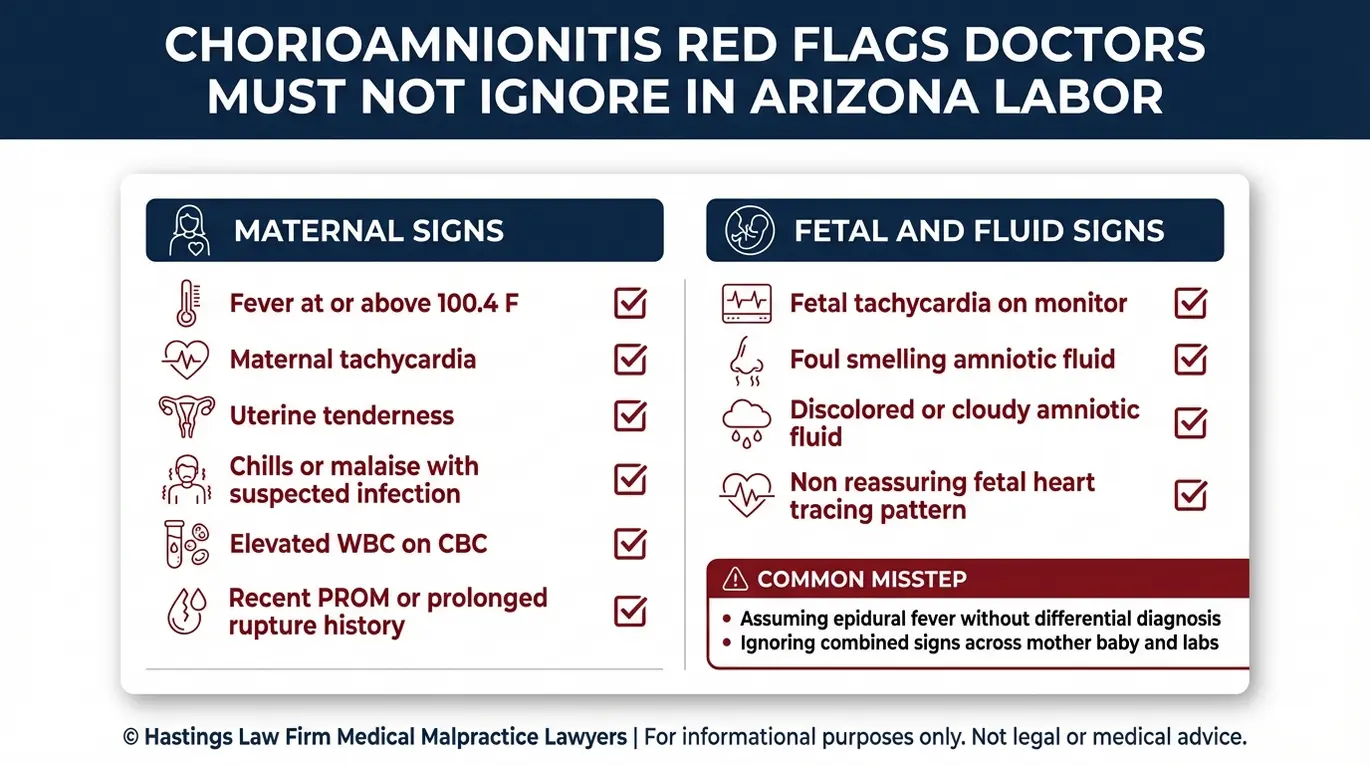
Doctors fail to diagnose chorioamnionitis when they overlook or misinterpret critical clinical signs such as maternal fever, uterine tenderness, foul-smelling amniotic fluid, and fetal tachycardia, an abnormally rapid fetal heart rate above 160 beats per minute. These are not subtle findings. They are textbook indicators that medical teams are expected to catch in real time.
Medical negligence in these cases often involves a breach of the professional standard of care during labor. Here are the red flags that should prompt immediate evaluation for chorioamnionitis:
- Maternal fever above 100.4°F (38°C), especially during active labor
- Maternal tachycardia (heart rate above 100 beats per minute)
- Fetal tachycardia (fetal heart rate above 160 beats per minute on the monitor)
- Uterine tenderness or pain beyond normal labor contractions
- Foul-smelling amniotic fluid, which is cloudy or discolored, a sign that may indicate bacterial contamination of the amniotic cavity
- Purulent (pus-like) cervical discharge
When these signs appear, the standard of care calls for diagnostic testing. A complete blood count (CBC) measuring white blood cell count can reveal the body’s immune response to infection. In certain clinical scenarios, an amniocentesis, where a small sample of amniotic fluid is drawn and analyzed, may be appropriate to confirm the diagnosis. Failing to order these tests when clinical indicators are present can constitute medical negligence.
Our team reviews medical records to determine whether the care team documented these findings and responded appropriately. If our investigation identifies gaps in that response, it may support a claim that the provider breached the standard of care.
Epidural Use Masking Fever Signs
Epidurals can cause a benign temperature rise known as epidural-associated fever, a well-documented phenomenon where the epidural itself triggers a mild increase in maternal temperature without any underlying infection. This creates a diagnostic challenge for medical providers during labor.
A competent physician is expected to perform a differential diagnosis, meaning they must consider all possible causes of the fever rather than simply attributing it to the epidural. If the mother also shows uterine tenderness, elevated heart rate, or changes in fetal monitoring, misinterpreting the fever as epidural-related without ruling out chorioamnionitis may represent a serious lapse in care.
The Hastings Law Firm Difference
Results matter, but what truly sets us apart is how we achieve them. Every verdict, every settlement, and every Arizona courtroom victory comes from one guiding promise: To treat each client’s fight for justice as if it were our own.
This balance of skill, experience, and empathy reflects our core philosophy that justice should not only compensate the injured, but also make health care safer nationwide.

Standard of Care Violations Regarding Improper Treatment of Maternal Infections
The standard of care for chorioamnionitis requires the immediate administration of broad-spectrum IV antibiotics, which are intravenous medications designed to target a wide range of bacteria, and in many cases, expedited delivery via C-section to protect the fetus from developing sepsis. In Arizona medical malpractice claims, determining the exact timing of treatment is critical for establishing liability.
Once chorioamnionitis is diagnosed, a clock starts. The established broad-spectrum antibiotics protocol typically includes medications such as Ampicillin and Gentamicin, administered intravenously to begin fighting the infection as quickly as possible.
Every minute matters because bacteria multiply exponentially. The medical team cannot afford to wait for lab cultures to return before initiating treatment; they must act on clinical suspicion. If antibiotics are delayed even by an hour, the effectiveness of the treatment drops, and the risk of severe complications for the baby increases. According to research published in the systematic review on Chorioamnionitis and Risk for Maternal and Neonatal Sepsis (PubMed), delays in antibiotic administration are directly associated with increased risk of both maternal and neonatal sepsis.
The decision to deliver is equally time-sensitive. When infection is confirmed and the fetus shows signs of distress, the OB/GYN team must evaluate whether continued labor is safe or whether an emergency C-section is necessary. Delaying delivery in the presence of active infection allows bacteria to cross the placenta and enter the baby’s bloodstream, potentially causing neonatal sepsis, brain injury, or worse.
We examine the timeline from diagnosis to treatment and from treatment to delivery. Our attorneys work with qualified OB/GYN experts to determine whether the treatment was started promptly, whether the right antibiotics were chosen, and whether the delivery decision was made within a medically appropriate window. These details often reveal the difference between acceptable care and a preventable injury.

Maternal and Fetal Injuries Caused by Untreated Chorioamnionitis
Untreated chorioamnionitis can lead to devastating outcomes, including cerebral palsy and meningitis in infants, and pelvic infections, sepsis, or blood clots in mothers. These injuries represent a failure to manage a maternal infection effectively before birth.
| Maternal Complications | Infant Complications |
|---|---|
| Sepsis and septic shock | Neonatal sepsis (a bloodstream infection in the newborn that can become life-threatening) |
| Endometritis (postpartum uterine infection) | Cerebral palsy from oxygen deprivation (hypoxia) |
| Postpartum hemorrhage | Meningitis (infection of the brain and spinal cord membranes) |
| Pelvic abscess | Respiratory distress syndrome (RDS) |
| Blood clots (deep vein thrombosis) | Pneumonia |
| Emergency hysterectomy | Stillbirth or neonatal death |
For mothers, untreated infection can spread beyond the uterus into the bloodstream, triggering sepsis, a condition that can cause organ failure and death if not treated aggressively. Some mothers require emergency hysterectomies, permanently ending their ability to have children.
For infants, the consequences can be even more profound. Neonatal sepsis may lead to prolonged NICU stays, brain injury, and long-term developmental disabilities. The Centers for Disease Control and Prevention (CDC) data on cerebral palsy shows that this condition affects thousands of children and often requires a lifetime of therapy, specialized equipment, and around-the-clock care.
The financial impact of these injuries is significant. Lifetime care costs for a child with cerebral palsy can reach into the millions of dollars. Families must consider expenses for physical therapy, occupational therapy, home modifications, and specialized educational support that the child will require throughout adulthood. These costs often exceed what a standard health insurance policy covers, leaving families with a substantial financial burden unless they secure proper legal compensation. An Arizona Maternal Chorioamnionitis Injury Lawyer helps families identify the full scope of damages, both current and future, and a maternal birth injury attorney ensures these costs are accounted for when building the case.

Proving Liability in Arizona Chorioamnionitis Cases
Proving liability requires demonstrating that the healthcare provider breached the accepted standard of care and that this breach directly caused the specific injury to the mother or child. In Arizona, this means establishing four legal elements: duty, breach, causation, and damages.
Every doctor and nurse involved in a delivery owes a duty of care to the patient. The question in a chorioamnionitis case is whether they breached that duty by failing to diagnose, treat, or respond appropriately. Establishing that breach, and connecting it to the resulting harm, requires a thorough investigation and specific evidence.
The critical evidence we examine in these cases includes:
- Medical records, including nursing notes, physician orders, and medication administration logs
- Electronic fetal monitoring strips, which may show fetal tachycardia or other signs of distress that were present but not acted upon, as described in the NCBI Bookshelf resource on Fetal Monitoring
- Laboratory results, including CBC/white blood cell counts and any culture results
- Placental pathology reports, which are examined after delivery and can confirm infection even when clinical signs were missed
- Timing records, documenting when symptoms appeared, when providers were notified, and when treatment began
Expert witnesses are essential in Arizona malpractice cases. Our attorneys work with board-certified OB/GYN specialists and neonatologists who review the records and testify about what the standard of care required and where the providers fell short.
The Role of Funisitis and Placental Pathology
Placental pathology, the microscopic examination of the placenta and umbilical cord after delivery, can provide definitive evidence of infection. When the pathology report shows funisitis, which is inflammation of the umbilical cord caused by the fetal immune system responding to infection, it confirms that the baby was exposed to the bacteria before birth.
This evidence is particularly powerful when a provider claims the infection was not present or was not clinically significant. Funisitis proves the infection reached the baby. In cases of subclinical chorioamnionitis, where the mother may not have shown obvious symptoms, the pathology report may be the single most important piece of evidence establishing that the infection was real and causing harm before delivery.
Contact the Arizona Birth Injury Attorneys at Hastings Law Firm Today for Help
You do not have to face the hospital’s legal team alone. If your baby or you suffered harm that you believe was connected to an undiagnosed or untreated infection during labor, our team can help you find out what happened.
Our founder, Tommy Hastings, is a board-certified trial lawyer with over 20 years of experience in medical malpractice litigation. Our in-house medical staff, including nurse practitioners and patient advocates, review your records alongside our attorneys to identify where the standard of care may have been violated. Our team includes former defense attorneys who understand how hospitals and insurers approach these cases, giving us a clear strategic advantage.
We prepare every case to be trial-ready from day one, conducting a thorough investigation to ensure no detail is overlooked. Time matters in these cases. Medical records, fetal monitoring data, and pathology samples need to be preserved. Speaking with an Arizona Maternal Chorioamnionitis Injury Lawyer early helps protect the evidence you may need.
Every consultation is free and confidential. You pay no attorney fees or costs unless we recover compensation for you. Call us today or complete our online form to take the first step toward understanding your options.
Frequently Asked Questions About Maternal Chorioamnionitis Injury in Arizona


This content was researched and written by the Hastings Law Firm editorial team, which includes attorneys, medical professionals, and experienced researchers. Our writing is informed by internal knowledge and practical experience, and we cross-check critical details against authoritative sources cited throughout. Every piece undergoes human-led fact-checking and legal review. Because legal and medical information can change, if you spot an error, please contact us. Learn more about our content standards and review process on our editorial policy page.

Tommy Hastings, founder of Hastings Law Firm, is a board-certified personal injury trial lawyer dedicated exclusively to healthcare injury cases. Since 2001, he has represented injured patients and families in litigation against major hospital systems, pharmaceutical companies, and negligent healthcare providers nationwide. He has handled numerous high-profile cases that have drawn national media attention and resulted in multi-million dollar recoveries. He draws on that experience in his writing, helping readers understand how these cases work and what options may be available to them.
