


Arizona Mammography Malpractice Lawyer
Written by: Hastings Law Firm | Reviewed by: Tommy Hastings | Updated: July 27, 2026
Mammogram errors can delay a breast cancer diagnosis and lead to more aggressive treatment, a worse prognosis, and lasting emotional distress. These cases often turn on whether radiology standards were followed, whether dense breast tissue was handled appropriately, and whether results were communicated clearly to the right clinicians. Liability may involve a radiologist, an imaging center, or another provider when preventable breakdowns contribute to harm. If you or a loved one were harmed or worse due to mammography malpractice in Arizona, contact Hastings Law Firm for a free, confidential case review.
Trusted Legal Representation for Mammogram Negligence in Arizona
What You Should Know About Mammogram Misdiagnosis Claims in Arizona:
- A delayed breast cancer diagnosis can lead to more aggressive treatment and a worse prognosis when a mammogram error prevents timely follow up.
- Options can depend on showing that the delay caused measurable harm such as disease progression or a reduced chance of survival.
- Responsibility can extend beyond the radiologist when equipment problems or facility quality failures contribute to imaging or labeling errors.
- A claim can still arise even when a suspicious finding was seen if communication failures prevent the result from reaching the right clinician.
- Outcomes can be shaped by how dense breast tissue was handled when supplemental imaging or patient notification was not addressed.
- Recovery can include economic losses and non economic harms tied to the progression of cancer and its treatment.
- Compensation in Arizona is not reduced by statutory damages caps for personal injury or wrongful death.
- Access to medical records can be central when evaluating what the images showed and how results were documented and communicated.

A Healthcare Focused Law Firm
When a mammogram fails to detect breast cancer, the consequences can be devastating. A delayed diagnosis often means the cancer has time to progress, leading to more aggressive treatment, a worse prognosis (likely outcome), and profound emotional distress. If you or a loved one experienced a missed or delayed breast cancer diagnosis due to a mammogram error, you may have grounds for a medical malpractice claim.
Hastings Law Firm focuses exclusively on medical malpractice, and our team includes in-house medical professionals who understand radiology standards and how failures in breast cancer screening happen. Founded by board-certified trial attorney Tommy Hastings in 2005, we have spent nearly two decades handling these cases. Tommy Hastings is a 2025 inductee into the American Board of Trial Advocates (ABOTA), an honor given to elite trial lawyers. In our work as an Arizona Mammography Malpractice Lawyer, we can review your medical records, identify where the standard of care may have been broken, and explain your legal options.
If something feels wrong about how your diagnosis was handled, contact us for a free, confidential case evaluation.
Radiology Standard of Care in Breast Cancer Screening
The standard of care requires radiologists to follow the American College of Radiology guidelines, which includes accurately identifying abnormalities, properly classifying breast density, and recommending immediate follow-up diagnostics like ultrasounds or biopsies for any suspicious findings.
The “prudent provider” standard asks: what would a reasonably competent radiologist have seen on that scan? If a qualified peer reviewing the same images would have flagged an abnormality, the failure to do so may be medical negligence.
A key distinction exists between a screening mammogram, a routine annual exam for asymptomatic patients (those showing no symptoms), and a diagnostic mammogram, an investigative study ordered due to clinical concerns. The duty of care increases significantly with diagnostic imaging.
Radiologists are also expected to classify findings using the Breast Imaging Reporting and Data System (BI-RADS), a standardized scoring system that ranks findings from 0 to 6. A misclassification can delay a biopsy (a procedure to test a tissue sample for cancer).
Results must be clearly communicated to the referring physician. When that communication breaks down, a treatable cancer can become a life-threatening one.
Arizona mammography malpractice attorneys will evaluate whether the following standards were met:
- The radiologist accurately identified visible abnormalities on the images
- Breast density was properly classified and documented
- BI-RADS scoring was appropriate for the findings
- A biopsy or supplemental imaging was recommended for suspicious results
- Results were promptly and clearly communicated to the referring physician
- The patient was notified of findings requiring follow-up
Impact of Dense Breast Tissue on Liability
Dense breast tissue, containing more fibrous and glandular tissue than fatty tissue, can make tumors significantly harder to detect on a standard mammogram. Since both dense tissue and cancers appear white on imaging, tumors can be effectively hidden. This often causes a false negative, a result incorrectly showing no cancer.
When a radiologist identifies dense breast tissue, the standard of care may require ordering supplemental imaging, such as a breast ultrasound. Failing to inform a patient about their breast density, or neglecting to recommend additional testing, can be negligence if a cancer is missed.

Common Mammogram Interpretation Errors by Radiologists
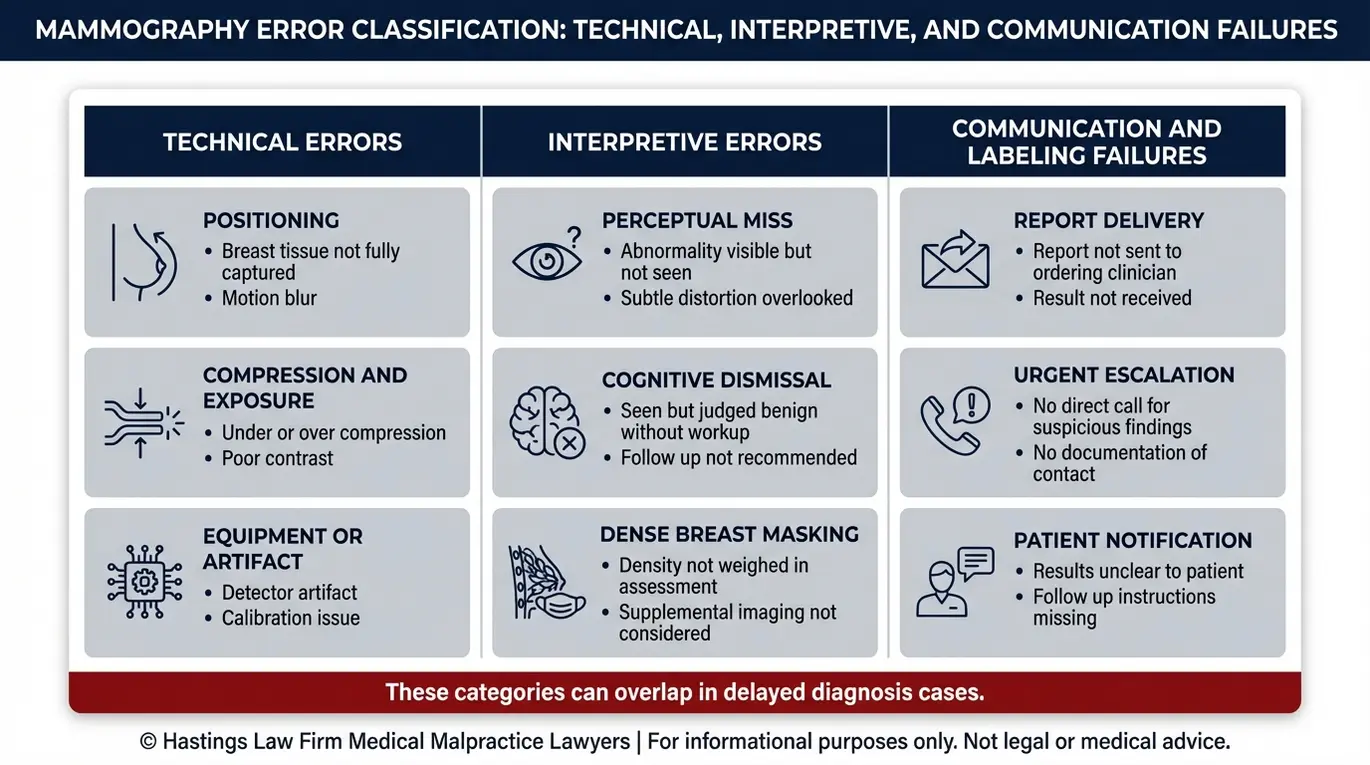
Mammogram errors generally fall into two categories: perceptual errors, where the radiologist fails to see a visible abnormality on the image, and cognitive errors, where the abnormality is seen but incorrectly dismissed as benign without proper follow-up testing. While a false positive causes unnecessary alarm, the failure to diagnose an existing cancer is far more dangerous.
These errors are distinct from technical failures, but all three can contribute to a delayed diagnosis.
| Error Type | What Happens | Examples |
|---|---|---|
| Technical Errors | The image itself is compromised, making accurate interpretation difficult or impossible | Poor breast positioning, improper compression, outdated equipment or equipment errors, image artifacts |
| Interpretive Errors | The radiologist misreads or overlooks findings on an adequate image | The radiologist commits a misinterpretation or overlooks microcalcifications (tiny calcium deposits that can signal early-stage cancer) or architectural distortion (an abnormal arrangement of breast tissue that may indicate a hidden tumor) |
| Communication Failures | The finding is identified but never reaches the patient or their doctor | Report is lost, mislabeled, sent to the wrong provider, or filed without notification |
Federal regulations under 21 CFR Part 900 govern mammography facility quality standards, including equipment maintenance, technologist qualifications, and record-keeping. When a facility fails to meet these requirements, imaging errors and labeling errors become more likely, and the facility itself may share liability.
Communication failures deserve special attention. Even when a radiologist correctly identifies a suspicious finding, the diagnosis can still be delayed if the report is mislabeled, lost in a system, or never forwarded to the patient’s primary care doctor. These breakdowns are preventable and can form the basis of a malpractice claim.
The Hastings Law Firm Difference
Results matter, but what truly sets us apart is how we achieve them. Every verdict, every settlement, and every Arizona courtroom victory comes from one guiding promise: To treat each client’s fight for justice as if it were our own.
This balance of skill, experience, and empathy reflects our core philosophy that justice should not only compensate the injured, but also make healthcare safer nationwide.

Proving Causation and Liability in Breast Cancer Delays
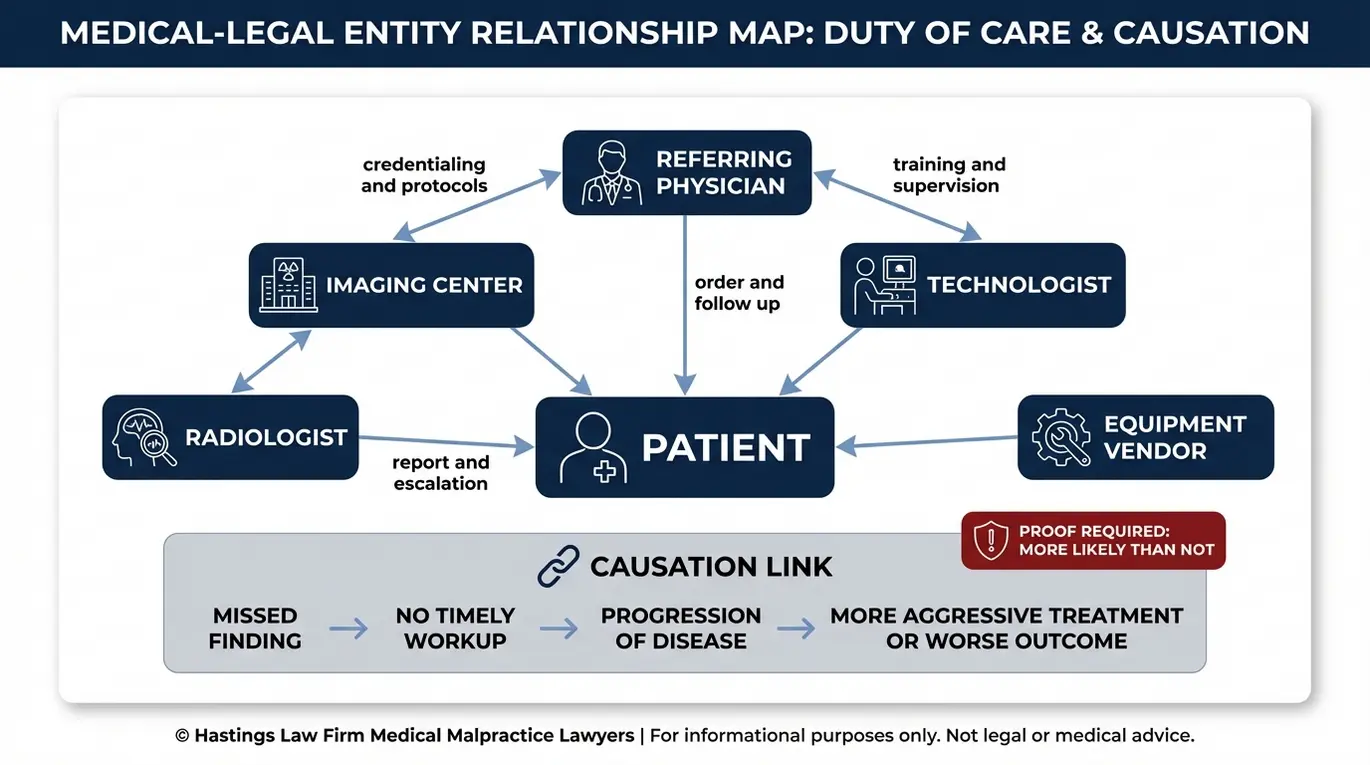
To prove liability, you must demonstrate that the radiologist’s failure to identify the cancer directly caused a progression of the disease, resulting in a worse stage, more aggressive treatment, or a reduced chance of survival.
Arizona uses a “more likely than not” standard for the burden of proof. This means we must show that, without the missed or delayed diagnosis, your outcome would have been meaningfully better. Expert witness testimony from qualified radiologists and oncologists is essential in a radiology malpractice case to connect the misread mammogram to the harm you suffered.
Liability may extend beyond the radiologist. If faulty or poorly maintained equipment contributed to the error, the imaging center may bear responsibility. If a referring physician received an abnormal report but failed to act on it, they may also be liable for injuries or wrongful death. The State Bar of Arizona’s guidance on medical negligence outlines the legal framework for establishing these claims.
One important legal concept in delayed cancer diagnosis cases is “loss of chance.” A false negative mammogram, one that incorrectly shows no cancer, can cause cancer upstaging, meaning the disease advances to a higher stage during the period of delay. The legal injury is measured by the drop in survival probability. For example, if a one-year delay caused a patient’s cure rate to fall from 90% to 40%, that lost chance itself is a compensable harm.
Recoverable Damages for Delayed Cancer Diagnosis in Arizona
Victims of mammography malpractice can recover compensation for economic losses like additional medical bills and lost wages, as well as non-economic damages for the physical pain, emotional trauma, and shortened life expectancy caused by the progression of the cancer.
Economic damages cover the measurable financial impact of the delay:
- Additional medical costs from more aggressive treatment, such as needing a mastectomy instead of a lumpectomy, or chemotherapy instead of radiation alone
- Lost wages and reduced earning capacity during extended treatment and recovery
- Future medical expenses for ongoing care, monitoring, and rehabilitation help ensure future financial security
Non-economic damages address the personal toll:
- Physical pain and suffering from additional surgeries, treatments, and side effects
- Emotional distress, including anxiety, depression, and the psychological weight of a worsened prognosis
- Loss of enjoyment of life and the impact on daily functioning and relationships
In wrongful death cases, where a delayed diagnosis leads to a patient’s death, surviving family members may pursue compensation for their loss.
Arizona offers a significant protection for patients in these cases. Under the Arizona Constitution, there are no caps on damages for personal injury or wrongful death. This means a jury can award the full amount it believes is fair, without an artificial statutory limit reducing the recovery.
Contact the Arizona Healthcare Malpractice Attorneys at Hastings Law Firm Today for Help
A missed finding on a mammogram is not simply bad luck. In many cases, it is a preventable medical error, one that cost you time, health, and peace of mind.
Hastings Law Firm handles these cases exclusively. Our legal team, which includes in-house nurse consultants and former defense attorneys, understands how radiology failures happen and how to build the evidence needed to hold the responsible parties accountable. We prepare every case as if it will go to trial, which puts us in a strong position whether the case resolves through settlement or before a jury.
As an Arizona mammography malpractice law firm, we operate on a contingency fee basis, meaning you pay no attorney fees unless we recover compensation for you. Time is limited to file a claim under Arizona law, so we encourage you to act promptly.
Contact us today for a free, confidential case evaluation. We can review what happened, explain your options, and help you take the next step.
Frequently Asked Questions About Mammography Center Malpractice in Arizona


This content was researched and written by the Hastings Law Firm editorial team, which includes attorneys, medical professionals, and experienced researchers. Our writing is informed by internal knowledge and practical experience, and we cross-check critical details against authoritative sources cited throughout. Every piece undergoes human-led fact-checking and legal review. Because legal and medical information can change, if you spot an error, please contact us. Learn more about our content standards and review process on our editorial policy page.

Tommy Hastings, founder of Hastings Law Firm, is a board-certified personal injury trial lawyer dedicated exclusively to healthcare injury cases. Since 2001, he has represented injured patients and families in litigation against major hospital systems, pharmaceutical companies, and negligent healthcare providers nationwide. He has handled numerous high-profile cases that have drawn national media attention and resulted in multi-million dollar recoveries. He draws on that experience in his writing, helping readers understand how these cases work and what options may be available to them.
