


Arizona LASIK Center Malpractice Lawyer
Written by: Hastings Law Firm | Reviewed by: Tommy Hastings | Updated: July 27, 2026
LASIK is often chosen to improve vision, but preventable mistakes at a surgery center can leave lasting harm. High volume clinics may rush screening, shorten evaluations, and treat informed consent as a formality, which can increase the risk of unsafe candidacy decisions, surgical errors, or missed post procedure complications. Serious outcomes can affect daily life, work, and independence, especially when vision changes do not improve over time. If you or a loved one were harmed or worse due to LASIK center malpractice in Arizona, contact Hastings Law Firm for a free, confidential case review.

Trusted Legal Representation for LASIK Negligence in Arizona
What You Should Know About LASIK Surgery Negligence Claims in Arizona:
- Lasting vision harm can follow LASIK when a center prioritizes speed and patient volume over individualized screening and follow up care.
- A claim can remain viable even when symptoms appear long after the procedure, because Arizona timing rules can depend on when the injury was reasonably discovered.
- Recovery can be broader in Arizona because damages are not capped for personal injury and wrongful death.
- Liability disputes often focus on whether a patient should have been screened out as an unsafe candidate before surgery.
- Permanent vision loss can result when post procedure complications are not recognized and treated promptly.
- Informed consent paperwork does not excuse negligent care when patient specific risks were not properly addressed.
- Options can be limited if required expert support is not obtained early, because Arizona requires a qualified medical expert to certify that negligence occurred.
- Financial losses can extend beyond treatment costs, because vision injuries can reduce earning capacity and require ongoing care.
- Medical records can be central to evaluating what happened, because pre operative testing results and post operative notes show what was assessed and how concerns were handled.

A Healthcare Focused Law Firm
When you chose LASIK, or laser-assisted in situ keratomileusis, you trusted that the surgery center and surgeon would protect your vision. If that trust was broken and you are now living with complications that should have been prevented, you have every right to ask what went wrong.
Founded by Tommy Hastings, a board-certified trial lawyer with over 20 years of experience, our firm focuses exclusively on medical malpractice litigation. Our team includes in-house medical professionals who understand ophthalmology records, screening protocols, and the clinical standards that should have been followed before, during, and after your procedure.
If you or a loved one experienced vision loss or other lasting damage after LASIK, an experienced Arizona LASIK Center Malpractice Lawyer at our firm can review your case and explain your options. The consultation is free, confidential, and carries no obligation.
The Danger of High-Volume LASIK Centers and Assembly-Line Medicine
Many vision injuries stem from the “assembly line” business model used by high-volume discount LASIK centers, where speed and patient volume are prioritized over individual patient safety. These clinics often advertise aggressively low prices to attract as many candidates as possible, then move patients through evaluations and procedures at a pace that leaves little room for the thorough screening laser eye surgery demands. An Arizona LASIK malpractice lawyer frequently exposes medical negligence in these profit-driven settings.
In this model, preoperative exams may be shortened or delegated to undertrained staff. The surgeon performing the procedure may have had only minutes to review your records. The informed consent process, where the doctor should explain the real risks based on your specific eye anatomy, often becomes a formality rather than a meaningful conversation.
Some high-volume centers also use aggressive marketing strategies. A patient may be quoted one price, only to be told at the appointment that the advertised rate applies to a less advanced procedure. This kind of pressure, combined with a rushed clinical environment, raises serious questions about whether the standard of care was met.
Warning signs of a negligent LASIK center may include:
- Extremely brief preoperative evaluations
- Little or no discussion of your individual risk factors
- Pressure to proceed with surgery the same day as your consultation
- Advertising that emphasizes price over outcomes or surgeon qualifications
- High patient volume with very short procedure windows
Unsafe Candidacy and Screening Failures
The most common form of medical negligence in LASIK cases involves operating on a patient who was never a safe candidate for the procedure. Conditions like keratoconus, a progressive thinning and bulging of the cornea, can make LASIK extremely dangerous. Operating on a cornea that is already structurally compromised can lead to severe, irreversible damage.
Proper screening requires corneal topography, a diagnostic imaging technique that maps the shape and curvature of the cornea’s surface. This test can identify early signs of keratoconus or other contraindications that would disqualify someone from surgery. When a center skips or rushes this step to maintain throughput, patients with conditions like thin corneas, high myopia, hyperopia, or significant astigmatism may be cleared for a procedure their eyes cannot safely tolerate. An Arizona LASIK malpractice lawyer investigates whether these screening failures occurred in your case.
Types of Negligence Committed by Eye Surgeons
Malpractice in laser eye surgery typically involves failure to diagnose contraindications, surgical errors during flap creation, or inadequate post-operative care regarding infection or inflammation. A LASIK center malpractice attorney evaluates the full timeline of your care to identify exactly where the standard of care was breached.
Negligence can happen at any stage of treatment. Here is how the expected standard of care compares to common negligent actions:
| Stage | Standard of Care | Negligent Action |
|---|---|---|
| Pre-Operative | Perform complete corneal evaluation, including pachymetry (a measurement of corneal thickness) and topography; review full medical history; identify contraindications | Fail to measure corneal thickness; overlook thin corneas or pre-existing conditions; rush screening |
| Intra-Operative | Properly calibrate the laser; create a precise corneal flap (the thin tissue layer lifted during LASIK to reshape the cornea beneath); monitor equipment function | Miscalibrate the laser; create an irregular or incomplete flap; proceed despite equipment malfunction |
| Post-Operative | Schedule timely follow-up exams; monitor for signs of infection or inflammation; respond promptly to reported symptoms | Miss or delay follow-up visits; fail to recognize early signs of diffuse lamellar keratitis (DLK), a serious inflammatory condition; dismiss patient complaints |
Pre-operative failures
Pre-operative failures in laser eye surgery are often the most preventable errors. If a surgeon does not order the necessary diagnostic tests, or ignores results showing that a patient’s cornea is too thin or irregular, the decision to proceed with surgery can itself constitute medical malpractice.
Intra-operative errors
Intra-operative errors include complications with the microkeratome or femtosecond laser used to create the corneal flap. Negligence may also involve incorrect laser ablation patterns that permanently change the shape of the eye. These errors may cause immediate damage or set the stage for progressive vision loss.
Post-operative negligence
Post-operative negligence after laser eye surgery occurs when a surgeon or clinic fails to identify and treat complications in time. Conditions like DLK can often be managed effectively if caught early, but delayed treatment can result in permanent scarring and vision loss. As an Arizona LASIK Center Malpractice Lawyer, we examine every phase of your treatment to determine where liability exists.

The Hastings Law Firm Difference
Results matter, but what truly sets us apart is how we achieve them. Every verdict, every settlement, and every Arizona courtroom victory comes from one guiding promise: To treat each client’s fight for justice as if it were our own.
This balance of skill, experience, and empathy reflects our core philosophy that justice should not only compensate the injured, but also make healthcare safer nationwide.

Identifying Serious Injuries and Complications
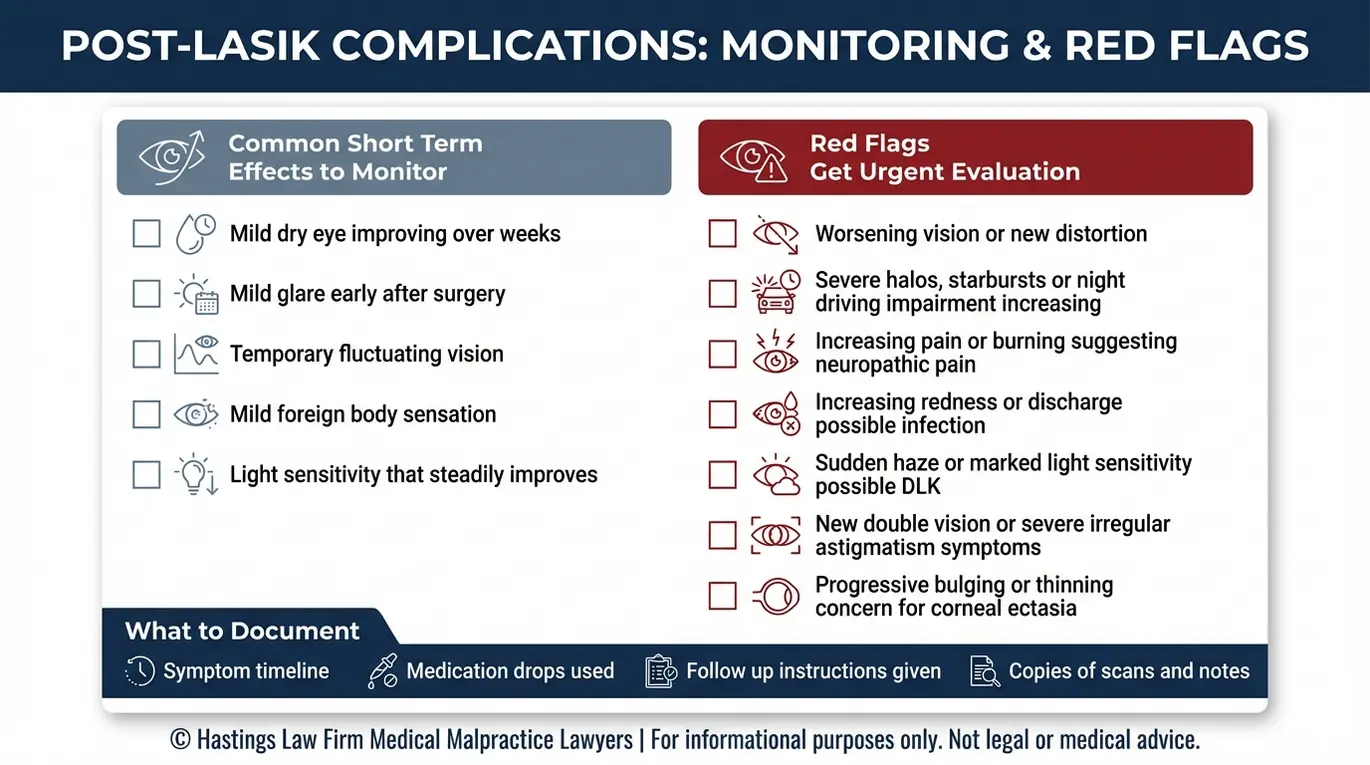
Serious complications from a failed LASIK procedure include corneal ectasia, chronic neuropathic pain, retinal detachment, and permanent visual distortions like halos or starbursts. Not every uncomfortable side effect after surgery signals malpractice, but certain symptoms indicate a preventable failure in clinical care.
Distinguish between temporary side effects and signs of lasting injury. Mild dry eyes and sensitivity to light in the first few weeks after LASIK are common and usually resolve. The complications below are different. They often indicate a failure in screening, surgical technique, or follow-up care.
Symptoms that may indicate a serious complication:
- Progressively worsening vision after an initial period of improvement
- Severe, persistent dry eyes that do not respond to treatment
- Halos, starbursts, or glare that make night driving dangerous
- Double vision or ghosting in one or both eyes
- Eye pain that does not subside weeks after surgery
- Diagnosed corneal ectasia (keratectasia), a condition where the cornea progressively thins and bulges outward after surgery, distorting vision
- Diffuse lamellar keratitis (DLK), an inflammatory condition that can cause scarring if not treated immediately
- Epithelial ingrowth, where cells from the cornea’s outer layer grow beneath the surgical flap, causing irritation, blurred vision, and potential tissue damage
Corneal ectasia is one of the most devastating outcomes of negligent LASIK. It typically occurs when surgery is performed on a cornea that was already too thin or structurally weak. This condition is progressive, meaning vision continues to deteriorate over time, leading to severe vision loss or even blindness, and it often requires corneal transplant surgery.
The impact of these injuries goes well beyond a prescription change. Patients may lose the ability to drive at night, work on a computer for extended periods, or perform their jobs. The National Eye Institute Refractive Error Quality of Life Instrument (NEI RQL-42) is one tool used to measure how refractive complications affect daily functioning and overall quality of life. A malpractice lawyer for LASIK injuries can use this type of evidence to demonstrate the full scope of harm you have experienced.
Proving Liability and the Affidavit of Merit
Arizona law requires a Preliminary Expert Opinion Affidavit to be served with the plaintiff’s initial disclosure statement, certifying that a qualified medical expert believes negligence occurred. In medical malpractice, proving liability means showing that a healthcare provider failed to meet the accepted standard of care.
To build a successful case, we must establish the four elements of negligence. First, there must be a duty, meaning the surgeon owed you a professional obligation to provide competent care. Second, we must show a breach of that duty, which means the care you received fell below the accepted standard. Third, causation requires proof that the breach directly caused your injury. And fourth, we must document the damages you suffered as a result.
The expert opinion affidavit is a critical step in this process. Arizona requires that a qualified medical professional, typically a board-certified ophthalmologist, review the facts of the case and provide a sworn statement that the care delivered was, in their opinion, negligent. This step is essential to meeting the burden of proof required in medical malpractice litigation. The Arizona Supreme Court addressed the requirements and implications of this affidavit in *Francisco v. Affiliated Urologists*, reinforcing its role as a threshold requirement for filing.
One question we hear often is whether signing an informed consent form before surgery prevents a patient from bringing a claim. The answer is no. Informed consent acknowledges the known risks of a procedure, but it does not give a surgeon permission to be negligent. If the doctor operated on someone who should have been screened out, or if the risks specific to your eye anatomy were never properly explained, that consent form may not shield the provider from liability.
Our firm retains qualified expert witness testimony early in the process, and as your Arizona LASIK Center Malpractice Lawyer, we handle every step of meeting this filing requirement.
Recoverable Damages for Vision Loss
Patients harmed by negligent eye surgery can recover compensation for corrective procedures like corneal cross-linking (CXL), a treatment that strengthens the cornea by stiffening its collagen fibers, as well as lost wages, and non-economic damages for the ways the injury has changed their daily life. Economic damages are the financial costs related to your injury, while non-economic damages cover your pain and suffering.
Economic damages may include:
- The cost of corrective surgeries or ongoing treatment
- Specialty vision correction devices such as scleral lenses, large rigid contact lenses that vault over the damaged cornea to restore functional vision
- Lost income if vision loss affects your ability to work
- Future medical care expenses, including the cost of long-term monitoring
Non-economic damages account for the personal toll of the injury:
- Chronic pain and suffering
- Depression, anxiety, or emotional distress
- Loss of enjoyment of life, such as the inability to drive at night, read comfortably, or participate in activities you once valued
- The ongoing frustration of living with visual distortions that affect every waking moment
In cases involving severe vision loss or blindness, a Life Care Planner may be brought in to calculate the full cost of future care, adaptive technology, and support services over the course of a lifetime. These projections ensure that settlements or verdicts adequately cover the long-term reality of living with a permanent visual impairment. A lawyer for laser eye surgery malpractice works closely with medical and financial experts to present the complete picture of what your injury will cost, both now and in the years ahead.
Arizona Statute of Limitations for Eye Injury Claims
In Arizona, medical malpractice claims must generally be filed within two years from the date the injury occurred or was discovered, but strict exceptions can affect your deadline. This timeline is known as the statute of limitations, which is a legal deadline for filing a lawsuit.
The standard filing window is established under A.R.S. § 12-542, which sets a two-year statute of limitations for personal injury claims, including those based on medical negligence. Missing this deadline typically means losing the right to bring a legal action, regardless of the strength of your case. Courts strictly enforce these time limits, which is why establishing the correct starting date for your claim is a pivotal part of the legal process.
The Discovery Rule is especially relevant in LASIK cases. Some complications, like corneal ectasia, may not appear until months or even years after surgery. The discovery rule allows the statute of limitations clock to start when the patient knew, or reasonably should have known, that the injury occurred and that it may have been caused by negligence. This rule can be the difference between having a valid claim and being time-barred.
⚠ Do not delay in preserving your medical records. Under 45 CFR § 164.524, you have a federal right to access your protected health information. Request copies of your pre-operative evaluations, surgical records, and post-operative notes as soon as possible. These documents are the foundation of any malpractice investigation, and obtaining them early helps protect against loss or alteration.
Even if your LASIK procedure was several years ago, your claim may still be viable under the discovery rule. An Arizona LASIK Center Malpractice Lawyer at our firm can review your timeline and determine whether you are still within the filing window.
Contact the Arizona Healthcare Malpractice Attorneys at Hastings Law Firm Today for Help
If a high-volume eye center compromised your vision, you do not have to face the process of getting answers alone. Hastings Law Firm focuses exclusively on medical malpractice, and our team includes in-house medical professionals, former defense attorneys, and a national network of ophthalmology experts who know how to evaluate LASIK negligence claims.
Our staff includes nurse consultants and former hospital defenders who use their insider knowledge to investigate surgical protocols and hospital policies. As your Arizona LASIK Center Malpractice Lawyer, we handle every aspect of the investigation, from obtaining and analyzing your surgical records to retaining the expert testimony Arizona requires. You pay no fees unless we recover compensation for you.
Contact our firm today for a free, confidential case evaluation. A LASIK negligence attorney on our team can review what happened, explain your legal options, and help you take the first step toward accountability.
Frequently Asked Questions About LASIK Center Malpractice in Arizona


This content was researched and written by the Hastings Law Firm editorial team, which includes attorneys, medical professionals, and experienced researchers. Our writing is informed by internal knowledge and practical experience, and we cross-check critical details against authoritative sources cited throughout. Every piece undergoes human-led fact-checking and legal review. Because legal and medical information can change, if you spot an error, please contact us. Learn more about our content standards and review process on our editorial policy page.

Tommy Hastings, founder of Hastings Law Firm, is a board-certified personal injury trial lawyer dedicated exclusively to healthcare injury cases. Since 2001, he has represented injured patients and families in litigation against major hospital systems, pharmaceutical companies, and negligent healthcare providers nationwide. He has handled numerous high-profile cases that have drawn national media attention and resulted in multi-million dollar recoveries. He draws on that experience in his writing, helping readers understand how these cases work and what options may be available to them.
