


Arizona Labor & Delivery Handoff Failure Lawyer
Obstetric communication failures during labor and delivery can leave families facing lifelong consequences when critical information is lost during a shift change. Breakdowns in handoffs can delay recognition of fetal distress, disrupt medication management, and slow urgent interventions, which can lead to serious birth injuries and long term care needs. Understanding how handoff errors happen, who may be responsible, and what evidence can show a breakdown in care can help families make informed decisions after a traumatic outcome. If you or a loved one were harmed or worse due to labor and delivery handoff failures in Arizona, contact Hastings Law Firm for a free, confidential case review.

Last Updated: July 27, 2026
Justice for Arizona Families Affected by Obstetric Communication Failures
When a baby is harmed during labor and delivery, the shock and grief can feel overwhelming. For many Arizona families, the injury traces back to something that should never have happened: a breakdown in communication between medical staff during a shift change. Critical details about fetal distress, a condition where the baby shows signs of not tolerating labor well, or oxygen deprivation (birth hypoxia), when reduced blood or oxygen flow threatens the baby’s brain, can be lost in the transition between providers. If you suspect a handoff failure contributed to your child’s birth injury, you are not wrong to ask questions.
As an Arizona labor and delivery handoff failure lawyer, Hastings Law Firm focuses exclusively on medical malpractice. Founded by Tommy Hastings, a board-certified trial lawyer, we handle cases with a trial-ready philosophy to ensure full accountability. Our team, acting as your dedicated Phoenix birth injury attorney, works with in-house nurses and medical consultants to investigate claims as a specialized obstetric negligence law firm across the state. If your family has been affected, a qualified birth trauma lawyer can review what happened and explain your legal options in a free, confidential consultation.

What Constitutes a Labor and Delivery Handoff Failure
A labor and delivery handoff failure occurs when critical patient information, such as signs of fetal distress or medication history, is not accurately communicated between outgoing and incoming medical staff during a shift change, resulting in preventable injury.
A patient handoff, the structured transfer of care responsibility from one provider to the next, is a critical safety checkpoint. In labor and delivery units, these transitions typically happen during nursing shift changes (often at 7 AM and 7 PM) or when an attending OB/GYN rotates off duty. A shift-change negligence lawyer in Arizona understands that the standard of care, meaning the level of treatment a reasonably competent provider would deliver, requires that every handoff include a complete and accurate briefing.
Most hospitals adopt standardized communication tools like the SBAR protocol (Situation, Background, Assessment, Recommendation) to organize these briefings. SBAR gives the incoming provider a snapshot of what is happening and what needs to happen next. When this framework is followed, the incoming team can continue care without interruption. However, a handoff failure attorney knows that in high-stress environments, information can degrade quickly.
Think of it as a high-stakes relay race where the baton gets lighter with each pass. An outgoing nurse may mention a concerning fetal heart rate pattern verbally but fail to document it in the medical records. If a key detail is lost, it can lead to medical malpractice regarding communication.
Key elements that should be communicated during every labor and delivery handoff:
- Current fetal heart rate patterns and any prior episodes of distress
- All medications administered, including dosages and timing
- Labor progression and any complications observed
- Outstanding orders or recommendations from the attending physician
- The patient’s relevant medical history, including risk factors
When any of these details are omitted, delayed, or distorted, the duty of care owed to both mother and baby may be breached, making the help of a handoff failure lawyer necessary.

Common Communication Errors During Shift Changes
Common errors include failing to mention concerning fetal heart rate patterns, omitting recent medication details like Pitocin dosage, or failing to relay the urgency of a recommended C-section during the transfer of care.
The period surrounding a shift change is one of the most vulnerable windows in labor and delivery. Monitoring may lapse as one team wraps up documentation while the next is still getting oriented. In those minutes, a deteriorating situation can go unnoticed. An Arizona birth injury lawyer often sees cases where oxygen deprivation during this gap leads to brain injury or cerebral palsy.
Specific communication errors our obstetric malpractice attorneys evaluate include:
- Unreported fetal monitoring changes. Electronic fetal monitoring (EFM), the continuous recording of the baby’s heart rate during labor, may show late or variable decelerations that the outgoing nurse recognized but did not clearly convey. The incoming nurse, seeing no documented concern, may not escalate care.
- Medication errors from incomplete charting. Pitocin (a synthetic form of oxytocin used to induce or augment labor) requires careful dosing. If the outgoing nurse does not chart the last dose, the incoming nurse may use a double-dose, causing dangerously strong contractions.
- Delayed emergency interventions. When an outgoing provider identifies the need for an emergency cesarean section (emergency C-section), a surgical delivery performed when immediate action is required, but does not effectively communicate that assessment, the incoming doctor may spend valuable time re-evaluating. A delivery room negligence lawyer can help identify if those lost minutes caused permanent injury.
Systemic Hospital Failures Contributing to Negligence
Hospital negligence involves a facility failing to follow proper safety standards, which can put patients at risk. Individual errors often reflect deeper institutional problems. When a hospital fails to enforce standardized handoff protocols, suffers from understaffing that prevents thorough shift transitions, or creates scheduling pressures that rush communication, hospital negligence may be the root cause. An Arizona obstetric malpractice attorney can investigate whether a hospital’s policies, or the absence of them, contributed to the breakdown in care.
The Hastings Law Firm Difference
Results matter, but what truly sets us apart is how we achieve them. Every verdict, every settlement, and every Arizona courtroom victory comes from one guiding promise: To treat each client’s fight for justice as if it were our own.
This balance of skill, experience, and empathy reflects our core philosophy that justice should not only compensate the injured, but also make health care safer nationwide.

Liability for Miscommunication Among Hospitals and Doctors
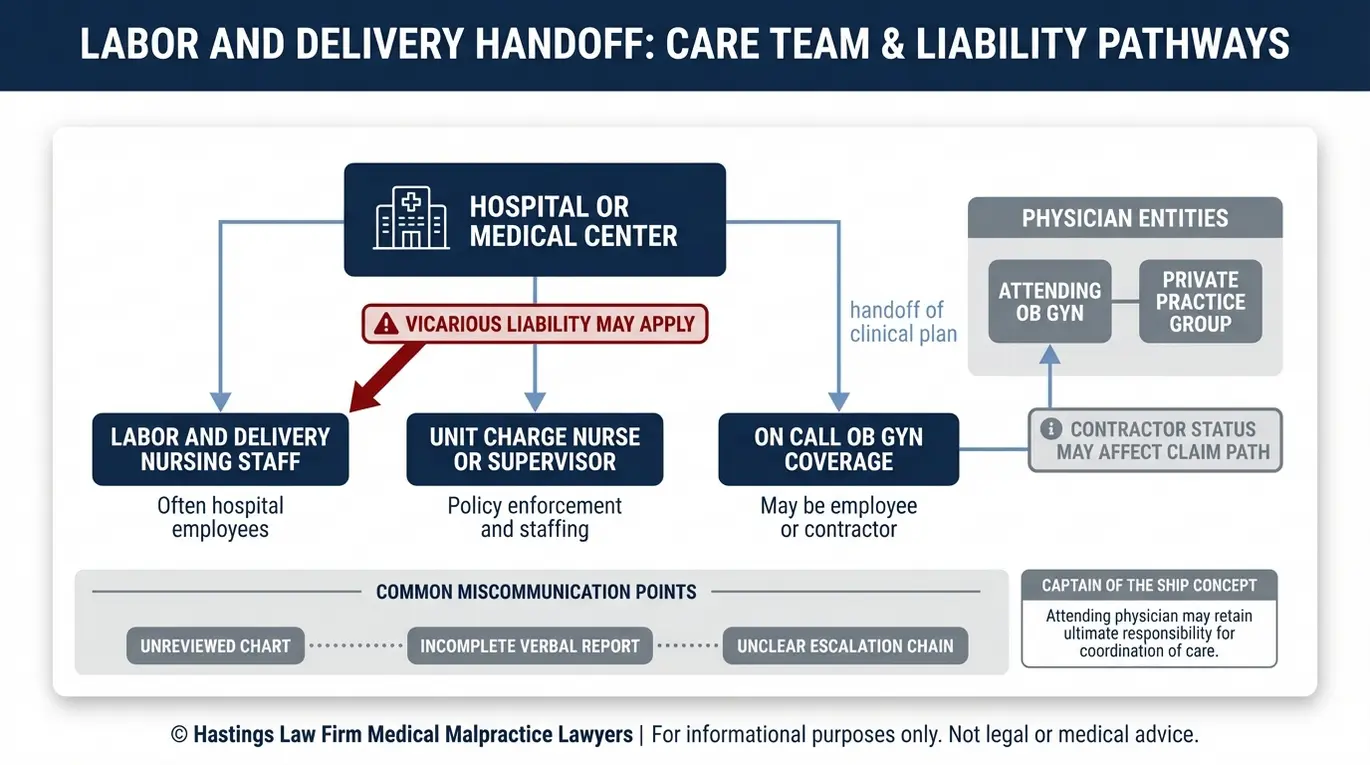
Liability can extend to the hospital for inadequate staffing or protocols, the attending OB/GYN for failing to review the chart, and the nursing staff for incomplete verbal reports.
In Arizona, hospitals are generally liable for the negligence of their employees under vicarious liability. If a labor and delivery nurse fails to provide a complete handoff regarding conditions like preeclampsia, sepsis, or maternal hemorrhage, a hospital negligence lawyer can help hold the facility responsible.
The analysis becomes more detailed when the physician is an independent contractor. Many OB/GYNs maintain privileges at a hospital but are not directly employed by it. Arizona courts have examined this distinction, and as the Arizona Supreme Court addressed in *Laurence v. Salt River Project Agricultural Improvement and Power District*, the nature of the relationship determines where liability falls.
The attending physician also carries an independent duty. Regardless of what information the nursing staff provides, the doctor has a responsibility to review the patient’s chart, assess EFM data, and form their own clinical judgment. When an attending OB/GYN relies solely on an incomplete verbal report without examining the medical records, a doctor malpractice attorney Arizona can pursue a separate negligence claim. Establishing liability for handoff errors against each responsible party is essential for full recovery.
Proving Negligence in Obstetric Handoff Cases
Proving negligence requires a thorough audit of medical records to identify discrepancies between the patient’s condition and what was documented or communicated during the shift change, often supported by expert testimony to establish causation.
The foundation of proving medical malpractice in handoff cases is the documentary evidence. Our team examines:
- EHR audit trails, the electronic health record’s metadata that logs exactly when a chart was opened, edited, or accessed by each provider, to establish who knew what and when
- Electronic fetal monitoring strips to identify signs of distress, such as fetal heart rate decelerations (sudden drops in heart rate that may indicate oxygen compromise)
- Nursing shift logs and verbal report documentation to compare what was recorded against what actually occurred
- Staffing schedules to assess whether systemic issues contributed to the failure
Under federal law, patients and families have the right to access their health information, as outlined in 45 CFR § 164.524 by the U.S. Department of Health and Human Services. Obtaining complete birth injury evidence early is essential, particularly because research published by PubMed Central on communication failures in inpatient maternity care has documented how handoff breakdowns contribute to preventable harm.
We look for discrepancies: “Nurse A” documented a concerning finding like brachial plexus risk factors, but “Nurse B” was unaware. Qualified experts then review the evidence to establish that the standard of care was breached. Contacting an Arizona labor and delivery attorney immediately ensures this evidence is preserved.

Recoverable Damages for Birth Injuries Caused by Communication Failures
Families may recover damages for past and future medical expenses, lifetime care costs, pain and suffering, and lost earning capacity depending on the severity of the injury.
Families seeking compensation for birth injury generally find damages fall into two categories:
| Economic Damages | Non-Economic Damages |
|---|---|
| Past and future medical bills | Pain and suffering |
| Surgeries and hospitalizations | Emotional distress |
| Physical and occupational therapy | Loss of enjoyment of life |
| Specialized equipment and home modifications | Loss of consortium (for parents) |
| Lifetime nursing or attendive care | Diminished quality of life |
| Lost future earning capacity |
For injuries like brain injury, shoulder dystocia, or Erb’s palsy (a brachial plexus injury affecting the nerves of the arm and shoulder), the lifetime cost of care can be substantial. Understanding damages in Arizona malpractice cases is important because the state Constitution prohibits placing caps on damages for personal injury or death. This means juries can award full compensation for both economic and non-economic losses, ensuring families have the resources to provide for their child’s future.
Contact the Arizona Birth Injury Attorneys at Hastings Law Firm Today for Help
Hastings Law Firm was founded on the belief that holding negligent providers accountable protects not only your family but future patients as well. When a hospital’s communication failures cause a preventable birth injury, families deserve both the truth about what happened and the financial security to move forward.
Arizona’s statute of limitations imposes strict deadlines for filing a medical malpractice claim. While cases involving minors may have different tolling rules, evidence like shift logs, EFM strips, and staffing records can deteriorate or disappear over time. The sooner an investigation begins, the stronger the case.
Our initial case evaluation is free and confidential, and you pay no attorney fees or costs unless we recover compensation for your family. If you believe a handoff failure during labor and delivery injured your child, contact the Phoenix office of Hastings Law Firm to start the investigation. Let us help you find the answers you deserve.
Frequently Asked Questions About Labor & Delivery Handoff Failure in Arizona


This content was researched and written by the Hastings Law Firm editorial team, which includes attorneys, medical professionals, and experienced researchers. Our writing is informed by internal knowledge and practical experience, and we cross-check critical details against authoritative sources cited throughout. Every piece undergoes human-led fact-checking and legal review. Because legal and medical information can change, if you spot an error, please contact us. Learn more about our content standards and review process on our editorial policy page.

Tommy Hastings, founder of Hastings Law Firm, is a board-certified personal injury trial lawyer dedicated exclusively to healthcare injury cases. Since 2001, he has represented injured patients and families in litigation against major hospital systems, pharmaceutical companies, and negligent healthcare providers nationwide. He has handled numerous high-profile cases that have drawn national media attention and resulted in multi-million dollar recoveries. He draws on that experience in his writing, helping readers understand how these cases work and what options may be available to them.
