


Arizona Kernicterus Malpractice Lawyer
Kernicterus is a form of permanent infant brain damage linked to dangerously high bilirubin levels from untreated severe jaundice. The condition is described as largely preventable when newborns receive timely screening, careful monitoring, and appropriate treatment. When warning signs are missed or established protocols are not followed, families can face lifelong medical needs, therapy demands, and major changes to daily life. Clear information about screening, treatment, and common breakdowns in care can help families make sense of what happened. If you or a loved one were harmed or worse due to kernicterus malpractice in Arizona, contact Hastings Law Firm for a free, confidential case review.

Last Updated: July 27, 2026
Dedicated Legal Representation for Infant Brain Injury Cases in Arizona
When a newborn suffers brain damage from untreated jaundice, the emotional weight on a family is enormous. You may feel confused, overwhelmed, and unsure whether what happened to your child should have been prevented. Those feelings are valid, and you deserve clear answers.
Kernicterus is a form of permanent brain damage caused by dangerously high bilirubin levels in a newborn’s blood. In almost every case, it is preventable with timely screening and treatment. When medical providers fail to follow established protocols, families are left carrying the consequences for a lifetime.
As an Arizona Kernicterus Malpractice Lawyer, Hastings Law Firm focuses exclusively on medical malpractice. Our team does not divide its attention among unrelated areas of law; the entire staff is focused solely on medical negligence litigation. Our team of attorneys, nurse consultants, and medical experts is prepared to investigate what happened during your child’s care and help you understand your legal options. If you believe your child was harmed by a failure to treat jaundice, we welcome the opportunity to review your case in a free, confidential evaluation.

Understanding Kernicterus and Preventable Brain Damage
Kernicterus is a rare but preventable type of brain damage that occurs in newborns with severe jaundice when high levels of bilirubin cross the blood-brain barrier. Kernicterus is the specific term for permanent brain damage caused by excessive jaundice. Bilirubin is a yellow substance the body produces when it breaks down red blood cells. In healthy newborns, the liver processes bilirubin and removes it. But when bilirubin builds up faster than a baby’s body can handle, it can reach toxic levels and cause lasting harm.
The progression from common jaundice to permanent injury typically follows a predictable path:
- Jaundice (common): Most newborns develop some degree of yellowing in the first few days of life. This is usually mild and resolves on its own or with simple treatment.
- Hyperbilirubinemia (dangerous): When bilirubin levels rise beyond a safe threshold, the condition is called hyperbilirubinemia, meaning abnormally high bilirubin in the blood. At this stage, medical intervention is necessary to bring levels down.
- Acute Bilirubin Encephalopathy (urgent): If hyperbilirubinemia goes untreated, bilirubin can begin crossing into the brain, causing acute encephalopathy, a condition marked by neurological symptoms such as extreme sleepiness, difficulty feeding, and muscle tone changes.
- Kernicterus (permanent): Without emergency treatment, the damage becomes irreversible. Kernicterus, sometimes referred to as chronic bilirubin encephalopathy, causes lifelong neurological disabilities including cerebral palsy, hearing loss, vision problems, and intellectual impairment.
What makes kernicterus so devastating is that it should not happen with competent medical care. The screening tools exist. The treatments are well established.
According to a detailed review published by PubMed Central on Bilirubin Induced Encephalopathy, the medical community has long understood the mechanisms by which unconjugated bilirubin damages brain tissue. When a newborn still develops kernicterus, it often points to a breakdown in the standard of care. A Kernicterus malpractice attorney in Arizona can help determine whether your child’s providers missed the warning signs or failed to act on them.

Recognizing the Warning Signs of Severe Jaundice
Early signs of worsening jaundice include yellowing of the skin spreading to the abdomen and legs, lethargy, high-pitched crying, poor feeding, and arching of the back. Prompt identification of these signs is necessary to stop the progression of jaundice to brain injury.
According to the Centers for Disease Control and Prevention’s overview of jaundice and kernicterus, parents and providers should watch for a specific set of warning signs. When bilirubin begins affecting the brain, the condition is called acute bilirubin encephalopathy (ABE), the early and potentially reversible stage of brain injury from toxic bilirubin levels. If ABE progresses without treatment, it becomes chronic bilirubin encephalopathy (CBE), which refers to the permanent neurological damage known as kernicterus.
Red flag symptoms that may indicate dangerous bilirubin levels include:
- Yellowing of the skin that spreads below the chest to the abdomen, arms, and legs
- Extreme sleepiness or difficulty waking the baby
- A high-pitched, inconsolable cry
- Poor feeding or refusal to latch
- Arching of the back or neck (a neurological sign)
- Weak or floppy muscle tone
- Seizures
The long-term consequences of untreated severe jaundice can be profound. Children who develop kernicterus may live with cerebral palsy, permanent hearing loss, abnormal eye movements, and significant developmental delays. These outcomes affect every aspect of a child’s life and require ongoing medical care, therapy, and support.
If your baby showed any of these symptoms and medical staff described them as “normal” or did not act on them, an Arizona infant jaundice lawyer can review the medical records and help determine whether the care your child received met the expected standard.

The Hastings Law Firm Difference
Results matter, but what truly sets us apart is how we achieve them. Every verdict, every settlement, and every Arizona courtroom victory comes from one guiding promise: To treat each client’s fight for justice as if it were our own.
This balance of skill, experience, and empathy reflects our core philosophy that justice should not only compensate the injured, but also make health care safer nationwide.

Standard of Care for Bilirubin Screening and Treatment
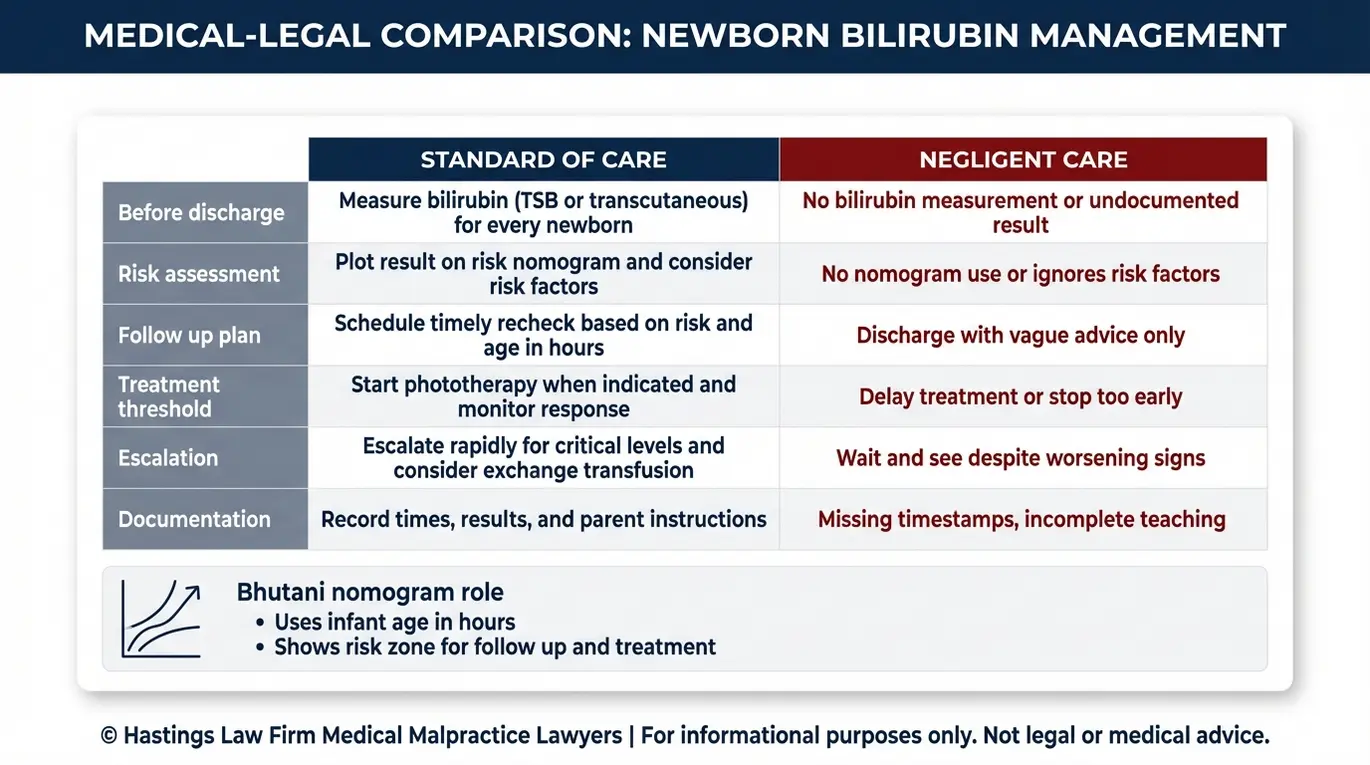
The standard of care requires hospitals to screen all newborns for bilirubin levels before discharge using total serum bilirubin (TSB) or transcutaneous testing and to plot results on a risk nomogram to determine follow-up needs. The standard of care refers to the clinical rules that medical providers must follow to ensure newborn safety. TSB, a blood test that measures the exact amount of bilirubin in the blood, provides precise data when skin tests are inconclusive.
The American Academy of Pediatrics (AAP) updated its clinical guidelines for the management of neonatal hyperbilirubinemia to reinforce universal screening and evidence-based treatment thresholds. These guidelines represent the national benchmark for newborn jaundice management.
A central tool in this process is the Bhutani Nomogram, a chart that plots a baby’s bilirubin level against their age in hours. The nomogram categorizes the baby into risk nomogram zones (low, low-intermediate, high-intermediate, or high), which then guide the provider’s decisions about monitoring, treatment, and safe discharge timing. As explained in educational resources from the University of Texas Medical Branch (UTMB) on physiologic hyperbilirubinemia, this nomogram is a fundamental clinical tool that providers are expected to use.
When bilirubin levels cross treatment thresholds, two primary interventions are available. Phototherapy uses specialized lights to break down bilirubin in the baby’s skin so it can be excreted. In critical cases where phototherapy is not enough, an exchange transfusion may be required. This procedure replaces the baby’s blood to rapidly lower bilirubin levels.
| Standard of Care | Negligent Care |
|---|---|
| Screen all newborns for bilirubin before discharge | Discharge without bilirubin testing |
| Plot TSB results on the Bhutani Nomogram | Fail to use or misread the nomogram |
| Initiate phototherapy at guideline thresholds | Delay or withhold phototherapy |
| Schedule follow-up within 24 to 48 hours for at-risk infants | No follow-up appointment arranged |
| Escalate to exchange transfusion when indicated | Ignore rising levels or delay escalation |
| Assess and document risk factors (blood type incompatibility, prematurity, bruising) | Overlook known risk factors |
A case study published by PubMed analyzing multiple missteps and system failures leading to kernicterus in two infants illustrates how breakdowns at several points in the care chain can lead to devastating outcomes. An Arizona birth injury attorney can evaluate whether your child’s providers followed these protocols or deviated from them.
A.R.S. § 12-542, as published by the Arizona Legislature, sets time limits for filing a medical malpractice claim. We address those deadlines in a later section. As a malpractice lawyer for kernicterus cases, our team at Hastings Law Firm knows exactly where to look in the medical records for evidence of these failures.
Common Medical Errors Leading to Kernicterus
Medical negligence often occurs when providers fail to measure bilirubin levels, misinterpret lab results, delay phototherapy, or discharge an infant too early without arranging proper follow-up. Medical errors in these cases often involve a failure to follow established safety protocols for bilirubin management. Kernicterus is a preventable brain injury caused by high bilirubin levels. These errors are not rare or unforeseeable events but are well-documented failures that directly contradict established standard of care guidelines.
Common errors we investigate in kernicterus cases include:
- Failure to screen before discharge: Sending a newborn home without checking bilirubin levels, especially when risk factors like prematurity or bruising are present.
- Misreading or ignoring lab results: A provider may receive a TSB result in the high-risk zone and fail to initiate treatment, resulting in a failure to treat, or neglect to escalate care to an exchange transfusion.
- Delayed or inadequate phototherapy: Starting light therapy too late, using the wrong intensity, or placing the baby too far from the light source can allow bilirubin to continue rising.
- Phototherapy interruption: Stopping treatment before bilirubin has dropped to a safe and stable level is a specific and documented error. Bilirubin can rebound quickly once phototherapy is discontinued prematurely.
- Early discharge without follow-up: Discharging a baby before 48 hours of age without scheduling a follow-up bilirubin check within 24 to 48 hours is a recognized gap in care.
- Failure to account for risk factors: Conditions such as ABO incompatibility, Rh incompatibility, cephalohematoma (a collection of blood under the scalp from delivery), and dehydration from poor feeding all increase the risk of dangerous hyperbilirubinemia. When providers overlook these factors, they may underestimate the severity of the situation.
- System failures: Lab reporting errors, computer glitches that mask critical values, or communication breakdowns between nursing staff and physicians can all contribute to a misdiagnosis or failure to diagnose.
An Arizona medical malpractice lawyer with experience in birth injury cases understands how to identify these errors in the medical records. At Hastings Law Firm, our in-house nursing staff and medical consultants review charting, lab data, and nursing notes to reconstruct what happened hour by hour. A Kernicterus lawsuit in Arizona often hinges on proving that a timely intervention, one that the standard of care required, would have prevented the brain damage.
Establishing Liability in Arizona Hospitals
Liability for kernicterus may extend to the attending pediatrician, neonatal nurses, the hospital for unsafe discharge policies, or laboratories for reporting errors. Liability is the legal responsibility a provider has for injuries caused by negligence. Identifying the liable parties requires a careful review of who was involved in the baby’s care and where the breakdown occurred.
Doctor negligence in kernicterus cases often involves clinical decision-making failures: not ordering a bilirubin test, misinterpreting the Bhutani Nomogram, or failing to escalate treatment when levels continued to rise. Nursing negligence, on the other hand, may involve failures in monitoring and reporting. Nurses are often the first to observe changes in a newborn’s condition, and a delay in communicating concerns to the physician can be just as harmful as the physician’s failure to act.
Hospital negligence may involve systemic failures. Inadequate staffing, broken or poorly maintained phototherapy equipment, lack of standardized screening protocols, and gaps in discharge procedures are institutional problems that can directly contribute to a preventable injury. In Arizona’s major hospital systems, including those across Phoenix and Tucson, we evaluate whether facility-level policies met the accepted standard of care.
When suing a hospital for kernicterus, vicarious liability may also apply. This legal principle holds a hospital responsible for the negligent actions of its employees, including nurses and on-staff physicians, who were acting within the scope of their duties. Our team includes former defense attorneys and experienced hospital nurses who previously worked for the systems they now challenge. This background helps us anticipate defense tactics and identify charting inconsistencies.
Recovering Compensation for Lifelong Care
Families may recover economic damages for past and future medical care, therapy, and specialized equipment, as well as non-economic damages for pain, suffering, and loss of quality of life. Recovering compensation helps provide for the lifelong needs of a child with brain damage. When a newborn is injured by jaundice, the financial burden can last a lifetime because kernicterus causes permanent brain damage.
One of Arizona’s most important legal protections for injured patients is found in the state constitution. Unlike many states that impose caps on what injured patients can recover, Arizona’s Constitution explicitly prohibits the legislature from limiting damages in personal injury and wrongful death cases. Article 2, Section 31 preserves the right to full compensation, meaning there is no artificial ceiling on what a jury can award your family.
To accurately project the future medical costs of caring for a child with kernicterus-related disabilities, attorneys and medical experts develop a Life Care Plan. This document outlines every anticipated medical need over the child’s lifetime, including:
- Ongoing physical, occupational, and speech therapy
- Hearing aids, cochlear implants, and audiological care
- Specialized educational support and tutoring
- Adaptive equipment such as wheelchairs, communication devices, and home modifications
- 24-hour attendant care or assisted living for severe cases
- Prescription medications and regular specialist visits
- Future surgeries or medical procedures
Non-economic damages account for the suffering that cannot be measured with a receipt: the child’s pain, the loss of experiences and milestones, and the emotional toll on the entire family. These damages are deeply personal and often represent the largest portion of a kernicterus recovery.
As an Arizona Kernicterus Malpractice Lawyer, Hastings Law Firm works with nationally recognized medical experts and life care planners to build a full picture of what your family will need. Compensation for kernicterus must reflect not just today’s costs but the decades of care ahead.
Arizona Statute of Limitations for Birth Injuries
Arizona law generally requires medical malpractice claims to be filed within two years of the injury, but specific tolling rules apply to minors that may extend this deadline. A statute of limitations is a legal deadline that limits how long you have to file a lawsuit. These claims often involve injuries like kernicterus and require a detailed investigation.
Under A.R.S. § 12-542, the standard statute of limitations for medical malpractice in Arizona is two years. For most adults, the clock begins running on the date the injury occurs or, under what is known as the discovery rule, on the date the patient knew or reasonably should have known that the injury was caused by negligence.
For minors, the timeline can be different. Arizona law includes tolling provisions that may pause the statute of limitations until the child reaches a certain age. However, these rules involve legal details that vary depending on the specific circumstances of the case.
Regardless of any potential tolling, families should not wait to explore their legal options. Medical records can be altered or lost. Witnesses’ memories fade. Equipment logs may be overwritten. The sooner an investigation begins, the stronger the evidence will be. An Arizona birth injury statute of limitations question is best answered by an attorney who can review the specific facts and confirm the applicable filing deadline for your family.
*This information is for educational purposes and does not constitute legal advice. Contact an attorney to discuss the deadlines that apply to your situation.*
Contact the Arizona Birth Injury Attorneys at Hastings Law Firm Today for Help
Your child’s diagnosis may have left you with more questions than answers. You may be wondering whether what happened was preventable, whether someone should be held accountable, and what options exist to secure your child’s future care. Those are the exact questions we are here to help you answer.
Founded by board-certified trial attorney Tommy Hastings, Hastings Law Firm is dedicated exclusively to medical malpractice litigation. Our legal team includes former defense attorneys, in-house nurse consultants, and a national network of medical experts. We bring those resources to every Arizona case because families dealing with kernicterus deserve the same level of preparation and commitment that hospitals bring to their own defense.
As an Arizona Kernicterus Malpractice Lawyer, our goal is twofold: to help your family recover the compensation needed for lifelong care, and to hold negligent providers accountable so this does not happen to another child.
We offer a free, confidential case evaluation, and you pay no attorney fees unless we recover compensation for your family. If you are ready to get answers, we are ready to listen.
Frequently Asked Questions About Kernicterus Malpractice in Arizona


This content was researched and written by the Hastings Law Firm editorial team, which includes attorneys, medical professionals, and experienced researchers. Our writing is informed by internal knowledge and practical experience, and we cross-check critical details against authoritative sources cited throughout. Every piece undergoes human-led fact-checking and legal review. Because legal and medical information can change, if you spot an error, please contact us. Learn more about our content standards and review process on our editorial policy page.

Tommy Hastings, founder of Hastings Law Firm, is a board-certified personal injury trial lawyer dedicated exclusively to healthcare injury cases. Since 2001, he has represented injured patients and families in litigation against major hospital systems, pharmaceutical companies, and negligent healthcare providers nationwide. He has handled numerous high-profile cases that have drawn national media attention and resulted in multi-million dollar recoveries. He draws on that experience in his writing, helping readers understand how these cases work and what options may be available to them.
