


Arizona IV Fluid Contamination Lawyer
Written by: Hastings Law Firm | Reviewed by: Tommy Hastings | Updated: July 27, 2026
Contaminated IV fluids can introduce harmful pathogens directly into the bloodstream, leading to sudden infections and life threatening complications. These events can leave patients and families facing extended hospitalization, invasive treatment, and lasting organ damage, while also raising concerns about where the contamination occurred. Causes may involve manufacturing defects, compounding pharmacy sterility failures, or unsafe handling during IV administration. If you or a loved one were harmed or worse due to IV fluid contamination in Arizona, contact Hastings Law Firm for a free, confidential case review.
Trusted Arizona Medical Attorneys for Contaminated IV Malpractice Claims
What You Should Know About Contaminated IV Malpractice Claims in Arizona:
- Life threatening infections can develop quickly when contaminated IV fluids enter the bloodstream.
- Responsibility can turn on where contamination occurred, such as manufacturing, compounding, or bedside handling.
- Long term harm can follow severe IV related infections, including permanent organ damage and prolonged recovery.
- Fatal outcomes are possible in severe cases, which can shift the claim toward wrongful death damages.
- Liability can depend on proving a breach of the standard of care and a direct link between the contamination and the infection.
- Recovery options can differ by source, since manufacturer claims may focus on product defect while hospital claims may focus on negligent acts or omissions.
- Case outcomes can hinge on traceability evidence, including lot numbers and hospital administration records.
- Causation disputes can be shaped by laboratory findings, including cultures and genetic matching of pathogens.
- Financial recovery can include medical expenses, lost income, and non economic harms tied to pain, suffering, and reduced quality of life.
- Key records can include infection control logs, incident reports, recall notices, and compounding sterility documentation.

A Healthcare Focused Law Firm
When intravenous (IV) fluids, the sterile solutions delivered directly into a patient’s bloodstream, are contaminated, the consequences can be sudden and severe. If you or someone in your family developed a serious infection after receiving IV therapy, you may be dealing with confusion, fear, and a growing sense that something went wrong during your care.
These cases are medically complex and deeply personal. At Hastings Law Firm, our team includes medical malpractice attorneys, in-house nurse consultants, and former defense lawyers. Tommy Hastings founded our firm in 2005 as a board-certified trial attorney to focus exclusively on medical negligence. As an experienced Arizona IV fluid contamination lawyer, our team understands how to trace the source of an infection and build a case that reflects the full scope of what happened.
If you suspect contaminated IV fluids caused harm, contact us for a free, confidential case evaluation. We can review what happened and explain your options.
Common Causes of Intravenous Fluid Contamination
IV fluid contamination typically occurs due to errors during the manufacturing process, improper sterilization at compounding pharmacies, or unsanitary handling by hospital staff. Each of these failures creates a different pathway for bacteria or other harmful agents to enter a patient’s body, and each one raises different legal questions about who is responsible.
Understanding where the breakdown happened is the first step in any contaminated IV case. Experienced lawyers for IV contamination often trace these errors back to the source during IV therapy administration or preparation. Here are the most common causes:
- Manufacturing defects: Bacteria or particulate matter can be introduced at the factory level during mass production. When this happens, entire batches of IV fluid may be affected, sometimes prompting an FDA or CDC recall. Contaminated IV attorneys frequently handle these product liability claims against the manufacturer.
- Compounding pharmacy errors: A compounding pharmacy is a facility that custom-mixes medications or IV solutions for individual patients. If staff fail to maintain aseptic technique, the strict sterilization protocols required to prevent microbial contamination, dangerous organisms can be introduced during preparation. An attorney for contaminated fluids will investigate the pharmacy’s history for prior violations.
- Bedside procedural negligence: Even properly manufactured fluids can become contaminated at the point of care. Staff who fail to sanitize IV ports, use non-sterile equipment, or improperly store solutions can introduce bacteria directly into the line. Arizona IV fluid contamination lawyers review hospital logs to identify these lapses. A CDC investigation into a *Burkholderia stabilis* outbreak linked infections to contaminated nonsterile ultrasound gel, illustrating how easily procedural lapses in a clinical setting can lead to widespread patient harm.
An Arizona IV fluid contamination lawyer can help determine which of these failures applies to your situation. Our team evaluates if the case involves a manufacturer defect, a compounding error, or hospital-level negligence.
Risks Associated with Total Parenteral Nutrition (TPN)
Total Parenteral Nutrition (TPN), a specialized liquid nutrition formula delivered intravenously to patients who cannot eat, presents a particularly high contamination risk. Because TPN solutions are rich in sugars, amino acids, and lipids, they create an ideal environment for bacterial infection and growth.
TPN must be prepared under strict compounding standards. Even small lapses in sterility during mixing can introduce organisms that multiply rapidly once the solution reaches body temperature. When contaminated TPN is administered, the infection enters the bloodstream immediately, bypassing every natural defense the body has. Cases involving contaminated TPN often require lawyers experienced in both medical malpractice and compounding pharmacy liability to identify exactly where the process failed.

Severe Injuries Caused by Contaminated IV Fluids
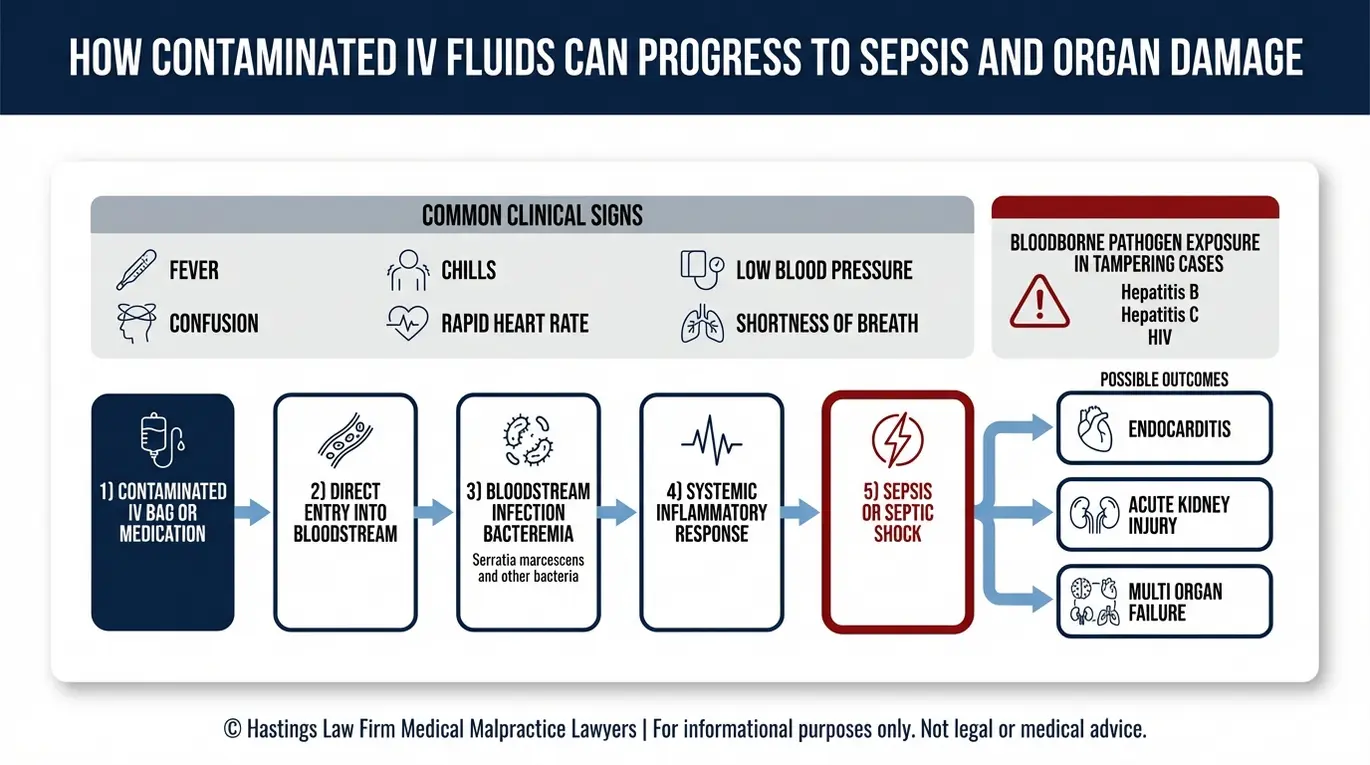
Contaminated IV fluids introduce dangerous pathogens directly into the bloodstream, rapidly causing life-threatening conditions such as sepsis, endocarditis, and organ failure. Because IV therapy bypasses the skin and digestive system, there is no barrier between the contaminant and the patient’s circulatory system. The body’s response can escalate within hours, creating a situation where IV infection lawyers recognize the urgency of immediate legal investigation.
A bloodstream infection, known medically as bacteremia, occurs when bacteria enter the blood. One pathogen frequently linked to contaminated fluid outbreaks is *Serratia marcescens*, a gram-negative bacterium that thrives in moist environments and is resistant to many common antibiotics. When a bacterial infection like this takes hold, patients can deteriorate quickly.
The CDC’s guidance on sepsis signs and symptoms outlines how rapidly the condition can progress. Consulting an attorney for contaminated fluids is often crucial for families facing these outcomes. Here is a summary of the injuries commonly seen in IV contamination cases:
| Condition | How It Develops | Potential Long-Term Impact |
|---|---|---|
| Sepsis / Septic shock | Bacteria trigger a systemic inflammatory response; organs begin to shut down | Permanent organ damage, amputation, death |
| Endocarditis | Bacteria settle on heart valves, causing infection and inflammation | Heart valve replacement, chronic heart failure |
| Chronic bloodstream infection | Persistent bacteremia resistant to initial antibiotic therapy | Prolonged hospitalization, repeated IV antibiotic courses |
| Hepatitis C / HIV transmission | Exposure through contaminated needles or tampered syringes | Lifelong antiviral treatment, liver damage |
For patients who survive these infections, the road to recovery is often long. Many face months of IV antibiotic therapy, multiple surgeries, and lasting damage to the heart, kidneys, or liver. Our lawyers for sepsis from IVs work with medical experts to document these hardships. An Arizona IV fluid contamination lawyer evaluates both the immediate and long-term medical consequences when building a claim handled by contaminated IV attorneys.
Syringe Swapping and Drug Tampering Risks
Not all contamination is accidental. Drug diversion, when a healthcare worker steals controlled substances and replaces them with saline or another substitute, represents a serious and underreported threat. Patients who receive tampered syringes may be exposed to bloodborne pathogens, infectious agents transmitted through blood such as Hepatitis B, Hepatitis C, or HIV.
These cases involve a different dimension of negligence. Hospitals and clinics have a duty to monitor controlled substance access and detect diversion patterns. When oversight systems fail, patients bear the consequences. Attorneys handling IV contamination cases investigate whether facility protocols for drug tracking and employee monitoring met the standard of care.
The Hastings Law Firm Difference
Results matter, but what truly sets us apart is how we achieve them. Every verdict, every settlement, and every Arizona courtroom victory comes from one guiding promise: To treat each client’s fight for justice as if it were our own.
This balance of skill, experience, and empathy reflects our core philosophy that justice should not only compensate the injured, but also make healthcare safer nationwide.

Proving Liability for Contaminated IV Injuries in Arizona
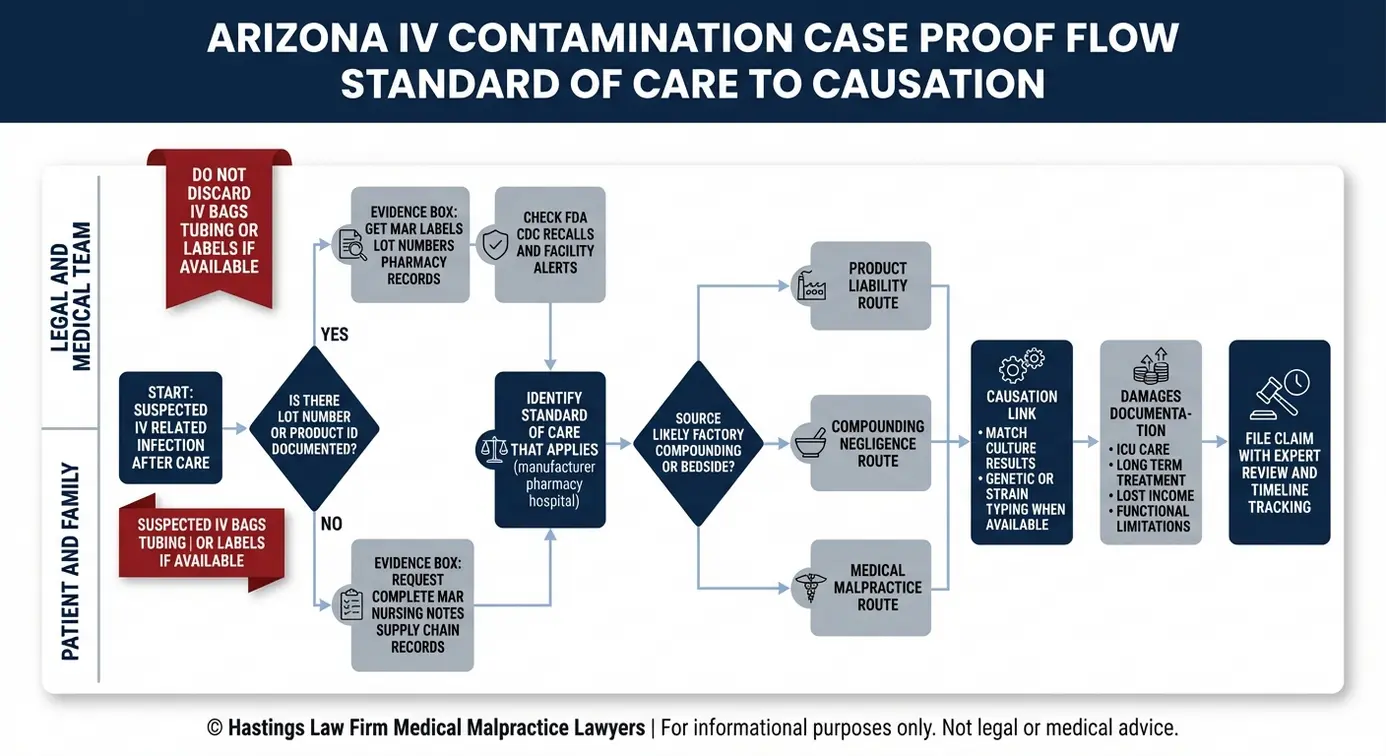
Establishing liability requires proving that a breach in the standard of care, whether by a manufacturer, pharmacy, or nurse, directly caused the patient’s infection and subsequent damages. Arizona law requires the same core elements for any medical malpractice claim: duty, breach, causation, and damages.
Under Arizona Revised Statutes § 12-561 et seq., a medical malpractice claim requires evidence that the provider failed to exercise the degree of care, skill, and treatment that a reasonably competent provider would have used under similar circumstances. In contaminated IV cases, this means identifying the specific safety protocol that was violated and demonstrating they failed to uphold their duty of care.
Causation is often the most challenging element that an IV malpractice attorney must demonstrate. Our team works to link a specific batch of fluid to the infection by tracing the medication lot number, the unique identifier assigned to a production batch, through hospital administration records.
Arizona IV fluid contamination lawyers can work with infectious disease specialists who use whole genome sequencing (WGS). This laboratory process maps the DNA of a bacterial strain to confirm if the pathogen in the patient matches the source. Contaminated IV attorneys establish this link to solidify the claim.
Here is a checklist of evidence a lawyer for fluid contamination typically examines in IV contamination claims:
- Medical records documenting the IV fluid administered, including type, time, and lot number
- Lab cultures and pathology reports identifying the specific bacteria or virus
- Hospital infection control logs and internal incident reports
- FDA and CDC recall notices related to the fluid or equipment used
- Compounding pharmacy preparation records and sterility testing logs
- Expert testimony from infectious disease specialists and nursing professionals
The legal theory may also differ depending on the source of contamination. Product liability claims against a manufacturer can involve strict liability, meaning the focus is on whether the product was defective rather than whether someone was negligent. Claims against a hospital or nurse, by contrast, require proof of a specific negligent act or omission. Skilled lawyers for IV contamination determine which legal theories apply and which parties should be held accountable.
Recoverable Damages for IV Fluid Infections
Victims of IV contamination may recover compensation for past and future medical bills, lost wages, and non-economic damages such as pain and suffering or loss of enjoyment of life. The specific damages depend on the severity of the infection and its lasting effects.
Common categories of recoverable damages pursued by Arizona IV fluid contamination lawyers include:
- Medical costs: ICU stays, surgeries, long-term antibiotic therapy, rehabilitation, and ongoing specialist care
- Lost income: Compensation for economic damages like wages lost during treatment and recovery, as well as loss of future earning capacity
- Pain and suffering: Physical pain, emotional distress, and diminished quality of life resulting from the infection
- Wrongful death: If a contaminated IV leads to a patient’s death, surviving family members may pursue compensation for funeral expenses, loss of financial support, and loss of companionship
Because IV infections often require extended hospitalization and can cause permanent organ damage, the financial burden on families can be significant. Experienced contaminated IV fluid lawyers work with medical and economic experts to document the full scope of losses. Working with an attorney for contaminated fluids ensures that no potential cost is overlooked. Qualified lawyers for IV contamination pursue maximum compensation for both current and future needs.
Contact the Arizona Healthcare Malpractice Attorneys at Hastings Law Firm Today for Help
If you or a family member developed a serious infection after receiving IV fluids, you deserve answers. At Hastings Law Firm, our medical and legal team works together to trace the source of contamination, identify every responsible party, and pursue the full compensation your family needs to move forward.
Our in-house nurse consultants review your medical records from the start, and our attorneys, including former defense counsel who know how hospitals and manufacturers build their cases, prepare every claim as if it is going to trial. That preparation makes a difference at every stage.
There is no cost to speak with us. We handle every case on a contingency fee basis, meaning you pay no attorney fees or costs unless we recover compensation for you.
Contact an Arizona IV fluid contamination lawyer at Hastings Law Firm today for a free, confidential case evaluation. Let us help you find the answers you deserve.
Frequently Asked Questions About IV Fluid Contamination in Arizona


This content was researched and written by the Hastings Law Firm editorial team, which includes attorneys, medical professionals, and experienced researchers. Our writing is informed by internal knowledge and practical experience, and we cross-check critical details against authoritative sources cited throughout. Every piece undergoes human-led fact-checking and legal review. Because legal and medical information can change, if you spot an error, please contact us. Learn more about our content standards and review process on our editorial policy page.

Tommy Hastings, founder of Hastings Law Firm, is a board-certified personal injury trial lawyer dedicated exclusively to healthcare injury cases. Since 2001, he has represented injured patients and families in litigation against major hospital systems, pharmaceutical companies, and negligent healthcare providers nationwide. He has handled numerous high-profile cases that have drawn national media attention and resulted in multi-million dollar recoveries. He draws on that experience in his writing, helping readers understand how these cases work and what options may be available to them.
