


Arizona Intraventricular Hemorrhage Malpractice Lawyer
Intraventricular hemorrhage is a serious brain bleed that most often affects premature infants and can leave families facing intensive care, uncertain outcomes, and long term developmental challenges. Some cases occur as a complication of prematurity, while others may be linked to preventable problems during delivery or neonatal care. Understanding risk factors, warning signs, grading severity, and how complications develop can clarify what happened and why it matters. If you or a loved one were harmed or worse due to intraventricular hemorrhage malpractice in Arizona, contact Hastings Law Firm for a free, confidential case review.

Last Updated: July 27, 2026
Trial-Ready Arizona Attorneys for Severe Infant Brain Injuries
Learning that your newborn has suffered bleeding in the brain is overwhelming. You may be facing a NICU stay, uncertain diagnoses, and a flood of medical terminology that no parent should have to process alone. If your child was born prematurely and diagnosed with an intraventricular hemorrhage, you likely have questions that go beyond the medical, questions about whether something could have been done differently.
At Hastings Law Firm, we focus exclusively on medical malpractice. Our team includes in-house nurse consultants and former defense attorneys who understand how hospitals document care and how breakdowns in that care can lead to preventable injury. As an Arizona intraventricular hemorrhage malpractice lawyer, Tommy Hastings and his legal team have the medical knowledge and trial experience to investigate what happened and hold the responsible parties accountable.
If you believe your child’s brain bleed may have been caused or worsened by medical negligence, we welcome a confidential conversation. Contact us for a free case evaluation to review your child’s records and help you understand your options.

Understanding Intraventricular Hemorrhage in Premature Infants
Intraventricular hemorrhage (IVH) is a type of bleeding into the fluid-filled areas (ventricles) of a newborn’s brain, most commonly affecting premature infants with low birth weight. Unlike a general intracranial hemorrhage, which can occur in various parts of the brain, IVH specifically originates in and around the germinal matrix, a fragile network of blood vessels near the ventricles that supplies blood to the developing brain.
Babies born before 32 weeks of gestation or weighing less than 1,500 grams are at the highest risk. At that stage of development, the blood vessels in the germinal matrix are extremely thin and vulnerable to changes in blood flow or pressure. Even minor fluctuations in blood pressure or oxygen levels can cause these vessels to rupture.
Distinguishing between IVH that occurs spontaneously, as a complication of premature birth, and IVH that results from preventable causes like birth trauma or mismanaged neonatal care is necessary for any claim. According to research indexed through the National Library of Medicine (PubMed), hemorrhages involving the brain’s ventricular system can have serious consequences depending on their severity and cause, such as hydrocephalus.
When an Arizona brain bleed lawyer investigates these cases, this distinction between spontaneous and preventable bleeding is central to the analysis. Under A.R.S. § 12-2602, Arizona requires a preliminary expert opinion to certify that a claim has merit before a case can proceed.
Key Risk Factors for IVH:
- Gestational age under 32 weeks
- Birth weight below 1,500 grams (approximately 3.3 lbs)
- Respiratory distress syndrome
- Rapid changes in blood pressure after delivery
- Traumatic or instrument-assisted delivery
Identifying Symptoms of IVH and Brain Bleeds in Infants
Symptoms of IVH can be subtle, including pauses in breathing (apnea), decreased muscle tone, lethargy, or more obvious signs like seizures and a bulging fontanelle (soft spot). The challenge for families is that early warnings like fetal distress during labor may be overlooked, and the resulting bleed might produce no visible symptoms at all initially.
Silent symptoms are common in lower-grade hemorrhages. A Grade I or II bleed may not cause any outward changes in the infant’s behavior or appearance. These bleeds are often detected only through routine screening with cranial ultrasound, which is why timely imaging in the NICU matters so much.
When symptoms are present, they can include:
- Apnea (pauses in breathing)
- Seizures or abnormal eye movements
- Weak or absent sucking reflex
- Pale or blue skin coloring
- Lethargy or decreased responsiveness
- A sudden drop in blood count (anemia)
- Swelling of the head from ventricular dilation, an early sign of post-hemorrhagic hydrocephalus (PHH), a condition where excess fluid builds up in the ventricles and puts pressure on the brain
According to the Children’s Hospital of Philadelphia (CHOP), these symptoms may develop rapidly or gradually over hours. When NICU staff fail to recognize or respond to these signs promptly, it can form the basis of a malpractice involving IVH claim reviewed by an infant brain hemorrhage lawyer.
The Hastings Law Firm Difference
Results matter, but what truly sets us apart is how we achieve them. Every verdict, every settlement, and every Arizona courtroom victory comes from one guiding promise: To treat each client’s fight for justice as if it were our own.
This balance of skill, experience, and empathy reflects our core philosophy that justice should not only compensate the injured, but also make health care safer nationwide.

IVH Grading System and Long Term Consequences
The severity of an intraventricular hemorrhage is classified into four grades, with Grade III and IV representing severe bleeding that often results in permanent cognitive or physical disabilities. The Papile grading system is the widely accepted scale that categorizes the extent of bleeding and its impact on surrounding brain tissue. The grade helps determine the necessary medical interventions and long-term care needs for the child.
Grade I involves a small amount of bleeding limited to the germinal matrix. Grade II extends into the ventricles but does not cause them to enlarge. In both cases, the prognosis is generally more favorable, though ongoing monitoring is still necessary. A systematic review and meta-analysis published in PubMed found that even low-grade IVH can be associated with developmental concerns in childhood.
Grade III occurs when the bleeding is significant enough to cause the ventricles to expand, a condition known as hydrocephalus. This increased pressure can damage surrounding brain tissue and often requires surgical intervention.
Grade IV is the most severe. Bleeding extends beyond the ventricles and into the brain tissue itself. Children with Grade IV IVH face a high risk of cerebral palsy, severe developmental delays, motor deficits, and cognitive impairment. Many require a ventriculoperitoneal shunt (VP shunt), a surgically implanted device that drains excess cerebrospinal fluid from the brain to the abdomen.
| Grade | Location of Bleeding | Ventricle Enlargement | Typical Long-Term Outlook |
|---|---|---|---|
| I | Germinal matrix only | No | Generally favorable with monitoring |
| II | Ventricles (no expansion) | No | Favorable; some developmental risk |
| III | Ventricles with expansion | Yes (hydrocephalus) | Risk of cognitive and motor delays; may require shunt |
| IV | Ventricles and brain tissue | Yes (severe) | High risk of cerebral palsy, significant impairment; often requires shunt |
A Grade IV brain bleed attorney can help determine whether the grade of your child’s hemorrhage, and the complications that followed, may be connected to errors in medical care.

Common Medical Negligence Leading to Intraventricular Hemorrhage
Medical negligence contributes to IVH through improper management of a premature infant’s blood pressure, respiratory distress, or traumatic delivery methods that place excessive stress on the baby’s fragile brain vessels. Not every brain bleed is caused by error, but certain patterns in care raise serious questions about whether the standard of care was followed.
The types of negligence we evaluate in IVH malpractice claims typically fall into several categories. A medical negligence lawyer in AZ will specifically look for:
Traumatic Delivery: The use of vacuum extractors (suction devices applied to the baby’s scalp) or forceps (metal instruments used to guide the baby’s head) during delivery can cause direct trauma to fragile blood vessels. These instruments carry increased risk for premature infants and those with low birth weight because the mechanical force can overwhelm a premature infant’s ability to regulate blood flow in the brain. This process of regulation is called cerebral autoregulation.
NICU Errors: Rapid infusion of IV fluids or blood products can cause dangerous spikes in blood pressure. In a premature infant whose blood vessels are not yet fully developed, these sudden pressure changes can rupture the germinal matrix.
Oxygenation Failures: Failure to recognize and treat hypoxia (oxygen deprivation) or ischemia (restricted blood flow) immediately after birth can set off a chain of injury that leads to hemorrhage.
Delayed C-Section: When signs of fetal distress are present, prolonged labor without intervention can expose the baby to sustained oxygen deprivation and pressure that may trigger or worsen a brain bleed.
Red flags we look for in medical records:
- Use of vacuum extractor or forceps on a low birth weight infant
- Documented fetal distress with delayed surgical delivery
- Rapid fluid or medication administration in the NICU
- Gaps in vital sign monitoring during the first 72 hours of life
- Failure to obtain timely cranial imaging after a high-risk delivery
The Role of Mechanical Delivery Tools in IVH
Vacuum extractors and forceps deserve special attention in these cases. A vacuum extractor creates suction on the infant’s scalp, pulling the baby through the birth canal. Forceps grip the baby’s head to guide delivery. Both instruments generate external force on the skull.
In a full-term infant with fully developed blood vessels, these forces may be tolerated without serious injury. But in a premature baby, the vessels in and around the germinal matrix have not yet matured. The mechanical stress from these tools can behave similarly to a traumatic brain injury, tearing delicate vessels and causing hemorrhage. Medical literature indicates that these instruments carry elevated risk for premature and low birth weight infants, and their use under those circumstances may represent a breach of duty.
Liable Parties in Arizona Birth Injury Lawsuits
Liability for an infant’s brain bleed may extend beyond the delivering obstetrician to include neonatologists, NICU nurses, anesthesiologists, and the hospital entity itself for staffing or protocol failures. When suing for newborn brain bleed injuries, we examine every provider who touched the care timeline.
Obstetricians and other physicians are often the first focus. The delivering OB-GYN may bear responsibility for decisions about instrument use, labor management, or delayed cesarean delivery. Neonatologists who managed the baby after birth may be liable for errors in fluid management, ventilation, or failure to order timely imaging.
Nursing staff in the NICU have a duty to monitor and report changes in the infant’s condition. A failure to notice or escalate warning signs, like dropping blood counts or changes in the fontanelle, can be a critical link in the chain of negligence.
The hospital itself may face direct liability for systemic problems. Inadequate nurse-to-patient ratios in the NICU, failure to maintain proper equipment, or lack of protocols for managing high-risk premature infants can all form the basis of an institutional negligence claim. As Arizona hospital negligence lawyers, we look for evidence of vicarious liability or direct corporate negligence.
Evidence Required to Prove an IVH Malpractice Claim
Successful claims require a comprehensive audit of medical records, fetal heart rate strips, and diagnostic imaging (MRI/CT) interpreted by qualified medical experts to establish a direct link between the provider’s actions and the injury. Proving IVH malpractice demands more than showing that a brain bleed occurred; the evidence must connect specific failures in care to the timing and severity of the hemorrhage.
Diagnostic Imaging is often the most critical piece. A cranial ultrasound, a non-invasive imaging tool used to examine the brain through the fontanelle, is the standard first-line screening for IVH in premature infants. Research published through the National Library of Medicine details recommended cranial ultrasound screening protocols for very preterm infants.
MRI and CT scans may follow to provide more detailed views. What matters in a legal case is the timing of these images. Sequential scans can help establish whether the bleed occurred during delivery, shortly after birth, or progressed due to NICU mismanagement.
Medical Records provide the factual backbone. We look for charting inconsistencies, gaps in vital sign documentation, fluid administration logs, and notes about fetal distress during labor. As a birth injury evidence attorney, our team examines these records line by line.
Expert Testimony ties the evidence together. Board-certified neonatologists and maternal-fetal medicine specialists review the records and imaging to define what the standard of care required and whether the providers met it. Their opinions establish causation, the direct connection between what went wrong and the harm your child suffered.
Evidence we gather and review:
- Fetal monitoring strips
- Labor and delivery nursing notes
- NICU admission records and flow sheets
- Cranial ultrasound, MRI, and CT imaging with timestamps
- Medication and fluid administration records
- Expert opinions from neonatology and obstetric specialists

Recoverable Damages for IVH Birth Injuries in Arizona
Arizona law allows families to recover economic damages for lifetime medical care and lost earning capacity, as well as non-economic damages for pain, suffering, and loss of enjoyment of life, with no constitutional cap on compensation amounts. The Arizona Constitution, Article 2, Section 31, prohibits any cap on the amount of damages recoverable in a personal injury or medical malpractice case. This sets Arizona apart from many other states that impose statutory limits on what families can recover.
For a child with a severe IVH, the financial reality is staggering. IVH compensation in Arizona must account for these long-term needs.
| Damage Type | Examples |
|---|---|
| Economic Damages | Past and future medical bills, physical therapy, occupational therapy, speech therapy, specialized medical equipment, home modifications, lost future earning capacity |
| Non-Economic Damages | Pain and suffering, mental anguish, loss of enjoyment of life, loss of consortium (impact on family relationships) |
Economic damages are calculated with the help of life care planning experts and economists who project the full future medical costs over the child’s expected lifespan. This includes not only hospital bills and therapy sessions but also adaptive equipment, in-home nursing, and educational support services.
Non-economic damages address the suffering that cannot be assigned a receipt. The pain your child endures, the experiences they may never have, and the emotional toll on your family all factor into this category. A birth injury damages lawyer can help ensure these losses are fully documented and presented.
Proving the Standard of Care in Neonatal Brain Bleed Cases
Proving negligence requires establishing the “Standard of Care”—what a prudent specialist would have done under similar circumstances—and demonstrating via expert testimony that the defendant’s deviation from this standard caused the hemorrhage.
In the context of neonatal care, the standard of care in IVH cases is measured against what a reasonably competent neonatologist, obstetrician, or NICU nurse would have done in the same clinical setting. A Level III NICU, for example, is expected to have the staff, equipment, and protocols to manage extremely premature infants. If a facility accepts high-risk deliveries but lacks the resources or training to provide appropriate care, that gap can itself be a breach of duty.
Arizona law imposes a specific procedural requirement that directly affects how these cases are filed. Under A.R.S. § 12-2602, any medical malpractice claim must be supported by a preliminary expert opinion affidavit, sometimes called an Affidavit of Merit. This means a qualified medical expert must review the facts and certify that the claim has a good-faith basis before the lawsuit can proceed. This requirement filters out frivolous claims and confirms that the case is grounded in real medical evidence regarding the duty of care.
Our neonatal negligence attorneys work closely with specialists who can review the medical literature, analyze your child’s records, and provide testimony explaining exactly where the care fell short. Peer-reviewed research and published clinical guidelines often support these opinions, giving juries a clear framework for evaluating whether the treating providers met or fell below the accepted standard.
Timeline of an IVH Lawsuit: Settlement vs. Trial
While many birth injury cases settle to avoid the uncertainty of a jury verdict, the process involves a lengthy discovery and expert review phase that can take several years to ensure the full scope of the child’s long-term needs is understood. Discovery is the formal process where both sides exchange evidence and witness testimony.
The investigation phase typically takes three to six months to obtain records and retain experts. Once filed, the discovery phase can last one to two years or more. One factor unique to the IVH lawsuit timeline is the child’s development. Full extent of delays may not be clear until later. Waiting to assess the true scope of injury significantly affects the value of the case and the litigation strategy. This timeline allows our team to gather all necessary evidence to support your claim.
Arizona Statute of Limitations for Infant Brain Injury Claims
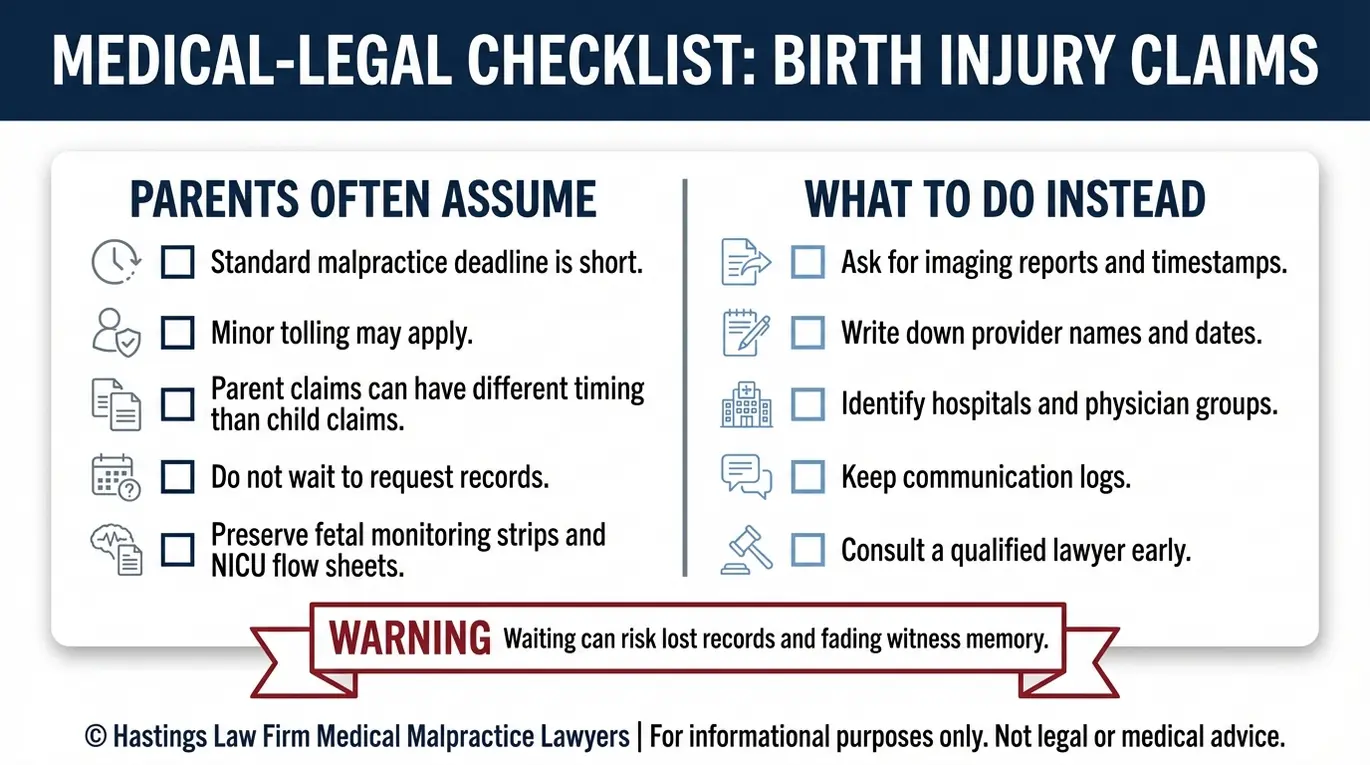
In Arizona, the standard statute of limitations for medical malpractice is two years, but for injuries to minors, this period is often “tolled” (paused) until the child turns 18, though parents should file sooner to preserve evidence. Tolling can extend the filing deadline until the child turns 18, under A.R.S. § 12-502.
Distinctions may exist between the child’s claim and any claims the parents may have independently. Because the tolling rules can be complex and vary depending on the specific circumstances and type of claim, it is important to consult with an attorney to understand how these rules apply to your family’s situation. Each family’s situation is different.
Even though the law may give you more time, filing sooner is almost always better. Medical records can be lost or destroyed after retention periods expire. Witnesses, including nurses and physicians, move to new positions or retire. Memories fade. The earlier an investigation begins, the stronger the evidence will be.
⚠️ Important: Do not assume that tolling protections guarantee unlimited time. Consult with a statute of limitations Arizona birth injury attorney as soon as possible to confirm your specific filing deadline for IVH claims and ensure preservation of evidence.
Contact the Arizona Birth Injury Attorneys at Hastings Law Firm Today for Help
If your child suffered a severe intraventricular hemorrhage, you deserve to know whether medical negligence played a role. These are not cases of simple bad luck. They are cases that require careful investigation by attorneys who understand both the medicine and the law.
Hastings Law Firm is built for exactly this kind of work. Tommy Hastings is Board Certified in Personal Injury Trial Law by the Texas Board of Legal Specialization, an achievement held by fewer than 2% of attorneys in that state. Our team of trial attorneys, in-house nurse consultants, and former defense lawyers focuses exclusively on medical malpractice. We know how hospitals chart care, where errors hide in the records, and how to build cases that hold providers accountable.
We operate on a contingency fee basis, which means you pay no attorney fees or costs unless we secure a recovery for your family. Your consultation is free and confidential.
If you have questions about your child’s diagnosis, call Hastings Law Firm today. We can review the medical records, consult with neonatal experts, and give you an honest assessment of what happened and what options you have.
Frequently Asked Questions About Intraventricular Hemorrhage Malpractice in Arizona


This content was researched and written by the Hastings Law Firm editorial team, which includes attorneys, medical professionals, and experienced researchers. Our writing is informed by internal knowledge and practical experience, and we cross-check critical details against authoritative sources cited throughout. Every piece undergoes human-led fact-checking and legal review. Because legal and medical information can change, if you spot an error, please contact us. Learn more about our content standards and review process on our editorial policy page.

Tommy Hastings, founder of Hastings Law Firm, is a board-certified personal injury trial lawyer dedicated exclusively to healthcare injury cases. Since 2001, he has represented injured patients and families in litigation against major hospital systems, pharmaceutical companies, and negligent healthcare providers nationwide. He has handled numerous high-profile cases that have drawn national media attention and resulted in multi-million dollar recoveries. He draws on that experience in his writing, helping readers understand how these cases work and what options may be available to them.
