


Arizona Intrauterine Growth Restriction Lawyer
Written by: Hastings Law Firm | Reviewed by: Tommy Hastings | Updated: July 27, 2026
Placental insufficiency and fetal growth restriction can leave families facing lasting harm when warning signs are missed during prenatal care. Intrauterine growth restriction can reflect a fetus not receiving enough oxygen and nutrients, and delayed recognition can raise the risk of serious complications such as brain damage, organ injury, or worse. The discussion also highlights how growth patterns, monitoring, and delivery timing can affect outcomes and later disputes about whether a baby was simply small. If you or a loved one were harmed or worse due to intrauterine growth restriction malpractice in Arizona, contact Hastings Law Firm for a free, confidential case review.

Experienced Legal Representation for Placental Insufficiency Birth Injuries in Arizona
What You Should Know About Placental Insufficiency Birth Injury Claims in Arizona:
- Permanent injury risk can increase when fetal growth restriction is not recognized and addressed during pregnancy.
- Severe outcomes can follow delayed intervention when placental insufficiency limits oxygen and nutrient delivery.
- Disputes over whether a baby was constitutionally small can shape how growth restriction injuries are evaluated.
- Options can narrow when delivery timing decisions are delayed despite signs of fetal distress.
- Long term financial strain can follow IUGR related brain injury due to ongoing care and support needs.
- Compensation may cover economic losses and non economic harms tied to IUGR related birth injuries.
- Recovery in Arizona is not limited by damage caps, which can affect the potential scope of compensation.
- Case clarity can depend on whether prenatal records show missed warning signs such as abnormal Doppler findings or low amniotic fluid.
- Accountability questions can turn on whether appropriate monitoring tools were used when growth concerns appeared.
- Expert review of fetal monitoring and placental findings can be central when causation is disputed.

A Healthcare Focused Law Firm
When a baby is harmed because warning signs of restricted growth went unrecognized or unaddressed during pregnancy, the emotional toll on a family is profound. You trusted your medical team to monitor your pregnancy closely, and learning that something may have been missed can leave you searching for answers and unsure of what to do next.
You are not alone, and your instinct that something went wrong deserves to be taken seriously. As an Arizona Intrauterine Growth Restriction Lawyer, Hastings Law Firm focuses exclusively on medical malpractice cases, including birth injuries linked to placental insufficiency and fetal growth restriction. Our team of attorneys, nurse consultants, and medical experts can review what happened during your prenatal care and explain your legal options in a free, confidential evaluation.
Understanding Intrauterine Growth Restriction and Fetal Growth Restriction
Intrauterine growth restriction (IUGR), a condition in which a fetus does not reach its expected growth potential during pregnancy, is typically defined as an estimated fetal weight falling below the 10th percentile for its gestational age, or the expected size based on how far along the pregnancy is. This condition involves the baby’s failure to grow at a healthy rate during pregnancy. The condition is also referred to as fetal growth restriction (FGR), and it is distinct from a baby simply being small. A baby who is small for gestational age (SGA) or has a low birth weight, meaning smaller than expected at birth, may be perfectly healthy.
A baby with true IUGR, however, is not growing properly because it is not receiving adequate nutrients or oxygen. The underlying problem usually involves the placenta, the organ responsible for delivering oxygen and nutrition from the mother to the fetus. When the placenta cannot keep up with the baby’s needs, growth slows. The longer this goes undetected, the greater the risk of serious complications, including brain damage, organ injury, and stillbirth.
Early detection matters for the safety of the pregnancy. When providers identify IUGR promptly, they can increase monitoring, manage contributing conditions, and plan the timing of delivery to protect the baby. When warning signs are missed or overlooked, a preventable injury can become permanent. As an Arizona IUGR malpractice attorney, our firm investigates whether prenatal providers met their obligations or fell short.
According to the National Center for Biotechnology Information (NCBI), fetal growth restriction remains a leading contributor to perinatal morbidity and mortality, reinforcing the importance of timely recognition and management.
Types of IUGR: Symmetrical vs. Asymmetrical Patterns
Symmetrical IUGR affects the entire body proportionally and typically begins early in pregnancy, whereas asymmetrical IUGR occurs later and involves a “brain-sparing effect” where the head continues growing while the body remains small. These patterns help medical professionals determine why growth has slowed and how to manage the pregnancy safely. Understanding the difference between these two patterns is important both for medical management and for building a legal case.
In symmetrical IUGR, the baby’s head, abdomen, and limbs are all uniformly small. This pattern often stems from genetic conditions, early infections, or toxic exposures. Because all measurements track consistently small, it can be harder to detect on a single ultrasound without serial comparisons.
Asymmetrical IUGR is more commonly linked to placental insufficiency in the second or third trimester. The brain-sparing effect, the body’s attempt to redirect limited blood flow to the brain at the expense of the abdomen and other organs, is an important warning sign. Research published in the European Journal of Pediatrics confirms that when Doppler flow studies reveal this redistribution pattern, it signals that the placenta is failing and the baby is compensating to survive.
| Feature | Symmetrical IUGR | Asymmetrical IUGR |
|---|---|---|
| Onset Timing | Early pregnancy (first trimester) | Later pregnancy (second or third trimester) |
| Physical Characteristics | Head, abdomen, and limbs all proportionally small | Head circumference preserved; abdominal circumference reduced |
| Common Causes | Genetic abnormalities, early infections, toxic exposures | Placental insufficiency, maternal hypertension, preeclampsia |
Both types carry serious risks if they are not identified and managed appropriately. The distinction between them can shape both the medical response and the legal analysis of whether providers acted within the standard of care.
The Hastings Law Firm Difference
Results matter, but what truly sets us apart is how we achieve them. Every verdict, every settlement, and every Arizona courtroom victory comes from one guiding promise: To treat each client’s fight for justice as if it were our own.
This balance of skill, experience, and empathy reflects our core philosophy that justice should not only compensate the injured, but also make healthcare safer nationwide.

Diagnosing Placental Insufficiency and Growth Issues
Doctors diagnose IUGR and placental insufficiency using a combination of fundal height measurements, serial ultrasounds to estimate fetal weight, and Doppler flow studies to assess blood flow through the umbilical cord. Proper testing identifies if the baby is receiving enough oxygen and nutrients to thrive. Because the placenta functions effectively as the fetus’s lungs and kidneys, verifying its performance is critical. Each of these tools provides different information, and relying on only one can allow warning signs to slip through.
Fundal height, the distance from the pubic bone to the top of the uterus, is a basic screening tool measured at routine prenatal visits. When the measurement falls behind expectations, it should trigger further investigation with ultrasound. Serial ultrasounds allow providers to track the estimated fetal weight (EFW), the calculated weight of the baby based on measurements of the head, abdomen, and femur, over time. A single ultrasound showing a small baby may not tell the full story, but a pattern of slowing or stagnating growth across multiple scans is a red flag.
When growth concerns arise, providers typically use umbilical artery Doppler flow studies, which are imaging tests that measure the speed and direction of blood moving through the umbilical cord. These studies can reveal whether the placenta is delivering adequate blood flow. When Doppler results are abnormal, particularly when they show absent or reversed end-diastolic flow, the baby may be in danger.
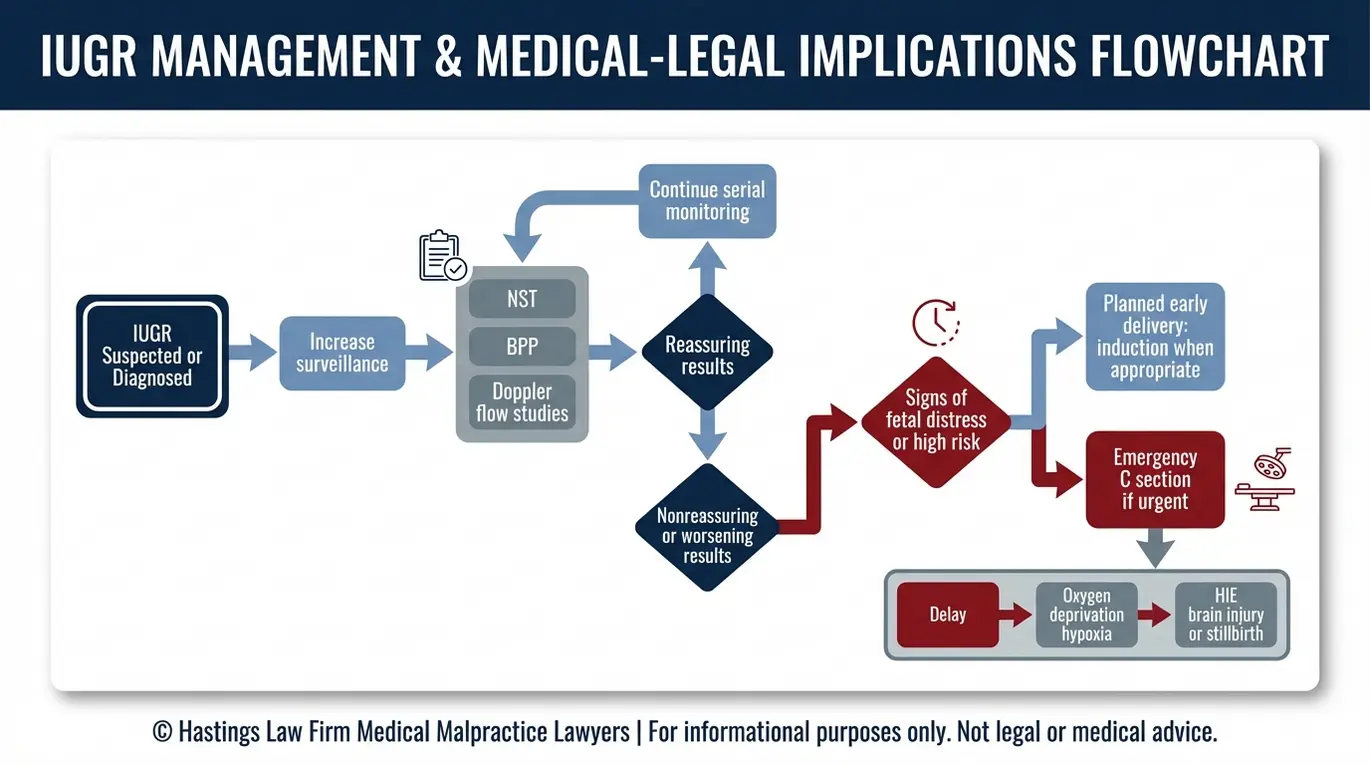
An Arizona birth injury lawyer experienced in IUGR cases will evaluate which diagnostic tools were used and when. Providers should also perform a non-stress test (NST) and biophysical profile (BPP) once risk factors are identified to assess overall fetal well-being.
Key diagnostic steps that should be followed when IUGR risk factors are present:
- Routine fundal height measurement at every prenatal visit
- Serial ultrasound monitoring of estimated fetal weight at regular intervals
- Doppler flow studies of the umbilical artery when growth concerns arise
- Non-stress testing to evaluate fetal heart rate patterns
- Biophysical profile scoring to assess fetal movement, breathing, and amniotic fluid
- Evaluation for oligohydramnios, or abnormally low amniotic fluid volume
Defense attorneys in these cases often argue that the baby was “constitutionally small,” meaning naturally petite. An IUGR attorney in Phoenix can counter that argument by showing that Doppler abnormalities, declining growth velocity, or oligohydramnios point to a baby that was not simply small, but deprived of what it needed to thrive.
Critical Treatment Decisions and Emergency Delivery
The management of IUGR often requires increased surveillance and, in critical cases, early delivery via induction or emergency C-section to prevent stillbirth or hypoxic brain injury. The central challenge is timing: delivering too early exposes the baby to the risks of premature delivery, while waiting too long can leave the baby in an environment where the placenta can no longer sustain it.
When fetal heart rate monitoring reveals concerning patterns, such as a non-reassuring heart rate, absent end-diastolic flow on Doppler studies, or oligohydramnios, abnormally low amniotic fluid surrounding the baby, the standard of care may call for prompt delivery. Delaying that decision in the face of these warning signs can lead to oxygen deprivation, also known as hypoxia, which can cause lasting brain damage. Our attorneys scrutinize these records to determine if the delivery was delayed negligently.
One of the most serious consequences of delayed intervention is hypoxic-ischemic encephalopathy (HIE), a type of brain injury caused by a combination of reduced oxygen and blood flow to the baby’s brain around the time of birth. According to research published in PubMed Central, HIE remains a significant risk factor for long-term neurological impairment and is closely associated with failures in fetal monitoring and delivery timing. When providers recognize the warning signs but wait too long to act, the injury that follows may have been preventable.
Families seeking legal help for IUGR negligence often come to us after learning that the fetal monitoring data showed distress signals well before delivery occurred. Our team examines the fetal heart rate tracings, the timing of clinical decisions, and whether the medical team escalated care appropriately.
Common Medical Errors Leading to IUGR Injuries
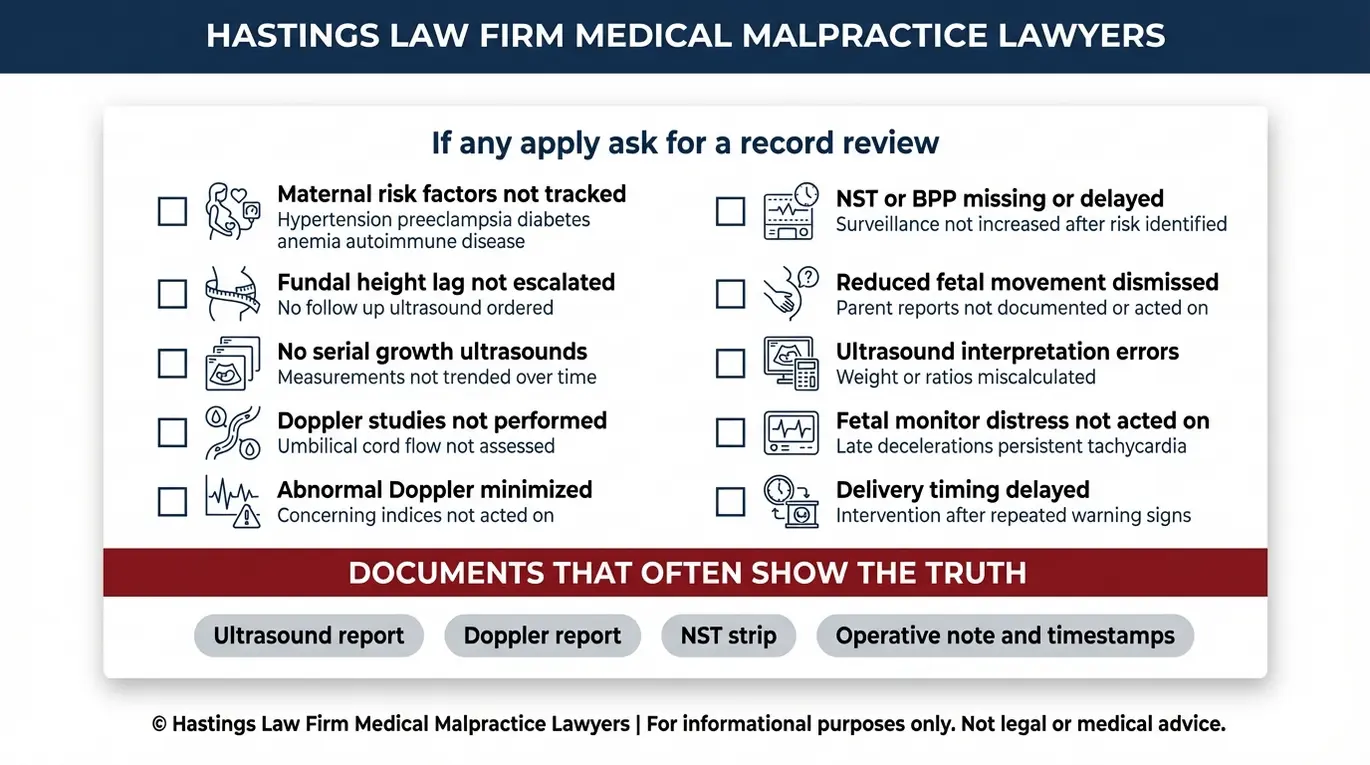
Medical malpractice in IUGR cases occurs when providers fail to identify maternal risk factors, misinterpret ultrasound data, neglect to perform Doppler studies, or fail to intervene when fetal monitoring shows signs of distress. These are not just clinical missteps; they are a breach of duty and a violation of the standard of care that can cause permanent harm.
An Arizona Intrauterine Growth Restriction Lawyer investigates the full timeline of prenatal care to identify where the breakdown occurred. Common errors we evaluate include:
- Failure to screen for known maternal risk factors such as maternal hypertension, preeclampsia, maternal diabetes, anemia, or autoimmune disorders
- Failing to act upon a mother’s reported concerns regarding reduced fetal movement
- Not ordering serial ultrasounds after an initial finding of lagging growth
- Miscalculating estimated fetal weight on ultrasound or failing to identify asymmetrical growth patterns
- Neglecting to perform Doppler flow studies when growth restriction is suspected
- Failing to order a non-stress test (NST), a test that monitors the baby’s heart rate in response to its own movements, or a biophysical profile (BPP), a scoring system that evaluates fetal well-being through ultrasound and heart rate monitoring
- Failing to proceed with timely delivery if the medical team identifies signs of fetal distress
Proving these errors requires specific medical expertise. A medical malpractice attorney for IUGR cases works with maternal-fetal medicine (MFM) specialists who can testify about what the standard of care required at each stage of the pregnancy. Placental pathologists can examine the placenta after delivery to confirm whether insufficiency was present and whether it should have been detected earlier. Our in-house nurse consultants and national expert network help us build a detailed medical timeline that connects the failure to the outcome.
Recovering Compensation for Long-Term Birth Injuries
Families may recover economic damages for past and future medical care, therapy, and lost earning capacity, as well as non-economic damages for pain, suffering, and loss of enjoyment of life. In cases involving IUGR-related birth injuries, the financial burden can extend across a child’s entire lifetime.
Children who suffer brain damage from oxygen deprivation may develop cerebral palsy, cognitive impairment, or other neurodevelopmental impairment. According to the Centers for Disease Control and Prevention (CDC), cerebral palsy is one of the most common motor disabilities in childhood, and the costs associated with lifelong care are substantial. These children often require specialized therapies, adaptive equipment, educational support, and around-the-clock care for years or even decades.
Recoverable damages in Arizona IUGR birth injury cases may include:
- Past and future medical expenses, including surgeries, hospital stays, and specialist visits
- Physical, occupational, and speech therapy costs
- Assistive devices and home modifications
- Lost earning capacity if the child’s disability limits future employment
- Pain and suffering experienced by the child
- Loss of enjoyment of life
- Parents’ emotional distress and loss of consortium
- Wrongful death damages if the IUGR led to stillbirth
A life care planner, a professional who projects the full scope of future medical and support needs, is important in these cases. Their analysis helps ensure that compensation for IUGR injuries reflects the true cost of care rather than a short-term estimate. Arizona birth injury settlements must account for every aspect of a child’s future needs, and our team works with qualified experts to document those costs thoroughly. We fight to ensure every predicted expense is covered.
Contact the Arizona Birth Injury Attorneys at Hastings Law Firm Today for Help
A child’s injury caused by unrecognized or mismanaged growth restriction is not just a medical outcome to accept. It may represent a failure in the standard of care, and your family deserves to know what happened and why.
Founded by Tommy Hastings, a board-certified trial attorney, we are prepared to take the case to a jury from day one. Our team includes former defense attorneys and experienced hospital nurses who previously worked for the systems we now challenge. This background allows us to anticipate defense tactics and identify charting inconsistencies in detailed records.
As an Arizona Intrauterine Growth Restriction Lawyer, we are committed to helping families find the truth and hold negligent providers accountable. Contact Hastings Law Firm for a free, confidential case evaluation. There are no fees unless we recover compensation for your family.
Frequently Asked Questions About Intrauterine Growth Restriction in Arizona


This content was researched and written by the Hastings Law Firm editorial team, which includes attorneys, medical professionals, and experienced researchers. Our writing is informed by internal knowledge and practical experience, and we cross-check critical details against authoritative sources cited throughout. Every piece undergoes human-led fact-checking and legal review. Because legal and medical information can change, if you spot an error, please contact us. Learn more about our content standards and review process on our editorial policy page.

Tommy Hastings, founder of Hastings Law Firm, is a board-certified personal injury trial lawyer dedicated exclusively to healthcare injury cases. Since 2001, he has represented injured patients and families in litigation against major hospital systems, pharmaceutical companies, and negligent healthcare providers nationwide. He has handled numerous high-profile cases that have drawn national media attention and resulted in multi-million dollar recoveries. He draws on that experience in his writing, helping readers understand how these cases work and what options may be available to them.
