


Arizona Intensivist Malpractice Lawyer
Intensive care medicine demands constant monitoring, clear communication, and precise decisions when patients are at their most vulnerable. When an ICU physician falls short, families can face sudden complications, lasting injury, or worse, and it can be difficult to understand what went wrong. Intensivist negligence can involve missed changes in vital signs, medication mistakes, delayed recognition of rapidly evolving problems, or errors during bedside procedures. Accountability may involve the physician, the hospital, or both depending on the working relationship. If you or a loved one were harmed or worse due to intensivist malpractice in Arizona, contact Hastings Law Firm for a free, confidential case review.

Last Updated: July 27, 2026
Trusted Legal Representation for ICU Negligence Victims in Arizona
When a loved one is admitted to an Intensive Care Unit, you trust that every decision, every medication, and every moment of monitoring is handled with the highest level of medical skill. If that trust was broken and your family member suffered a preventable injury or death while under critical care, you deserve answers.
ICU patients depend on life support machines to maintain breathing and organ function. They also require managed ICU sedation. This involves using medications to keep critically ill patients comfortable and safe during treatment. When the physicians overseeing this care fall short, the consequences can be devastating.
As an experienced Arizona intensivist malpractice lawyer, Hastings Law Firm focuses exclusively on medical malpractice cases. Led by founder Tommy Hastings, a board-certified trial attorney who has practiced since 2005, our team includes attorneys, in-house nurses, and former defense attorneys prepared to investigate what happened. Contact our Phoenix office for a free, confidential case evaluation. There are no fees unless we recover compensation for you.

Understanding Intensivist Negligence and Critical Care Errors
Intensivist negligence occurs when a critical care physician fails to meet the strict standard of care required in high-stakes ICU settings, resulting in preventable patient harm. Because the ICU treats the most vulnerable patients in any hospital, even a brief lapse in judgment or communication can lead to catastrophic outcomes.
An intensivist, a physician who specializes in critical care medicine, the discipline focused on treating patients with life-threatening injuries and illnesses, functions as the primary decision-maker in the ICU. Think of this doctor as the coordinator of a complex, fast-moving medical team. They oversee ventilator settings, medication protocols, diagnostic testing, and nursing directives. Their duty of care extends to every system keeping the patient alive, and the margin for error is razor-thin.
When that coordination breaks down, patients suffer. Common causes of intensivist malpractice include:
- Failure to maintain patient monitoring, preventing the team from spotting changing conditions, such as dropping oxygen levels or worsening organ function, in a timely manner
- Communication breakdowns between the intensivist and nursing staff, respiratory therapists, or consulting specialists
- Administrative errors, including switched patient records, incorrect charting, or failure to delegate critical tasks to qualified nursing staff
- Understaffing pressures that force a single ICU doctor to manage too many critically ill patients at once
Research from the National Center for Biotechnology Information (NCBI) has documented how acute care nursing staff shortages compromise safe patient-to-nurse ratios, placing additional strain on intensivists who may already be stretched beyond safe limits.
The breach may stem from an individual physician’s error or a systemic failure in how the ICU is managed. An intensivist malpractice attorney can investigate these circumstances to identify where the standard of care was violated. At Hastings Law Firm, our in-house medical staff reviews ICU records, staffing logs, and communication notes to build a clear picture of what went wrong and why. These cases are complex, requiring a deep understanding of medical protocols. If you suspect Arizona intensivist negligence contributed to your loved one’s injury, a critical care malpractice lawyer can help you understand your options.
Common Medical Errors Committed by Intensivists
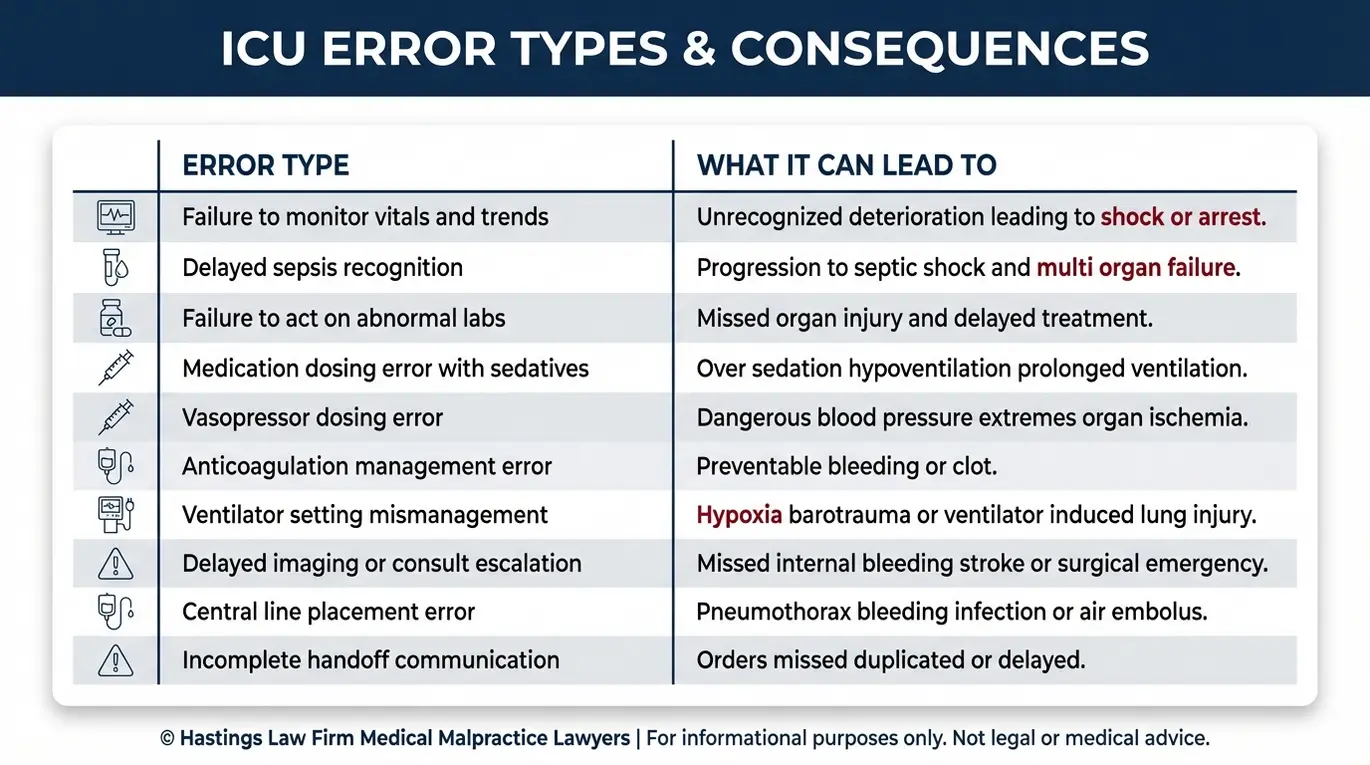
Common errors by ICU doctors include failure to monitor vital signs, medication dosing mistakes, delayed diagnosis of sepsis or organ failure, and improper ventilator management. Each of these errors can trigger a rapid and irreversible decline in a patient who is already critically ill.
Diagnostic Failures
Conditions in the ICU can change within minutes. Sepsis, internal bleeding, pulmonary embolism, and acute organ failure all require immediate recognition and intervention.
When an intensivist fails to diagnose a rapidly evolving condition, or delays ordering the laboratory tests and imaging needed to confirm it, the window for effective treatment can close. Diagnostic errors and laboratory testing errors in the ICU carry a far higher mortality risk than in general hospital settings, often constituting critical care physician negligence.
Medication Errors
ICU patients often receive some of the highest-risk medications in all of medicine. Vasopressors, the drugs used to raise dangerously low blood pressure, require precise dosing and constant hemodynamic monitoring. Sedatives, paralytics, and high-dose antibiotics all carry serious risks if administered incorrectly.
The Institute for Safe Medication Practices (ISMP) High-Alert Medications List identifies many of the drugs routinely used in ICUs as having the greatest potential for patient harm. When used in error, these mistakes can lead to permanent injury or wrongful death. A single miscalculated dose or a failure to adjust medication in response to changing labs can cause cardiac arrest, respiratory failure, or death.
Procedural Errors
Intensivists routinely perform bedside procedures such as intubation, central line insertion, and chest tube placement. Errors during these procedures, including improper placement or failure to confirm positioning, can lead to collapsed lungs, uncontrolled bleeding, or airway compromise.
The table below outlines how specific critical care physician negligence can lead to serious patient harm:
| ICU Error | Potential Consequence |
|---|---|
| Failure to monitor vital signs | Undetected cardiac arrest or respiratory failure |
| Delayed sepsis diagnosis | Multi-organ failure or death |
| Medication dosing mistake | Toxic reaction, cardiac arrest, or brain injury |
| Improper mechanical ventilation, the use of a machine to support breathing | Lung damage (barotrauma) or oxygen deprivation |
| Procedural error during intubation | Airway injury, aspiration, or hypoxic brain damage |
| Failure to review laboratory results | Missed metabolic crisis or worsening infection |
If you are considering suing an intensivist in Arizona, understanding which errors occurred is the first step. An Arizona intensivist malpractice lawyer can work with qualified medical experts to connect these failures to the harm your family experienced.
The Hastings Law Firm Difference
Results matter, but what truly sets us apart is how we achieve them. Every verdict, every settlement, and every Arizona courtroom victory comes from one guiding promise: To treat each client’s fight for justice as if it were our own.
This balance of skill, experience, and empathy reflects our core philosophy that justice should not only compensate the injured, but also make health care safer nationwide.

Proving Liability and The Standard of Care in ICU Settings
Proving ICU negligence requires demonstrating that the intensivist deviated from the accepted medical standard of care for critical care medicine and that this deviation directly caused the patient’s injury. This is the foundation of every ICU negligence claim, and it demands more than just showing that a bad outcome occurred.
The “Emergency” Distinction
The standard of care in an ICU is different from what applies in a routine office visit. ICU patients are, by definition, in critical condition. Courts and juries understand this context. However, the fact that a patient was already seriously ill does not lower the bar for the quality of care they should receive.
The standard of care still requires that an intensivist act with the skill, knowledge, and attentiveness that a reasonably competent critical care physician would demonstrate under similar circumstances. An Arizona intensivist malpractice lawyer understands the nuances of showing a breach. This includes failures in hemodynamic monitoring, such as tracking heart function. It also includes reviewing arterial blood gas (ABG) results, which measure oxygen levels in the blood.
Overcoming the “Inevitable Outcome” Defense
One of the most common defense strategies in ICU malpractice cases is the argument that the patient was already so ill that harm was inevitable regardless of what the doctor did. This defense can be persuasive if it goes unchallenged. That is why expert testimony from qualified intensivists is essential. Our medical experts analyze the clinical timeline to establish whether the patient’s decline was truly unavoidable or whether timely intervention could have changed the outcome.
A report by the HHS Office of Inspector General found that hospitals did not capture half of patient harm events. This limits the information available to improve safety and can also complicate efforts to prove negligence.
What We Examine to Build Your Case
As a medical malpractice attorney for ICU errors, Hastings Law Firm conducts a detailed investigation that includes reviewing:
- ✅ Complete medical records, nursing notes, and physician orders
- ✅ ICU monitoring data, including ventilator logs and vital sign trends
- ✅ Medication administration records and pharmacy dispensing logs
- ✅ Laboratory and imaging results, along with the timing of when they were ordered and reviewed
- ✅ Staffing records and shift-change documentation
- ✅ Expert analysis from board-certified intensivists who can define the applicable standard of care in Arizona
Proving ICU negligence takes more than medical records alone. It requires a legal team that understands critical care medicine at a clinical level. Our in-house nurses and former defense attorneys know where to look for gaps that indicate a breach. Our national network of medical experts provides the testimony needed to establish causation and the standard of care in Arizona.

Liability Distinction: Suing the Intensivist vs. The Hospital
Liability may fall on the intensivist personally if they are an independent contractor, or on the hospital if the doctor is a direct employee or if the facility failed to enforce safety protocols. A thorough investigation into employment contracts and hospital policies is required to identify the correct parties to name in a claim.
Employment Status Matters
The relationship between an intensivist and the hospital is not always what it appears. Many ICU doctors are not direct employees of the hospital where they practice. Instead, they work through independent staffing agencies or medical groups, which can create confusion about liability for intensivist errors when negligence occurs. A hospital malpractice lawyer can investigate these employment structures to determine the correct parties to name in a claim.
| Factor | Hospital Employee | Independent Contractor |
|---|---|---|
| Who pays the doctor | Hospital directly | Staffing agency or medical group |
| Hospital’s direct liability | Generally liable for doctor’s negligence | May not be directly liable |
| Vicarious liability applies? | Yes | Only under specific legal theories |
| Ostensible agency claim possible? | Not typically needed | Yes, if hospital held doctor out as its own |
Vicarious Liability and Ostensible Agency
Even when an intensivist is technically an independent contractor, the hospital may still be liable under the theory of ostensible agency. If the hospital presented the doctor as part of its own medical team, and the patient had no reason to believe otherwise, the hospital can be held accountable for that physician’s negligence.
Hospitals may face independent liability for failures in credentialing and privileging. This is the process of verifying a doctor’s qualifications. Facilities are also responsible for maintaining safe ICU staffing ratios, which involves the patient-to-nurse ratio. These systemic issues often overlap with nursing negligence and physician negligence.
Arizona-Specific Considerations
In many medical malpractice cases, a physician’s malpractice insurance policy may include a consent-to-settle clause, which can require the doctor’s personal consent before a settlement is finalized. This is one of the procedural details that an experienced Arizona medical malpractice counsel can help you handle effectively.
At Hastings Law Firm, our team includes former defense attorneys who understand how hospitals structure these relationships to limit their exposure. We know where to look and how to hold every responsible party accountable. Contact a hospital malpractice lawyer to discuss your claim.
Recoverable Damages in Critical Care Malpractice Cases
Patients and families affected by intensivist malpractice in Arizona may recover damages in ICU lawsuits, including economic damages for medical bills and lost wages, as well as non-economic damages for pain, suffering, and loss of consortium. The specific compensation available depends on the nature and severity of the harm.
Economic Damages
Economic damages cover the measurable financial losses caused by the malpractice, including:
- Past and future medical bills, including rehabilitation, long-term care, and specialized equipment
- Lost wages and diminished earning capacity if the patient can no longer work
- Home care and assistance costs for patients who require ongoing support
Non-Economic Damages
Non-economic damages address the personal toll of the injury, including:
- Physical pain and suffering endured during and after the ICU stay
- Emotional distress and loss of enjoyment of life
- Loss of consortium, the impact on the relationship between the patient and their spouse or family
Wrongful Death Damages
When ICU negligence results in death, surviving family members may pursue a wrongful death claim. Arizona law allows recovery for funeral and burial expenses, loss of the deceased’s future income, loss of companionship and guidance, and the emotional suffering of surviving family members. If you have lost a loved one, a wrongful death lawyer Phoenix residents trust can help you pursue justice.
No Damage Caps in Arizona
One important protection for Arizona families: the Arizona Constitution, Article 2, Section 31, explicitly prohibits caps on damages for personal injury or death. There is no statutory ceiling on what a jury may award in compensation for critical care negligence, including non-economic damages. Arizona also follows a system of comparative negligence, meaning your award may be adjusted if the defense successfully argues partial fault, though this is rare in ICU settings.
An Arizona intensivist malpractice lawyer can evaluate the full scope of your losses and pursue every category of damages that applies to your case.
Statute of Limitations for Arizona ICU Malpractice Claims
In Arizona, the standard statute of limitations Arizona enforces for medical malpractice is generally two years from the date of the injury or the date the injury was discovered. You must file your legal claim within two years from the date you knew or should have known of the negligence.
The Discovery Rule
In complex ICU cases, the link between a doctor’s error and the patient’s decline is not always immediately apparent. Arizona recognizes the discovery rule, which means the two-year clock may not start until the patient or family knew, or reasonably should have known, that the injury resulted from negligence.
This exception can be critical when determining the time limit to sue intensivist defendants or when the full picture only becomes clear after reviewing medical records or consulting with an independent expert.
Evidence Disappears Quickly
Hospital staffing records, electronic monitoring data, and internal communications can be altered, overwritten, or lost over time. The sooner you contact an Arizona intensivist malpractice lawyer, the better the chance of preserving the evidence needed to support your claim. The relevant filing requirements are outlined in Title 12 of the Arizona Revised Statutes, which governs civil actions including the medical malpractice filing deadline.
Do not wait to explore your legal options. Early action protects both your rights and your evidence.
Contact the Arizona Doctor Malpractice Attorneys at Hastings Law Firm Today for Help
Losing a loved one or watching them suffer because of preventable ICU errors is something no family should have to endure. At Hastings Law Firm, we exist to give families the answers they deserve and to hold negligent medical providers accountable.
Our team of attorneys, in-house nurses, and Board Certified Patient Advocates is built specifically for cases like these. We understand the medicine, we know the defense strategies, and we prepare every case as if it is going to trial. That preparation is what allows us to pursue full and fair compensation on your behalf.
There is no cost to speak with us. We work on a contingency fee basis, which means you pay no attorney fees or costs unless we secure a recovery for your family. If you believe an intensivist’s negligence caused harm to someone you love, contact our Phoenix office today for a free, confidential case evaluation. Let us review what happened and explain your options.
Frequently Asked Questions About Intensivist Malpractice in Arizona


This content was researched and written by the Hastings Law Firm editorial team, which includes attorneys, medical professionals, and experienced researchers. Our writing is informed by internal knowledge and practical experience, and we cross-check critical details against authoritative sources cited throughout. Every piece undergoes human-led fact-checking and legal review. Because legal and medical information can change, if you spot an error, please contact us. Learn more about our content standards and review process on our editorial policy page.

Tommy Hastings, founder of Hastings Law Firm, is a board-certified personal injury trial lawyer dedicated exclusively to healthcare injury cases. Since 2001, he has represented injured patients and families in litigation against major hospital systems, pharmaceutical companies, and negligent healthcare providers nationwide. He has handled numerous high-profile cases that have drawn national media attention and resulted in multi-million dollar recoveries. He draws on that experience in his writing, helping readers understand how these cases work and what options may be available to them.
