


Arizona Improper Delivery Technique Lawyer
Improper delivery techniques can cause serious birth injuries when a provider uses excessive force, misuses instruments, or fails to follow accepted obstetric protocols during a difficult delivery. Some complications are unavoidable, but preventable harm can occur when warning signs are missed, communication breaks down, or critical decisions are delayed. These events can leave families facing long term medical needs, uncertainty about what happened, and concerns about accountability. If you or a loved one were harmed or worse due to improper delivery technique in Phoenix, Arizona, contact Hastings Law Firm for a free, confidential case review.

Last Updated: September 24, 2026
Arizona Birth Injury Attorneys for Improper Delivery Cases
When a child is injured during birth because of how the delivery was physically handled, the questions that follow can feel overwhelming. You may be wondering whether what happened was preventable, whether someone made a mistake, and what options exist for your family going forward. These are fair and important questions, and you deserve clear answers.
At Hastings Law Firm, founded by board-certified trial attorney Tommy Hastings, our legal and medical team focuses exclusively on medical malpractice, including cases involving labor and delivery negligence. We understand the weight of what your family may be facing, and we are here to help you make sense of it. If you believe your child was harmed by a delivery error, an experienced Arizona improper delivery technique lawyer at our Phoenix office can review your records, explain what the evidence shows, and walk you through your options at no cost to you.

Understanding Improper Delivery Techniques and Medical Negligence
Improper delivery technique refers to the negligent application of physical force or the misuse of obstetric maneuvers by a healthcare provider during childbirth. This can include the incorrect use of instruments like forceps, excessive traction on an infant, or the use of maneuvers that deviate from the accepted medical standard of care, which is the level of treatment a reasonably competent OB/GYN would provide under similar circumstances.
There is an important distinction between a natural birth complication and a preventable injury caused by human error. Childbirth carries inherent risks, and not every difficult delivery involves negligence. But when a provider deviates from established protocols, rushes through a critical decision, or fails to respond appropriately to changing conditions, the outcome can shift from an unavoidable complication to medical malpractice.
Many delivery injuries stem from preventability gaps. For example, shoulder dystocia, a condition where the baby’s shoulder becomes lodged behind the mother’s pelvic bone during delivery, is a recognized obstetric emergency. Trained providers are expected to follow specific steps to resolve it safely. When a physician instead applies excessive downward force or abandons protocol under pressure, the resulting injury to the child is not simply “a complication.” It is a consequence of the technique used.
Communication failures during the second stage of labor also contribute to these cases. If nursing staff fail to relay critical changes in the mother’s or baby’s condition, or if the delivering physician does not respond to documented warning signs, the breakdown in the chain of care can directly lead to harm. In these scenarios, the injury is not a result of the birthing process itself, but of a failure to manage it competently. An Arizona improper delivery technique lawyer can help determine whether these failures crossed the line from unfortunate to actionable.
Risks of Instrumental Delivery and Excessive Force Errors
Instrumental delivery errors occur when a physician improperly positions forceps or vacuum extractors, applies excessive force, or attempts these methods when a C-section is medically indicated. Instrumental delivery involves the use of specialized tools to assist in the birth process. These technique failures can cause severe trauma to the infant’s skull, nerves, and brain.
Forceps delivery involves using curved metal instruments placed around the baby’s head to guide it through the birth canal. Vacuum extraction, also called ventouse, uses a soft or rigid cup attached to the baby’s head with suction. Both are accepted tools when used correctly and under appropriate circumstances. The errors arise in how, when, and why they are applied.
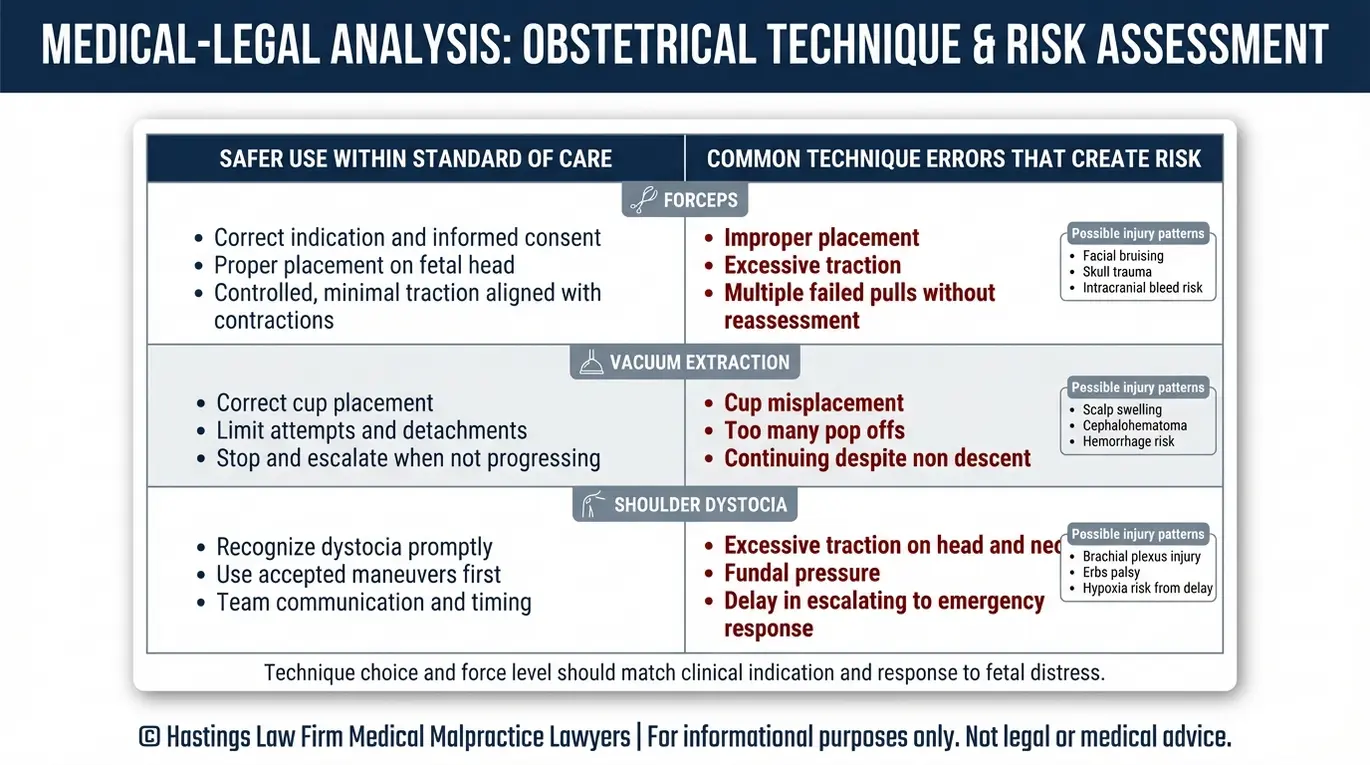
The table below outlines how proper technique compares to common errors associated with each method:
| Delivery Method | Proper Use | Common Errors |
|---|---|---|
| Forceps | Correct placement on the baby’s head with controlled, guided traction during contractions | Misalignment causing skull fractures, excessive force leading to intracranial hemorrhage, prolonged application |
| Vacuum Extraction | Proper cup placement on the flexion point, limited traction attempts (generally no more than three pop-offs) | Off-center placement causing scalp lacerations, excessive suction duration, continued use after failed attempts |
| Shoulder Dystocia Management | Use of recognized maneuvers such as the McRoberts maneuver to reposition the mother and relieve the impaction | Excessive lateral traction on the baby’s head and neck, pulling downward instead of following protocol |
| Timing Decision | Recognizing when instruments are not appropriate and transitioning to an emergency C-section | Persisting with instrumental delivery despite failed attempts or worsening fetal distress, resulting in a delayed C-section |
When shoulder dystocia occurs, the standard of care generally calls for specific repositioning techniques before any significant traction is applied to the baby. Pulling too hard or at the wrong angle on the baby’s head can stretch or tear the nerves in the neck and shoulder, a mechanism directly tied to brachial plexus injuries. The decision of whether to continue an instrumental attempt or move to a C-section is time-sensitive, and errors in that judgment can cause lasting harm.
An Arizona improper delivery technique lawyer or delivery technique error attorney can work with obstetric experts to reconstruct what happened during these critical moments and identify where the standard of care was breached.
The Dangers of the Kristeller Maneuver
The Kristeller maneuver, also known as fundal pressure, involves a provider pressing down on the top of the mother’s uterus during delivery to help push the baby out. Manual fundal pressure is a physical technique used during labor. This improper manual delivery technique is widely discouraged or outright banned by many medical institutions because of its risks to both mother and child.
Despite these warnings, manual fundal pressure is still used by some practitioners. When applied improperly or with excessive force, it can cause uterine rupture in the mother or traumatic injury to the baby, including compression injuries and oxygen deprivation. Because fundal pressure is often poorly documented in delivery records, identifying its use may require a detailed review of nursing notes, witness accounts, and physical evidence of injury.
The Hastings Law Firm Difference
Results matter, but what truly sets us apart is how we achieve them. Every verdict, every settlement, and every Arizona courtroom victory comes from one guiding promise: To treat each client’s fight for justice as if it were our own.
This balance of skill, experience, and empathy reflects our core philosophy that justice should not only compensate the injured, but also make health care safer nationwide.

Traumatic Injuries Resulting from Delivery Room Errors
Injuries caused by improper delivery techniques are often physical and permanent, ranging from nerve damage caused by excessive pulling to brain damage caused by oxygen deprivation or mechanical trauma. Traumatic birth injuries are physical harms that occur during the labor and delivery process. Unlike genetic conditions, these injuries are directly linked to the forces applied during birth, making them potentially provable through medical records and expert analysis.
The types of injuries most commonly seen in these cases include:
- Brachial plexus injuries, including Erb’s palsy, a condition involving damage to the network of nerves running from the neck through the shoulder and arm. These injuries typically result from excessive lateral traction on the baby’s head during delivery, especially in shoulder dystocia cases. Research published by PubMed Central on brachial plexus birth palsy highlights the connection between delivery mechanics and nerve injury outcomes.
- Cerebral palsy, which can develop when a baby’s brain is deprived of oxygen during a prolonged or mismanaged delivery. In some cases, a timely decision to move to a C-section could have prevented the deprivation.
- Hypoxic-ischemic encephalopathy (HIE), a specific form of brain injury caused when oxygen flow to the baby’s brain is interrupted during or around the time of birth. This diagnosis often requires immediate medical intervention to limit brain tissue damage. HIE can lead to developmental delays, seizures, and long-term cognitive impairment.
- Maternal injuries, including uterine rupture, severe perineal tearing (damage to the tissue between the vaginal opening and the anus), or hemorrhage resulting from the improper use of instruments or excessive fundal pressure. These injuries can lead to long-term health issues and may require surgical correction.
An improper delivery technique lawyer in Arizona can help families determine whether a child’s diagnosis is connected to the events of delivery by working with medical professionals who specialize in analyzing birth records and injury causation. If you are looking for a lawyer for improper delivery technique cases, understanding the specific injury and its mechanism is the first step in building a claim. The most severe outcomes often involve hypoxia (oxygen deprivation), where every minute of delayed intervention matters.
Establishing the Standard of Care for Obstetricians
Proving a claim requires establishing that a competent obstetrician, acting under similar circumstances, would have used a different technique or made a different decision. The standard of care is the legal benchmark for medical performance. This involves a detailed analysis of fetal heart rate strips, delivery notes, and hospital protocols to demonstrate a clear breach of the standard of care.
In Arizona, medical experts serving as expert witnesses in the same specialty define what “competent care” looks like for a given clinical situation. Tommy Hastings has over 20 years of experience investigating medical negligence cases, helping families understand whether the standard of care was met during delivery. An OB/GYN reviewing the case will evaluate whether the actions taken during delivery were consistent with what a reasonable provider would have done given the same information available at the time.
Fetal heart rate monitoring, also called cardiotocography (CTG), is one of the most important pieces of evidence in these cases. According to the NCBI Bookshelf resource on fetal monitoring, continuous monitoring produces a real-time record of the baby’s heart rate patterns in relation to the mother’s contractions. A nonreassuring fetal heart rate tracing, an irregular pattern classified as Category II or Category III, can indicate fetal distress and may require immediate intervention. If monitoring strips show signs of distress that were either missed or not acted upon, that evidence can support a claim that the provider breached the standard of care.
There is also an important legal distinction between a “judgment call” and a protocol violation. A physician may argue that their decision was a reasonable exercise of clinical judgment. Our role as an Arizona improper delivery technique lawyer is to work with qualified experts to examine whether that judgment fell within acceptable medical boundaries, or whether the evidence shows a departure from what the standard required.

Liability for Delivery Errors in Private and Public Hospitals
Liability for improper delivery can extend beyond the individual obstetrician to include the hospital, nursing staff, or staffing agencies. Liability refers to the legal responsibility for damages caused by negligence. While doctors are often independent contractors, hospitals may be liable for systemic failures, inadequate staffing, or granting privileges to providers who were not qualified.
One of the most common defenses in Arizona birth injury cases is the “independent contractor” argument. Hospitals frequently classify their physicians as independent contractors rather than employees, attempting to shield themselves from vicarious liability for the doctor’s actions. This means the hospital may be held legally responsible for the actions of its staff. However, if the hospital held the physician out to patients as part of its medical team, or if the patient had no meaningful choice in selecting the doctor, this defense can be challenged.
Nursing staff may also bear responsibility. Nurses are often the ones administering Pitocin, a drug used to induce or strengthen contractions, and monitoring its effects on the mother and baby. If a nurse fails to recognize dangerous contraction patterns, does not alert the physician to changes in the baby’s condition, or does not follow established protocols for epidural monitoring, that failure can be a direct link in the chain of negligence.
When evaluating who may be liable, we look at:
- The delivering physician and their clinical decisions
- Nursing staff involved in labor monitoring and medication administration
- The hospital or birthing center for staffing levels, training, and credentialing
- Staffing agencies that supplied temporary or contract medical personnel
- Supervising physicians who were responsible for oversight
Understanding this structure is why these cases require an improper delivery technique lawyer in Arizona with experience investigating institutional accountability. While doctors are often independent contractors, hospital negligence may still apply for systemic failures or inadequate credentialing. As a birth injury attorney, our role includes identifying every party whose actions or omissions contributed to the harm.

Recovering Damages for Birth Injuries Without Caps in Arizona
Arizona is one of the few states with a constitutional prohibition on damage caps, allowing families to recover the full value of their losses. Legal damages are the financial compensation awarded to cover losses and future care. Article 2, Section 31 of the Arizona Constitution explicitly protects this right, meaning no legislative cap can limit what a jury awards in a medical malpractice case.
This protection is especially meaningful in birth injury cases where the financial impact spans a lifetime. Economic damages often include the cost of ongoing medical treatment, physical therapy, assistive devices, specialized education, and in-home care. These future costs are typically established through a life care plan, a detailed projection of the child’s anticipated needs prepared by qualified professionals. The American Association of Nurse Life Care Planners provides standards for how these plans are developed and used in litigation.
Non-economic damages account for the child’s pain and suffering, loss of quality of life, and the emotional toll on the family. In cases involving particularly reckless conduct, punitive damages may also be available to hold the responsible parties accountable beyond simple compensation.
For claims involving public hospitals or government-run facilities, A.R.S. § 12-821.01 governs the process, including strict notice requirements that must be met early. An Arizona improper delivery technique lawyer familiar with both private and public entity claims can ensure these procedural requirements are handled correctly.
Contact the Arizona Birth Injury Attorneys at Hastings Law Firm Today for Help
If your child was injured during delivery and you believe a medical error may be the cause, you are not alone, and you do not have to figure this out by yourself. Legal representation helps families manage the details of medical litigation. Hastings Law Firm was built on a single mission: to restore trust for families who have been let down by the healthcare system and to help prevent the same mistakes from happening to others.
Our team includes former defense attorneys, in-house nurse consultants, and board-certified patient advocates who understand how to investigate what happened during your child’s delivery. We prepare every case as if it is going to trial, because that preparation is what drives fair outcomes.
There is no cost to speak with us. We work on a contingency fee basis, meaning you pay no attorney fees or costs unless we secure a recovery for your family. Contact our Phoenix office today for a free, confidential consultation to discuss your case with a dedicated Arizona improper delivery technique lawyer. Let us review the records, explain what we find, and help you understand your options.
Frequently Asked Questions About Improper Delivery Technique in Arizona


This content was researched and written by the Hastings Law Firm editorial team, which includes attorneys, medical professionals, and experienced researchers. Our writing is informed by internal knowledge and practical experience, and we cross-check critical details against authoritative sources cited throughout. Every piece undergoes human-led fact-checking and legal review. Because legal and medical information can change, if you spot an error, please contact us. Learn more about our content standards and review process on our editorial policy page.

Tommy Hastings, founder of Hastings Law Firm, is a board-certified personal injury trial lawyer (by the Texas Board of Legal Specialization) dedicated exclusively to healthcare injury cases. Since 2001, he has represented injured patients and families in litigation against major hospital systems, pharmaceutical companies, and negligent healthcare providers nationwide. He has handled numerous high-profile cases that have drawn national media attention and resulted in multi-million dollar recoveries.
