


Arizona ICU Monitoring Failure Lawyer
Written by: Hastings Law Firm | Reviewed by: Tommy Hastings | Updated: July 27, 2026
ICU monitoring failures can leave families reeling because the ICU is meant to catch danger early and respond without delay. When alarms are ignored, vital signs are missed, or care is not escalated as a patient worsens, the result can be preventable, life changing harm or fatal outcomes. These events are often tied to system problems like staffing shortages, communication breakdowns, or equipment issues, and the medical record can show what was known and what was done. If you or a loved one were harmed or worse due to ICU monitoring failures in Arizona, contact Hastings Law Firm for a free, confidential case review.
Compassionate Arizona Medical Attorneys for ICU Negligence Claims
What You Should Know About Failure to Escalate Care in ICU Claims in Arizona:
- Outcomes can be catastrophic when ICU warning signs are documented but care is not escalated in time.
- Preventable harm can follow when alarms are silenced, ignored, or answered too slowly due to alarm fatigue.
- Recovery can turn on whether vital sign trends were consistently recorded and recognized before the window to intervene closed.
- Fatal outcomes can result when early signs of infection are not monitored and treated promptly.
- Liability can extend beyond an individual clinician when staffing, training, or shift change communication failures contribute to an ICU injury.
- Hospital responsibility can depend on whether the involved clinicians were employees or independent contractors.
- Options can be limited if Arizona timing rules are missed, even when the injury was not immediately discoverable.
- Recovery can depend on electronic equipment logs and monitoring data that show alarms, setting changes, and response timing.
- Compensation can include financial losses and human losses such as pain and suffering, mental anguish, and loss of enjoyment of life.
- Wrongful death recovery can include funeral and burial expenses, lost earnings, and the emotional loss of the relationship.

A Healthcare Focused Law Firm
When a loved one is admitted to the ICU, you trust that every alarm, every reading, and every change in condition will be caught and acted on immediately. If medical staff broke that trust and your family member suffered a preventable injury or death because they failed to monitor or respond, you deserve to know what happened.
ICU monitoring failures are among the most serious forms of medical negligence because they happen in settings where patients are already at their most vulnerable. These cases demand attorneys who understand both the medicine and the law. As an Arizona ICU monitoring failure lawyer team that works exclusively in medical malpractice, Hastings Law Firm has the clinical insight and litigation experience to investigate what went wrong in the ICU and hold the responsible parties accountable.
If you believe your family member was harmed by inadequate ICU care, we can review what happened and explain your options. Contact our Phoenix office for a free, confidential case evaluation.
Common Types of ICU Monitoring Failures and Care Escalation Errors
ICU monitoring failures occur when medical staff neglect to track vital signs, ignore equipment alarms, or fail to recognize and escalate treatment for a patient whose condition is deteriorating. These breakdowns can lead to preventable brain injury, organ failure, sepsis, or death.
An experienced Arizona ICU monitoring failure lawyer will look closely at the specific type of failure that occurred. Your ICU negligence attorney knows that each one leaves a distinct trail in the medical record. Below are some of the most common patterns we encounter.
Failure to Escalate (Failure to Rescue)
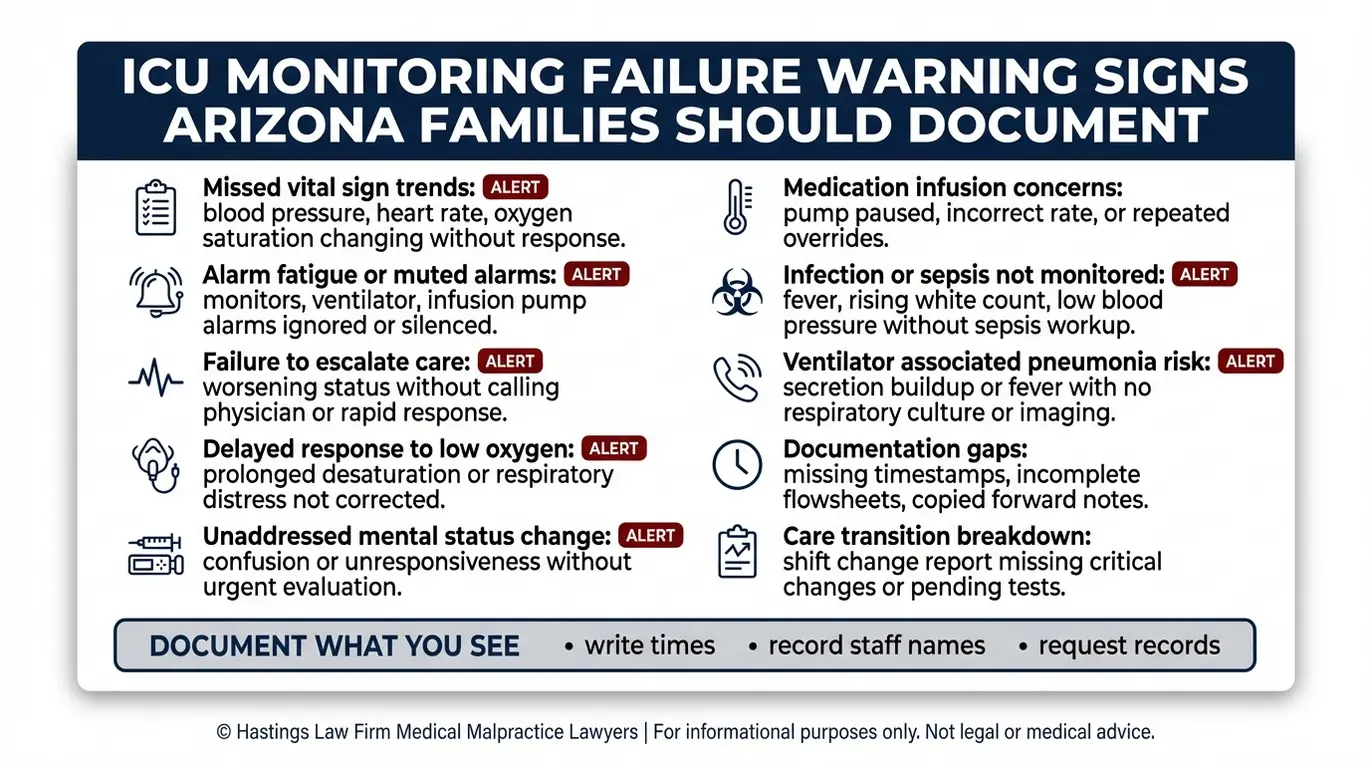
Failure to rescue, or FTR, describes situations where medical staff document signs of a patient’s decline but do not act. This is a leading contributor to preventable ICU deaths. This failure to rescue occurs when medical staff see warning signs but do not call for immediate help. A patient’s oxygen saturation may be dropping, their heart rate rising, or their blood pressure falling, yet no one calls a physician or activates a rapid response.
According to the Agency for Healthcare Research and Quality (AHRQ) Patient Safety Network, failure to rescue is a major concern. When delays in the failure to escalate care follow documented warning signs, the gap between what was known and what was done becomes central to the case.
Alarm Fatigue
Alarm fatigue leads clinical staff to silence, ignore, or respond slowly to alarms that signal real danger. This condition occurs when staff become desensitized to the constant stream of alerts from ventilators, infusion pumps, and cardiac monitors. ECRI’s guidance on reducing alarm fatigue identifies this as a persistent threat to patient safety. In ICU negligence cases, alarm data stored by the equipment itself can reveal whether alerts were acknowledged, delayed, or muted entirely.
Missed or Misinterpreted Vital Signs
Vital signs like blood pressure, intracranial pressure, and oxygen levels require consistent recording and interpretation. When staff fail to chart these readings at required intervals, or chart them but miss a dangerous trend, the window to intervene can close quickly.
Infection Oversight
ICU patients are highly susceptible to hospital-acquired infections, including ventilator-associated pneumonia and sepsis. These infections often occur when bacteria enter the body during invasive procedures or through long-term medical devices. Failure to monitor for early signs of infection, such as rising white blood cell counts, fever, or changes in mental status, can allow a treatable condition to become fatal.
Arizona’s legal standards for hospital negligence, shaped by foundational cases like *Purcell v. Zimbelman*, recognize that hospitals have a duty to enforce protocols that protect patients from these preventable complications.
Root Causes of ICU Errors and System Failures
Most ICU errors stem from systemic issues such as understaffing, lack of training, or communication breakdowns during shift changes, rather than isolated mistakes by a single provider. Experienced Arizona malpractice counsel understand that these root causes often determine who is legally responsible.
A lawyer for ICU monitoring failures will investigate the institutional conditions that allowed the error to happen. The most common systemic failures include:
- Inadequate staffing and nurse-to-patient ratios: The nurse-to-patient ratio, the number of patients assigned to one nurse during a shift, directly affects monitoring quality. When ICU nurses are responsible for too many critically ill patients, checks of vital signs get delayed. Early warning signs can go unnoticed, and rates of hospital-acquired infections increase. Research from the AHRQ Patient Safety Network on nursing workforce challenges confirms that staffing shortfalls are closely linked to adverse patient outcomes.
- Handoff and care transition errors: An ICU handoff, or shift-change sign-out, must be precise to prevent life-threatening errors. This is the structured transfer of patient information from one care team to the next. When these handoffs are rushed, incomplete, or informal, important details about a patient’s trajectory can be lost. The AHRQ WebM&M case study on written signout protocols highlights how standardized communication tools reduce these errors.
- Equipment malfunctions or improper setup: Dialysis machines, cardiac monitors, and infusion pumps require proper calibration and maintenance. When equipment fails or is set up incorrectly, the data clinicians rely on may be inaccurate or absent altogether, breaching the standard of care.
Review of Equipment Logs and Electronic Data
Modern ICU equipment stores detailed electronic audit trails, which are device event logs that record every alarm, setting change, and staff interaction. Telemetry monitoring, which is the continuous tracking of a patient’s cardiac rhythm and other vital signs, generates timestamped electronic monitoring data that can show exactly when a patient’s condition changed and whether anyone responded.
These digital records from infusion pumps, ventilators, and bedside monitors are often more reliable than handwritten patient charts. They can reveal whether alarms were silenced, how long a dangerous reading persisted before intervention, and whether equipment was functioning correctly. For an Arizona malpractice case involving ICU negligence, this electronic evidence can be decisive.
The Hastings Law Firm Difference
Results matter, but what truly sets us apart is how we achieve them. Every verdict, every settlement, and every Arizona courtroom victory comes from one guiding promise: To treat each client’s fight for justice as if it were our own.
This balance of skill, experience, and empathy reflects our core philosophy that justice should not only compensate the injured, but also make healthcare safer nationwide.

Determining Liability for Critical Care Negligence in Arizona
Liability in ICU cases often extends beyond the individual nurse or technician to the hospital system itself, particularly when administrative or institutional failures contributed to the patient’s injury.
We investigate and prepare every case from day one as if it will go to a jury trial. An Arizona ICU monitoring failure lawyer will evaluate which parties bear legal responsibility. In many cases, a Phoenix critical care attorney will structure the analysis around two overlapping legal theories.
Vicarious liability
This legal theory means the hospital is responsible for the actions of its staff. Vicarious liability holds an employer responsible for the negligent acts of its employees. If a hospital-employed nurse failed to escalate a patient’s deteriorating condition, the hospital can be held liable for that failure. This principle typically applies to nurses, respiratory therapists, and other staff who work directly for the facility, ensuring that the entity profiting from the care pays for the negligence.
The analysis changes when the provider is an independent contractor rather than a hospital employee. Many ICU physicians and specialists are not directly employed by the hospital. Whether the hospital is still liable may depend on how much control it exercised over the provider’s work and whether the patient reasonably believed the provider was part of the hospital’s team.
Corporate negligence
Corporate negligence targets the hospital’s own institutional conduct. Under this theory, a hospital can be held liable for failing to maintain adequate staffing, enforce monitoring protocols, or ensure proper credentialing of its medical staff. When the root cause of an ICU injury traces back to policy failures or institutional decisions, corporate negligence provides a path to hold the institution accountable for medical malpractice at an organizational level.
In wrongful death cases arising from ICU negligence, both theories may apply simultaneously, especially when medical experts can demonstrate that both individual care and system-level safeguards broke down.

How We Prove ICU Malpractice Using Medical Evidence
Proving medical malpractice requires a thorough forensic review of the medical chart, electronic audit trails, and qualified expert testimony to establish that the standard of care was breached and that the breach directly caused the patient’s injury.
As an ICU failure lawyer in Arizona, we follow a structured process to build your case:
Step 1: Acquiring the complete medical record. We obtain the complete medical record, not just the discharge summary. This includes nursing notes, physician orders, medication administration records, lab results, imaging studies, and electronic monitoring data. The University of Arizona Health Information Access Policy governs how health information is maintained and accessed within the state’s institutions.
Step 2: Independent expert review. Our in-house medical staff, including nurse practitioners and board-certified patient advocates, conduct an initial analysis of the records. We then engage independent medical experts with direct ICU experience to evaluate whether the standard of care was met. These experts assess whether monitoring was adequate, whether clinical signs were recognized, and whether escalation occurred within an acceptable timeframe. This objective analysis is necessary for overcoming defense arguments and validating the claim.
Step 3: Establishing causation. Proving a breach alone is not enough, as a lawyer must also be establishing causation to show that the failure directly caused the harm. For example, if pulse oximetry data shows a prolonged drop that went unaddressed, our experts can link that delay to a resulting brain injury. Similarly, if rising intracranial pressure (ICP), which is the pressure inside the skull, was not treated in time, the connection between the monitoring failure and the permanent injury must be clearly established through the medical evidence.

Compensation and Damages in Arizona ICU Failure Cases
Patients and families affected by ICU negligence in Arizona may be entitled to compensation for both economic and non-economic losses. An Arizona ICU monitoring failure lawyer can help identify the full scope of damages available under state law and pursue fair ICU injury compensation.
Economic damages
Economic damages cover the measurable financial impact of the injury. These are out-of-pocket costs such as past and future medical bills, rehabilitation costs, in-home care, and lost income or earning capacity if the patient can no longer work. In cases involving severe brain injury or permanent disability, ensuring these future needs are calculated correctly is essential for the family’s financial stability.
Non-economic damages
Non-economic damages address the human toll of the injury. Arizona allows recovery for physical pain and suffering, mental anguish, loss of enjoyment of life, and loss of consortium, which compensates a spouse or family for the loss of companionship and support.
In wrongful death cases, surviving family members may pursue damages for funeral and burial expenses, loss of the decedent’s future earnings, and the emotional loss of the relationship. Arizona law designates specific family members who are eligible to bring these claims, and the timeline for filing is strict.
Contact the Arizona Healthcare Malpractice Attorneys at Hastings Law Firm Today for Help
ICU monitoring failures involve complex medical evidence, electronic data, and layered questions of liability that require a legal team with real clinical knowledge. Founded by board-certified trial attorney Tommy Hastings, our firm focuses on securing full compensation for families who have been betrayed by the healthcare system. Our team includes former defense attorneys who know how hospitals prepare their defense, along with in-house medical professionals who can interpret the records from day one.
As an Arizona ICU monitoring failure lawyer team, we prepare every case as if it will go to trial. That level of preparation strengthens our position whether the case resolves through settlement or before a jury.
There is no cost to speak with us. We work on a contingency fee basis, which means you pay no attorney fees or costs unless we recover compensation for you. Please contact our firm and our Phoenix office for a free case evaluation. Let us help you get the answers you deserve.
Frequently Asked Questions About ICU Monitoring Failure in Arizona


This content was researched and written by the Hastings Law Firm editorial team, which includes attorneys, medical professionals, and experienced researchers. Our writing is informed by internal knowledge and practical experience, and we cross-check critical details against authoritative sources cited throughout. Every piece undergoes human-led fact-checking and legal review. Because legal and medical information can change, if you spot an error, please contact us. Learn more about our content standards and review process on our editorial policy page.

Tommy Hastings, founder of Hastings Law Firm, is a board-certified personal injury trial lawyer dedicated exclusively to healthcare injury cases. Since 2001, he has represented injured patients and families in litigation against major hospital systems, pharmaceutical companies, and negligent healthcare providers nationwide. He has handled numerous high-profile cases that have drawn national media attention and resulted in multi-million dollar recoveries. He draws on that experience in his writing, helping readers understand how these cases work and what options may be available to them.
