


Arizona Hypernatremic Dehydration Lawyer
Hypernatremic dehydration in a newborn can cause severe brain related injury when warning signs are missed, testing is delayed, or treatment is handled improperly. Common problems involve inadequate monitoring of feeding, weight loss, and electrolyte levels, misdiagnosis as infection, and rehydration that lowers sodium too quickly. These failures can leave families facing long term neurological impairment and extensive care needs. If you or a loved one were harmed or worse due to hypernatremic dehydration in Arizona, contact Hastings Law Firm for a free, confidential case review.

Last Updated: September 24, 2026
Arizona Malpractice Attorneys for Preventable Infant Injuries
When a newborn suffers harm from hypernatremic dehydration, a dangerous condition where sodium levels in the blood rise too high due to fluid loss, parents are often left searching for answers. Hypernatremia, an excess of sodium in the blood, can cause seizures, brain swelling, and lasting neurological damage, particularly when medical providers miss the warning signs or fail to act in time.
If your child was injured because a hospital or physician did not properly monitor hydration, feeding, or electrolyte levels, you may have a medical malpractice claim. As an Arizona Hypernatremic Dehydration Lawyer, Hastings Law Firm works with in-house medical staff and nationally recognized experts to determine whether your baby’s injury was preventable.
We offer a free, confidential case evaluation, and you pay nothing unless we recover compensation on your behalf. Contact us to review what happened and understand your options.

Liability for Failures in Monitoring Newborn Weight and Hydration
Negligence often begins when medical staff fail to properly track an infant’s weight loss or dismiss early signs of breastfeeding-associated hypernatremia, a form of dehydration that occurs when a newborn does not receive enough breast milk, as normal newborn fussiness or fatigue.
Tracking weight is a primary indicator of health in newborns. Healthy newborns and neonates lose some weight after birth, but excessive neonatal weight loss, typically defined as more than 10% of birth weight, signals a serious hydration problem. The standard of care requires nurses, pediatricians, and lactation consultants to monitor feeding adequacy, track daily weights, and intervene before dehydration progresses. When these steps are skipped or delayed, sodium levels can climb to dangerous thresholds that threaten the infant’s brain and central nervous system. A skilled newborn weight loss attorney knows that these early failures are often the root cause of severe injury.
First-time mothers are at higher risk because milk supply may not be fully established in the first days after delivery. Inadequate milk intake is a well-documented risk factor for neonatal dehydration. Yet in many cases, hospital staff discharge mother and baby without confirming that breastfeeding is effective or scheduling a timely follow-up weight check. An infant dehydration attorney in Arizona can evaluate whether that early discharge violated the standard of care, and our team investigates whether staff ignored protocols mandating supplemental feeding.
When injuries like these occur, hospitals and their defense teams sometimes attempt to shift blame to the mother, suggesting she should have recognized the problem sooner. Our team, which includes an Arizona infant hypernatremia lawyer, former defense attorneys, and experienced nurses, knows how to counter that argument. We examine the medical records to show what the clinical staff knew, what they documented, and where the standard of care required them to act.
A hypernatremia malpractice lawyer reviews the full clinical picture. Warning signs that should prompt immediate evaluation include:
- Weight loss exceeding 10% of birth weight
- Brick dust urine (orange or reddish crystals in the diaper)
- Jaundice that worsens after the first 48 hours
- Fewer than expected wet or soiled diapers
- Lethargy, weak cry, or poor latch during feeding
- Sunken fontanelle (soft spot) or dry mucous membranes (the moist linings of the mouth and nose)
If these red flags were present and documented but not acted on, that gap between recognition and response is often where dehydration negligence counsel can establish liability.

Misdiagnosis Claims Involving Sepsis and Hypernatremia
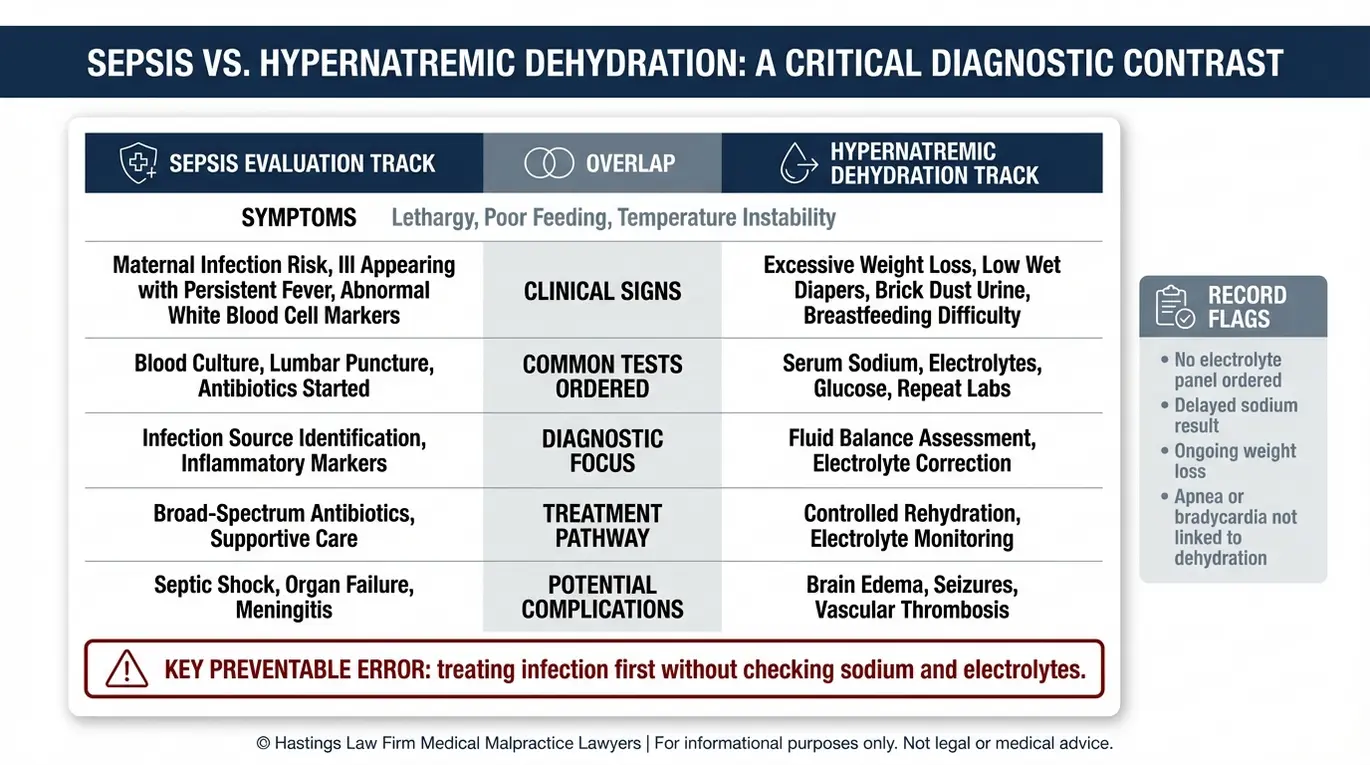
Doctors sometimes misdiagnose hypernatremic dehydration as sepsis because the two conditions share overlapping symptoms, and that diagnostic error can lead to unnecessary invasive testing while the actual brain injury worsens. Sepsis is a serious blood infection that shares symptoms with dehydration. Hypernatremic dehydration involves high sodium levels that can damage a baby’s developing brain.
A sepsis evaluation, also called a sepsis workup, is a series of tests used to detect bacterial infection in the blood or spinal fluid. It often includes a lumbar puncture (spinal tap), blood cultures, and IV antibiotics. These procedures carry real risks for a fragile neonate, especially one who is already dehydrated.
The critical issue in these cases is what tests were ordered and what tests were not. A basic electrolyte panel, a simple blood draw that measures serum sodium levels, can identify hypernatremia quickly. When physicians pursue an aggressive sepsis workup without first checking sodium and electrolyte levels, the dehydration goes untreated.
Every hour of delay allows sodium to continue rising, increasing the risk of permanent neurological damage. A neonatal dehydration lawyer identifies gaps in the diagnostic process that allowed the condition to progress unchecked.
Research published through the National Library of Medicine on maternal risk factors for neonatal hypernatremic dehydration confirms that clinical awareness of dehydration risk factors is essential to timely diagnosis. An Arizona dehydration misdiagnosis lawyer examines whether providers failed to consider dehydration alongside infection, particularly when the infant’s history included poor feeding or significant weight loss.
Clinical signs like apnea (pauses in breathing) and bradycardia (abnormally slow heart rate) can appear in both sepsis and severe dehydration. Experienced hypernatremia diagnostic error counsel can prove that the medical team missed clear indicators. The table below shows how these presentations overlap and where a simple diagnostic test could have changed the course of care:
| Clinical Sign | Sepsis Presentation | Hypernatremia Presentation |
|---|---|---|
| Lethargy / Poor feeding | Common | Common |
| Temperature instability | Common | Possible |
| Jaundice | Possible | Common |
| Apnea / Bradycardia | Common | Common in severe cases |
| Seizures | Possible (late) | Common when sodium is critically elevated |
| Key Diagnostic Test | Blood cultures, lumbar puncture | Basic electrolyte panel (serum sodium) |
A hypernatremic dehydration attorney looks at whether the medical team ordered appropriate diagnostic tests in the right sequence. When bacteremia and meningitis are ultimately ruled out but sodium levels were never checked, the misdiagnosis itself may constitute negligence. A Phoenix medical malpractice lawyer can work with neonatal experts to reconstruct the clinical timeline and determine whether earlier intervention would have prevented the injury.
The Hastings Law Firm Difference
Results matter, but what truly sets us apart is how we achieve them. Every verdict, every settlement, and every Arizona courtroom victory comes from one guiding promise: To treat each client’s fight for justice as if it were our own.
This balance of skill, experience, and empathy reflects our core philosophy that justice should not only compensate the injured, but also make health care safer nationwide.

Neurological Injuries Caused by Improper Rehydration Therapy
Even after dehydration is diagnosed, the treatment itself can cause harm if sodium levels are corrected too quickly. Rapid rehydration occurs when sodium levels are dropped too quickly, risking cerebral edema, which is a swelling of the brain.
Serum sodium, the concentration of sodium in the blood, must be brought down gradually in cases of hypertonic dehydration. The safe sodium correction rate, a protocol ensuring levels drop no more than 10 to 12 mEq/L per 24-hour period, must be strictly followed.
When physicians push IV fluids too fast or fail to recheck electrolytes at regular intervals, the sudden fluid shift can damage the central nervous system. This is an iatrogenic injury, meaning the harm was caused by the medical treatment itself.
An improper rehydration lawsuit focuses on whether the treating team followed established protocols. Retaining a hypernatremic brain damage lawyer is crucial to establishing that the injury resulted from treatment errors rather than the initial dehydration. Common treatment errors in these cases include:
- Rapid IV bolus administration without calculating the sodium deficit
- Failure to recheck serum sodium and electrolytes every 4 to 6 hours during correction
- Using hypotonic fluids that drop sodium levels too quickly
- No documented rehydration plan or target correction rate
- Failure to involve a pediatric nephrologist or intensivist for severely elevated sodium
The long-term consequences of rehydration injury can be devastating. Children may develop cerebral palsy, seizure disorders, developmental delays, or cognitive impairments that require a lifetime of specialized care. Your sodium correction injury attorney will analyze the fluid logs to find the deviation. An Arizona hypernatremia injury lawyer works with pediatric neurologists to document the full scope of the child’s prognosis and connect it to the treatment failures that caused the harm.

Seeking Compensation for Long-Term Pediatric Care
Arizona law allows families to recover damages for lifetime medical care, loss of future earning capacity, and pain and suffering caused by preventable medical errors involving infant dehydration. Damages represent the financial compensation sought for a medical error.
A child who suffers brain damage from cerebral edema, a swelling of the brain caused by fluid shifts, may need decades of therapy, specialized education, and around-the-clock support. Calculating the true cost of these needs requires a life care plan, a detailed projection prepared by medical and rehabilitation experts that accounts for every anticipated expense across the child’s lifetime.
This includes future medical expenses, physical therapy, occupational therapy, speech therapy, adaptive equipment, medications, and neurodevelopmental follow-up evaluations. An experienced lifetime care compensation lawyer ensures no future cost is overlooked.
An Arizona birth injury attorney also pursues compensation for future lost earning capacity. When a child’s neurological injuries limit their ability to live independently or hold employment as an adult, that economic loss can be substantial. Vocational and economic experts help quantify what the child would have earned over a working lifetime.
Noneconomic damages, including pain, suffering, and loss of enjoyment of life, are also recoverable under Arizona law. These damages reflect the human cost of the injury, both for the child and the family. In cases where the infant does not survive, families may pursue a wrongful death claim to hold the responsible parties accountable.
Every hypernatremic dehydration settlement or verdict is built on the strength of the medical evidence. Our team works with qualified experts to connect the standard of care failures directly to the child’s injuries, establishing the foundation for full and fair compensation for dehydration injury.
Contact the Arizona Birth Injury Attorneys at Hastings Law Firm Today for Help
Hypernatremic dehydration in a newborn is a known, preventable condition. Founded by Tommy Hastings, a board-certified trial lawyer, our firm focuses exclusively on medical negligence. Legal representation helps families investigate medical records to find the cause of a birth injury.
At Hastings Law Firm, our legal team includes in-house nurses, board-certified patient advocates, and former defense attorneys who understand how hospitals handle these cases from the inside. We investigate every detail of your child’s care, from feeding logs and weight records to lab orders and rehydration protocols.
There is no cost to speak with us. We work on a contingency fee basis, which means you pay no attorney fees unless we secure a recovery for your family. Your initial evaluation is led by a patient advocate who will listen to your story and help you understand whether your child’s injury should have been prevented.
If you believe your baby was harmed by dehydration that went undiagnosed or was improperly treated, contact Hastings Law Firm for a free case evaluation. Let us help you find the truth about what happened.
Frequently Asked Questions About Hypernatremic Dehydration in Arizona


This content was researched and written by the Hastings Law Firm editorial team, which includes attorneys, medical professionals, and experienced researchers. Our writing is informed by internal knowledge and practical experience, and we cross-check critical details against authoritative sources cited throughout. Every piece undergoes human-led fact-checking and legal review. Because legal and medical information can change, if you spot an error, please contact us. Learn more about our content standards and review process on our editorial policy page.

Tommy Hastings, founder of Hastings Law Firm, is a board-certified personal injury trial lawyer (by the Texas Board of Legal Specialization) dedicated exclusively to healthcare injury cases. Since 2001, he has represented injured patients and families in litigation against major hospital systems, pharmaceutical companies, and negligent healthcare providers nationwide. He has handled numerous high-profile cases that have drawn national media attention and resulted in multi-million dollar recoveries.
