


Arizona Horner’s Syndrome Lawyer
A Horner syndrome diagnosis after a difficult delivery can leave families searching for clear answers about what went wrong. In newborns, the condition is often linked to injury of the sympathetic nerve pathway in the neck and upper chest, sometimes associated with excessive traction, instrument use, or delayed decisions during delivery complications. Symptoms can affect the eyelid, pupil, and facial sweating, and the severity can range from temporary stretching to permanent tearing. If your child suffered harm or worse due to Horner syndrome birth injury in Arizona, contact Hastings Law Firm for a free, confidential case review.

Last Updated: July 27, 2026
Compassionate Arizona Medical Attorneys for Horner’s Syndrome Birth Injury Claims
When your child is born with an unexpected injury, the confusion and worry can feel overwhelming. If your baby has been diagnosed with Horner’s syndrome after a difficult delivery, you may be searching for answers about what happened and whether it could have been prevented. These are reasonable questions, and you deserve honest, clear information.
At Hastings Law Firm, our team of attorneys, in-house nurse consultants, and medical experts focuses exclusively on medical malpractice cases. We understand the medical details behind birth injuries, and we know how to investigate whether the care your child received met the standard your family had every right to expect.
If you believe your child’s Horner’s syndrome may be connected to delivery complications, an experienced Arizona Horner’s Syndrome Lawyer can review what happened and explain your options. Contact our Phoenix office for a free, confidential case evaluation.

Understanding Horner’s Syndrome as a Preventable Birth Injury
Horner’s syndrome in newborns is a rare neurological condition caused by damage to the sympathetic nerve pathway, often resulting from excessive traction or trauma to the neck and shoulder area during delivery. This condition is essentially a disruption of the nerve signals that control the eye and facial muscles on one side of the head.
The sympathetic nerves that control certain functions of the eye and face follow a long, specific route called the oculosympathetic pathway, a complex nerve track that winds through the body. They originate in the brain, travel down the spinal cord into the upper chest, and then loop back upward along the carotid artery, the major blood vessel in the neck, before reaching the eye and surrounding facial structures. Because these nerves pass through the neck and shoulder region, they are especially vulnerable during a traumatic birth.
This exposed position makes them highly susceptible to injury when a baby’s head is pulled away from the shoulder during a difficult delivery, disrupting the signal transmission needed for normal eye function. While some cases of Horner’s syndrome are congenital, meaning a child is born with the condition due to developmental factors, many cases in newborns are acquired.
This means the nerve damage happened during the birthing process itself. In acquired cases, the physical forces of labor disrupt the nerve continuity. Unlike congenital issues which may be genetic, acquired Horner’s syndrome is a mechanical injury typically inflicted during the final stages of labor.
If birth trauma involves stretching, compression, or tearing of the delicate nerve fibers along this sympathetic nerve pathway, the result can be the characteristic set of symptoms associated with Horner’s syndrome. An Arizona Horner’s Syndrome Lawyer can help you determine whether your child’s condition resulted from preventable delivery complications. A Horner’s syndrome attorney with access to qualified medical professionals can evaluate the circumstances of the birth and identify whether the injury was caused by the actions or omissions of the delivery team.
How Medical Negligence During Delivery Causes Nerve Damage
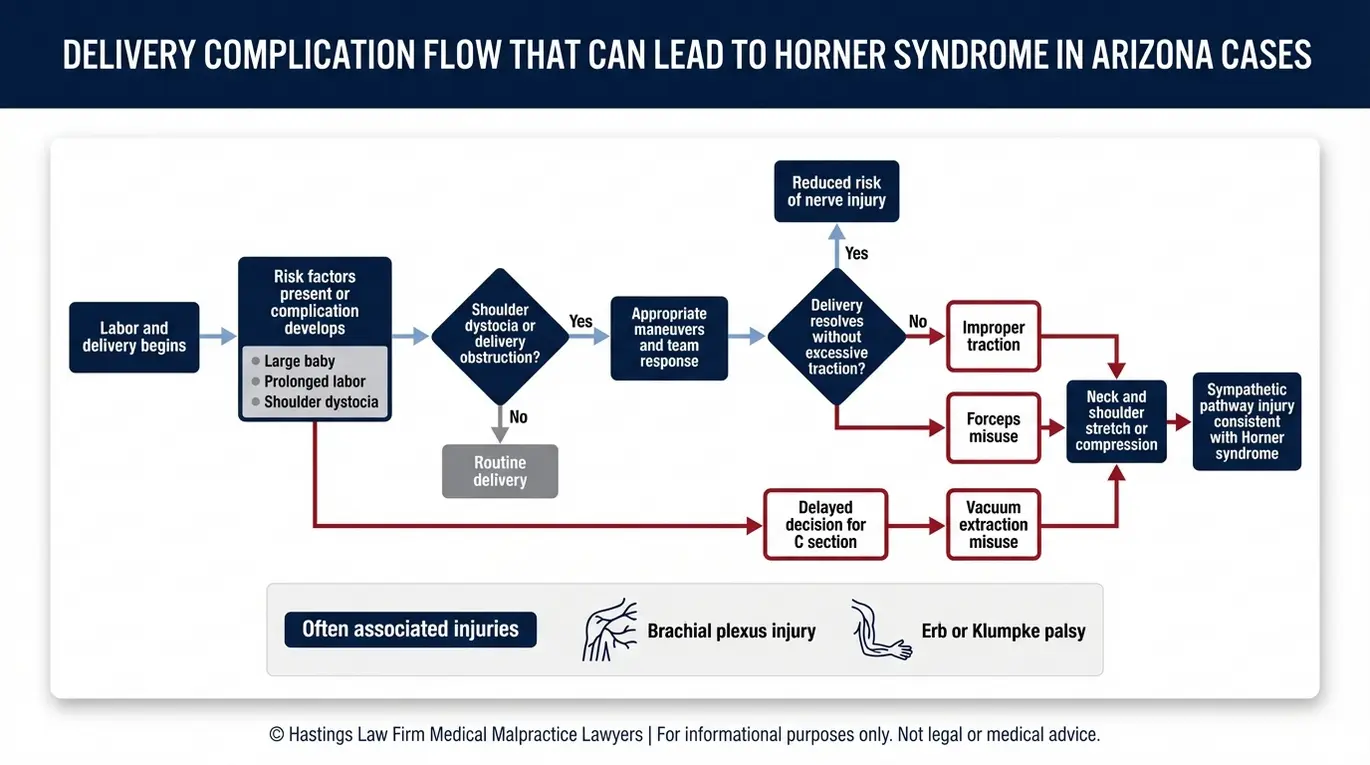
Medical negligence occurs when healthcare providers fail to manage complications like shoulder dystocia appropriately, resorting to excessive force, improper use of extraction tools, or failing to order a timely C-section, which can stretch or tear the delicate nerves that lead to Horner’s syndrome. This type of legal claim focuses on whether the medical team adhered to established safety protocols during the delivery.
Doctors must be prepared to handle shoulder dystocia, a delivery emergency where the baby’s shoulder becomes lodged behind the mother’s pelvic bone after the head has already delivered. When this happens, the standard of care requires the provider to follow established maneuvers designed to free the baby safely. Problems arise when excessive traction, meaning too much downward pulling force on the baby’s head and neck, is applied instead.
There are several ways negligent delivery practices can cause nerve damage:
Improper traction during shoulder dystocia
Pulling too hard on the infant’s head while the shoulder remains stuck can stretch or tear the sympathetic nerves running through the neck and upper chest. This often happens when a provider violates the protocol to stop pulling and perform internal maneuvers during a dystocia event.
Misuse of forceps or vacuum extraction devices
These instruments, when applied with excessive force or at an incorrect angle, can cause direct trauma to the baby’s head, neck, and shoulder structures. Applying them requires high skill; twisting or pulling with too much torque can crush or avulse the nerves.
Delayed decision to perform a C-section
When a baby is too large for a safe vaginal delivery, a condition known as macrosomia, continuing with vaginal delivery rather than transitioning to a C-section can expose the infant to preventable injury. Physicians must accurately estimate fetal weight and pelvic size before labor progresses to avoid forcing a large baby through a birth canal that cannot accommodate them.
Connection to brachial plexus injuries
The same traumatic forces that cause Horner’s syndrome can simultaneously damage the brachial plexus, the network of nerves controlling the arm. This is why Horner’s syndrome in newborns often occurs alongside conditions like Erb’s palsy or Klumpke’s palsy.
According to a study on the incidence of shoulder dystocia and risk factors for recurrence published in PMC, identifiable risk factors often exist before delivery begins. A Horner’s syndrome lawyer in Arizona can review your medical records to determine whether the delivery team recognized and responded to these risk factors appropriately. A birth injury attorney or malpractice lawyer experienced in these cases knows exactly what documentation to examine and which experts to consult.
The Hastings Law Firm Difference
Results matter, but what truly sets us apart is how we achieve them. Every verdict, every settlement, and every Arizona courtroom victory comes from one guiding promise: To treat each client’s fight for justice as if it were our own.
This balance of skill, experience, and empathy reflects our core philosophy that justice should not only compensate the injured, but also make health care safer nationwide.

Recognizing Symptoms of Horner’s Syndrome in Infants
The classic triad of symptoms in infants includes ptosis, or drooping of the upper eyelid; miosis, meaning the pupil on the affected side is abnormally constricted; and anhidrosis, the absence of sweating on the affected side of the face. Early recognition of these symptoms helps doctors identify nerve damage connecting the brain to the eye.
Ptosis is often the first symptom parents notice, though it can be subtle in newborns. The affected eyelid may appear slightly lower than the other, giving the baby’s face an asymmetric look. In some cases, the drooping is mild enough that it is initially overlooked.
Miosis and anisocoria refer to the difference in pupil size between the two eyes. Anisocoria, a condition where one pupil is noticeably smaller than the other, is often the result of miosis in Horner’s syndrome. The affected pupil does not dilate properly in dim lighting, which can make the size difference more apparent in darker environments.
Anhidrosis means the baby does not sweat normally on the affected side of the face. Parents sometimes notice this as a flushing pattern where one cheek turns red while the other does not, particularly during crying or warm temperatures.
| Symptom | What Parents May Observe |
|---|---|
| Ptosis | One eyelid appears lower or droopier than the other |
| Miosis / Anisocoria | One pupil looks smaller, especially in low light |
| Anhidrosis | One side of the face does not sweat or flush evenly |
| Heterochromia | The eyes appear to be different colors |
One symptom unique to early-onset Horner’s syndrome is heterochromia, a difference in iris color between the two eyes. Because the sympathetic nerves influence melanin development in the iris, the affected eye may remain a lighter color while the unaffected eye darkens normally over the first year of life.
If your child shows any of these signs following a difficult delivery, consulting with an Arizona Horner’s Syndrome Lawyer and an infant nerve injury lawyer can help you understand whether the symptoms are linked to birth trauma.
Diagnosing the Injury and Determining Severity
Diagnosis typically involves a physical examination by an ophthalmologist or neurologist, confirmed through pharmacological eye drop tests and imaging scans to locate the site of nerve damage and assess its severity. Medical specialists use these tests to determine if the injury is a temporary stretch or a more serious permanent tear.
The clinical exam for Horner’s syndrome often begins with an ophthalmologist evaluating the baby’s pupil responses. The doctor looks for a characteristic “dilation lag,” where the affected pupil is slow to enlarge in dim lighting compared to the unaffected side. This simple observation can be one of the earliest clinical indicators.
To confirm the diagnosis and pinpoint where along the nerve pathway the damage occurred, doctors use the apraclonidine eye drop test, a pharmacological diagnostic tool shown by research in PubMed Central to be more effective than cocaine drops for detecting Horner syndrome. This test works by causing the affected pupil to dilate while the normal pupil stays the same. Another agent, hydroxyamphetamine, can help distinguish whether the injury involves the postganglionic (third-order) neuron or the preganglionic (first- or second-order) neurons in the nerve chain.
Imaging studies, including MRI and CT scans, are often ordered to rule out other serious conditions and to confirm that the nerve damage is consistent with birth trauma to the neck or upper spinal region. A case study published by Child Neurology in the journal Neurology highlights the importance of thorough workup in infants presenting with Horner’s syndrome.
One of the most important distinctions medical experts make is between neurapraxia, a temporary stretching of the nerve that often heals on its own, and avulsion, a complete tear of the nerve fibers that may result in permanent damage. An Arizona Horner’s Syndrome Lawyer works closely with qualified medical professionals to interpret these findings and build an accurate picture of your child’s prognosis.
Proving Liability and Medical Malpractice in Arizona
Building a case requires demonstrating that the attending physician deviated from the standard of care by using excessive force or failing to recognize delivery complications, and that this specific deviation directly caused the infant’s nerve injury. Liability in birth injury cases is established by showing that the physician’s care fell below the accepted medical standard.
In Arizona, medical malpractice claims are built on four elements. Each must be supported by evidence, and medical experts are essential to establishing the connection between what happened during delivery and your child’s diagnosis.
The elements of a medical negligence claim include:
- Duty of care: The OB/GYN and delivery team had a professional obligation to monitor and deliver your baby safely, following accepted medical practices.
- Breach of that duty: The provider’s actions fell below the standard of care, which is the level of treatment that a reasonably competent physician would have provided under similar circumstances.
- Causation: The breach must be directly linked to the nerve damage. Medical experts analyze delivery records, fetal monitoring strips, and imaging results to establish that the provider’s actions, not an unavoidable complication, caused the injury.
- Damages: The child suffered measurable harm as a result, including physical injury, the need for ongoing medical treatment, and the impact on quality of life.
Under Arizona Revised Statutes § 12-2604, expert witnesses in medical malpractice cases must meet specific qualifications, including active clinical practice or teaching in the relevant specialty. This requirement ensures that the opinions offered in court are credible and grounded in real clinical experience.
Our team, which includes former defense attorneys and in-house nurse consultants, reviews delivery records for key notations such as “shoulder dystocia,” “tight nuchal cord,” instrument use, and the timing of clinical decisions. Led by Tommy Hastings, a board-certified trial lawyer with over 20 years of experience, we prepare every case to stand up to the highest scrutiny. We examine whether established maneuvers were attempted before traction was escalated, whether fetal distress was recognized and acted upon, and whether a C-section should have been performed earlier.
As an Arizona Horner’s Syndrome Lawyer, Hastings Law Firm prepares every case from day one as if it will go to a jury. This level of preparation, combined with expert testimony from qualified specialists, allows us to present a clear account of what went wrong and why it matters. A skilled malpractice lawyer and medical negligence attorney experienced in birth injury cases understands how to translate clinical records into a compelling legal argument.

Compensation for Long-Term Impact and Damages
Families may recover compensation for past and future medical expenses, physical therapy, surgical interventions, and non-economic damages such as pain, suffering, and the permanent changes associated with the condition. These funds help your child receive the necessary care and support throughout their life.
Economic damages cover the tangible financial costs of the Horner’s syndrome injury. These can include corrective procedures like ptosis repair surgery to address the drooping eyelid, as well as ongoing visits with ophthalmologists, neurologists, and physical therapists.
If the child also sustained a brachial plexus injury, where the network of nerves controlling the arm and hand is damaged, the medical costs can be substantially higher. This includes conditions like Erb’s palsy affecting the upper arm or Klumpke’s palsy affecting the lower arm and hand.
Non-economic damages address the less visible but deeply real effects of the injury. Facial asymmetry, potential vision problems, and the emotional impact on a child growing up with a visible difference are all considered. These damages also account for the child’s pain and suffering, both past and future.
For severe cases, especially those involving associated nerve injuries to the arm, a Life Care Plan may be developed. This detailed, expert-prepared document projects the full scope of medical care, therapies, and support the child will need over a lifetime.
- Past and future medical expenses
- Corrective procedures such as ptosis repair surgery for drooping eyelid
- Physical and occupational therapy for associated brachial plexus injuries
- Pain and suffering
- Permanent disfigurement and facial asymmetry
- Emotional distress
- Future care needs outlined in a Life Care Plan
An Arizona Horner’s Syndrome Lawyer and birth injury compensation lawyer can evaluate the full scope of your child’s needs and pursue a recovery that accounts for both current costs and the care your child will require in the years ahead.
Contact the Arizona Birth Injury Attorneys at Hastings Law Firm Today for Help
You do not have to face the healthcare system alone. If your child was diagnosed with Horner’s syndrome after a difficult delivery, you deserve to know whether the injury could have been prevented. Getting those answers starts with a professional evaluation of your child’s medical records and the circumstances of the birth.
At Hastings Law Firm, we handle medical malpractice cases exclusively. Our team includes attorneys, nurse consultants, and board-certified patient advocates who work together to review the medical evidence and determine whether the care your child received fell below the standard of care. We operate on a contingency fee basis, which means you pay no attorney fees or costs unless we recover compensation for your family.
Contact our Phoenix office today to speak with our team. A free, confidential case evaluation can give you the clarity and direction you need to take the next step for your child’s future.
Frequently Asked Questions About Horner’s Syndrome in Arizona


This content was researched and written by the Hastings Law Firm editorial team, which includes attorneys, medical professionals, and experienced researchers. Our writing is informed by internal knowledge and practical experience, and we cross-check critical details against authoritative sources cited throughout. Every piece undergoes human-led fact-checking and legal review. Because legal and medical information can change, if you spot an error, please contact us. Learn more about our content standards and review process on our editorial policy page.

Tommy Hastings, founder of Hastings Law Firm, is a board-certified personal injury trial lawyer dedicated exclusively to healthcare injury cases. Since 2001, he has represented injured patients and families in litigation against major hospital systems, pharmaceutical companies, and negligent healthcare providers nationwide. He has handled numerous high-profile cases that have drawn national media attention and resulted in multi-million dollar recoveries. He draws on that experience in his writing, helping readers understand how these cases work and what options may be available to them.
