


Arizona Home Birth Negligence Lawyer
Home birth negligence can leave families coping with shock, grief, and lasting medical needs when a midwife or birth attendant fails to follow accepted safety protocols. Arizona home birth cases often focus on missed warning signs, poor monitoring, and delayed transfer to a hospital when complications arise. These errors can lead to severe and permanent injuries tied to oxygen deprivation or physical trauma, and families may also face uncertainty about who is responsible. If you or a loved one were harmed or worse due to home birth negligence in Arizona, contact Hastings Law Firm for a free, confidential case review.

Last Updated: September 24, 2026
Trusted Representation for Families Harmed by Home Birth Errors in Arizona
If your baby was injured during a planned home birth, you may be dealing with grief, confusion, and the weight of unanswered questions. You are not at fault for choosing a home birth. When a midwife or birth attendant fails to follow accepted safety protocols, including recognizing complications and transferring to a hospital in time, what follows is not a consequence of your birth plan. It is a consequence of provider negligence.
An experienced Arizona home birth negligence lawyer can help you understand what went wrong and whether the care your family received fell below what the law requires. At Hastings Law Firm, we focus exclusively on medical malpractice, and we have the medical and legal team to investigate these cases thoroughly. If you have questions about what happened during your home birth, we can review the circumstances and explain your options at no cost.

Understanding Home Birth Negligence and Arizona Law
Home birth negligence occurs when a midwife or birth attendant fails to meet the accepted standard of care, the level of skill and caution that a reasonably competent provider in the same field would exercise under similar circumstances. This includes the duty to recognize danger signs and promptly transfer the mother and baby to a hospital when complications arise. An Arizona home birth negligence attorney identifies these failures to build a case for affected families.
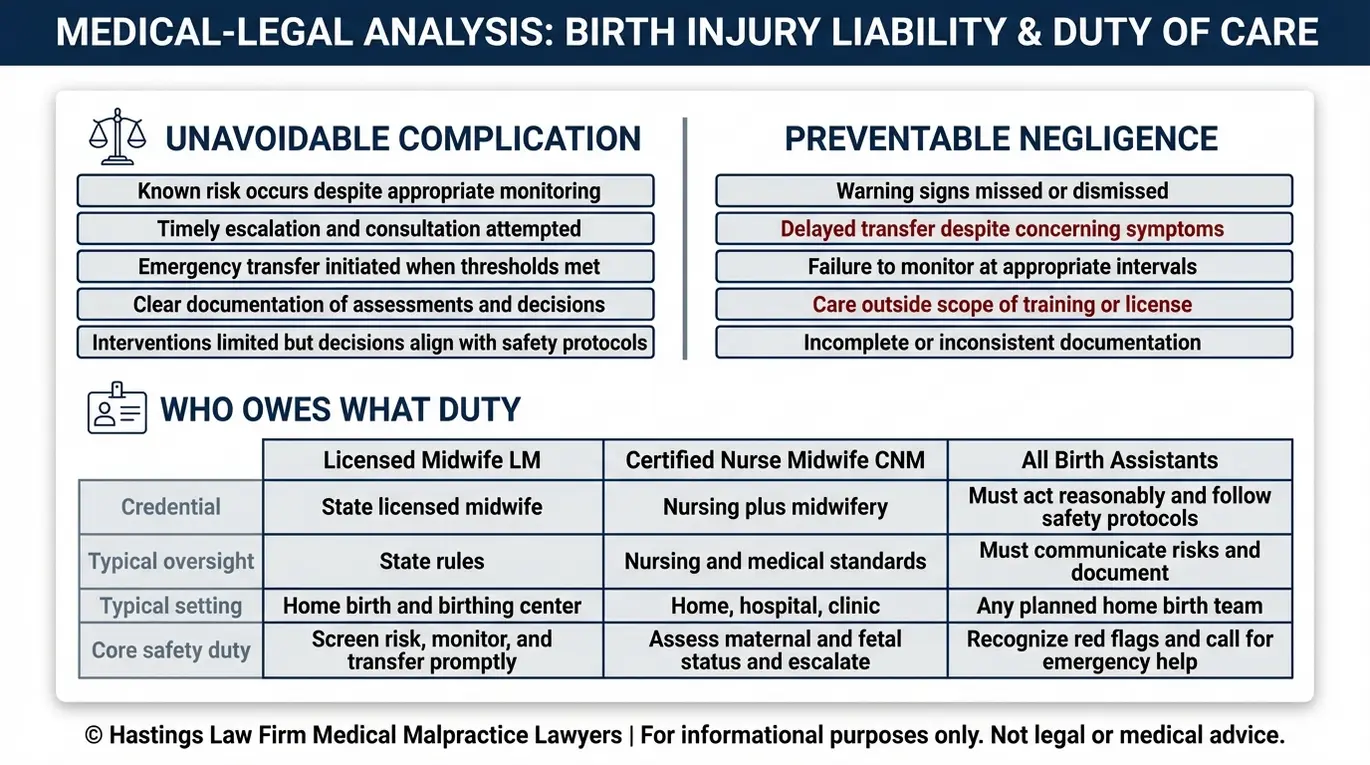
Not every difficult birth is the result of negligence. Childbirth carries inherent risks, and some complications develop without warning despite proper care. The legal distinction turns on whether the provider’s actions, or inactions, fell below what a qualified professional should have done.
An unavoidable complication, like a sudden placental abruption with no prior indicators, is not the same as a preventable injury caused by a provider who ignored warning signs or delayed a hospital transfer. A qualified lawyer for home birth negligence in Arizona understands these complex distinctions. In Arizona, these professional expectations are defined by state statutes and administrative codes.
Arizona law holds two main categories of midwives to professional standards. A Licensed Midwife (LM) is a provider authorized under state licensure to attend births outside of hospitals, with training and practice requirements outlined in the Arizona Administrative Code Title 9 Chapter 16. A Certified Nurse-Midwife (CNM) is an advanced-practice registered nurse with graduate-level education in both nursing and midwifery, often working in collaboration with physicians.
Both have a duty of care to their patients, and both can be held accountable for medical malpractice when a breach of standard of care causes harm. Arizona home birth malpractice lawyers scrutinize these qualifications to establish liability. Professional midwives in Arizona must follow state regulations to ensure patient safety.
If you chose a home birth and something went wrong, it is natural to question your own decision. Many families we speak with carry guilt about their birth plan, even when the evidence clearly points to provider error. Your choice of setting does not excuse medical negligence.
An Arizona home birth negligence lawyer examines the clinical facts, not the birth plan, to determine whether the provider met their professional obligations. The question is never whether you should have been in a hospital. We look at whether your provider acted within the standard of care and responded appropriately when things changed.
Common Examples of Midwife and Doula Negligence
Common forms of home birth negligence include failing to monitor fetal heart rates during labor, accepting high-risk patients who should deliver in a hospital, and delaying transfer when signs of distress appear. Each of these errors can turn a manageable situation into a catastrophic one. Consulting a home birth injury lawyer in Arizona is often the first step toward accountability. Midwives in Arizona must adhere to specific scope-of-practice rules defined by state health agencies.
An Arizona home birth negligence attorney investigates the specific decisions a provider made before and during labor. While every case is different, certain patterns of negligence appear repeatedly:
- Improper patient selection: Accepting mothers with known risk factors, such as twins, breech presentation, prior cesarean section, or gestational diabetes, who are not safe candidates for an out-of-hospital birth. This acceptance of high-risk pregnancies is a red flag that an Arizona midwife negligence attorney looks for immediately.
- Inadequate fetal monitoring: Failing to check fetal heart tones (FHT), the baby’s heartbeat as measured during labor, at appropriate intervals. Without consistent monitoring, signs of fetal distress, also called nonreassuring fetal status, can go undetected until it is too late.
- Scope of practice violations: Attempting interventions or managing complications that fall outside what a midwife is licensed to perform, such as manually repositioning a baby or administering medications without authorization. Attorneys for home birth errors in Arizona often see this overlap with delayed transfer.
- Failure to maintain emergency equipment: Not having basic resuscitation supplies on hand or failing to keep them in working condition.
- Poor documentation: Keeping incomplete or inaccurate records that obscure the timeline of labor and delivery negligence.
A doula, who provides emotional and physical support but is not a medical provider, can also contribute to harm if they discourage a mother from accepting a medically necessary hospital transfer or interfere with clinical decision-making, a factor your Arizona home birth malpractice lawyer will investigate.
These are not theoretical risks. As reported by ABC15 in their investigation of a Mesa birth center, families have filed lawsuits after stillbirths linked to inadequate care at Arizona birthing facilities. When a home birth negligence lawyer in Arizona reviews a case, we look at every decision the provider made and measure it against what a competent midwife should have done.

The Hastings Law Firm Difference
Results matter, but what truly sets us apart is how we achieve them. Every verdict, every settlement, and every Arizona courtroom victory comes from one guiding promise: To treat each client’s fight for justice as if it were our own.
This balance of skill, experience, and empathy reflects our core philosophy that justice should not only compensate the injured, but also make health care safer nationwide.

Failure to Transfer and Delayed Emergency C-Section Risks
Failure to transfer occurs when a home birth provider waits too long to move a laboring mother to a hospital despite clear signs that the birth is not progressing safely, leading to dangerous delays in interventions like an emergency cesarean section (emergency C-section), a surgical delivery performed when the baby or mother is in immediate danger. These delays are among the most common and most devastating forms of home birth negligence in Arizona. An untimely C-section performed too late can result in permanent injury, a scenario an Arizona home birth negligence attorney sees frequently.
Minutes matter when fetal distress is detected. Oxygen deprivation can begin causing irreversible brain damage, including hypoxic-ischemic encephalopathy (HIE), within a narrow window. When a baby’s heart rate shows prolonged decelerations or other warning patterns, the standard of care typically requires the provider to initiate transfer immediately, not to wait and reassess. Home birth injury lawyers in Arizona emphasize that every second counts.
The transition from home to hospital introduces its own risks. Communication breakdowns between the midwife and the receiving hospital team can waste critical time. If the emergency room is not informed of the clinical picture in advance, staff may not be prepared for the urgency of the situation.
A well-prepared midwife establishes a transfer plan before labor even begins, including a relationship with a backup physician and a clear protocol for when to call. A skilled attorney for home birth negligence Arizona will scrutinize this transfer plan. Deciding to move a laboring mother to a hospital is a clinical requirement when risks exceed the capabilities of a home setting.
One unique aspect of home birth cases involves the absence of hospital-based interventions. While hospital births carry risks like Pitocin errors or epidural complications, home births carry the risk of not having these tools at all. Medications like Pitocin, used to strengthen contractions during stalled labor, and epidural pain management are only available in a clinical setting.
When labor stalls or complications develop at home, the only appropriate response is transfer. Deciding to move a laboring mother to a hospital is a clinical requirement when risks exceed the capabilities of a home setting. If a provider delays that decision, the lack of access to these tools becomes part of the negligence, not an excuse for it. Arizona home birth malpractice attorneys argue that these limitations necessitate earlier transfer.
Warning signs that should prompt immediate transfer include:
- Prolonged fetal heart rate decelerations
- Meconium-stained amniotic fluid
- Maternal hemorrhage or signs of shock
- Labor failing to progress after an extended period
- Umbilical cord prolapse
- Signs of uterine rupture in a mother with a prior C-section
Identifying these missed signs is a core task for an Arizona midwife negligence lawyer. An Arizona home birth negligence lawyer evaluates the timeline of these events closely, identifying exactly when the provider should have called for transport and what happened in the gap between recognition and action.

Injuries Caused by Home Birth Errors
Severe and permanent injuries can result from prolonged labor, oxygen deprivation, or physical trauma during a home birth where negligence delayed appropriate care. These outcomes often require a lifetime of medical support. An Arizona home birth injury lawyer can help families assess these future needs. These outcomes can affect a child’s motor skills, speech, and overall development.
Hypoxic-ischemic encephalopathy (HIE), a type of brain injury caused by reduced oxygen and blood flow to the brain during or near the time of birth, is one of the most serious consequences of delayed transfer. HIE can lead to cerebral palsy, cognitive disabilities, seizure disorders, and other forms of permanent brain damage.
When a newborn requires neonatal cooling therapy, a treatment that lowers the baby’s body temperature to slow brain injury, it is a strong clinical indicator that significant oxygen deprivation occurred. Home birth negligence attorneys in Arizona often use these records to prove causation. The Modified Sarnat Exam for Neonatal Encephalopathy published by Stanford Medicine is one of the tools clinicians use to classify the severity of these injuries.
Physical trauma is another category of harm linked to home birth negligence. Shoulder dystocia, a complication where the baby’s shoulder becomes lodged behind the mother’s pelvic bone during delivery, requires specific maneuvers to resolve safely. Unlike hospital scenarios involving forceps injuries or vacuum extractor injuries, home birth trauma often results from panic and lack of skilled personnel.
Without hospital resources and trained personnel, improper handling of a stuck baby can cause brachial plexus injuries, commonly known as Erb’s palsy, resulting in weakness or paralysis of the arm. Your Arizona midwife malpractice lawyer will check if proper maneuvers were attempted. These physical and neurological conditions often require extensive medical intervention and long-term support.
| Injury | Cause | Potential Long-Term Care Needs |
|---|---|---|
| HIE / Brain Damage | Prolonged oxygen deprivation | Physical therapy, cognitive support, 24-hour care, life care plan |
| Cerebral Palsy | Oxygen deprivation during labor | Mobility aids, occupational therapy, adaptive equipment |
| Erb’s Palsy | Shoulder dystocia, improper delivery | Surgery, nerve grafts, ongoing physical therapy |
| Seizure Disorders | Brain injury from oxygen loss | Medication management, neurological monitoring |
An Arizona home birth negligence attorney works with medical experts to connect these injuries directly to the provider’s failure to act, building the evidence needed to establish that the harm was preventable. Lawyers for home birth negligence Arizona ensure no detail is overlooked.
Liability in Home Birth Cases: Who Can You Sue
Potential defendants in an Arizona home birth injury case may include the attending midwife, a birthing center, a backup physician, or any combination of providers who owed a duty of care and failed to meet it. Identifying all liable parties is a job for an Arizona home birth negligence lawyer. Identifying responsible parties is a critical step in building an Arizona medical malpractice claim.
Licensed Midwives (LMs) and Certified Nurse-Midwives (CNMs) carry different levels of training, oversight, and insurance coverage, which affects how claims are pursued. A lay midwife, someone who assists with births without formal state licensure, may also be held liable, though collecting a judgment can be more challenging without malpractice insurance. An attorney for home birth negligence in Arizona can explain these challenges. The definitions and scope of midwifery practice in Arizona are outlined in Arizona Revised Statutes § 32-1601.
Birthing centers can face institutional liability for unsafe protocols, inadequate staffing, or failure to enforce transfer policies. If a center’s own guidelines required hospital transfer under certain conditions and staff did not follow them, the facility itself may be responsible. Arizona home birth malpractice attorneys frequently hold centers accountable for these institutional failures.
Vicarious liability may also apply when a backup physician or OB/GYN had a collaborative agreement with the midwife. If that physician failed to respond to a consultation request, was unreachable during an emergency, or provided negligent guidance during the transfer process, they may share fault.
An Arizona home birth negligence lawyer will investigate these collaborative agreements. A birth injury lawyer examines every relationship in the chain of care to determine where the breakdown occurred and who bears responsibility. Arizona law distinguishes between licensed midwives and nurse-midwives regarding their professional liability.
In wrongful death cases, where a baby or mother did not survive, the scope of liability and the number of responsible parties can expand. Experienced home birth negligence lawyers in Arizona can manage these complex claims. An Arizona birth injury attorney ensures that no potentially liable party is overlooked.
Damages and Compensation in Arizona Birth Injury Lawsuits
Arizona does not cap damages in medical malpractice cases, meaning families can pursue the full scope of compensation their child’s injuries require. This protection is built into the Arizona Constitution, Article 2, Section 31, which prohibits any law that would limit the amount of damages recoverable for personal injury or wrongful death. An Arizona home birth negligence lawyer fights to ensure this right is protected.
Damages in an Arizona home birth negligence case fall into two main categories, which an attorney for home birth negligence in Arizona will calculate:
- Economic damages: These cover measurable financial losses, including past and future medical expenses, rehabilitative therapies, surgeries, assistive devices, home modifications, special education, and lost earning capacity if the child’s injuries affect their ability to work as an adult. Arizona home birth malpractice lawyers often work with economists here.
- Non-economic damages: These compensate for losses that are real but harder to quantify, such as pain and suffering, loss of enjoyment of life, and the emotional toll on the child and family. A home birth injury lawyer Arizona ensures these intangible losses are valued.
For children with severe injuries like cerebral palsy or HIE, a life care plan prepared by medical and economic experts projects the full cost of care across the child’s lifetime. Arizona is one of the few states with constitutional protection against damage caps in these cases.
In wrongful death cases, families may also recover damages for funeral and burial costs, loss of companionship, and the grief associated with losing a child or a mother. An Arizona home birth negligence lawyer works with financial planners, life care specialists, and medical experts to build a damages case that reflects the true cost of the injury, not just immediate bills.
Arizona Statute of Limitations for Birth Injury Claims
Arizona generally requires medical malpractice claims to be filed within two years of the date the injury was discovered or reasonably should have been discovered. But birth injury cases involving a minor child follow different rules that can extend this legal deadline. Consulting a lawyer for home birth negligence Arizona is important to understanding these timelines. Legal deadlines for birth injury claims in Arizona are subject to specific tolling rules for minors.
Under Arizona’s tolling provisions for minors, the statute of limitations is paused until the child reaches age eighteen, giving families until the child’s twentieth birthday to file. This is particularly important in home birth negligence cases, where conditions like cerebral palsy or developmental delays may not become apparent for months or even years after delivery. An Arizona home birth negligence lawyer can explain how this applies to your family.
Even with extended deadlines, acting early protects your case. Medical records can be altered or lost. Witnesses’ memories fade. Equipment logs and communication records from the birth may become harder to obtain over time. Filing information with the Maricopa County Clerk of Superior Court and other Arizona courts requires careful preparation, and an Arizona home birth negligence attorney can ensure your claim is filed correctly and on time.
If you believe your child was injured during a home birth, consulting with an Arizona home birth negligence lawyer sooner rather than later gives your legal team the best opportunity to preserve evidence and build a strong case.
Why Choose Hastings Law Firm for Your Arizona Home Birth Case
Hastings Law Firm is not a general personal injury practice. We handle medical malpractice cases exclusively, and we have done so since 2005. That singular focus means our attorneys, in-house nurse consultants, and patient advocates understand the medical details of birth injury cases at a level that general firms simply cannot match. We are deeply committed to patient safety. As an experienced Arizona home birth negligence lawyer, we know what to look for. Our team focuses on medical malpractice to provide clients with specialized knowledge during birth injury litigation.
Our founder, Tommy Hastings, is Board Certified in Personal Injury Trial Law by the Texas Board of Legal Specialization, a distinction held by fewer than 2% of Texas attorneys. This distinction identifies him as a board certified trial attorney with proven expertise. He has secured significant results in birth injury and medical negligence cases that help protect a child’s future. Every case we accept is prepared from the outset as though it will go to a jury, which gives us a firm negotiation posture that defense attorneys and insurance carriers take seriously. This is why we are a top choice for home birth negligence representation in Arizona.
What sets us apart as an Arizona birth injury attorney team:
- Medical professionals on staff: Our team includes nurse practitioners and Board Certified Patient Advocates who review records, identify charting inconsistencies, and help reconstruct what happened during your labor and delivery.
- Former defense attorneys: Several of our lawyers previously represented hospitals and insurers. They understand the defense playbook and how to counter it effectively. Arizona home birth malpractice lawyers need this insight.
- National expert network: We work with top-tier medical experts across the country who provide objective case reviews and credible testimony.
- Contingency fee structure: You pay no attorney fees or costs unless we recover compensation for your family. Contact our home birth injury lawyer Arizona team today.
Restoring Trust After Medical Betrayal
When a medical error occurs during labor and delivery, the feeling that trust was violated can be overwhelming. We understand that questioning the care you received from a trusted provider is not easy. Many of the families who contact us feel conflicted about holding their midwife or birthing team accountable. That hesitation is normal, and we respect it.
Our role is to give you the facts. We review the medical records, consult with independent experts, and build an honest picture of what happened. If the evidence shows that your provider’s decisions caused harm, we help you take the next step. Our patient advocates are here to support you through the process with transparency and care, because restoring trust starts with the truth.
Contact the Arizona Birth Injury Attorneys at Hastings Law Firm Today for Help
You did not cause what happened to your child. If a midwife, birthing center, or other provider failed to meet the standard of care during your home birth, your family deserves answers and the resources to move forward. A legal evaluation can help clarify whether a medical provider failed to meet the required standard of care.
Hastings Law Firm offers free, confidential case evaluations for Arizona home birth negligence cases. Our team will review your medical records, explain whether you have a viable claim, and outline what the legal process looks like. There is no fee unless we win.
Your child’s future may depend on the decisions you make now. We are here to help you understand your options and to stand beside your family every step of the way. Contact us today to speak with an Arizona birth injury lawyer who will listen and give you an honest assessment of your case.
Frequently Asked Questions About Home Birth Negligence in Arizona


This content was researched and written by the Hastings Law Firm editorial team, which includes attorneys, medical professionals, and experienced researchers. Our writing is informed by internal knowledge and practical experience, and we cross-check critical details against authoritative sources cited throughout. Every piece undergoes human-led fact-checking and legal review. Because legal and medical information can change, if you spot an error, please contact us. Learn more about our content standards and review process on our editorial policy page.

Tommy Hastings, founder of Hastings Law Firm, is a board-certified personal injury trial lawyer (by the Texas Board of Legal Specialization) dedicated exclusively to healthcare injury cases. Since 2001, he has represented injured patients and families in litigation against major hospital systems, pharmaceutical companies, and negligent healthcare providers nationwide. He has handled numerous high-profile cases that have drawn national media attention and resulted in multi-million dollar recoveries.
