


Arizona Hernia Mesh Lawyer
Written by: Hastings Law Firm | Reviewed by: Tommy Hastings | Updated: July 27, 2026
Hernia mesh complications can leave patients with chronic pain, infection, and the need for complex revision surgery that disrupts daily life and recovery. Many claims focus on whether the device itself was defectively designed, manufactured, or marketed rather than whether a surgeon made an error. Problems such as erosion, migration, and inflammatory reactions can develop slowly, which can delay recognition of the cause. If you or a loved one were harmed or worse due to defective hernia mesh in Arizona, contact Hastings Law Firm for a free, confidential case review.
Trusted Arizona Medical Attorneys for Hernia Mesh Injury Claims
What You Should Know About Hernia Mesh Complications Claims in Arizona:
- Recovery can hinge on whether the injury is tied to a defective device rather than a surgical mistake, since many hernia mesh claims target manufacturers under product liability.
- Long term harm can follow mesh failure inside the body, including chronic pain, infection, and the need for revision surgery.
- Medical emergencies can occur when mesh migration leads to bowel obstruction or organ injury.
- Future treatment can become more difficult when adhesions form, since mesh removal is often more complex and higher risk than the original procedure.
- Options can narrow if a claim is not filed in time, since Arizona law limits how long a person has to bring a hernia mesh case.
- Compensation can include medical expenses and lost wages plus pain, suffering, and loss of quality of life.
- Additional damages may be possible in severe misconduct situations, but Arizona law can limit punitive damages when certain regulatory compliance applies.
- Outcomes can vary based on where a case proceeds, since many hernia mesh lawsuits are consolidated in federal MDL while remaining individual cases.
- Critical evidence can be lost if explanted mesh is discarded, since the removed device can be tested for degradation, design flaws, or manufacturing errors.
- Identifying the mesh brand can be essential, since operative reports and hospital records may show the manufacturer and model information.

A Healthcare Focused Law Firm
If you or someone you love is dealing with ongoing pain, infection, or additional surgeries after a hernia mesh implant, you already know something went wrong. What you may not know is whether you have a legal claim against the manufacturer responsible for the device.
At Hastings Law Firm, we focus exclusively on medical cases, and our team includes in-house medical professionals who understand both the clinical and legal sides of defective device injuries. As your Arizona hernia mesh lawyer, we work to identify the device, trace the defect, and pursue full accountability from the companies that put these products on the market.
If you are experiencing complications from hernia mesh, we offer a free, confidential case evaluation. Contact us to review what happened and learn what options may be available to you.
Filing a Defective Hernia Mesh Lawsuit in Arizona
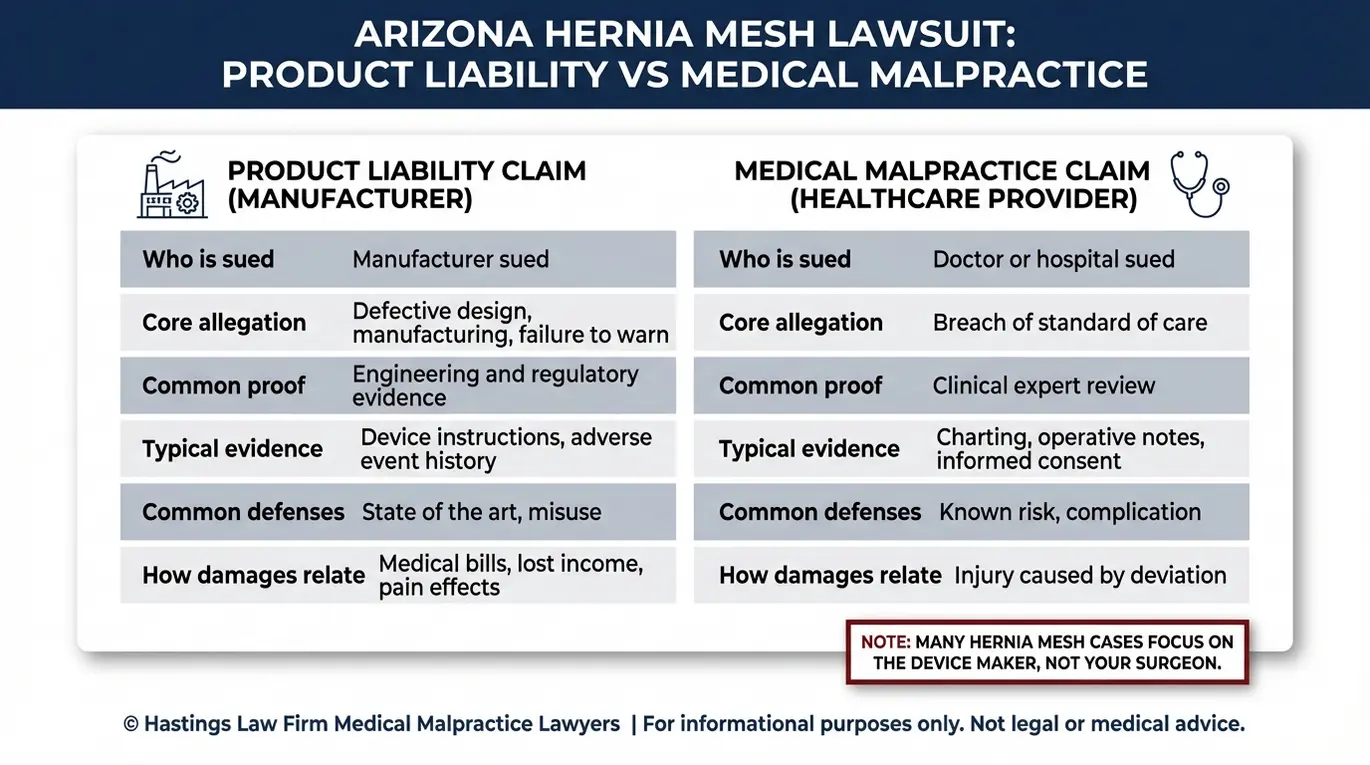
A hernia mesh lawsuit is a legal claim filed against device manufacturers for designing, manufacturing, or marketing a defective product that caused injury. Unlike a standard medical malpractice case where the claim targets a doctor or hospital, most hernia mesh cases fall under product liability. The focus is on the company that made the device, not necessarily the surgeon who implanted it.
This distinction matters. In a product liability claim, you do not need to prove your surgeon made an error during the procedure. Instead, the case centers on negligence at the corporate level: whether the mesh itself was defective and whether the manufacturer failed to ensure its safety before selling it. Because these corporations maintain substantial legal defenses, having a legal team that understands the medical science is critical.
The goal of these cases is to secure compensation for the real harm the defective medical device caused. That often includes the cost of revision surgery, which is a follow-up procedure to remove or replace the failed mesh. Compensation also addresses lost wages, ongoing medical care, and the physical and emotional toll of living with complications.
Proving that a device was defective requires more than medical records alone. Our Arizona hernia mesh lawyers work with a national expert network that includes biomedical engineers, surgeons, and materials scientists. They analyze the device to identify the specific defect and connect it to your injuries. This collaboration between legal strategy and medical expertise is central to how we build each case. If you are considering working with a hernia mesh attorney in Arizona, understanding that your claim likely targets the manufacturer is an important first step.
Common Hernia Mesh Complications and Injuries
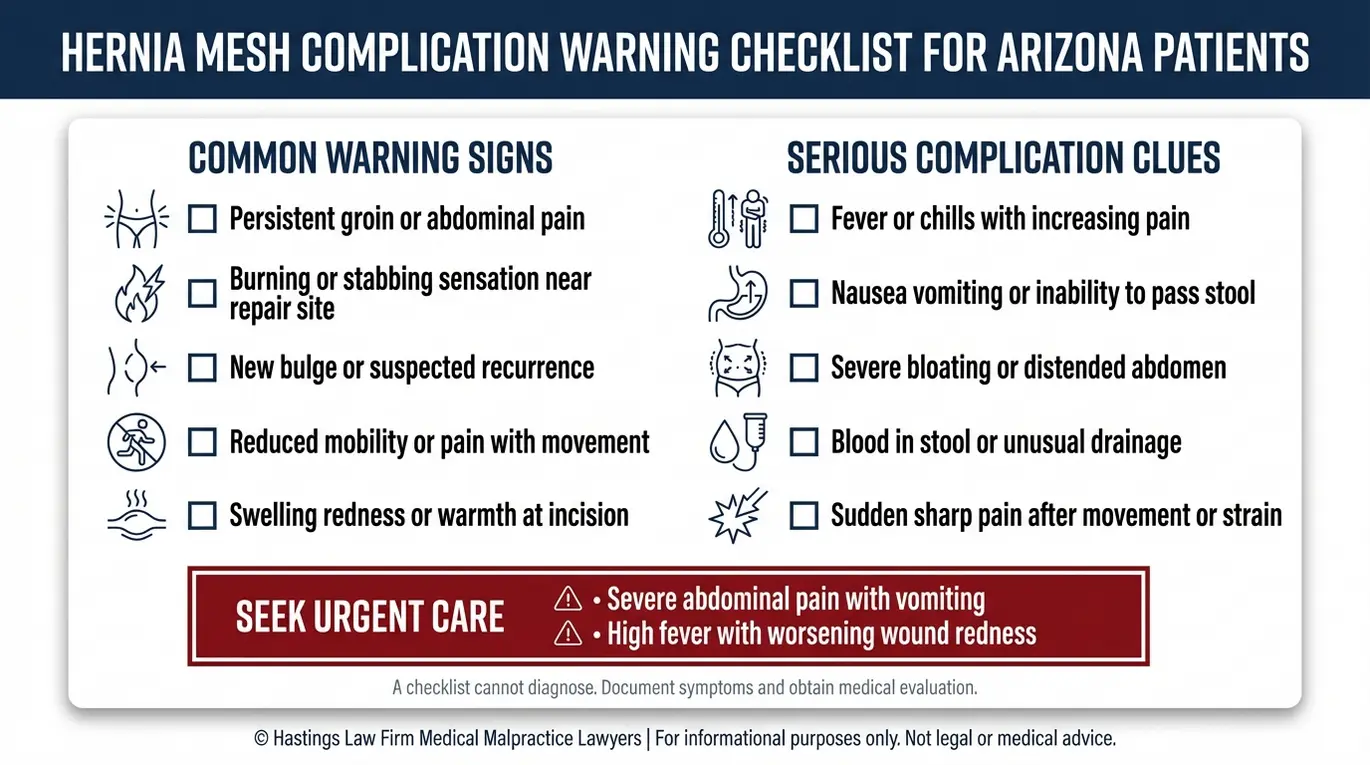
Common complications from defective hernia mesh include chronic pain, infection, mesh migration, and organ perforation, and many of these conditions require revision surgery to address.
These are not minor side effects. When a mesh device fails inside the body, the consequences can be severe and long-lasting.
Mesh erosion occurs when the mesh material gradually wears into surrounding tissue or organs. Over time, the device can break down and embed itself in the bladder, intestines, or abdominal wall. This process is often slow, which means patients may not connect their symptoms to the mesh for months or even years after the original surgery.
Mesh migration is the physical movement of the implant away from its original placement. When the mesh shifts, it can press against nerves, obstruct the bowel, or puncture nearby organs. Bowel obstruction caused by a displaced mesh is a medical emergency that may require immediate surgery.
Adhesions, which are bands of scar tissue that form between internal organs and the mesh, can cause chronic abdominal pain and digestive problems. These adhesions sometimes bind organs together in ways that make future surgical correction extremely difficult. Because of this, revision surgery to remove the mesh is complex and carries a higher risk of complications than the initial procedure.
Persistent infection and inflammation around the implant site are also common. The body may mount a continuous immune response to the foreign material, leading to fever, swelling, and drainage. A study published through PMC/NCBI examining the 10 most used meshes for laparoscopic groin hernia repair highlights the ongoing clinical attention given to complication patterns across widely used products. This reinforces that these failures are often tied to the devices themselves.
If you have experienced any of these issues, an Arizona hernia mesh lawyer can help determine whether your complications are linked to a known defective product.
Symptoms to discuss with your doctor and a lawyer for hernia mesh cases:
- Chronic or worsening abdominal pain at or near the surgical site
- Fever, swelling, or signs of infection that keep returning
- Bloating, nausea, or bowel changes suggesting obstruction
- Being able to feel the mesh through the skin
- Recurrence of the original hernia
- Pain during movement, exercise, or daily activities
The Hastings Law Firm Difference
Results matter, but what truly sets us apart is how we achieve them. Every verdict, every settlement, and every Arizona courtroom victory comes from one guiding promise: To treat each client’s fight for justice as if it were our own.
This balance of skill, experience, and empathy reflects our core philosophy that justice should not only compensate the injured, but also make healthcare safer nationwide.

Understanding Defective Mesh Products and Recalls
Many mesh products were rushed to market through the FDA’s 510(k) clearance process without rigorous human testing, leading to high failure and complication rates.
How the 510(k) Loophole Works
FDA 510(k) clearance is a regulatory pathway that allows a new medical device to reach the market by demonstrating it is “substantially equivalent” to a device already being sold. Unlike full FDA approval, this process does not require the manufacturer to conduct independent clinical trials on human patients. The U.S. Food and Drug Administration’s Premarket Notification 510(k) program was designed to speed access to new devices, but it also created a gap in safety testing that manufacturers utilized for decades.
The result: hernia mesh products made from polypropylene, a type of plastic polymer used in many surgical mesh devices, entered operating rooms without being tested in the human body for long-term safety. Polypropylene can degrade over time inside the body, triggering chronic inflammation, tissue erosion, and device failure. Despite these known risks, manufacturers continued selling these products.
Several major companies have faced legal action, regulatory scrutiny, and product recalls. Ethicon, a subsidiary of Johnson & Johnson, voluntarily withdrew its Physiomesh product after data revealed higher-than-expected complication and reoperation rates. C.R. Bard and its subsidiary Davol have been named in thousands of lawsuits over mesh products linked to erosion and chronic pain. Atrium Medical‘s C-QUR mesh and products from Covidien have also generated significant litigation. You can review current safety notices through the FDA’s Medical Device Recalls and Early Alerts database.
| Manufacturer | Notable Products | Key Issue |
|---|---|---|
| Ethicon (J&J) | Physiomesh | Voluntary withdrawal; high failure and complication rates |
| C.R. Bard / Davol | Various mesh lines | Erosion, chronic pain, thousands of lawsuits |
| Atrium Medical | C-QUR mesh | Inflammatory coating reactions |
| Covidien | Various mesh lines | Device failure, tissue reactions |
An experienced Arizona hernia mesh lawyer can identify which product was used in your surgery and connect it to known defect patterns.
Technical Failures: Memory Recoil Rings and Coatings
Hernia mesh is a medical implant used to repair damaged tissue. Some mesh devices failed because of specific design components. The Kugel mesh, for example, included memory recoil rings, small plastic rings embedded in the mesh designed to help it spring open and lay flat during implantation. These rings were prone to breaking inside the body, creating sharp fragments that could perforate the bowel or abdominal wall.
Atrium’s C-QUR mesh used an Omega-3 fatty acid coating, a layer of fish oil-derived material applied to the mesh surface intended to reduce inflammation and adhesion formation. Instead, the coating triggered severe inflammatory reactions in many patients, causing pain, infection, and the need for surgical removal.
These design-level failures are central to many product liability claims and illustrate why device-specific investigation matters in every case.
Legal Basis for Claims: Proving Liability
Claims against hernia mesh manufacturers are generally based on three legal theories: design defects, manufacturing defects, or failure to warn doctors and patients of known risks.
Under Arizona product liability law, as outlined in the Arizona Revised Statutes, manufacturers have a legal duty to design safe products and produce them without error. They must also clearly communicate known risks to both medical providers and patients.
- Failure to warn: The manufacturer knew about specific risks associated with the mesh but did not adequately disclose those risks to surgeons or patients. If a surgeon was never told about high complication rates, they could not factor that information into their decision-making.
- Design defect: The mesh was inherently dangerous because of how it was designed. For example, a product that reacts with human tissue or degrades over time may be considered defective regardless of how carefully it was manufactured.
- Manufacturing defect: A specific batch or lot of mesh was contaminated, damaged, or improperly produced, making it different from the manufacturer’s own specifications.
Your Arizona hernia mesh lawyer will evaluate your medical records, the specific device used, and the manufacturer’s history to determine which theory, or if the manufacturer’s negligence, supports your claim.
Preserving Explanted Mesh as Evidence
If you have already had revision surgery, or if removal is being planned, preserving the explanted mesh is one of the most important steps you can take for your legal case. The explanted mesh is the device that was surgically removed from your body.
The physical mesh is critical physical evidence of the defect. It can be tested for material degradation, design flaws, and manufacturing errors. Ask your surgeon to send the removed device to pathology for specimen preservation, the formal process of cataloging and storing surgical tissue or devices for future analysis. If the mesh is discarded, a critical piece of evidence may be lost permanently.
Contact an attorney before your revision surgery whenever possible so the preservation process can be coordinated in advance.
Compensation Available for Arizona Mesh Victims
Patients harmed by defective hernia mesh may recover economic damages for medical bills and lost wages, as well as non-economic damages for pain, suffering, and loss of quality of life.
The specific value of any claim depends on the severity of the injury, the number of corrective procedures needed, and the extent to which the complications have affected your daily life. An Arizona hernia mesh lawyer will work to document every category of loss so that nothing is left out of your claim.
Economic damages cover the financial costs you can calculate directly:
- Past and future medical expenses, including revision surgeries, hospital stays, and rehabilitation
- Lost wages from time missed at work during treatment and recovery
- Reduced earning capacity if your injuries limit your ability to return to your previous job
Non-economic damages address the personal toll of the injury:
- Chronic pain and physical limitation
- Mental anguish, anxiety, or depression related to ongoing complications
- Loss of consortium, which reflects the impact on your relationship with your spouse or partner
- Diminished quality of life
Punitive damages may also be available in cases where the evidence supports that the manufacturer engaged in especially harmful conduct. This may include concealing safety data or continuing to sell a product after learning it was dangerous. Under Arizona law, punitive damages may be pursued when a manufacturer acted with intent to harm, ill will, or conscious disregard for a substantial risk of harming others. However, Arizona Revised Statutes § 12-689 provides certain exemptions from punitive damages for manufacturers who complied with applicable government standards and regulations.
A hernia mesh attorney can evaluate the full scope of your losses and identify every category of damages that may apply to your case. While many cases result in settlements before trial, we prepare every file as if it will go to court to maximize your potential recovery.
Arizona Statute of Limitations and MDL Process
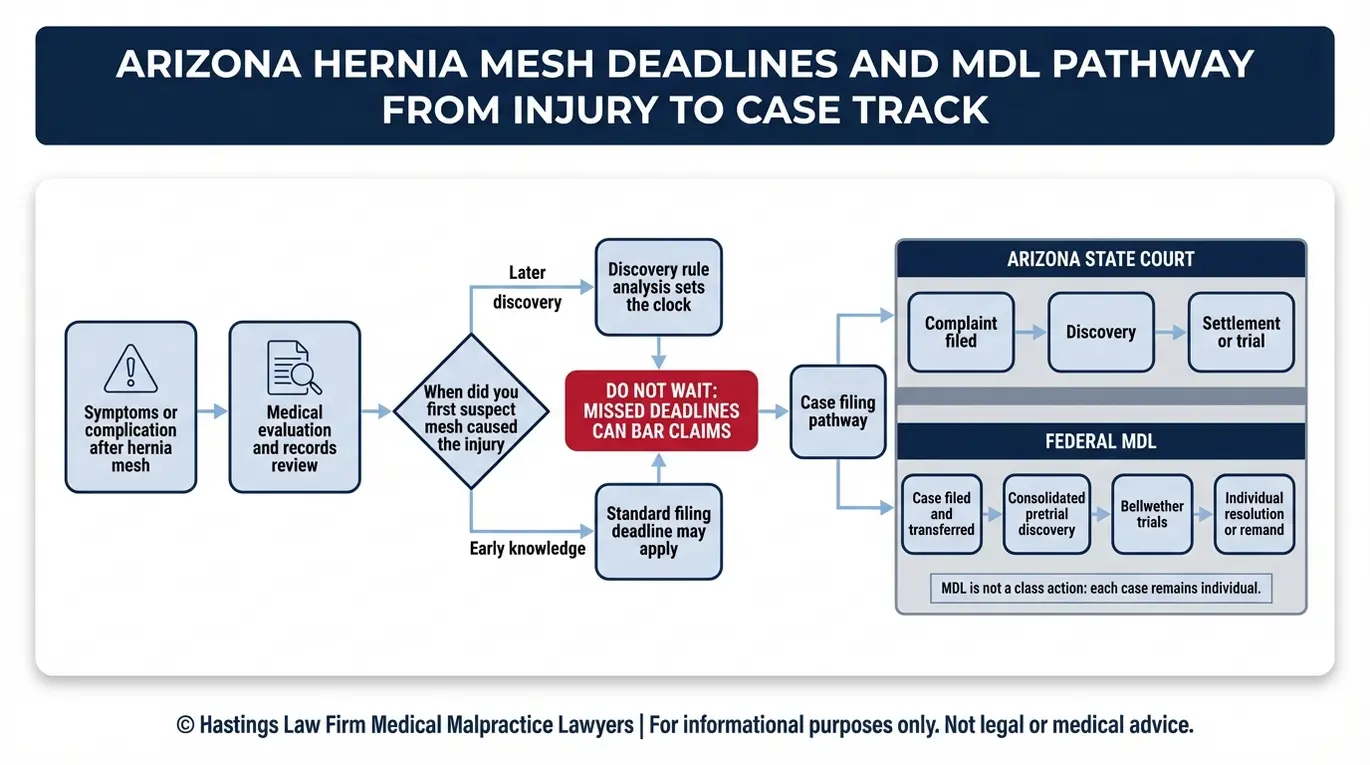
Arizona law strictly limits the time you have to file a hernia mesh claim, and the deadline often depends on when you first discovered, or reasonably should have discovered, that the mesh caused your injury.
Arizona’s statute of limitations for personal injury and product liability claims is generally two years. However, because hernia mesh complications can develop slowly, the discovery rule may apply. The discovery rule starts the clock on the date you knew, or should have known, that the mesh was responsible for your symptoms. This distinction is vital, which is why consulting an Arizona hernia mesh lawyer early matters.
Many hernia mesh lawsuits are consolidated into what is known as MDL, or Multidistrict Litigation. An MDL is a legal process where individual lawsuits with similar facts are grouped together in a single federal court for pretrial proceedings to increase efficiency. It is not a class action. Each person’s case remains an individual lawsuit with its own facts, injuries, and potential settlement.
pretrial proceedings like discovery and expert testimony avoid repeating the same process thousands of times across different courtrooms. Within an MDL, bellwether trials are selected as test cases. These are individual trials chosen to go before a jury first, and their outcomes help both sides evaluate the strength of the remaining claims.
Bellwether results often influence whether and how settlement negotiations move forward. The United States Judicial Panel on Multidistrict Litigation’s transfer order for the Ethicon Physiomesh MDL (MDL-2782) is one example of how these cases are organized at the federal level. Whether your case belongs in an Arizona state court or a federal MDL depends on the product involved and the specifics of your injury. We evaluate each case individually to determine the best path forward.
Contact the Arizona Medical Device Attorneys at Hastings Law Firm Today for Help
You deserve to obtain the truth about why your hernia mesh failed and who should be held accountable. At Hastings Law Firm, those answers drive everything we do. Our team of attorneys, nurse consultants, and medical experts is built for exactly these cases. We believe that holding manufacturers accountable is how we help prevent the same harm from reaching another patient.
We represent clients on a contingency fee basis, which means you pay no attorney fees or costs unless we recover compensation for you. There is no financial risk in reaching out.
If you or a loved one is suffering from hernia mesh complications, our Arizona hernia mesh lawyers are ready to listen. Contact our hernia mesh law firm today for a free, confidential case evaluation. Let us review your medical records, identify the device, and explain your legal options.
Frequently Asked Questions About Hernia Mesh in Arizona


This content was researched and written by the Hastings Law Firm editorial team, which includes attorneys, medical professionals, and experienced researchers. Our writing is informed by internal knowledge and practical experience, and we cross-check critical details against authoritative sources cited throughout. Every piece undergoes human-led fact-checking and legal review. Because legal and medical information can change, if you spot an error, please contact us. Learn more about our content standards and review process on our editorial policy page.

Tommy Hastings, founder of Hastings Law Firm, is a board-certified personal injury trial lawyer dedicated exclusively to healthcare injury cases. Since 2001, he has represented injured patients and families in litigation against major hospital systems, pharmaceutical companies, and negligent healthcare providers nationwide. He has handled numerous high-profile cases that have drawn national media attention and resulted in multi-million dollar recoveries. He draws on that experience in his writing, helping readers understand how these cases work and what options may be available to them.
