


Arizona Hematologist Malpractice Lawyer
Hematology care requires careful diagnosis, close monitoring, and precise medication management. When a blood specialist makes an error, the results can be devastating and sometimes irreversible, affecting health, finances, and a family’s sense of security. Common concerns involve missed or delayed diagnoses, anticoagulant mistakes, chemotherapy dosing problems, and overlooked lab results, with disputes often focusing on whether the standard of care was met and whether the error caused the harm. If you or a loved one were harmed or worse due to hematologist malpractice in Arizona, contact Hastings Law Firm for a free, confidential case review.

Last Updated: July 27, 2026
Trusted Legal Representation for Healthcare Negligence in Arizona
When a blood specialist’s error changes the course of your health or the life of someone you love, the experience can feel isolating. Hematology, the branch of medicine focused on blood disorders and blood cancers, demands precision at every stage of diagnosis and treatment. Errors in this field can lead to devastating, sometimes irreversible consequences.
If you suspect that a hematologist’s negligence caused serious harm, you are not wrong for asking questions. You deserve clear answers about what happened and whether the care you received fell below what the medical community expects.
As an Arizona hematologist malpractice lawyer, Hastings Law Firm focuses exclusively on medical malpractice cases. Our team includes in-house medical professionals, such as nurse practitioners and board-certified patient advocates, who understand the clinical details behind blood disorder claims. If you or a loved one has been harmed, we can review your situation in a free, confidential evaluation and explain your legal options.

Common Errors Committed by Arizona Hematologists
A hematologist, a physician who specializes in diagnosing and treating blood disorders, may be liable for malpractice if they fail to diagnose blood cancers, improperly manage anticoagulant medication, commit chemotherapy dosing errors, or miss signs of critical anemia types. These errors can cause lasting harm or death, and each one may represent a breach of the standard of care, the level of treatment a competent specialist would provide under similar circumstances.
Our team of attorneys and medical professionals at Hastings Law Firm investigates hematology malpractice cases by examining the specific clinical decisions that led to patient harm. As an Arizona hematologist malpractice lawyer, we see certain patterns of negligence repeatedly in these claims.
Common hematologist errors include:
- Failure to diagnose blood cancers. Leukemia and lymphoma can present with vague symptoms such as fatigue, bruising, or recurrent infections. A hematologist who dismisses these symptoms without ordering appropriate blood work or a bone marrow biopsy may allow a treatable cancer to advance to a stage where options are limited.
- Delayed or missed anemia diagnosis. A complete blood count (CBC), a routine blood test measuring red cells, white cells, and platelets, can reveal critical abnormalities early. When a hematologist fails to follow up on abnormal CBC results or misidentifies the type of anemia, improper treatment may follow.
- Anticoagulant mismanagement. Anticoagulants, commonly known as blood thinners, require careful dosing and regular monitoring. Failure to track a patient’s international normalized ratio (INR), a lab value that measures how quickly blood clots, can lead to uncontrolled hemorrhage or stroke.
- Chemotherapy dosing errors. Chemotherapy drugs are dosed based on precise calculations. An error in dosage or administration schedule can cause severe toxicity, organ damage, or suppress the immune system to dangerous levels.
- Ignoring critical lab results or patient symptoms. When a hematologist overlooks worsening bloodwork or dismisses patient-reported symptoms, conditions like sickle-cell anemia or hemophilia can spiral into medical emergencies.
Systematic Medication and Drug Administration Errors
Hematology often involves high-risk drugs where even a small dosing error can be fatal. Chemotherapy agents and anticoagulants sit among the most dangerous medications prescribed in clinical practice. These drugs require strict drug administration protocols for ordering, preparation, and administration.
When those protocols break down, the consequences for patients can be severe. A hematologist malpractice attorney examines whether the prescribing physician ordered the correct drug and dosage, whether pharmacy staff prepared it accurately, and whether nursing teams administered it according to established safety checks.
At Hastings Law Firm, our in-house nursing staff and patient advocates know how to read medication administration records and identify where drug protocols failed. If you suspect a medication error contributed to harm during hematology treatment, an Arizona hematologist malpractice lawyer at our firm can evaluate the clinical timeline and determine whether liability exists.

Negligence in Treating Blood Disorders and Cancer
Negligence in treating blood disorders occurs when a physician fails to recognize specific subtypes of anemia or delays the diagnosis of blood cancers, allowing the condition to progress to an untreatable stage. In hematology, timing is everything. A missed window of weeks or months can mean the difference between remission and terminal illness.
Blood cancers like leukemia and lymphoma are highly responsive to early intervention. When a hematologist delays ordering a bone marrow biopsy and aspiration, a procedure that extracts and examines bone marrow tissue to confirm or rule out cancer, the disease may advance beyond the point where treatment is effective. A hematology malpractice attorney looks closely at the diagnostic timeline to identify where delays occurred and whether earlier action could have changed the outcome.
Anemia is another area where misdiagnosis carries serious risks. The condition is not one-size-fits-all. Aplastic anemia, where the bone marrow stops producing enough blood cells, requires a fundamentally different treatment approach than iron-deficiency anemia.
A peripheral blood smear, a lab test where blood cells are examined under a microscope for shape and size abnormalities, can help distinguish between subtypes. Treating the wrong type of anemia can worsen the underlying condition and delay the correct therapy. Clotting disorders like hemophilia and thrombophilia also demand accurate, timely diagnosis. Failure to manage these conditions properly can lead to catastrophic bleeding episodes or dangerous blood clots, including deep vein thrombosis (DVT) and pulmonary embolism.
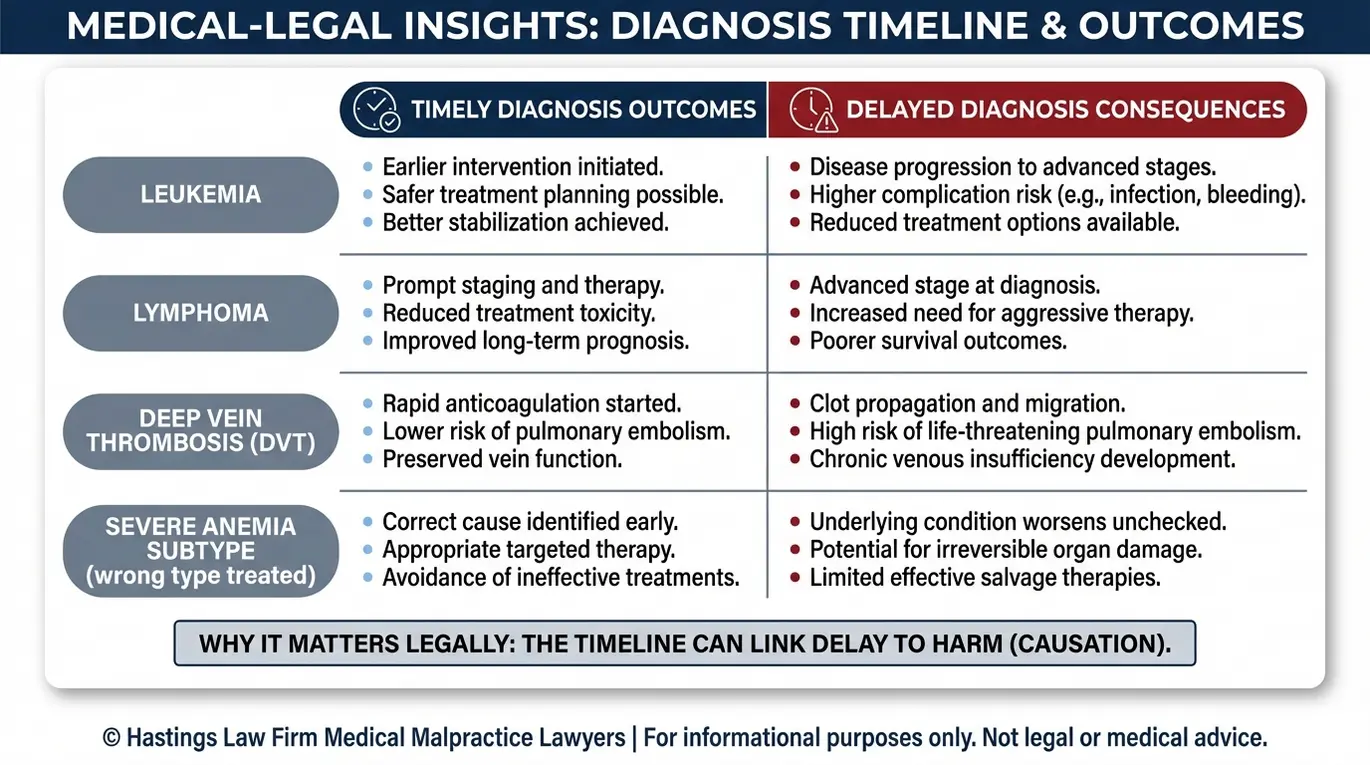
The following table illustrates why diagnostic timing matters so much in hematology cases:
| Condition | Timely Diagnosis Outcomes | Delayed Diagnosis Consequences |
|---|---|---|
| Lymphoma | High remission rates with early-stage chemotherapy or radiation | Progression to advanced stages with significantly reduced survival |
| Leukemia | Targeted therapy can achieve remission when caught early | Cancer spreads to organs; treatment options narrow dramatically |
| Deep Vein Thrombosis (DVT) | Anticoagulant therapy prevents clot migration | Pulmonary embolism, stroke, or death |
| Aplastic Anemia | Bone marrow transplant or immunosuppressive therapy can restore function | Severe infection, uncontrolled bleeding, organ failure |
| Sickle-Cell Crisis | Proper pain management and hydration reduce organ damage | Repeated crises lead to stroke, chronic organ damage |
A lawyer for blood disorder negligence at Hastings Law Firm works alongside medical experts to reconstruct the clinical timeline and determine whether a hematologist’s failure to act changed the trajectory of your condition.
The Hastings Law Firm Difference
Results matter, but what truly sets us apart is how we achieve them. Every verdict, every settlement, and every Arizona courtroom victory comes from one guiding promise: To treat each client’s fight for justice as if it were our own.
This balance of skill, experience, and empathy reflects our core philosophy that justice should not only compensate the injured, but also make health care safer nationwide.

Establishing the Standard of Care in Hematology Claims
To prove a malpractice claim, your attorney must define the prevailing standard of care, what a prudent hematologist would have done under similar circumstances, and demonstrate exactly how your provider breached that duty of care. Founded by board-certified trial attorney Tommy Hastings, our firm identifies these breaches by comparing provider actions to established clinical protocols.
Hematologists are held to a higher standard than general practitioners. Because they are trained specialists, the law measures their conduct against what other qualified hematologists in the same field would consider acceptable. This distinction matters. A family doctor who misses a blood cancer diagnosis may be judged differently than a board-certified hematologist who had the training and tools to catch it.
Professional bodies like the American Board of Internal Medicine (ABIM) and the American Society of Hematology publish clinical practice guidelines and certification standards that can help inform what reasonable care looks like. These standards are not static; they evolve with new research and therapies. A hematologist is expected to stay current with these advancements to ensure patients receive the most effective care available.
Proving that a breach occurred requires qualified medical expert testimony. In hematology cases, an expert witness must be a practicing or teaching hematologist who can explain how the provider’s actions fell short. Concepts like body surface area (BSA), the measurement used to calculate safe chemotherapy doses, and myelosuppression, dangerously low blood cell counts caused by treatment, often require expert interpretation for a jury to understand.
At Hastings Law Firm, we maintain relationships with top-tier medical experts across the country who specialize in hematology and oncology. Our attorneys, including former defense counsel who know how the other side builds its case, work with these experts from the earliest stages of investigation. When you work with a malpractice lawyer at our firm, expert analysis is built into the process from day one.
Proving Liability Under Arizona Medical Malpractice Laws
Liability is established by proving the four elements of negligence: a duty of care existed, the hematologist breached that duty, the breach directly caused the injury (causation), and actual damages resulted. Each element must be supported by evidence and, typically, by expert medical testimony.
Here is how we approach each element when building a case:
- Duty of care. A doctor-patient relationship must exist. Once a hematologist agrees to evaluate or treat you, they owe you a legal duty to provide care consistent with accepted medical standards.
- Breach of duty. We examine whether the hematologist’s decisions fell below the standard of care. This can include missed lab results, failure to order diagnostic tests, improper treatment protocols, or inadequate follow-up.
- Causation. This is often the most contested element. Under Arizona law, your attorney must prove proximate cause, meaning the hematologist’s error directly led to the harm. Defense attorneys frequently argue that the patient’s underlying condition, not the doctor’s error, caused the injury.
- Damages. You must demonstrate actual harm, whether physical, financial, or emotional.
Under A.R.S. § 12-563, a medical malpractice claim in Arizona requires the injured party to prove that the healthcare provider failed to exercise the degree of care expected of a reasonably competent specialist in the same field. This legal process guides how we prepare every hematology negligence case.
Issues of hospital and facility negligence can also apply. If a hospital lab delayed processing critical bloodwork, or if nursing staff failed to communicate abnormal results to the treating hematologist, the facility itself may share liability. Protocols for reporting critical values like panic-level platelet counts must be strictly followed to prevent patient harm. Our Arizona hematologist malpractice lawyer team investigates every link in the chain of care to identify all responsible parties.

Compensation for Victims of Hematology Negligence in Arizona
Arizona patients harmed by hematology negligence may recover economic damages for medical bills and lost wages, as well as non-economic damages for pain, suffering, and loss of enjoyment of life, with no constitutional cap on the amount awarded. These legal remedies are designed to address the profound impact a medical error has on a patient’s life.
Economic damages cover the measurable economic losses and financial impact of the injury. This includes past and future medical expenses, lost income, rehabilitation costs, and the ongoing expense of treating permanent blood disorders caused by negligence. For patients who now require lifelong blood transfusions or cancer treatment they might have avoided, these costs can be substantial. Factor replacement therapy for hemophilia, for instance, can cost hundreds of thousands of dollars annually, creating a financial burden that no family should have to bear alone.
Non-economic damages address the personal toll: chronic pain, emotional distress, loss of relationships, and diminished quality of life. Unlike many states that limit these awards, Arizona’s constitution prohibits caps on personal injury or wrongful death damages. Juries are free to award compensation that reflects the full scope of what was lost.
When hematology negligence results in death, surviving family members may pursue a wrongful death claim. These cases account for the loss of companionship, financial support, and guidance the deceased would have provided. Funeral and burial expenses are also recoverable, helping families manage the immediate financial strain of their loss.
Arizona also applies comparative negligence principles, which means a patient’s recovery may be reduced if they are found partially responsible. An experienced Arizona hematologist malpractice lawyer can anticipate this defense strategy and build a case that addresses it directly.
Contact the Arizona Doctor Malpractice Attorneys at Hastings Law Firm Today for Help
If you or someone in your family has suffered harm because of a blood specialist’s error, you deserve honest answers about what happened and whether negligence was involved. Our legal team specializes in evaluating these medical events to determine if malpractice occurred. These cases have strict filing deadlines under Arizona law, and critical medical records can become harder to obtain over time.
Hastings Law Firm offers a free, confidential case evaluation led by a patient advocate. Our team of attorneys, nurses, and medical consultants focuses exclusively on medical malpractice. We work on a contingency fee basis, which means you pay no attorney fees or costs unless we recover compensation on your behalf.
Contact us today to speak with a Board Certified attorney or patient advocate about your situation. Let us help you find the answers you deserve.
Frequently Asked Questions About Hematologist Malpractice in Arizona


This content was researched and written by the Hastings Law Firm editorial team, which includes attorneys, medical professionals, and experienced researchers. Our writing is informed by internal knowledge and practical experience, and we cross-check critical details against authoritative sources cited throughout. Every piece undergoes human-led fact-checking and legal review. Because legal and medical information can change, if you spot an error, please contact us. Learn more about our content standards and review process on our editorial policy page.

Tommy Hastings, founder of Hastings Law Firm, is a board-certified personal injury trial lawyer dedicated exclusively to healthcare injury cases. Since 2001, he has represented injured patients and families in litigation against major hospital systems, pharmaceutical companies, and negligent healthcare providers nationwide. He has handled numerous high-profile cases that have drawn national media attention and resulted in multi-million dollar recoveries. He draws on that experience in his writing, helping readers understand how these cases work and what options may be available to them.
