


Arizona Gynecologist Malpractice Lawyer
Gynecologist and obstetrician negligence can leave patients facing lasting physical harm, emotional trauma, and uncertainty about whether an injury was preventable. Problems in diagnosis, surgery, pregnancy care, delivery, or postpartum monitoring can escalate quickly and may lead to catastrophic outcomes or worse. Arizona law focuses on whether care fell below the medical standard and whether that failure directly caused measurable damages. Understanding these issues can help families recognize when a serious medical injury may involve negligence. If you or a loved one were harmed or worse due to gynecologist or obstetrician negligence in Arizona, contact Hastings Law Firm for a free, confidential case review.

Last Updated: July 27, 2026
Trusted Legal Representation for Women’s Health Physician Negligence
When a gynecologist or obstetrician fails to provide safe, competent care, the consequences can change a woman’s life forever. Injuries from missed diagnoses, surgical mistakes, and preventable birth complications leave patients dealing with physical pain, emotional trauma, and deep uncertainty about what went wrong and who is responsible.
You deserve answers, and you deserve a legal team that understands both the medicine and the law behind your case. Hastings Law Firm is a medical malpractice practice built specifically for cases like these. Our team includes experienced trial attorneys, in-house nurse consultants, and former defense lawyers who know how hospitals and insurers respond to claims. Founded by board-certified trial attorney Tommy Hastings, our firm focuses exclusively on medical negligence and prepares every case for trial from day one.
If you believe you or a loved one was harmed by a gynecologist’s error, contact us for a free, confidential case evaluation. There is no fee unless we recover compensation for you.

Understanding Malpractice in Gynecology and Obstetrics
Gynecological malpractice occurs when a healthcare provider deviates from the accepted medical standard of care during reproductive health treatment, surgery, or childbirth, directly causing injury or death to the patient. Standard of care refers to the level of skill and care that a reasonably competent provider would use under similar circumstances. To pursue a valid claim, it is not enough to show that something went wrong. The question is whether the provider’s actions fell below what a reasonably competent OB/GYN, an obstetrician-gynecologist who specializes in both pregnancy and reproductive health, would have done.
Arizona law sets a clear framework for these cases. Under Arizona Revised Statutes § 12-563, a patient must prove three elements: that the provider failed to meet the medical standard of care, that this failure was the direct cause of the injury, and that the injury resulted in measurable damages. Each element must be supported by qualified medical testimony.
One of the most important distinctions Arizona gynecologist malpractice lawyers evaluate is the difference between a known complication and preventable negligence. Every medical procedure carries some inherent risk. A known complication is an outcome that can occur even when the physician does everything correctly. Negligence, on the other hand, involves a failure to act as a competent specialist would have acted given the same clinical information.
This distinction matters because OB/GYN medicine spans two related but distinct disciplines. Obstetrics covers pregnancy, labor, and delivery, including the management of high-risk pregnancy, a situation involving conditions that threaten the health of the mother or fetus, such as preeclampsia or fetal distress. Gynecology addresses broader reproductive health, including diagnostic testing, hormone management, and surgical procedures. As Arizona gynecologist malpractice lawyers, we must understand both sides of the specialty to identify where the standard of care was breached and connect that breach to the harm the patient suffered.

Frequent Types of Gynecologist Negligence in Arizona
Common forms of negligence include surgical errors during hysterectomies, failure to diagnose reproductive cancers, improper prenatal care, and medication errors causing hormonal or physical injury. We focus on identifying patterns of negligence that emerge in malpractice lawsuits against gynecologists to help families understand their legal options.
Diagnostic Errors
Diagnostic errors happen when a healthcare provider fails to correctly identify a medical condition in a timely manner. Missed or delayed diagnoses are among the most devastating forms of OB/GYN negligence. A Pap smear, a screening test that collects cells from the cervix to detect abnormalities, is one of the most effective tools for early detection of cervical cancer. When a provider fails to follow up on abnormal Pap smear results, delays ordering a biopsy of a suspicious mass, or misinterprets imaging studies, the consequences can be severe.
According to the National Academies report on Improving Diagnosis in Health Care, diagnostic errors affect an estimated 12 million Americans each year in outpatient settings alone. In gynecology, these errors can mean the difference between catching cervical cancer or ovarian cancer at a treatable stage and discovering it after it has spread.
Surgical Errors
Surgical negligence involves mistakes made during an operative procedure. Gynecological surgery, including hysterectomy (surgical removal of the uterus) and laparoscopic procedures, requires precision and careful technique. Negligence during these operations can include nicking the bladder or bowel, leaving surgical instruments inside the body, or making critical anesthesia errors. These mistakes often require additional corrective surgeries and can lead to long-term disability.
Obstetric Negligence
Obstetric negligence involves errors made during pregnancy, labor, or the delivery of a child. Mismanagement during pregnancy and labor puts both mother and baby at risk. This can include failure to identify or properly manage a high-risk pregnancy involving preeclampsia, inadequate fetal monitoring during labor, or delayed decisions about emergency interventions such as a C-section.
| Type of Procedure/Care | Examples of Negligence |
|---|---|
| Diagnostic screening (Pap smear, imaging) | Failure to follow up on abnormal results; delayed biopsy |
| Gynecological surgery (hysterectomy, laparoscopy) | Organ perforation; retained surgical instruments; anesthesia errors |
| Prenatal care | Failure to identify high-risk pregnancy; inadequate monitoring of preeclampsia |
| Labor and delivery | Misuse of Pitocin; delayed C-section; failure to respond to fetal distress |
Postpartum Negligence and Maternal Mortality Risks
Postpartum care refers to the medical monitoring required immediately after childbirth. The period after delivery or a gynecological procedure is a medically vulnerable window that demands careful monitoring. Postpartum hemorrhage, excessive bleeding after childbirth, remains one of the leading preventable causes of maternal death. When providers fail to recognize or respond to signs of uncontrolled bleeding, the patient’s condition can deteriorate rapidly.
Postpartum sepsis, also called puerperal sepsis, a life-threatening infection that can develop after delivery or surgery, typically presents with early warning signs such as fever, rapid heart rate, and abdominal pain. When clinical staff overlook these symptoms or delay treatment with antibiotics, an infection that might have been managed can escalate into septic shock and organ failure. As Arizona gynecologist malpractice lawyers, we evaluate whether providers followed established protocols for postpartum monitoring and whether earlier intervention could have prevented the harm.
The Hastings Law Firm Difference
Results matter, but what truly sets us apart is how we achieve them. Every verdict, every settlement, and every Arizona courtroom victory comes from one guiding promise: To treat each client’s fight for justice as if it were our own.
This balance of skill, experience, and empathy reflects our core philosophy that justice should not only compensate the injured, but also make health care safer nationwide.

Identifying Injuries Caused by Gynecologic Errors
Negligence in women’s healthcare can result in catastrophic injuries including uterine rupture, permanent infertility, stage 4 cancer progression due to delay, septic shock, and wrongful death. The full scope of harm often extends well beyond the initial error.
Physical injuries from gynecologic negligence can include:
- Organ perforation or damage during surgery, sometimes requiring removal of healthy organs
- Uterine rupture, a tear in the wall of the uterus that can cause life-threatening hemorrhage
- Infertility, the permanent inability to conceive, resulting from surgical errors, undiagnosed infections, or unnecessary removal of reproductive organs
- Uterine infection or systemic sepsis from unmonitored postoperative or postpartum conditions
- Wrongful death of the patient or, in obstetric cases, the infant
When a diagnosis is missed or delayed, the consequences compound over time. A patient whose ovarian cancer was not caught on routine screening may go from a treatable early stage to a terminal diagnosis within months. That window of lost treatment opportunity is a central element in many cases we evaluate.
The emotional impact deserves recognition as well. A woman who loses the ability to have children because of a preventable surgical error carries psychological harm that can last a lifetime. Research published in a systematic review on post-traumatic stress following childbirth (PubMed Central) confirms that traumatic medical experiences during reproductive care can lead to lasting PTSD, anxiety, and depression. An OB/GYN negligence lawyer understands that these non-physical injuries are real, measurable, and compensable under Arizona law.

The Investigative Process Proving Medical Liability
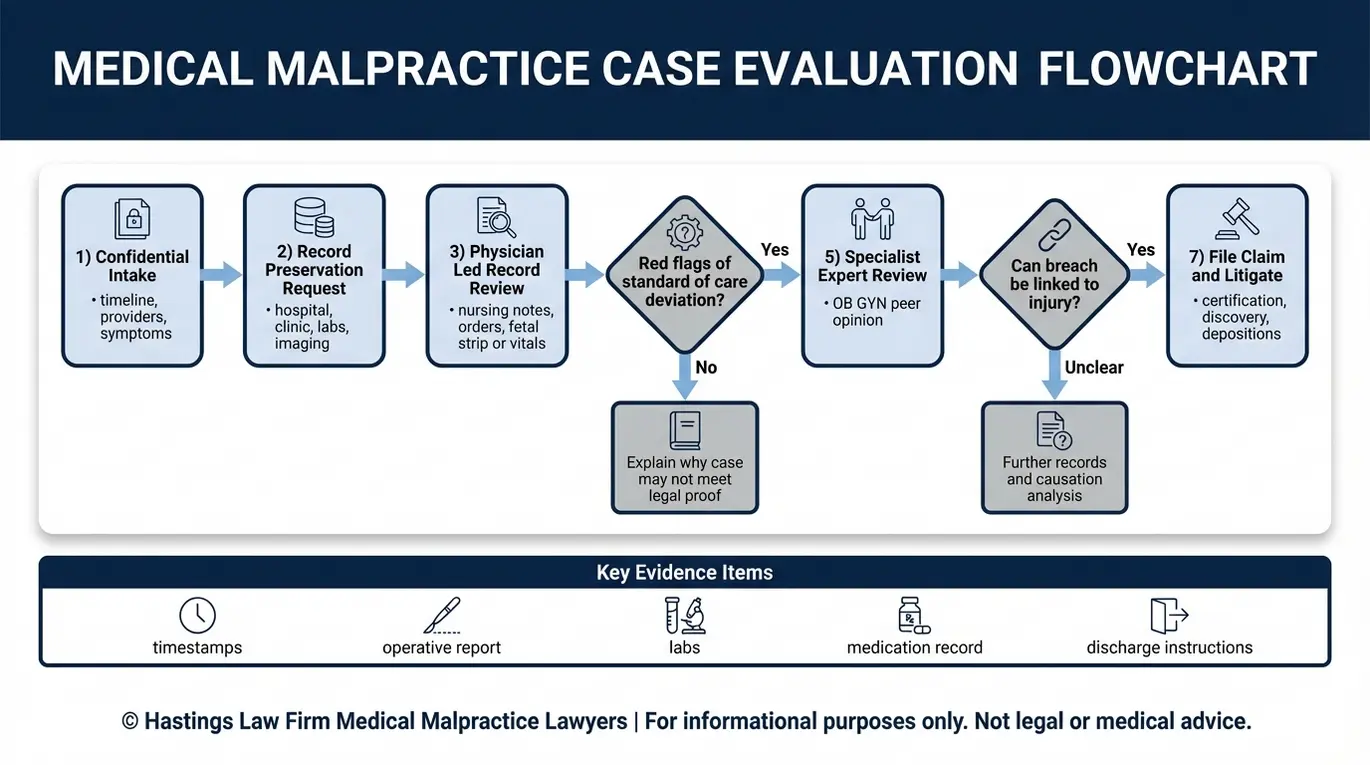
Proving liability requires a thorough review of medical records to identify charting inconsistencies, followed by expert testimony to certify that the physician’s actions fell below the state’s required standard of care. Our team uses a systematic legal investigation to reconstruct the medical events and determine where errors occurred. This process is methodical, and every step builds on the one before it.
Step 1: Intake and Record Preservation
The process begins with a confidential case evaluation. If the case moves forward, our team immediately works to secure all relevant medical records, including operative reports, lab results, nursing notes, fetal monitoring strips, and imaging studies. Preserving this evidence early is critical because records can be altered, misplaced, or destroyed over time.
Step 2: Medical Review and Analysis
Once the records are gathered, our legal team works alongside in-house medical professionals to reconstruct the timeline of care. This review identifies gaps, inconsistencies, and deviations from accepted protocols. As malpractice lawyers for gynecologist errors, we look for specific red flags: delayed responses to lab results, missing documentation during critical events, or failures to escalate care when clinical indicators called for it.
Step 3: Expert Validation and Certification
Arizona law requires a specific process before a malpractice case can proceed. Under Arizona Revised Statutes § 12-2603, the patient must provide a preliminary expert opinion from a qualified medical professional confirming that the standard of care was breached. This expert, typically a practicing OB/GYN with relevant experience, reviews the records and provides an opinion on whether the provider’s conduct fell below what the profession requires. Our firm maintains a national network of respected medical experts to provide this analysis, functioning as Arizona OB/GYN malpractice counsel prepared to build cases from the ground up.
Leveraging In-House Medical Experts for Case Review
What sets our investigation apart is the involvement of our in-house medical team from the very beginning. Our nurse consultants and Board Certified Patient Advocates bring clinical experience from inside the healthcare system. They know how hospital charting works, what documentation should be present, and where critical information is often buried or missing. This physician-led record review and medical analysis allows us to identify issues that a legal team working without clinical support might overlook entirely.
Maximizing Compensation Without Damage Caps
Under Arizona law, patients can recover economic damages for medical bills and lost wages, as well as non-economic damages for pain and suffering. Non-economic damages represent the emotional and physical suffering that does not have a fixed price tag. The Arizona Constitution prohibits caps on damages for personal injury and wrongful death.
Economic Damages
Economic damages cover the tangible financial losses caused by negligence. They include past and future medical bills, costs of corrective surgeries and rehabilitation, prescription expenses, and lost earning capacity if the injury prevents the patient from working. In cases involving long-term or permanent injury, future medical care costs can represent the largest portion of a claim.
Non-Economic Damages
Not all harm shows up on a bill. Non-economic damages account for pain and suffering, loss of consortium (the impact on a spouse or family relationship), emotional distress, and loss of enjoyment of life. For a woman who has permanently lost her ability to have children or who lives with chronic pain from a botched surgery, these damages reflect the true cost of what was taken from her. Unlike economic damages which are calculated from receipts and bills, these damages acknowledge the profound degradation of quality of life and the mental anguish endured during recovery.
The Arizona Advantage
Arizona law provides unique constitutional protections for patients seeking injury recovery. Unlike many states that restrict what injured patients can recover, Arizona’s Constitution provides a powerful protection. Article 2, Section 31 of the Arizona Constitution explicitly prohibits any law that would cap or limit damages recoverable for death or personal injury. This means there is no artificial ceiling on compensation for gynecologist negligence in Arizona.
This constitutional safeguard ensures that families facing lifetime care costs or profound loss are not shortchanged by arbitrary legislative limits. As your Arizona gynecologist malpractice lawyers, we build every case to reflect the full extent of harm, knowing that Arizona law supports a patient’s right to complete recovery.
Contact the Arizona Doctor Malpractice Attorneys at Hastings Law Firm Today for Help
Women’s health concerns deserve to be taken seriously, both inside the doctor’s office and inside the courtroom. If you or someone you love was harmed by a gynecologist’s or obstetrician’s negligence, you have the right to find out what happened and to pursue fair compensation for the damage it caused.
Hastings Law Firm handles every case on a contingency fee basis, which means you pay no attorney fees or costs unless we secure a recovery for you. Our team of trial attorneys, in-house medical professionals, and former defense counsel is ready to review your situation and help you understand your options.
Reach out today for a free, confidential case evaluation. As experienced Arizona gynecologist malpractice lawyers, we are here to provide the answers you deserve and to protect your future.
Frequently Asked Questions About Gynecologist Malpractice in Arizona


This content was researched and written by the Hastings Law Firm editorial team, which includes attorneys, medical professionals, and experienced researchers. Our writing is informed by internal knowledge and practical experience, and we cross-check critical details against authoritative sources cited throughout. Every piece undergoes human-led fact-checking and legal review. Because legal and medical information can change, if you spot an error, please contact us. Learn more about our content standards and review process on our editorial policy page.

Tommy Hastings, founder of Hastings Law Firm, is a board-certified personal injury trial lawyer dedicated exclusively to healthcare injury cases. Since 2001, he has represented injured patients and families in litigation against major hospital systems, pharmaceutical companies, and negligent healthcare providers nationwide. He has handled numerous high-profile cases that have drawn national media attention and resulted in multi-million dollar recoveries. He draws on that experience in his writing, helping readers understand how these cases work and what options may be available to them.
