


Arizona Gastroenterologist Malpractice Lawyer
Gastroenterologist negligence during invasive GI procedures can leave patients facing severe complications, unexpected surgery, and lasting emotional distress. Some outcomes are known risks of endoscopy, but harm may be preventable when a specialist departs from the standard of care before, during, or after a procedure. Disputes often focus on whether warning signs were missed, whether technique was appropriate, and whether follow up and discharge guidance were adequate. If you or a loved one were harmed or worse due to gastroenterologist negligence in Arizona, contact Hastings Law Firm for a free, confidential case review.

Last Updated: July 27, 2026
Trusted Legal Representation for GI Doctor Negligence in Arizona
When a gastroenterologist’s error causes serious harm during a procedure like a colonoscopy (a scope-guided exam of the colon) or a flexible sigmoidoscopy (a similar exam of the lower colon and rectum), the physical and emotional toll can be overwhelming. You may be dealing with unexpected surgeries, mounting bills, and a sense of betrayal by a provider you trusted. These feelings are valid, and you deserve clear answers about what went wrong.
As an Arizona gastroenterologist malpractice lawyer, Hastings Law Firm focuses exclusively on medical negligence. Our team of attorneys, in-house nurse consultants, and former defense lawyers understands how GI injury cases are built and how to hold the right parties accountable.
If you believe a gastroenterologist’s mistake caused your injury, we can review what happened and explain your options in a free, confidential consultation.

Identifying Medical Negligence in Invasive GI Procedures
Gastroenterology malpractice occurs when a specialist deviates from the accepted standard of care during a diagnostic or therapeutic procedure, directly causing patient harm. The standard of care is the level of treatment a reasonably competent gastroenterologist would have provided under similar clinical circumstances. This legal benchmark compares the actions of the defendant doctor against what a prudent specialist would have done in the same situation, such as ordering specific imaging before an invasive scope or halting a procedure when visualization is poor. Not every bad outcome after a GI procedure qualifies as negligence, but when a preventable error leads to injury, it may form the basis of a legal claim.
Endoscopic procedures carry inherent risks, but some carry significantly more than others. The procedures most frequently involved in GI doctor negligence claims include:
- Esophagogastroduodenoscopy (EGD), a scope exam of the esophagus, stomach, and upper small intestine
- Endoscopic retrograde cholangiopancreatography (ERCP), a more involved procedure used to diagnose and treat bile duct and pancreatic conditions
- Colonoscopy, used for colon cancer screening, polyp removal, and evaluation of GI symptoms
- Sigmoidoscopy, a more limited scope of the lower colon
ERCP, in particular, carries elevated complication rates compared to standard diagnostic scoping. Research published in the National Library of Medicine (PubMed) has examined how factors like trainee involvement during ERCP can influence complication rates. This data reinforces the importance of physician experience and technique in high-risk procedures, suggesting that while teaching hospitals play an important role, the supervising physician must maintain strict oversight to prevent unnecessary harm.
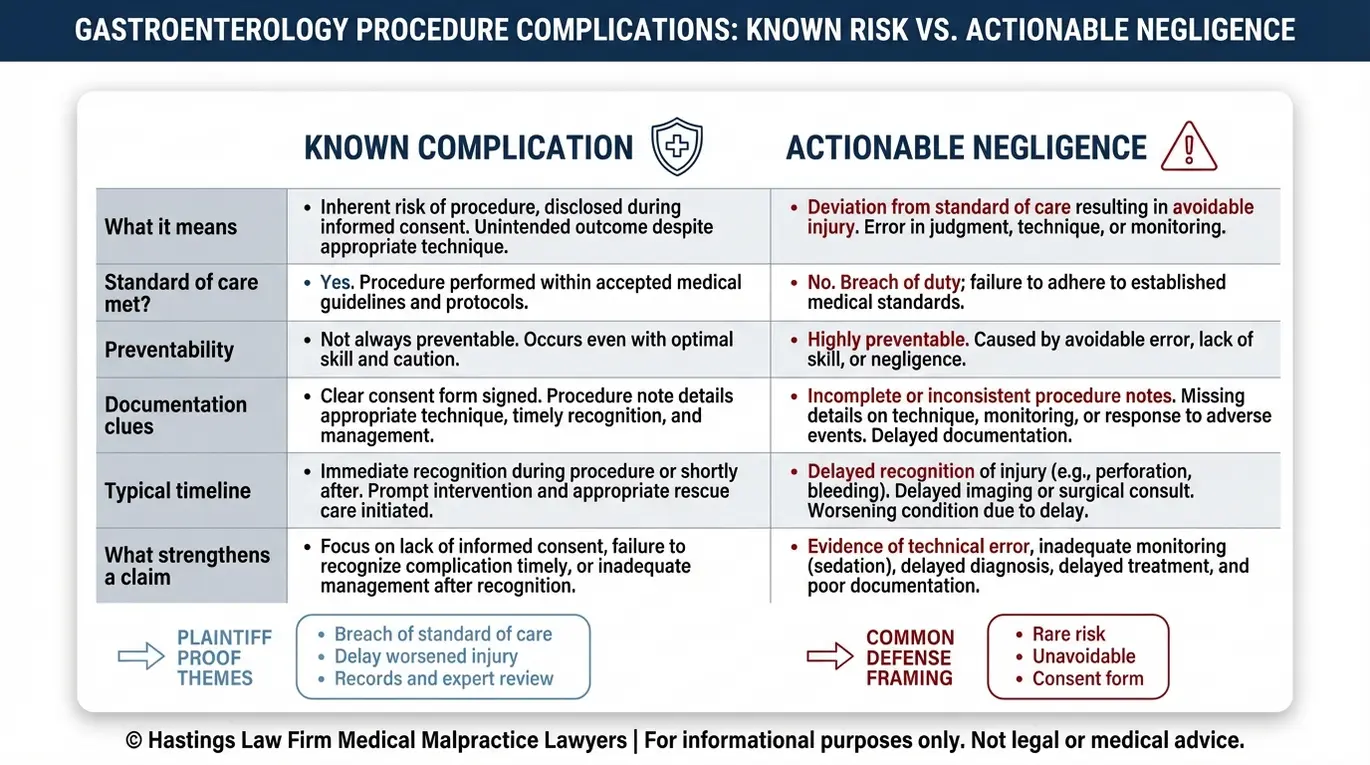
One of the most important distinctions in these cases is the difference between a “known complication” and actionable negligence. Defense attorneys routinely argue that perforations, bleeding, or infections are recognized risks of endoscopic procedures, and that is technically true. However, a known complication becomes medical negligence when it results from a breach of care, such as using excessive force during scope insertion, failing to recognize abnormal anatomy, or continuing a procedure despite warning signs.
A gastroenterology malpractice attorney evaluates the specific clinical decisions made before, during, and after the procedure to determine whether the harm was truly unavoidable or the result of a preventable error. We scrutinize the procedure notes for evidence of rushed techniques or ignored safety protocols.
Common Errors Committed by Gastroenterologists
The most frequent grounds for gastroenterologist medical malpractice claims against GI specialists include bowel perforations during scoping, failure to diagnose colorectal cancer, and sedation-related injuries. Each category of error carries distinct risks and potential consequences for the patient.
Procedural Errors
A bowel perforation, which is a tear or puncture in the wall of the colon, esophagus, or stomach, is one of the most serious complications of endoscopic procedures. When caused by negligence, such as improper scope technique or failure to account for a patient’s anatomy, a perforation can lead to internal bleeding, abdominal infection, and sepsis. Some patients require emergency surgery, and in severe cases, negligence by a GI specialist during a routine procedure has resulted in wrongful death. Immediate recognition of a perforation allows for prompt surgical repair, often reducing long-term damage. However, when a perforation goes unnoticed during the procedure and the patient is sent home, the contents of the bowel leak into the abdominal cavity, causing rapid and life-threatening infection.
Diagnostic Failures
Gastroenterologists are responsible for identifying and removing precancerous polyps during colonoscopy. A polypectomy, the removal of polyps from the colon lining, is a standard part of screening. When a physician misses polyps, misinterprets pathology results, or fails to recommend appropriate follow-up intervals, a misdiagnosis or delayed diagnosis of colorectal cancer can result.
A study published in the JAMA Network found a direct link between a physician’s adenoma detection rate and future colorectal cancer risk in their patients, underscoring how individual physician performance directly affects patient outcomes.
Post-Operative Negligence
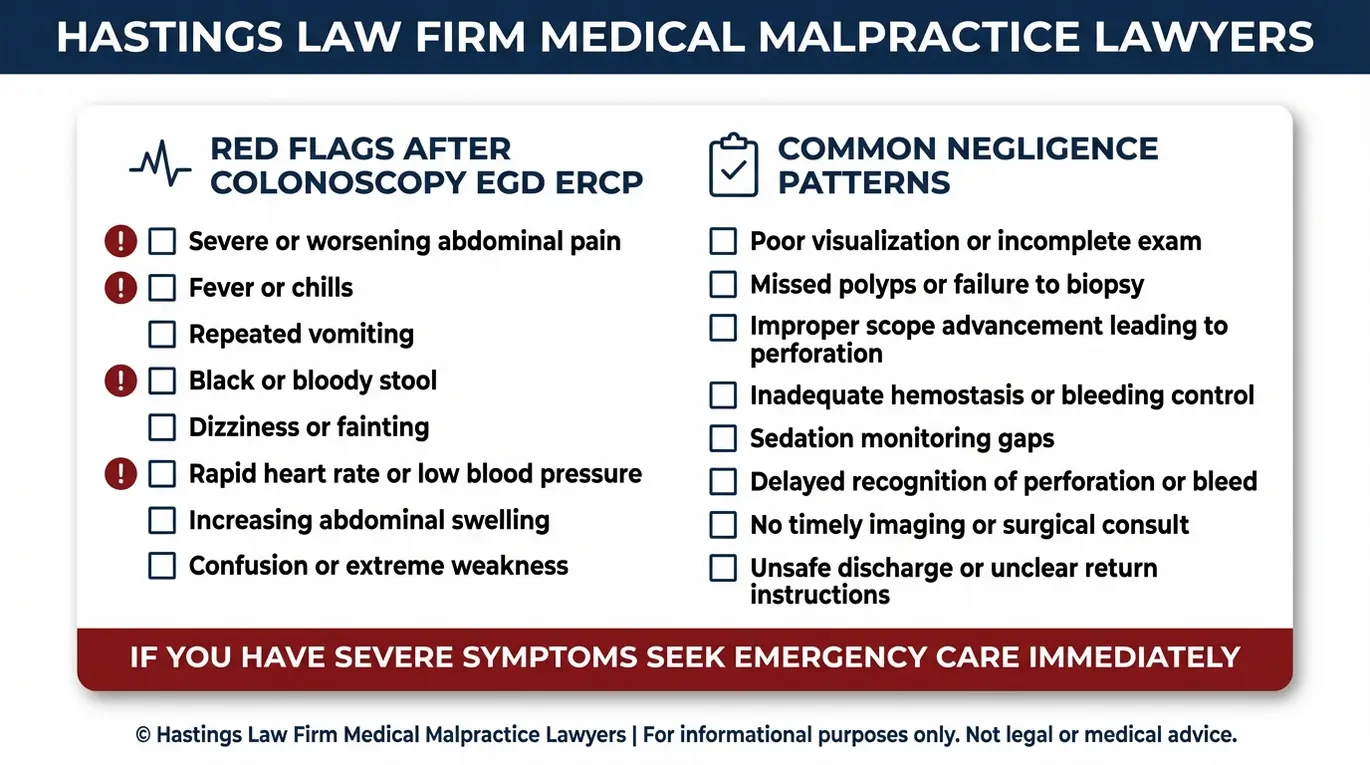
Errors in gastroenterology do not always happen during the procedure itself. Failure to recognize signs of post-procedure complications after discharge, such as worsening abdominal pain, fever, or rectal bleeding, can allow treatable conditions to become life-threatening. Delayed follow-up on biopsy results or inadequate discharge instructions are also common sources of liability.
Patients must be clearly informed of what symptoms require immediate medical attention. If a doctor dismisses a patient’s complaints of severe pain as “normal gas” without proper evaluation, and that patient later suffers from advanced sepsis, the physician may be liable for the resulting deterioration.
| Error Type | Potential Patient Outcome |
|---|---|
| Bowel or esophageal perforation | Sepsis, emergency surgery, colostomy, death |
| Missed or misidentified polyps | Delayed cancer diagnosis, advanced-stage disease |
| Sedation/anesthesia errors | Aspiration, respiratory failure, brain injury |
| Inadequate post-procedure follow-up | Undetected infection, internal bleeding, organ damage |
The Hastings Law Firm Difference
Results matter, but what truly sets us apart is how we achieve them. Every verdict, every settlement, and every Arizona courtroom victory comes from one guiding promise: To treat each client’s fight for justice as if it were our own.
This balance of skill, experience, and empathy reflects our core philosophy that justice should not only compensate the injured, but also make health care safer nationwide.

Proving Liability: Expert Witnesses and Case Investigation
Arizona law requires claimants to present sufficient evidence, typically through expert testimony, proving that the physician’s actions caused the injury. This is not a simple process, and it is one of the primary reasons that suing a gastroenterologist requires specialized legal and medical expertise.
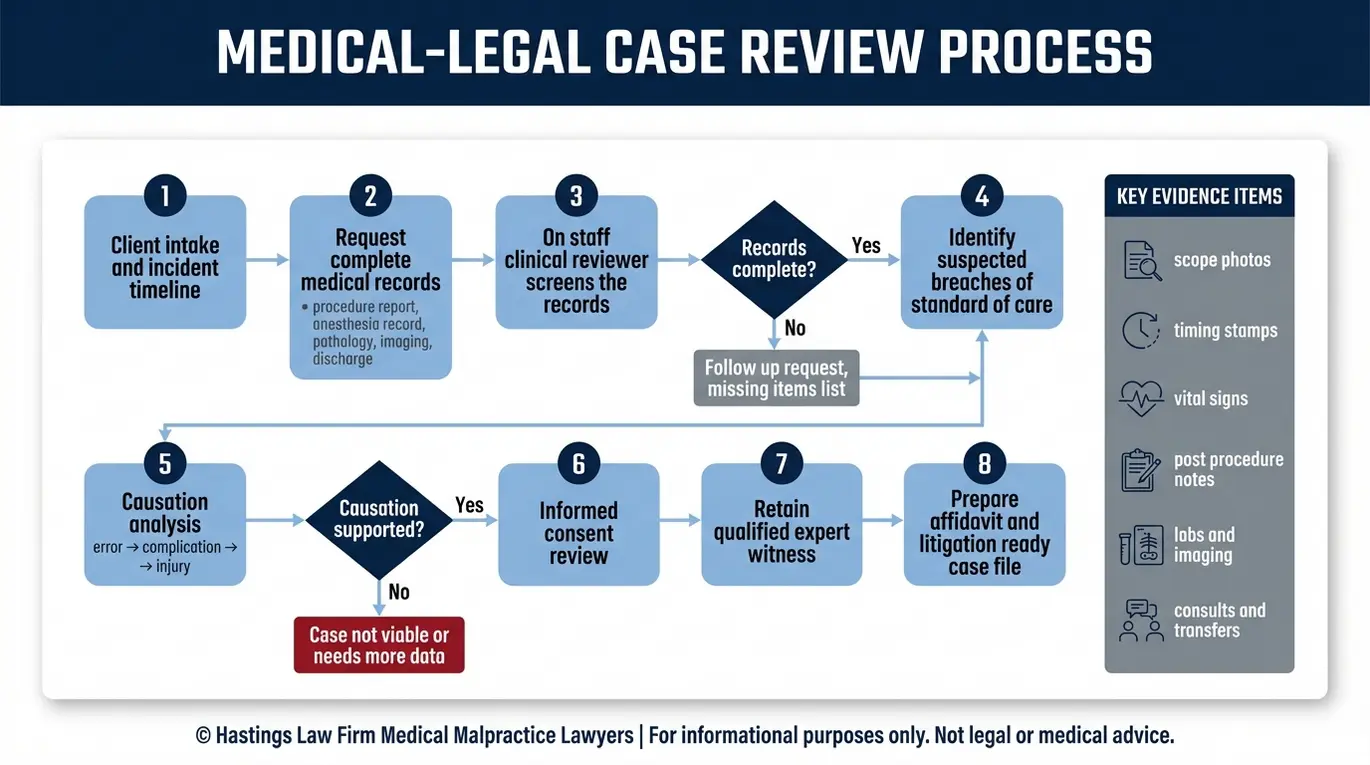
Our investigation follows a structured sequence designed to identify whether a breach of care occurred and whether it directly caused the harm.
- Step 1: Obtain and secure all medical records. This includes the endoscopy report (the formal procedure note documenting scope findings, interventions, and any complications), pre-procedure assessments, anesthesia logs, nursing notes, pathology results, and post-procedure discharge instructions. Under federal HIPAA rules, patients have a legal right to access their own medical records. HIPAA is a law that ensures your medical privacy and your right to obtain clinical copies, as explained by MICA’s guide to HIPAA Right of Access compliance.
- Step 2: Conduct a clinical timeline analysis. We reconstruct the sequence of decisions made before, during, and after the procedure. This timeline is essential to identifying where the standard of care may have been breached, such as a long delay between the onset of patient distress and the physician’s response.
- Step 3: Retain qualified expert witnesses. Under Arizona Revised Statutes Title 12, expert testimony from a physician in the same specialty is typically required to establish both the standard of care and the breach. We work with board-certified gastroenterologists who can objectively evaluate the treating physician’s decisions. These experts clarify detailed medical issues for the jury, explaining how a competent doctor would have acted differently.
- Step 4: Establish causation. It is not enough to show that a doctor made an error. Arizona malpractice counsel must prove that the specific error, such as an improperly angled scope or a missed polyp, directly caused the specific injury. This often requires linking clinical data points, including metrics like the physician’s adenoma detection rate (ADR), which measures how frequently a doctor identifies precancerous polyps during screening colonoscopies.
- Step 5: Evaluate informed consent. We examine whether the patient was meaningfully warned of the specific risks associated with their procedure, or whether the consent process was rushed or incomplete.
Role of the On-Staff Clinical Reviewer
Before we retain outside experts in GI negligence cases, our in-house nurse consultants and Board Certified Patient Advocates conduct an independent clinical review of the records. This early screening identifies red flags in charting, gaps in documentation, and potential deviations from protocol. This review helps identify red flags in charting or gaps in medical documentation, ensuring that when we do engage an external expert, the right questions are already framed.
Recovering Damages for GI Injuries in Arizona
Patients harmed by gastroenterology negligence may recover compensation for medical bills, lost wages, and pain and suffering, with no state-imposed cap on the amount for non-economic damages. This is a meaningful distinction. The Arizona Constitution, Article II, Section 31, expressly prohibits the legislature from placing caps on personal injury or wrongful death damages, meaning juries can award the full compensation for a patient’s losses.
Recoverable damages in GI malpractice cases generally fall into two categories:
Economic damages compensate for measurable financial losses:
- Past expenses and future medical care costs, including corrective surgeries, hospitalization, colostomy supplies, and ongoing care
- Lost wages, loss of income, and diminished earning capacity
- Rehabilitation and home care costs
Economic damages provide the financial stability needed to handle the aftermath of an injury. This includes covering the costs of long-term management of digestive complications or reconstructive surgeries that may be required years down the road.
Non-economic damages address the personal toll of the injury:
- Physical pain and suffering
- Emotional distress
- Loss of enjoyment of life
- Loss of consortium for spouses and family members
The severity of GI injuries often drives significant non-economic damages. A patient who requires a permanent colostomy after a preventable perforation, for example, faces not just medical costs but a fundamental change in daily life.
They may suffer from anxiety, social isolation, and a profound loss of dignity. Arizona law ensures these losses are not artificially limited by legislative caps, allowing juries to acknowledge the full scope of the patient’s suffering.
Contact the Arizona Doctor Malpractice Attorneys at Hastings Law Firm Today for Help
If you or a loved one suffered a serious injury after a gastroenterology procedure, the Arizona gastroenterologist malpractice attorneys at Hastings Law Firm are ready to help you understand what happened and whether you have a case.
Our firm handles nothing but medical negligence. This singular focus is led by Tommy Hastings, a board-certified trial attorney with over 20 years of experience. Combined with our in-house medical staff, former defense attorneys, and national network of physician experts, we evaluate GI cases with a level of clinical depth that general practice firms cannot match.
Arizona’s legal deadlines are strict, and critical evidence can be lost with time. We encourage you to reach out while records and recollections are still available.
Your consultation is free, confidential, and comes with no obligation. We work on a contingency fee basis, which means you pay no attorney fees or costs unless we recover compensation on your behalf. Contact us today for a risk-free case evaluation.
Frequently Asked Questions About Gastroenterologist Malpractice in Arizona


This content was researched and written by the Hastings Law Firm editorial team, which includes attorneys, medical professionals, and experienced researchers. Our writing is informed by internal knowledge and practical experience, and we cross-check critical details against authoritative sources cited throughout. Every piece undergoes human-led fact-checking and legal review. Because legal and medical information can change, if you spot an error, please contact us. Learn more about our content standards and review process on our editorial policy page.

Tommy Hastings, founder of Hastings Law Firm, is a board-certified personal injury trial lawyer dedicated exclusively to healthcare injury cases. Since 2001, he has represented injured patients and families in litigation against major hospital systems, pharmaceutical companies, and negligent healthcare providers nationwide. He has handled numerous high-profile cases that have drawn national media attention and resulted in multi-million dollar recoveries. He draws on that experience in his writing, helping readers understand how these cases work and what options may be available to them.
