


Arizona Forceps Eye Birth Injury Lawyer
Written by: Hastings Law Firm | Reviewed by: Tommy Hastings | Updated: July 27, 2026
Forceps assisted delivery can cause serious infant eye trauma when blades are misplaced or too much force is used. Families may face lasting vision impairment, complex medical care, and uncertainty about whether the injury was preventable. Understanding how direct ocular trauma differs from brain based vision impairment can clarify what happened during labor and delivery. Arizona rules discussed here also affect how claims are evaluated and what compensation may cover for long term needs. If you or a loved one were harmed or worse due to forceps eye birth injury in Arizona, contact Hastings Law Firm for a free, confidential case review.

Top Rated Legal Advocacy for Infant Eye Trauma in Arizona
What You Should Know About Infant Traumatic Eye Damage Claims in Arizona:
- Lifelong vision impairment can follow forceps related eye trauma, including outcomes as severe as blindness.
- Clarity about the injury source can change accountability, since direct ocular trauma points to instrument misuse while cortical visual impairment can point to oxygen deprivation during labor or delivery.
- Options can narrow when forceps are used without confirming key safety criteria, because proceeding despite missing prerequisites increases the risk of severe infant injury.
- A lack of meaningful choice can become central when informed consent is disputed, because forceps risks and alternatives such as cesarean delivery are expected to be discussed.
- Case viability in Arizona can depend on early expert support, because a preliminary medical expert affidavit is required before a malpractice case can move forward.
- Recovery can be broader in Arizona than in capped states, because the Arizona Constitution prohibits limits on damages for personal injury.
- Compensation can extend beyond initial treatment, because damages discussed include future medical care, specialized education, adaptive technology, and reduced future earning capacity.
- Disputes can turn on documentation conflicts, because inconsistencies between operative notes, fetal monitoring, and nursing records may indicate the record does not match events.
- Injury risk can rise when instruments are used sequentially, because switching from vacuum extraction to forceps is associated with higher rates of serious complications.
- The pattern of harm can help distinguish instrument effects, because forceps are described as more associated with facial nerve injury and direct ocular trauma while vacuum extraction is more associated with scalp related injuries.

A Healthcare Focused Law Firm
When your newborn suffers an eye injury during a forceps-assisted delivery, the fear and confusion can be overwhelming. You trusted your medical team to bring your child safely into the world, and now you are facing questions about what went wrong and what the future holds for your baby’s vision.
At Hastings Law Firm, we focus exclusively on medical malpractice cases, including birth injuries caused by the misuse of delivery instruments. Our legal team works alongside in-house nurses and board-certified patient advocates to thoroughly investigate what happened in the delivery room. If you or a loved one need an Arizona forceps eye birth injury lawyer who understands both the medicine and the law, we are prepared to help.
Contact us for a free, confidential case evaluation. We can review the circumstances of your child’s birth and explain your legal options.
Identifying Traumatic Eye Injuries Caused by Forceps Delivery
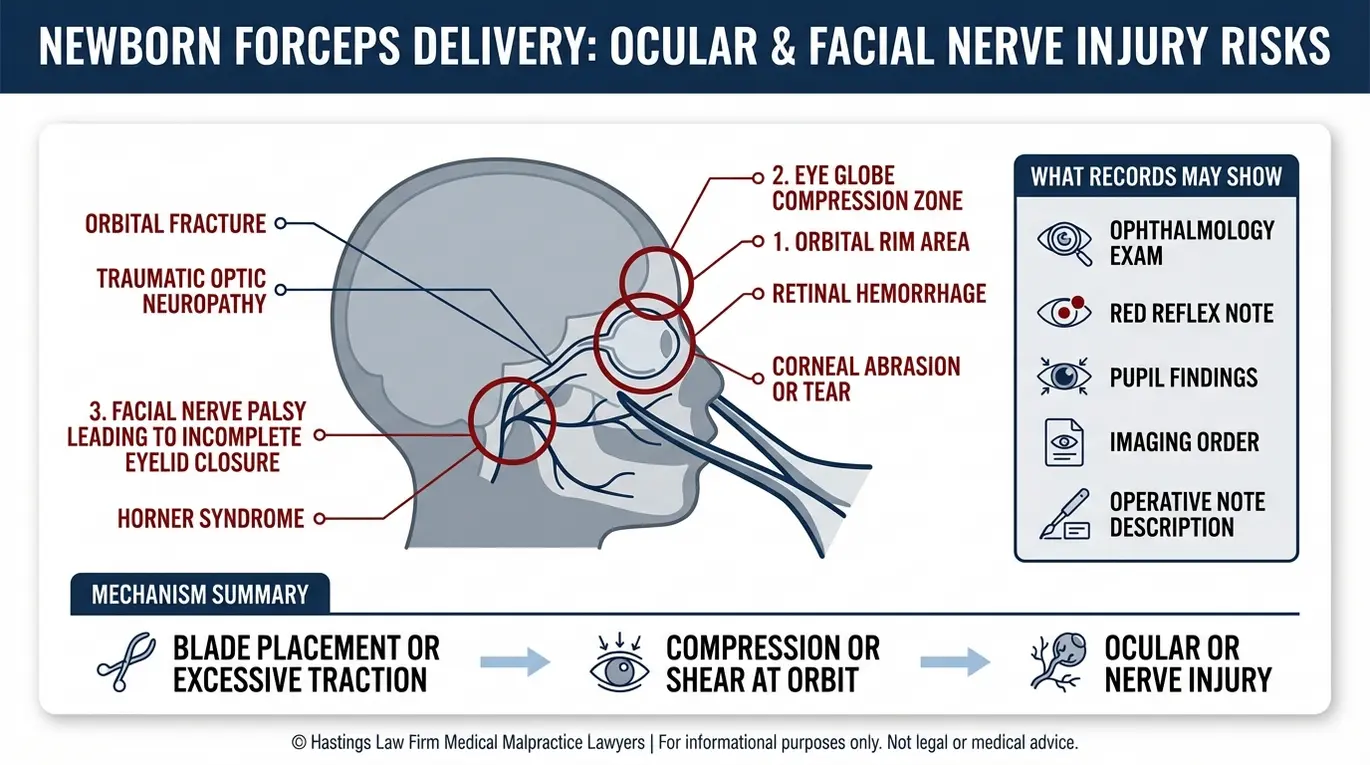
Forceps delivery injuries to the eye occur when excessive traction or improper blade placement compresses the infant’s skull or globe, resulting in trauma ranging from corneal abrasions to permanent optic nerve damage and blindness. Forceps are metal tools doctors use to assist during childbirth. Understanding the specific type of injury your child sustained is essential for building a medical malpractice case.
Forceps are metal instruments designed to cup the sides of a baby’s head and guide the infant through the birth canal. When positioned correctly, they can assist with a safe delivery. When misplaced or used with excessive force, however, the blades can press directly against the facial nerve, eye socket, or the eye itself.
The mechanism of injury typically involves one of two problems. The first is direct compression, where the blade presses against the orbital bone or the globe of the eye. The second is indirect trauma, where pressure on surrounding nerves, often resulting in cranial nerve damage, affects eye function even without direct contact.
An Arizona forceps injury attorney will look for specific diagnoses in your child’s medical records that indicate instrument-related trauma. Records may document Descemet’s membrane rupture, damage to a delicate layer inside the cornea that helps maintain its clarity, or Horner’s syndrome, a disruption of the nerve pathway running from the brain to the face and eye. The following injuries are commonly associated with improper forceps use:
| Injury Type | Description | Potential Long-Term Impact |
|---|---|---|
| Retinal Hemorrhage | Bleeding within the layers of the retina caused by pressure or traction | May resolve or cause permanent vision changes |
| Corneal Abrasion or Tear | Scratches or lacerations to the cornea from blade contact | Can lead to scarring and impaired vision |
| Descemet’s Membrane Rupture | A break in the innermost layer of the cornea, often from birth trauma | May result in corneal clouding and visual impairment |
| Traumatic Optic Neuropathy | Damage to the optic nerve from compression or stretching | Can cause partial or complete blindness |
| Horner’s Syndrome | Nerve damage affecting the eye and face on one side | Drooping eyelid, constricted pupil, decreased sweating |
| Orbital Fracture | A break in the bones surrounding the eye | May require surgical repair; can affect eye movement |
Facial trauma that does not directly involve the eye can still affect vision. Facial nerve palsy, for example, prevents the infant from fully closing the eyelid, leaving the cornea exposed and vulnerable to drying and infection. According to the Joint Trauma System’s Eye Trauma Initial Care Clinical Practice Guideline, early recognition and treatment of eye trauma significantly affects outcomes.
If you or a loved one are searching for a forceps eye injury lawyer in Phoenix, our team includes medical professionals who can review your child’s records and identify whether the documented injuries are consistent with instrument misuse. Birth injury legal counsel from our firm will examine the operative notes, nursing records, and any imaging studies to piece together what occurred.
Distinguishing Cortical Visual Impairment vs Direct Ocular Trauma
Not all vision problems following a difficult delivery stem from direct injury to the eye. Some infants experience cortical visual impairment, a condition where the eyes are structurally normal but the brain cannot properly process visual information.
This condition, often called CVI, results from damage to the visual processing centers in the brain rather than to the eye itself. This type of injury is frequently associated with hypoxic-ischemic encephalopathy (HIE), which occurs when the brain is deprived of adequate oxygen and blood flow during labor or delivery. HIE can happen alongside forceps injuries or as a result of prolonged fetal distress that prompted the instrumental delivery in the first place.
The distinction matters for your legal case. Direct ocular trauma points to mechanical injury from the forceps themselves. Cortical visual impairment may indicate a delay in recognizing fetal distress or a failure to proceed to a cesarean section sooner. In some cases, both types of injury are present, suggesting multiple points of negligence during the delivery process.
Our medical team evaluates the complete clinical picture to determine whether your child’s vision problems resulted from physical trauma, oxygen deprivation, or both.
When Is Forceps Delivery Appropriate and Safe
Operative vaginal delivery using forceps is only appropriate when specific safety criteria are met, including full cervical dilation, ruptured membranes, known fetal position, and an engaged fetal head, absent any contraindications that would make a C-section the safer standard of care. When these criteria are not confirmed before proceeding, the risk of injury increases substantially.
An Arizona forceps birth injury lawyer will examine whether the medical team followed established protocols before attempting an instrumental delivery. Forceps may be indicated in situations such as:
- Maternal fatigue that prevents effective pushing
- Fetal distress requiring rapid delivery
- Prolonged second stage of labor (failure to progress)
- Medical conditions that make prolonged pushing dangerous for the mother
However, indications alone do not justify forceps use. The Global Library of Women’s Medicine’s chapter on Operative Vaginal Delivery outlines strict prerequisites that must be confirmed before any attempt.
Safety Checklist for Forceps Delivery:
- Cervix is fully dilated (10 centimeters)
- Membranes have ruptured
- Fetal head is fully engaged in the pelvis (meaning the widest part has passed through the pelvic inlet)
- Fetal position is precisely known
- Estimated fetal weight does not suggest cephalopelvic disproportion (baby too large for the pelvis)
- Adequate anesthesia is in place
- The operator has sufficient training and experience
- Backup for emergency cesarean section is immediately available
Physicians must confirm an engaged fetal head, a position where the baby has descended far enough that the widest diameter of the skull has passed through the pelvic inlet. They must also rule out contraindications, situations such as an unknown fetal position or bleeding disorders that increase injury risk. Contraindications to forceps delivery include situations where any of the above criteria cannot be confirmed, where the baby is in an unfavorable position, or where conditions like bleeding disorders increase the risk of injury. Failing to check these specific safety boxes before applying instruments is a critical failure in the standard of care that can lead to severe consequences for the infant.
A negligent forceps delivery attorney will investigate whether informed consent was properly obtained. Informed consent means your doctor explained the specific risks of the procedure and you agreed to the treatment. The physician must explain the risks of forceps delivery, including the possibility of eye trauma and skull injury, and must discuss alternatives such as continued labor or cesarean section. If these risks were not explained and you were not given a meaningful choice, that failure may support your legal claim.
We review the consent documentation, labor notes, and any recorded conversations to determine whether you received the information necessary to make an informed decision. If you need legal help for an operative delivery injury, our team can evaluate whether the standard of care was met before and during the procedure.
The Hastings Law Firm Difference
Results matter, but what truly sets us apart is how we achieve them. Every verdict, every settlement, and every Arizona courtroom victory comes from one guiding promise: To treat each client’s fight for justice as if it were our own.
This balance of skill, experience, and empathy reflects our core philosophy that justice should not only compensate the injured, but also make healthcare safer nationwide.

Proving Medical Malpractice in Forceps Eye Injury Cases
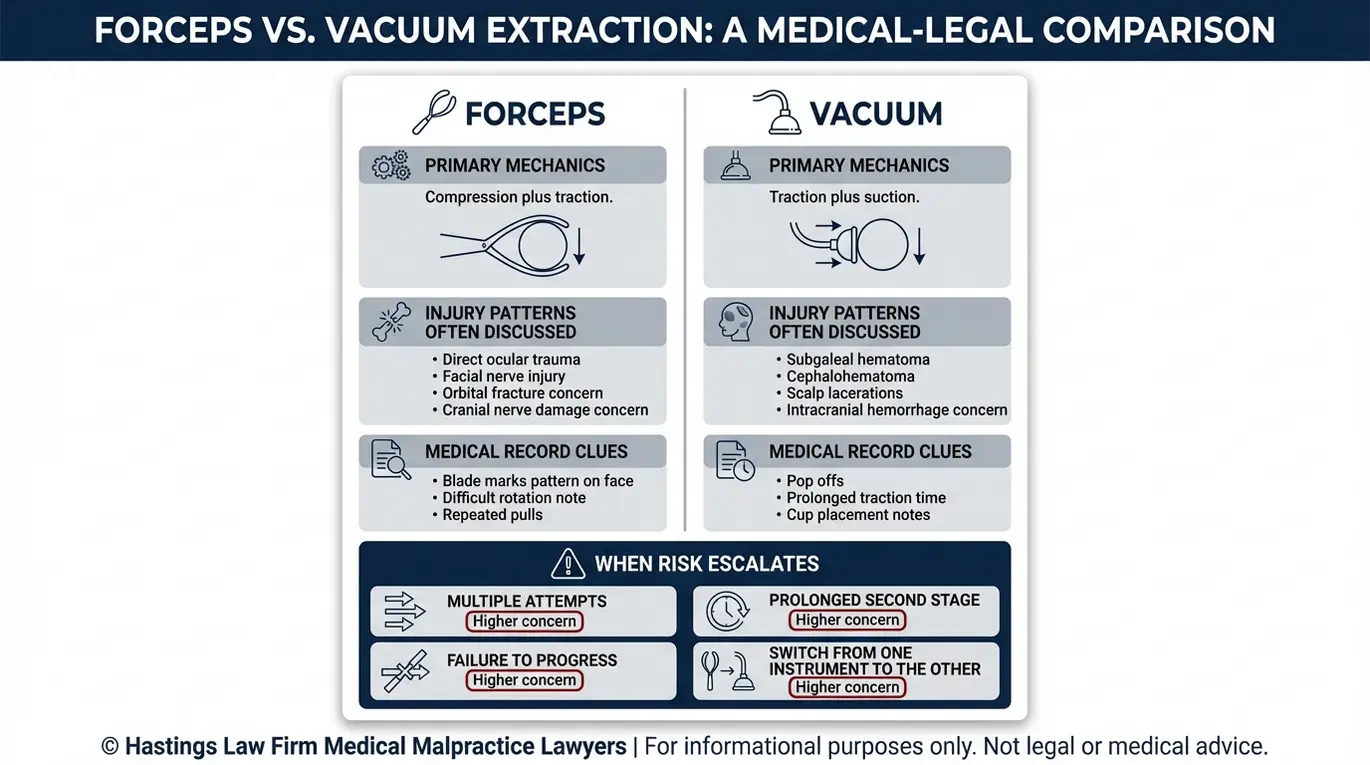
Proving malpractice requires demonstrating that the obstetrician deviated from the standard of care by applying excessive force, misplacing the blades, or persisting with a vaginal delivery when a C-section was medically necessary. Medical malpractice involves legal claims for errors made by healthcare providers. Arizona law imposes specific requirements that must be satisfied before a case can proceed.
As an Arizona forceps eye birth injury lawyer, our role is to build a case that connects the physician’s actions to your child’s injuries through credible medical evidence. This process involves several distinct steps:
- Obtaining Complete Medical Records: We gather all records from prenatal care, labor and delivery, and any subsequent treatment for your child’s eye injury. This includes the operative note, fetal monitor strips, nursing flow sheets, and physician orders.
- Medical Expert Review: Arizona requires a preliminary expert opinion before a malpractice case can move forward. According to Arizona Revised Statutes § 12-2603, a medical malpractice attorney for infant eye damage must obtain a medical expert affidavit from a qualified professional certifying that the claim has merit and that the provider’s conduct fell below the accepted standard of care.
- Standard of Care Analysis: Our medical experts evaluate whether a reasonably competent obstetrician, under the same circumstances, would have made the same decisions. This includes assessing whether forceps were appropriate, whether the technique was correct, and whether the provider should have abandoned the attempt and proceeded to cesarean delivery.
- Causation Determination: Proving medical negligence alone is not enough. We must also establish that the negligent conduct directly caused your child’s eye injury. This requires testimony from an expert witness connecting the mechanism of injury to the documented actions during delivery.
- Timeline Reconstruction: We compare the official operative note with the fetal monitor strips and nursing documentation to identify discrepancies. If the operative note states the delivery was routine but the fetal strips show prolonged distress, that inconsistency may indicate the written record does not accurately reflect what occurred.
Traumatic optic neuropathy, damage to the optic nerve caused by external force, is one of the more serious forceps-related eye injuries. Establishing that this injury resulted from forceps misuse rather than another cause requires detailed analysis of the delivery records and expert medical testimony. We meticulously review the angle of application and the force recorded to prove that the injury was not a natural consequence of birth, but a preventable error.
If you are considering suing for forceps blindness, understand that these cases require substantial medical and legal expertise. Our team includes professionals who previously worked in hospital settings and understand how delivery room decisions are made and documented.
Sequential Instrument Use and Skill Decline
The medical community generally advises that if an initial attempt with one instrument fails, switching to another significantly increases injury risk, and many professional guidelines recommend proceeding directly to cesarean section rather than attempting a second instrumental delivery.
For example, if vacuum extraction, a method using suction for traction, is unsuccessful and the physician then switches to forceps, the combined trauma from both instruments raises the likelihood of serious harm. Studies have documented that sequential use of forceps and vacuum is associated with higher rates of subdural hemorrhage, facial nerve injury, and other complications compared to use of a single instrument.
Operative vaginal delivery with forceps has become less common over the past several decades as cesarean section rates have increased. One consequence of this shift is that many obstetricians completing training today have less hands-on experience with forceps than previous generations. Limited training can translate to technical errors, including improper blade placement and excessive force.
We investigate the training and experience of the physician who performed your child’s delivery. If records suggest the provider lacked adequate competence with forceps, that information may strengthen your claim.
Comparing Vacuum Extraction and Forceps Risks
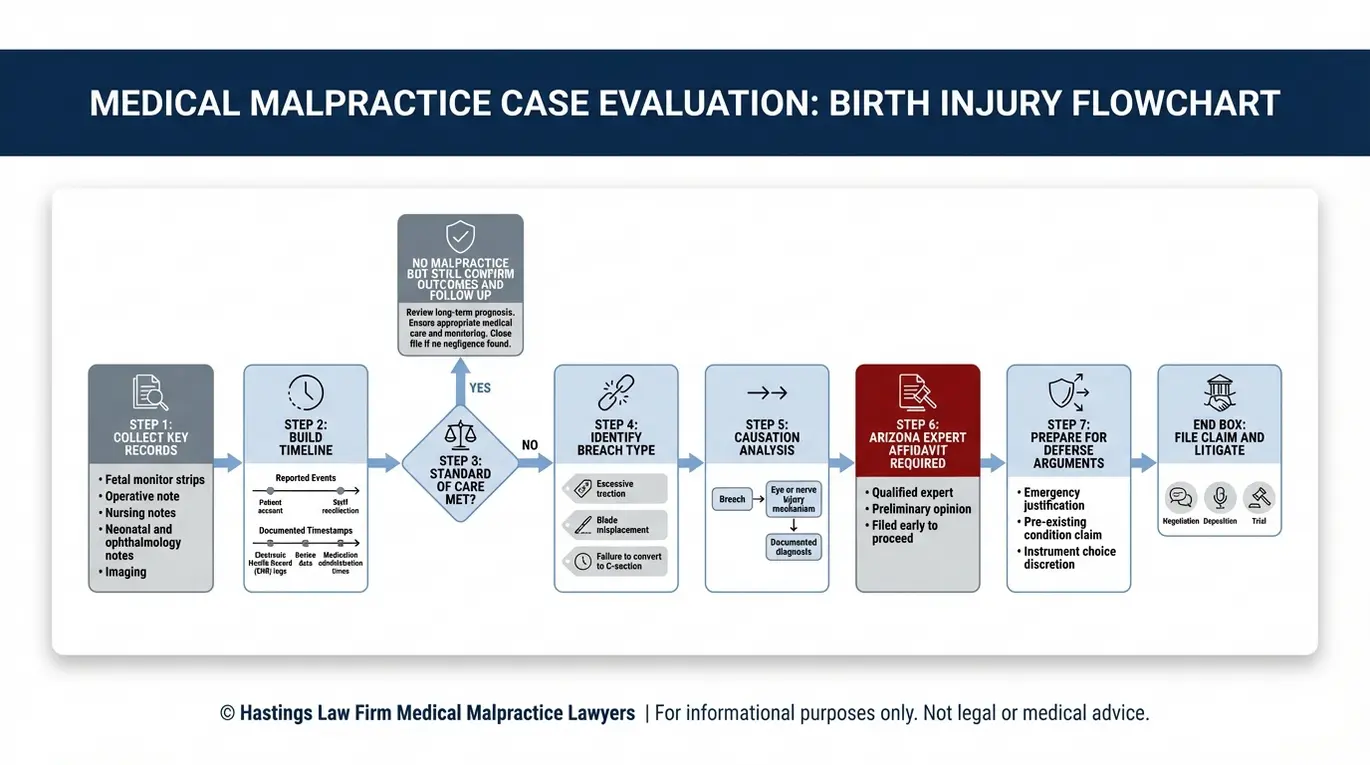
While both instruments carry risks, forceps are statistically more likely to cause facial nerve injury and direct ocular trauma, whereas vacuum extraction is more frequently associated with subgaleal hematomas and scalp injuries. Understanding these differences helps clarify why your child developed specific injuries.
The fundamental distinction lies in how each instrument works. Vacuum extraction uses suction applied to the baby’s scalp to provide traction during contractions. Forceps, by contrast, use compression and traction together, with metal blades positioned on either side of the baby’s head.
Because forceps blades must be placed near the ears and cheeks, they can compress the facial nerve or press against the orbital bones. This positioning explains why eye injuries and facial nerve palsy are more commonly associated with forceps than with vacuum delivery.
A systematic review and meta-analysis published in PubMed Central analyzed outcomes from both types of operative vaginal delivery and confirmed distinct injury patterns.
| Factor | Forceps | Vacuum Extraction |
|---|---|---|
| Mechanism | Compression + Traction | Traction (suction-based) |
| Primary Injury Zone | Face, skull base, orbits | Scalp |
| Common Infant Injuries | Facial nerve palsy, eye trauma, skull fracture | Cephalohematoma, subgaleal hematoma, retinal hemorrhage |
| Common Maternal Injuries | Perineal tears, vaginal lacerations | Fewer maternal injuries |
| Failure Rate Concern | May cause significant trauma if applied incorrectly | Risk of “pop-off” with scalp injury |
The team checks for subgaleal hematoma, bleeding that occurs between the skull and the scalp’s connective tissue layer, or cephalohematoma, a collection of blood beneath the membrane covering a skull bone. Unlike a cephalohematoma, which is confined to the area over a single skull bone, a subgaleal hematoma can spread across the entire scalp and lead to life-threatening blood loss.
Both instruments can cause retinal hemorrhage, though the mechanism differs. With forceps, direct pressure may damage blood vessels within the eye. With vacuum extraction, the rapid changes in intracranial pressure during application and pop-off events can cause bleeding, including intracranial hemorrhage. Understanding these distinct patterns helps experts distinguish between unavoidable complications and those caused by negligence.
A forceps vs vacuum injury lawyer will evaluate which instrument was used, how it was applied, and whether the choice of instrument was appropriate given your specific circumstances. An Arizona birth trauma attorney from our firm can determine whether the documented injuries are consistent with instrumental delivery negligence.
Arizona Laws Governing Birth Injury and Malpractice Claims
Arizona law governs birth injury claims through strict statutes of limitations and requirements for expert testimony, but notably, the state constitution prohibits caps on damages for personal injury, allowing families to pursue full financial recovery for lifelong care. A statute of limitations is the legal time limit for filing a claim. Understanding these legal requirements is essential for protecting your child’s rights.
An Arizona forceps eye birth injury lawyer must work within specific procedural rules while also taking advantage of provisions that benefit injured families.
Key Arizona Statutes and Provisions:
- Statute of Limitations: The general time limit for filing a medical malpractice claim in Arizona is two years from the date of injury or from when the injury reasonably should have been discovered (the discovery rule). For claims involving minors, the statute may be tolled, meaning the clock may not begin running until the child reaches adulthood.
Waiting to file creates practical problems. Evidence can be lost, and witnesses may move or forget details over time. Filing a claim closer to the date of injury ensures that records are intact and memories are fresh, providing a stronger foundation for the case.
- Expert Affidavit Requirement: Arizona requires plaintiffs to file a medical expert affidavit certifying that a qualified medical professional has reviewed the case and believes the standard of care was breached. This requirement filters out claims that lack medical support but also means you need experienced legal counsel who maintains relationships with credible experts.
- No Damages Caps: According to the Arizona Constitution, Article 2, Section 31 prohibits the legislature from enacting laws that limit the amount of damages recoverable for death or personal injury. This provision is significant because many states impose caps on non-economic damages like pain and suffering. Arizona families pursuing compensation under Phoenix medical malpractice laws can seek the full value of their losses without arbitrary limits.
- Comparative Negligence: Arizona follows a pure comparative negligence system, which means a plaintiff’s recovery is reduced by their percentage of fault. In birth injury cases involving infants, this provision has no practical effect because an infant cannot be found negligent. The focus remains entirely on the conduct of the medical providers.
Arizona birth injury compensation may include both economic damages (medical expenses, lost future earnings, cost of adaptive equipment) and non-economic damages (pain and suffering, loss of enjoyment of life). Because there are no caps, juries can award amounts that reflect the true lifetime impact of your child’s injuries. This is particularly important for severe eye injuries that require lifelong support and accommodation.
Our Phoenix office handles Arizona birth injury claims and can guide you through these procedural requirements while building the strongest possible case for your family.
Calculating Damages for Lifelong Vision Loss
Compensation for forceps-induced eye injuries includes current and future medical expenses, specialized education for the visually impaired, pain and suffering, and loss of future earning capacity. Life care planning estimates the total cost of a patient’s medical needs over their lifetime. Accurately calculating these damages requires expert analysis that projects costs over your child’s entire lifetime.
When a child loses vision due to medical negligence, the financial impact extends far beyond initial hospital bills. An Arizona forceps eye birth injury lawyer works with life care planners, economists, and medical specialists to document the full scope of your family’s losses.
Recoverable Damages in Eye Birth Injury Cases:
- Past and Future Medical Expenses: This includes surgeries to repair eye damage, treatment for complications, ophthalmology appointments, medications, and any prosthetic eyes if globe rupture occurred.
- Rehabilitation and Therapy Costs: Children with vision impairment may require occupational therapy, blindness resources, orientation and mobility training, and ongoing vision rehabilitation services.
- Adaptive Equipment and Technology: Screen readers, braille displays, magnification devices, and other assistive technology add up over a lifetime.
- Specialized Education: Children who are blind or visually impaired often need individualized education plans, specialized schools, or tutoring services that create additional expenses.
- Home Modifications: Depending on the severity of vision loss, your home may need modifications to help your child function safely and independently.
- Loss of Future Earning Capacity: Even with excellent education and support, vision impairment affects career options. Economists calculate the difference between what your child could have earned with full vision versus their projected earnings with their disability.
- Pain and Suffering: This compensates for the physical pain your child experienced and continues to experience.
- Loss of Enjoyment of Life: Vision loss affects your child’s ability to participate in activities that sighted children take for granted, from sports to art to simply recognizing faces.
- Disfigurement: If the injury resulted in visible changes to your child’s eye or face, compensation for disfigurement may be appropriate.
Life care planning is the process of projecting all long-term care costs from the present through the end of your child’s expected lifespan. This analysis is performed by qualified professionals who consider inflation, changes in technology, and anticipated medical developments. This plan is a roadmap for the child’s financial needs, accounting for inflation in medical sectors which often outpaces general inflation. It ensures that funds will be available for replacement of adaptive equipment every few years and for care assistance if the parents are no longer able to provide it.
When seeking compensation for eye birth injury or pursuing a settlement for forceps blindness, the quality of your damage documentation directly affects the outcome. Our firm invests in the expert resources necessary to present a complete picture of what your child has lost and what they will need going forward.
Why Choose Hastings Law Firm for Your Arizona Birth Injury Case
Hastings Law Firm offers a unique combination of board-certified trial advocacy, in-house medical expertise, and a compassionate, client-centric approach that treats you as a partner rather than a case file. We understand that your family is facing one of the most difficult situations imaginable, and we are here to provide both answers and a path forward.
Board-Certified Trial Expertise
Founder Tommy Hastings is board certified in Personal Injury Trial Law by the Texas Board of Legal Specialization, a distinction achieved by fewer than two percent of Texas attorneys. He was selected to serve on the Board of the American Board of Trial Advocates (ABOTA) in 2025, an invitation-only organization for elite trial lawyers. This level of certification signals to insurance companies and defense counsel that we prepare every case as though it will go to trial.
Medical Professionals on the Legal Team
The Hastings Law Firm medical malpractice team focuses exclusively on this complex field. Our team includes nurse practitioners and Board Certified Patient Advocates who understand hospital protocols, charting practices, and clinical decision-making. This medical insight allows us to identify breaches in the standard of care that other firms might miss.
Some of our attorneys previously defended hospitals and healthcare systems. That experience provides an insider perspective on defense strategies, helping us anticipate arguments and counter them effectively.
A Trial-Ready Approach
We investigate and prepare every case from day one as if it will go before a jury. This thorough preparation sends a clear message: we will not accept less than fair compensation. Insurance companies track which firms settle for less and which ones fight for full value. Our reputation for courtroom excellence ensures that your claim is taken seriously from the start, maximizing the potential for a fair resolution without unnecessary delays.
No Fee Unless We Recover
We handle birth injury cases on a contingency fee basis. You pay no attorney fees and no costs unless we secure a recovery for your family. This arrangement removes financial barriers and ensures our interests are aligned with yours.
Restoring Trust
Many families come to us feeling betrayed by the healthcare system. They know something went wrong, but they have been dismissed or given incomplete answers. Our mission is to restore trust by uncovering the truth, holding negligent providers accountable, and helping prevent the same tragedy from happening to another family. We encourage you to review our client testimonials to see how we have helped other families manage the aftermath of a birth injury.
The firm uses a structured, client-friendly process designed to minimize stress while maximizing case viability. If you are looking for an Arizona forceps eye birth injury lawyer or the best birth injury attorney Phoenix has to offer, we invite you to contact Hastings Law Firm to discuss your situation.
Contact the Arizona Birth Injury Attorneys at Hastings Law Firm Today for Help
Your child deserves answers, and your family deserves support from attorneys who understand the medical details of forceps injuries. At Hastings Law Firm, we have dedicated our practice to helping families affected by preventable birth injuries, and we are prepared to investigate what happened to your baby.
Arizona law limits the time you have to file a claim, so acting promptly helps preserve evidence and protect your legal rights. Contact our Phoenix office for a free, confidential consultation with a specialized medical malpractice attorney. We will review the circumstances of your child’s birth, explain what we find, and discuss your options.
You pay nothing unless we win. Let us help you find the answers you deserve.
Frequently Asked Questions About Forceps Eye Birth Injury in Arizona


This content was researched and written by the Hastings Law Firm editorial team, which includes attorneys, medical professionals, and experienced researchers. Our writing is informed by internal knowledge and practical experience, and we cross-check critical details against authoritative sources cited throughout. Every piece undergoes human-led fact-checking and legal review. Because legal and medical information can change, if you spot an error, please contact us. Learn more about our content standards and review process on our editorial policy page.

Tommy Hastings, founder of Hastings Law Firm, is a board-certified personal injury trial lawyer dedicated exclusively to healthcare injury cases. Since 2001, he has represented injured patients and families in litigation against major hospital systems, pharmaceutical companies, and negligent healthcare providers nationwide. He has handled numerous high-profile cases that have drawn national media attention and resulted in multi-million dollar recoveries. He draws on that experience in his writing, helping readers understand how these cases work and what options may be available to them.
