


Arizona Fetal Distress Lawyer
Fetal distress during labor can signal dangerous oxygen deprivation, and missed warning signs on electronic fetal monitoring can lead to severe and permanent birth injuries. Understanding how fetal heart rate patterns are categorized, what additional bedside tests may be used, and where delays in urgent delivery can occur helps families make sense of what happened. Arizona law also affects what damages may be available and how timing rules can limit options if action is delayed. If you or a loved one were harmed or worse due to fetal distress in Arizona, contact Hastings Law Firm for a free, confidential case review.

Last Updated: September 24, 2026
Committed Advocacy for Victims of Birth Injuries in Arizona
When your child suffers a preventable birth injury, the emotional and financial weight can feel overwhelming. You may have questions about what went wrong, whether the medical team responded appropriately, and what options your family has moving forward. These concerns deserve clear answers and compassionate support.
At Hastings Law Firm, we focus exclusively on medical malpractice cases. Founded by board-certified trial attorney Tommy Hastings, our team includes experienced attorneys, in-house nurse consultants, and board-certified patient advocates who understand both the medicine and the law. We approach every case with the goal of uncovering the truth and holding negligent providers accountable.
If you believe your child was harmed by medical negligence during labor or delivery, an experienced Arizona fetal distress lawyer can review your records and explain your legal options. Contact us for a free, confidential case evaluation.

Identifying Signs of Fetal Distress on Electronic Monitoring Strips
Fetal distress, clinically known as nonreassuring fetal status (NRFS), is identified through electronic fetal monitoring (EFM) patterns such as late decelerations, loss of variability, or tachycardia that indicate the baby is oxygen-deprived. When healthcare providers fail to recognize or respond to these warning signs, the baby may suffer severe, permanent injuries.
Electronic fetal monitoring is a technology that continuously tracks the baby’s heart rate alongside uterine contractions using fetal monitoring strips. These strips produce a visual record that trained nurses and physicians must interpret in real time. Medical standards categorize these tracings into three groups:
Category I (Normal): The fetal heart rate baseline falls between 110 and 160 beats per minute with moderate variability and no significant decelerations. This pattern indicates the baby is tolerating labor well and that the fetal acid-base status is currently normal.
Category II (Indeterminate): These tracings do not fit neatly into Category I or III. They require close observation, possible interventions, and frequent reassessment. Because these patterns are ambiguous, they present the greatest challenge for interpretation, and medical teams must remain vigilant for any deterioration. Most EFM readings during labor fall into this category.
Category III (Abnormal): This classification signals an immediate threat to the baby. It includes absent variability combined with recurrent late decelerations, bradycardia, or a sinusoidal pattern. Category III tracings represent severe non-reassuring fetal heart rate patterns that typically require urgent delivery to prevent permanent injury.
A fetal distress lawyer examines these strips to determine whether the medical team identified concerning patterns and responded appropriately. Red flag patterns that should prompt immediate action include:
- Late decelerations that occur repeatedly after contractions
- Prolonged decelerations lasting more than two minutes
- Minimal or absent fetal heart rate variability
- Sinusoidal patterns suggesting severe fetal anemia
- Bradycardia (heart rate below 110 bpm) that does not resolve
Role of Scalp Stimulation and Blood Sampling
When electronic fetal monitoring tracings are concerning, medical teams may use additional tests like scalp stimulation to assess the baby’s condition. Fetal scalp stimulation involves gently touching the baby’s scalp during a vaginal exam. A healthy baby will respond with an increase in heart rate. Fetal scalp blood sampling measures the scalp blood acidity (pH level) of blood drawn from the baby’s scalp to check for acidosis, a condition indicating dangerous oxygen deprivation (hypoxia). These tests help providers determine whether immediate delivery is necessary.

Common Causes of Nonreassuring Fetal Status in Arizona Hospitals
Common causes of NRFS include placental abruption, umbilical cord compression, uterine rupture, and infections, all of which restrict blood flow and oxygen to the fetus during labor. Understanding these causes helps Arizona fetal distress lawyers identify where the standard of care may have been violated.
Placental abruption occurs when the placenta separates from the uterine wall before delivery, cutting off the baby’s oxygen supply. This emergency often presents with vaginal bleeding and abdominal pain, requiring immediate recognition and rapid delivery. Umbilical cord problems, including a prolapsed cord that slips ahead of the baby or compression from positioning, can also restrict blood flow. Shoulder dystocia, where the baby’s shoulder becomes stuck behind the mother’s pelvic bone, can also lead to cord compression and distress if not managed correctly.
| Maternal Factors | Fetal/Placental Factors |
|---|---|
| Uterine rupture | Umbilical cord prolapse |
| Uterine tachysystole (excessive contractions) | Cord compression |
| Maternal hypotension from epidural | Placental abruption |
| Maternal infection or fever | Meconium in amniotic fluid |
Medication management plays a significant role in many cases. Pitocin (synthetic oxytocin) is commonly used to induce or augment labor, but improper dosing can cause uterine tachysystole, which is an excessive frequency of contractions that prevents adequate oxygen exchange between contractions. When the uterus contracts too frequently, the placenta does not have enough time to refill with oxygenated blood, creating a cumulative deficit for the baby. According to research published in PubMed on uterine tachysystole, this condition requires prompt recognition and intervention to prevent fetal compromise.
The presence of meconium (the baby’s first stool) in the amniotic fluid can indicate fetal stress and poses aspiration risks if the baby inhales it during delivery. Medical teams must monitor for this sign and prepare appropriate interventions.
The Hastings Law Firm Difference
Results matter, but what truly sets us apart is how we achieve them. Every verdict, every settlement, and every Arizona courtroom victory comes from one guiding promise: To treat each client’s fight for justice as if it were our own.
This balance of skill, experience, and empathy reflects our core philosophy that justice should not only compensate the injured, but also make health care safer nationwide.

Negligence Involving Delayed Emergency C-Sections and Timely Delivery
Medical negligence often occurs when a medical team recognizes fetal distress but fails to expedite delivery. The timing of emergency Cesarean sections (also known as Cesarean delivery) is a critical factor in preventing oxygen deprivation and permanent injury. The decision-to-incision time measures the period from when the physician decides on an emergency C-section to when the surgical incision begins.
Arizona fetal distress lawyers examine the medical records to identify where delays occurred. A typical negligence timeline may include:
- Category III tracing identified but physician not immediately notified
- Decision made for emergency C-section but operating room not prepared
- Anesthesia team unavailable or delayed in responding
- Surgical team assembled but incision delayed without documented justification
- Baby delivered with low Apgar scores and signs of oxygen deprivation
Prolonged oxygen deprivation can cause hypoxic-ischemic injury, also known as hypoxic-ischemic encephalopathy (HIE). This type of brain injury results from insufficient oxygen and blood flow and frequently leads to permanent conditions including cerebral palsy, developmental delays, and cognitive impairments. The severity of the damage is often directly correlated to the duration of oxygen deprivation.
A clear distinction exists between appropriate “watchful waiting” and negligence. When Category II tracings appear, providers may reasonably attempt conservative measures like repositioning the mother, administering oxygen, or adjusting Pitocin. However, the standard of care dictates that these conservative measures must produce results quickly. If interventions fail to improve the fetal heart rate or if Category III patterns emerge, continued waiting becomes indefensible and negligent.
Failure to Reassess Interventions
Liability can also arise when medical staff perform an intervention to address fetal distress but fail to reassess whether it worked. Medical teams use specific protocols to respond to fetal heart rate changes, but these steps only work if they are monitored for success. For example, if nurses reposition the mother to relieve cord compression, they must verify that the fetal heart rate improves. Documenting an intervention without confirming its effectiveness, then failing to escalate care when distress continues, may constitute a breach of the standard of care. An Arizona fetal distress lawyer will examine whether the team followed through on each step of the protocol.

Proving Medical Malpractice Through Expert Analysis of Medical Records
Proving malpractice requires clear evidence that the healthcare provider breached the accepted standard of care and that this breach directly caused the infant’s injury, typically established through expert testimony and medical record analysis.
Every medical malpractice claim must establish four elements: duty (the provider owed care to the patient), breach (the provider failed to meet the standard of care), causation (the breach caused the injury), and damages (the patient suffered measurable harm).
In Arizona, ARS 12-2602 requires plaintiffs to file a preliminary expert opinion affidavit certifying that the claim has merit. This means a qualified expert witness must review the case and attest that negligence occurred before the lawsuit can proceed.
Our firm has focused exclusively on medical malpractice litigation since 2005, using a trial-ready approach to investigate the clinical details of every birth injury. We conduct a thorough investigation that includes analyzing fetal monitoring strips for late decelerations and changes in fetal heart rate variability. We also examine electronic medical record audit trails to identify whether documentation was altered or added retroactively after an adverse outcome.
An experienced Arizona fetal distress attorney works with board-certified specialists in obstetrics, maternal-fetal medicine, and neonatology to reconstruct the timeline and identify exactly where care deviated from accepted standards.
Recoverable Damages in Arizona for Families and Children with Birth Injuries
Arizona law allows families to recover economic damages for past and future medical care, as well as non-economic damages for pain, suffering, and loss of enjoyment of life, with no state cap on these damages. The Arizona Constitution (Article 2, Section 31) prohibits the legislature from placing caps on damages in personal injury cases, meaning families can pursue full compensation for their losses.
An Arizona fetal distress lawyer will work with life care planning experts, economists, and medical specialists to document the complete scope of your child’s needs and project future care costs. Recoverable damages typically include:
Economic Damages:
- Past and future medical expenses
- Physical therapy, occupational therapy, and speech therapy
- Adaptive equipment such as wheelchairs and communication devices
- Home modifications for accessibility
- Special education and developmental services
- Lost earning capacity over the child’s lifetime
- Cost of full-time care or assisted living
Non-Economic Damages:
- Physical pain and suffering
- Mental anguish and emotional distress
- Loss of enjoyment of life
- Physical impairment and disfigurement
- Loss of consortium for family members
Because children with birth injuries like cerebral palsy or HIE often require lifelong care, accurately projecting these costs is essential. A life care plan details every necessary expense, from daily nursing care to wheelchair replacements every few years, ensuring that a settlement truly protects your child’s future financial security.
Understanding the Arizona Statute of Limitations for Birth Injury Claims
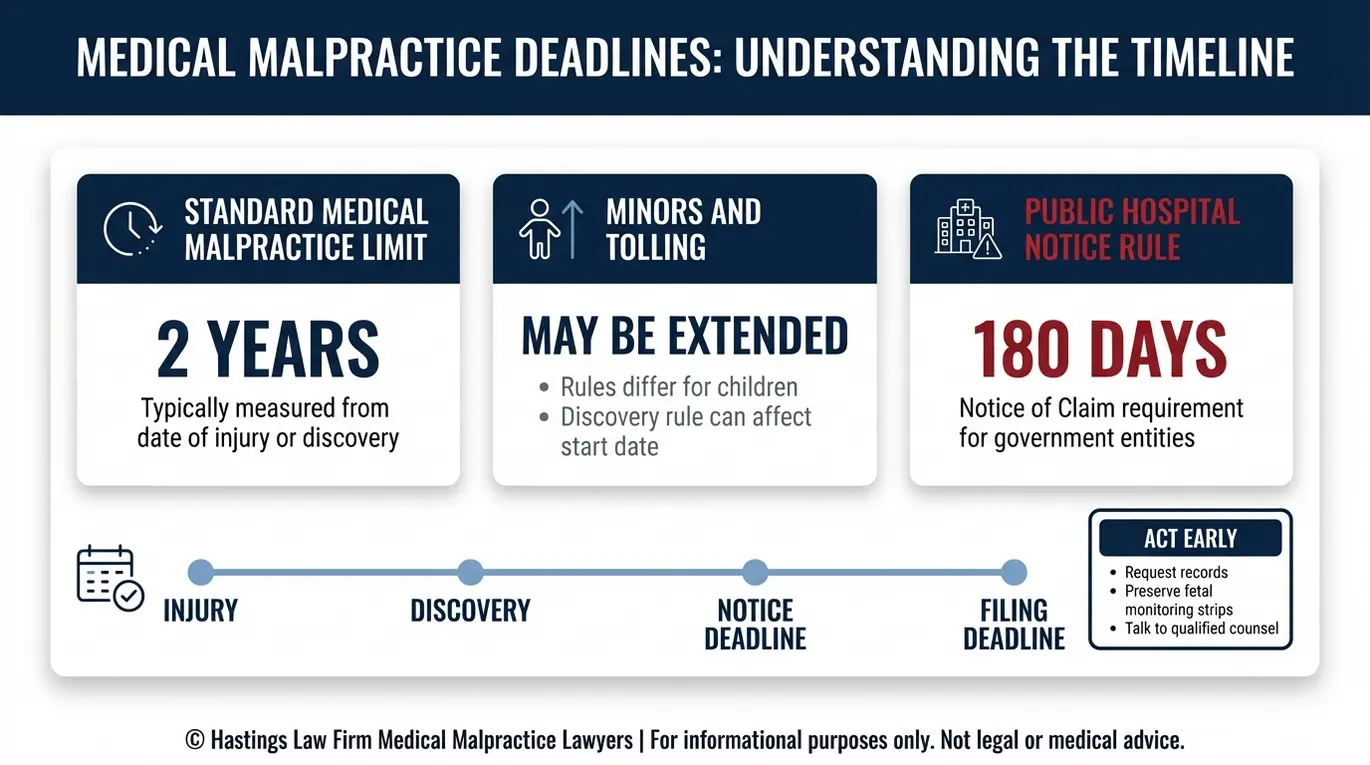
While the standard statute of limitations for medical malpractice in Arizona is two years, cases involving minors often invoke the “discovery rule” or tolling provisions that may extend the filing deadline significantly.
Under ARS 12-542, the standard limit is two years from the date of injury. However, ARS 12-502 provides that the statute of limitations is tolled for minors, meaning the clock may not begin running until the child reaches adulthood. In some cases, the discovery rule may also apply if the injury or its cause was not immediately discoverable by reasonable parents. Despite these extensions, waiting to pursue a claim creates risks: witnesses relocate, memories fade, and medical records can become harder to obtain.
Critical Deadline Warning: If the negligence occurred at a government-run hospital, such as a county or municipal facility, you must file a formal Notice of Claim within 180 days of the injury. This strict requirement applies regardless of the child’s age, and missing it can permanently bar your right to sue. It is one of the most unforgiving deadlines in Arizona law.
An Arizona fetal distress lawyer can evaluate your specific circumstances and explain which deadlines apply to your case. Given the complexity of these rules, consulting with an attorney promptly helps preserve your family’s legal options.
Contact the Arizona Birth Injury Attorneys at Hastings Law Firm Today for Help
At Hastings Law Firm, we believe every family deserves to know the truth about what happened during their child’s delivery. Our mission is to restore trust for clients who feel their trust has been compromised by the healthcare system and to secure the resources their children need for a lifetime of care.
Our team includes former defense attorneys who understand how hospitals and insurers approach these cases, as well as in-house medical professionals who can interpret complex clinical records. We prepare every case as if it will go to trial, which positions us to negotiate from strength.
There are no upfront costs to work with us. We handle birth injury cases on a contingency fee basis, meaning you pay no attorney fees unless we recover compensation for your family.
If your child suffered a birth injury that you believe was preventable, we are ready to investigate what happened and explain your options. Contact Hastings Law Firm today for a free, confidential case evaluation.
Frequently Asked Questions About Fetal Distress in Arizona


This content was researched and written by the Hastings Law Firm editorial team, which includes attorneys, medical professionals, and experienced researchers. Our writing is informed by internal knowledge and practical experience, and we cross-check critical details against authoritative sources cited throughout. Every piece undergoes human-led fact-checking and legal review. Because legal and medical information can change, if you spot an error, please contact us. Learn more about our content standards and review process on our editorial policy page.

Tommy Hastings, founder of Hastings Law Firm, is a board-certified personal injury trial lawyer (by the Texas Board of Legal Specialization) dedicated exclusively to healthcare injury cases. Since 2001, he has represented injured patients and families in litigation against major hospital systems, pharmaceutical companies, and negligent healthcare providers nationwide. He has handled numerous high-profile cases that have drawn national media attention and resulted in multi-million dollar recoveries.
