


Arizona Fertility Clinic Malpractice Lawyer
Written by: Hastings Law Firm | Reviewed by: Tommy Hastings | Updated: July 27, 2026
Fertility treatment depends on careful handling, accurate documentation, and reliable lab systems. When a clinic or outside lab makes a preventable error, the impact can include irreversible embryo loss, unexpected genetic mix ups, and profound emotional distress tied to lost reproductive opportunity. These situations can be hard to understand because clinics control key records and the laboratory environment, and some problems may not surface until much later. Clear records and expert review often shape what can be proven. If you or a loved one were harmed or worse due to fertility clinic negligence in Arizona, contact Hastings Law Firm for a free, confidential case review.

Trusted Legal Representation for IVF and Fertility Negligence in Arizona
What You Should Know About IVF Clinic Negligence Claims in Arizona:
- Life changing reproductive harm can follow fertility clinic errors, including irreversible embryo loss and long lasting emotional distress.
- Options for accountability can extend beyond the clinic when defective storage equipment, contaminated culture media, or outside genetic testing errors are involved.
- The ability to pursue compensation can be affected when a genetic mix up is discovered only years later through consumer DNA testing.
- Recovery can include financial losses tied to failed cycles and future treatment needs, as well as non economic harm tied to loss of reproductive opportunity.
- Punitive damages may be possible when conduct involves gross negligence or fraud such as concealing a known error.
- The risk of losing the right to proceed can increase when procedural requirements are missed, including expert support and other filing prerequisites.
- Disputes over what caused an outcome can be central because not every failed cycle is malpractice and IVF carries inherent risks.
- Clarity about what happened can depend on records controlled by the clinic, making complete medical records and lab documentation important.
- Proof issues can turn on chain of custody documentation and laboratory logs that show who handled genetic material and when.
- Product identification details can matter when contaminated media is suspected, including device identifiers and recall related batch information.

A Healthcare Focused Law Firm
Fertility treatment requires an extraordinary level of trust. You place your genetic material, your future family, and years of hope into the hands of a clinic and its staff. When that trust is broken by carelessness or error, the harm goes far beyond a failed medical procedure. It can feel like a deeply personal betrayal.
If you or your partner experienced negligence during IVF or another fertility treatment in Arizona, you deserve answers about what went wrong and why. As an Arizona fertility clinic malpractice lawyer, Hastings Law Firm focuses exclusively on medical malpractice. Our firm was founded by board-certified trial attorney Tommy Hastings, who has spent over twenty years advocating for patients injured by medical negligence. Our team includes in-house medical professionals who understand reproductive medicine and former defense attorneys who know how clinics and their insurers respond to claims.
We offer a free, confidential case evaluation. Contact us to review what happened and learn about your options.
Common Examples of Negligence in Arizona Fertility Clinics
Fertility clinic negligence occurs when medical professionals deviate from the standard of care, the level of treatment a reasonably competent provider would deliver under similar circumstances, resulting in errors such as embryo destruction, storage equipment failures, genetic testing mistakes, or the implantation of the wrong genetic material. These cases can involve a single preventable mistake or a pattern of protocol failures within a clinic’s laboratory.
In vitro fertilization (IVF), the process of fertilizing an egg outside the body and then transferring the embryo to the uterus, involves multiple stages where errors can occur. Each step requires precise handling, documentation, and monitoring. When any link in that chain breaks down, the consequences for patients can be devastating.
Common forms of fertility malpractice include:
- Procedural errors: Mistakes during egg retrieval, sperm preparation, or embryo transfer that reduce the viability of healthy embryos or cause direct physical harm to the patient. Even minor mishandling during transfer can prevent implantation.
- Lab failures: Mishandling of samples, contamination of culture media, or failure to maintain sterile laboratory environments, all of which can compromise embryo development. Contaminants like dust or bacteria can arrest cell division immediately.
- Storage failures: Breakdowns in cryopreservation equipment, the process of preserving embryos at extremely low temperatures using liquid nitrogen, leading to the thawing and permanent loss of viable embryos. Temperature sensors must be monitored constantly to prevent these catastrophic failures.
Because clinics control the records and the laboratory environment, patients are often left without a clear picture of what happened. We encourage anyone who suspects an error to request their complete medical records. The Guide to Getting and Using Your Health Records from ASTP outlines how to access these records, which can be an important first step. Our malpractice attorneys for fertility clinic errors can then review those records alongside our in-house medical staff to identify where the standard of care may have been breached.
Types of Fertility Malpractice Cases We Handle
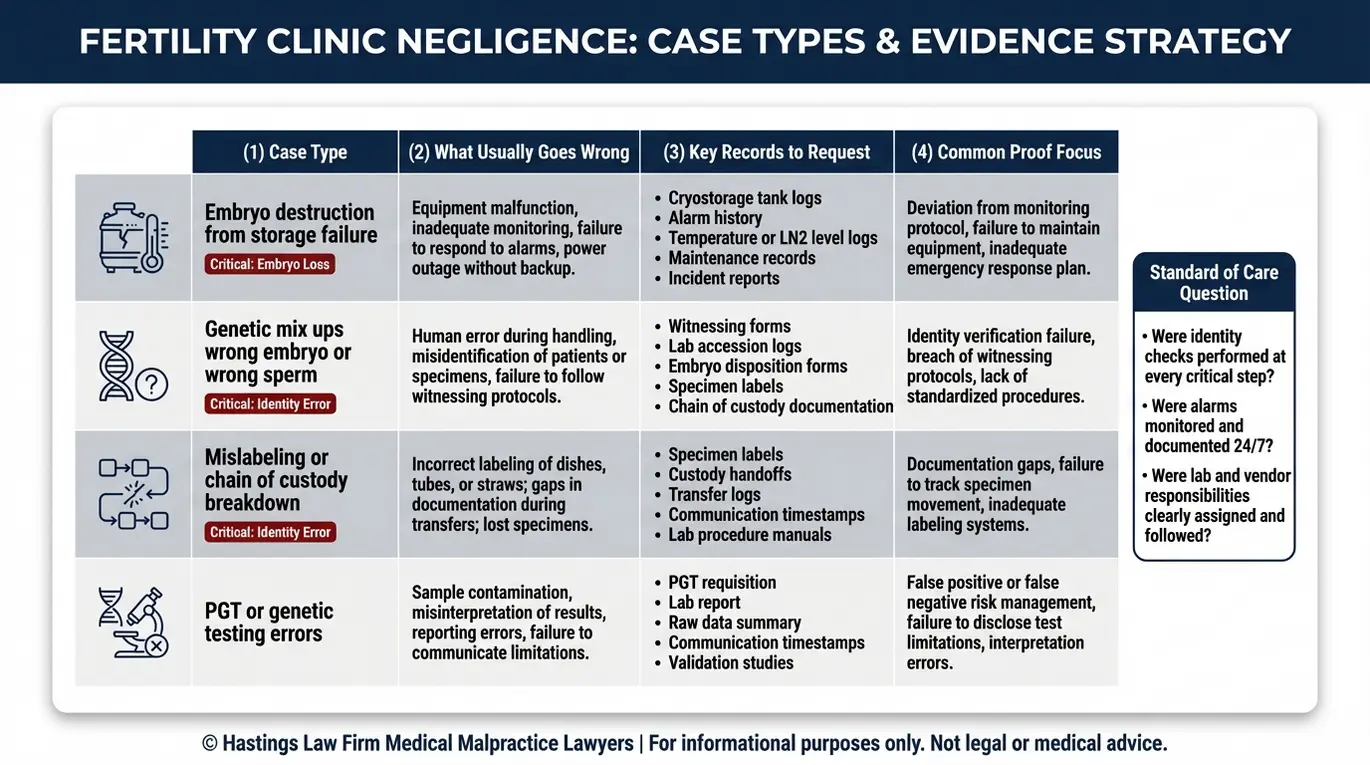
We handle a wide range of fertility-related claims, including the destruction of embryos due to storage failure, implantation of the wrong embryo, mislabeling of genetic material, and failure to screen for genetic anomalies. Each type of case involves distinct evidence and a different path to proving what went wrong.
| Case Type | What Happened | Key Evidence |
|---|---|---|
| Embryo Destruction | Viable embryos lost due to tank failure, mishandling, or lab error | Equipment maintenance logs, temperature monitoring records, staff protocols |
| Genetic Mix-Up | Wrong embryo or wrong sperm used, resulting in a child biologically unrelated to one or both parents | Chain-of-custody records, specimen labeling logs, DNA test results |
| PGT Errors | Preimplantation genetic testing produced a false positive or false negative, leading to the transfer of an affected embryo or the discard of a healthy one | Lab certifications, testing methodology records, genetic counseling notes |
| Mislabeling | Specimens incorrectly identified, tracked, or stored | Intake documentation, barcoding records, witness testimony |
Embryo destruction represents a total embryo loss that is often irreversible. When a storage tank malfunctions or a technician mishandles a sample, embryos that took months or years of treatment to create can be gone in an instant. For patients with limited remaining eggs or sperm, this may mean losing their only opportunity to have a biological child.
Genetic mix-ups, where the wrong embryo is implanted or the wrong sperm is used, raise some of the most emotionally complex issues in fertility law. These errors may not surface for years, sometimes not until a child’s physical features raise questions or a family takes a consumer DNA test.
Preimplantation genetic testing (PGT), a screening process used to check embryos for chromosomal abnormalities before transfer, presents a different challenge. A systematic review and meta-analysis published in PubMed on the diagnostic accuracy of preimplantation genetic testing for aneuploidy highlights the limitations and error rates associated with this testing. When a lab produces a false negative, parents may unknowingly transfer an embryo with a serious genetic condition. A false positive can lead to the destruction of a healthy embryo that was wrongly flagged as abnormal.
As a fertility lawyer in Arizona, we work with embryologists and reproductive specialists to reconstruct exactly what happened in the lab. Our IVF negligence attorney team examines whether proper protocols were followed at every stage.
Using Consumer DNA Testing to Discover Mix-Ups
Genetic mix-ups occur when a clinic uses the wrong sperm or embryo during fertility treatment. In many genetic mix-up cases, the error remains hidden for years. Families often discover the truth only after using direct-to-consumer (DTC) DNA testing services, such as 23andMe or Ancestry, which are commercial genetic tests available to the public without a doctor’s order.
A parent or child submits a sample expecting to explore their heritage, and the results reveal that the expected biological relationship does not exist. This delayed discovery is critical to understanding the legal timeline. If a genetic mix-up was not discoverable until a DNA test exposed it, the window to file a claim may extend beyond the standard deadline.
The Hastings Law Firm Difference
Results matter, but what truly sets us apart is how we achieve them. Every verdict, every settlement, and every Arizona courtroom victory comes from one guiding promise: To treat each client’s fight for justice as if it were our own.
This balance of skill, experience, and empathy reflects our core philosophy that justice should not only compensate the injured, but also make healthcare safer nationwide.

Determining Liability for Fertility Errors and IVF Failures
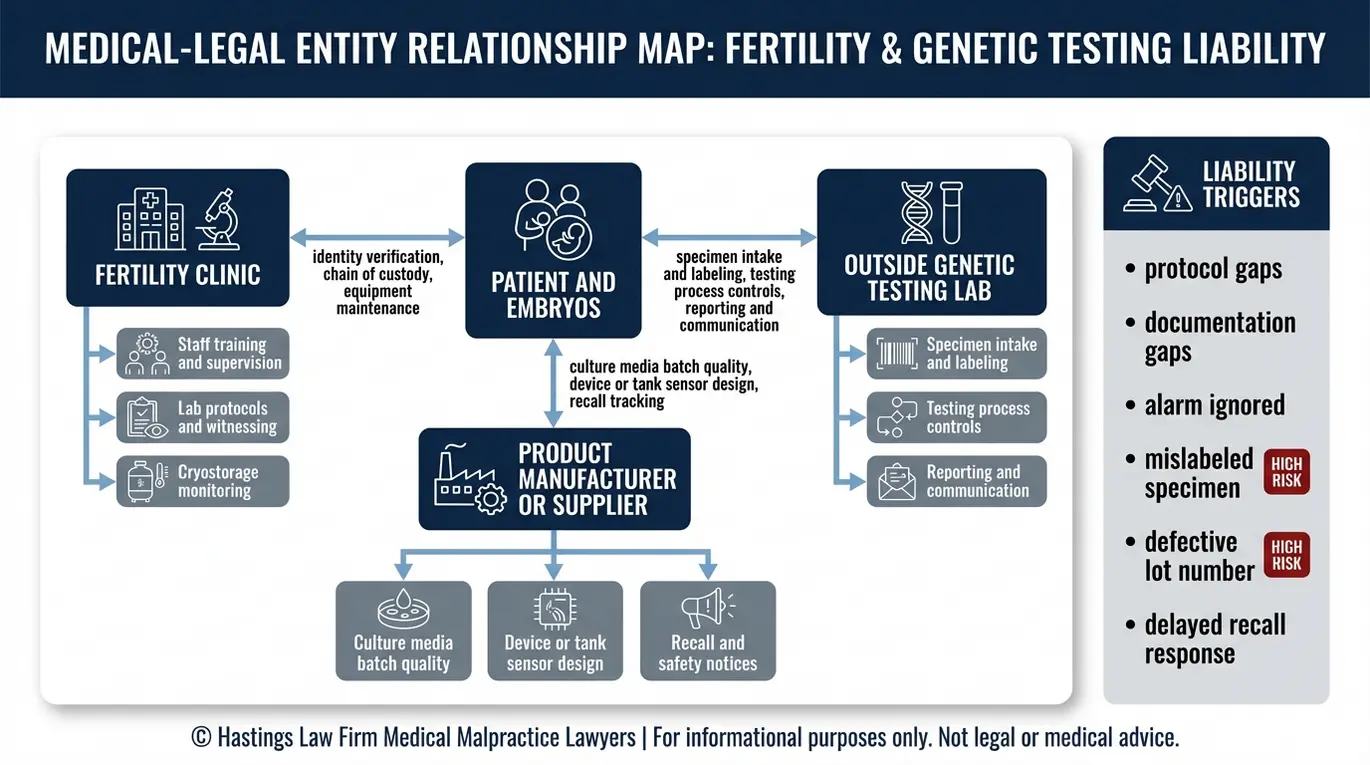
Liability in fertility cases often extends beyond the clinic to include third-party manufacturers of defective storage tanks, producers of contaminated culture media, or outside genetic testing laboratories. Identifying every responsible party is one of the first steps our team takes when evaluating a case.
| Potentially Liable Party | Basis of Responsibility |
|---|---|
| The Fertility Clinic | Staff negligence, failure to follow protocols, inadequate oversight of lab operations, improper equipment monitoring |
| The Product Manufacturer | Defective or contaminated products used during treatment (e.g., storage tanks, culture media) |
| The Outside Laboratory | Errors in genetic testing, reporting failures, or improper handling of specimens |
The clinic may be liable when its own staff or systems fail. This includes errors in specimen handling, lapses in equipment maintenance, or the absence of quality assurance protocols that should have caught problems before they reached the patient.
Manufacturers can be held accountable through product liability claims. For example, embryo culture media, the nutrient solution used to support embryo growth in the lab, has been the subject of recalls when contaminated with endotoxins, which are harmful bacterial toxins that can destroy developing embryos. The FDA’s explanation of medical device recalls describes how manufacturers are required to address known defects, and these recall records can be important evidence in a case. CooperSurgical, a major manufacturer of fertility lab products, has faced recall actions related to contaminated culture media.
Independent laboratories that perform genetic testing outside the clinic carry their own duty of care. If a lab delivers inaccurate PGT results, and a patient relies on those results to make irreversible decisions about their embryos, that lab may bear responsibility. We investigate these labs to determine if their testing protocols met accepted standards.
As Arizona fertility malpractice counsel, we investigate each layer of involvement to build the strongest possible case.
Verifying Defective Media Through UDI-DI Codes
Identifying the specific products used in your treatment is an important part of proving negligence. When contaminated culture media is suspected, one of the most important pieces of evidence is the Unique Device Identifier-Device Identifier (UDI-DI) code, a standardized product code assigned by the FDA that identifies the specific device or product used. Paired with recall lot numbers, which are the batch identification numbers assigned during manufacturing, these codes allow us to trace the exact media used during a patient’s cycle back to a specific production batch.
If that batch appears on an FDA recall list, it creates a direct link between the defective product and the embryo loss. This kind of evidence helps distinguish a natural IVF failure from one caused by a contaminated product, which is essential for establishing both liability and causation.
Recovering Compensation for IVF and Fertility Errors
Patients harmed by fertility negligence may recover economic damages for the cost of failed cycles and future treatments, as well as non-economic damages for the profound emotional distress and loss of reproductive opportunity. The nature of these losses is unlike most other medical malpractice cases because the harm often involves not just what happened to the patient’s body, but what was taken from their future.
Damages in fertility malpractice cases generally fall into three categories:
- Economic damages: Reimbursement for the cost of the failed IVF cycle, embryo storage fees, medications, and travel expenses. If the negligence permanently compromised a patient’s ability to conceive, future costs for additional IVF attempts, surrogacy, or adoption may also be recoverable.
- Non-economic damages: Compensation for mental anguish, loss of consortium (the impact on the relationship between partners), and the specific grief of lost embryos or losing potential children. Courts recognize that the emotional toll of fertility negligence can be severe and long-lasting.
- Punitive damages: In cases involving gross negligence or fraud, such as a clinic concealing a known error, Arizona courts may award punitive damages designed to deter similar conduct.
A malpractice lawyer for fertility clinics can help you identify every category of loss that applies to your situation. Our Arizona IVF injury attorney team works with financial and psychological experts to document the full scope of harm.
Reframing Claims as Fraud to Avoid Caps
Reframing a medical negligence case as fraud or battery involves a different legal strategy. In some cases, there may be a strategic basis for pleading claims as fraud or medical battery rather than standard negligence. This approach examines whether a clinic knowingly concealed laboratory errors or proceeded without informed consent.
Although Arizona does not impose statutory caps on medical malpractice damages, pleading claims as fraud or intentional misconduct can carry other strategic advantages, such as different standards of proof, broader theories of liability, or the potential for punitive damages that fully reflect the severity of the conduct. This strategy can be important in fertility cases where the nature of the wrongdoing goes beyond ordinary negligence.
The Legal Framework for Filing an Arizona Fertility Malpractice Lawsuit
Filing a lawsuit in Arizona requires adhering to strict procedural rules, including the statute of limitations and the requirement to secure an expert affidavit certifying the merit of the claim. Missing a deadline or failing to follow these steps can result in the dismissal of an otherwise valid case.
Here is a general overview of the process:
- Statute of limitations: Arizona generally requires medical malpractice claims to be filed within two years of the date the injury occurred or was discovered. The discovery rule, which we discuss in the FAQ below, can extend this timeline in cases where the harm was not immediately apparent.
- Preliminary expert opinion: Arizona law requires the claimant to serve a preliminary expert opinion affidavit from a qualified medical expert alongside the initial disclosures required by the Arizona Rules of Civil Procedure. This document confirms that the claim has validity and that the provider deviated from the accepted standard of care. This requirement ensures that claims are supported by credible expert testimony early in the litigation process, preventing frivolous filings against healthcare providers.
- Notice of claim (for public entities): If the negligence occurred at a publicly operated facility, Arizona law may require a formal notice of claim before a lawsuit can be filed. The procedural requirements and deadlines for this notice are strict; typically, this notice must be served within 180 days of the cause of action accruing.
- Discovery rule considerations: The Supreme Court of the State of Arizona has addressed how the discovery rule applies in medical malpractice cases. In fertility claims, where errors like genetic mix-ups may remain hidden for years, this rule can be particularly relevant to preserving the right to file suit.
Our Arizona IVF malpractice legal team handles every procedural requirement, from securing the expert affidavit to managing all court filings, so that you can focus on your family.
Proving Fertility Malpractice Through Evidence and Expert Testimony
Successful litigation relies on a combination of chain-of-custody records, lab logs, and expert testimony to prove that the outcome was caused by negligence rather than the natural risks of IVF. Not every failed cycle or botched genetic test is malpractice, and distinguishing between an inherent risk and a preventable error is the foundation of every case we evaluate.
Chain of custody, the documented trail showing who handled a specimen and when, is often the most revealing piece of evidence. In fertility cases, this includes:
- Specimen intake and labeling records
- Laboratory access logs
- Embryo identification and transfer documentation
- Cryopreservation monitoring data and temperature logs
- Communication records between the clinic and any genetic testing lab
We also retain qualified embryologists and reproductive specialists to review the clinical evidence and define what the standard of care required. These experts can testify about whether the clinic’s protocols met accepted medical standards and whether the deviation caused the patient’s specific harm.
The distinction between a “failed cycle” and a “negligent cycle” matters. IVF carries real risks, and not every unsuccessful outcome means someone made a mistake. Our job is to examine the records, consult with experts, and determine whether the evidence supports a claim.
The Laboratory Accreditation Manual from the University of Texas Health Science Center at San Antonio outlines laboratory standards that can serve as benchmarks when evaluating whether a fertility lab met its obligations. When suing a fertility clinic in Arizona, this combination of documentary evidence and expert analysis is what separates a viable claim from speculation.

Contact the Arizona Healthcare Malpractice Attorneys at Hastings Law Firm Today for Help
Fertility negligence is not just a medical failure. It is a violation of trust at one of the most vulnerable moments in a person’s life. If something went wrong during your IVF treatment or at your fertility clinic, you deserve to understand what happened and whether you have a legal claim.
At Hastings Law Firm, our team of attorneys, in-house medical staff, and former defense counsel is built specifically for cases like these. We investigate every detail, consult with reproductive medicine experts, and prepare every case as if it will go to trial.
As an Arizona fertility clinic malpractice lawyer, we are here to listen, to answer your questions, and to explain your options honestly. There is no fee unless we recover compensation for you, and your initial consultation is completely confidential.
Let us help you find the answers you deserve. Contact Hastings Law Firm today for a free case evaluation.
Frequently Asked Questions About Fertility Clinic Malpractice in Arizona


This content was researched and written by the Hastings Law Firm editorial team, which includes attorneys, medical professionals, and experienced researchers. Our writing is informed by internal knowledge and practical experience, and we cross-check critical details against authoritative sources cited throughout. Every piece undergoes human-led fact-checking and legal review. Because legal and medical information can change, if you spot an error, please contact us. Learn more about our content standards and review process on our editorial policy page.

Tommy Hastings, founder of Hastings Law Firm, is a board-certified personal injury trial lawyer dedicated exclusively to healthcare injury cases. Since 2001, he has represented injured patients and families in litigation against major hospital systems, pharmaceutical companies, and negligent healthcare providers nationwide. He has handled numerous high-profile cases that have drawn national media attention and resulted in multi-million dollar recoveries. He draws on that experience in his writing, helping readers understand how these cases work and what options may be available to them.
